

Notes
Percentage Rate of Change
\(\displaystyle\frac{f'(x)}{f(x)}\)
Questions & Solutions
\(\textbf{1)}\) \(\text{Find the percentage rate of change of } f(x)=4x^2+200 \text{ at } x=2.\)
\(\textbf{2)}\) \(\text{Find the percentage rate of change of } f(x)=3x+20 \text{ at } x=3.\)
\(\textbf{3)}\) \(\text{Find the percentage rate of change of } f(x)=2x^3+4x+1 \text{ at } x=1.\)
See Related Pages\(\)
\(\bullet\text{ Calculus Homepage}\)
\(\,\,\,\,\,\,\,\,\text{All the Best Topics…}\)
\(\bullet\text{ Definition of Derivative}\)
\(\,\,\,\,\,\,\,\, \displaystyle \lim_{\Delta x\to 0} \frac{f(x+ \Delta x)-f(x)}{\Delta x} \)
\(\bullet\text{ Equation of the Tangent Line}\)
\(\,\,\,\,\,\,\,\,f(x)=x^3+3x^2−x \text{ at the point } (2,18)\)
\(\bullet\text{ Derivatives- Constant Rule}\)
\(\,\,\,\,\,\,\,\,\displaystyle\frac{d}{dx}(c)=0\)
\(\bullet\text{ Derivatives- Power Rule}\)
\(\,\,\,\,\,\,\,\,\displaystyle\frac{d}{dx}(x^n)=nx^{n-1}\)
\(\bullet\text{ Derivatives- Constant Multiple Rule}\)
\(\,\,\,\,\,\,\,\,\displaystyle\frac{d}{dx}(cf(x))=cf'(x)\)
\(\bullet\text{ Derivatives- Sum and Difference Rules}\)
\(\,\,\,\,\,\,\,\,\displaystyle\frac{d}{dx}[f(x) \pm g(x)]=f'(x) \pm g'(x)\)
\(\bullet\text{ Derivatives- Sin and Cos}\)
\(\,\,\,\,\,\,\,\,\displaystyle\frac{d}{dx}sin(x)=cos(x)\)
\(\bullet\text{ Derivatives- Product Rule}\)
\(\,\,\,\,\,\,\,\,\displaystyle\frac{d}{dx}[f(x) \cdot g(x)]=f(x) \cdot g'(x)+f'(x) \cdot g(x)\)
\(\bullet\text{ Derivatives- Quotient Rule}\)
\(\,\,\,\,\,\,\,\,\displaystyle\frac{d}{dx}\left[\displaystyle\frac{f(x)}{g(x)}\right]=\displaystyle\frac{g(x) \cdot f'(x)-f(x) \cdot g'(x)}{[g(x)]^2}\)
\(\bullet\text{ Derivatives- Chain Rule}\)
\(\,\,\,\,\,\,\,\,\displaystyle\frac{d}{dx}[f(g(x))]= f'(g(x)) \cdot g'(x)\)
\(\bullet\text{ Derivatives- ln(x)}\)
\(\,\,\,\,\,\,\,\,\displaystyle\frac{d}{dx}[ln(x)]= \displaystyle \frac{1}{x}\)
\(\bullet\text{ Implicit Differentiation}\)
\(\,\,\,\,\,\,\,\,\)
\(\bullet\text{ Horizontal Tangent Line}\)
\(\,\,\,\,\,\,\,\,\)
\(\bullet\text{ Mean Value Theorem}\)
\(\,\,\,\,\,\,\,\,\)
\(\bullet\text{ Related Rates}\)
\(\,\,\,\,\,\,\,\,\)
\(\bullet\text{ Increasing and Decreasing Intervals}\)
\(\,\,\,\,\,\,\,\,\)
\(\bullet\text{ Intervals of concave up and down}\)
\(\,\,\,\,\,\,\,\,\)
\(\bullet\text{ Inflection Points}\)
\(\,\,\,\,\,\,\,\,\)
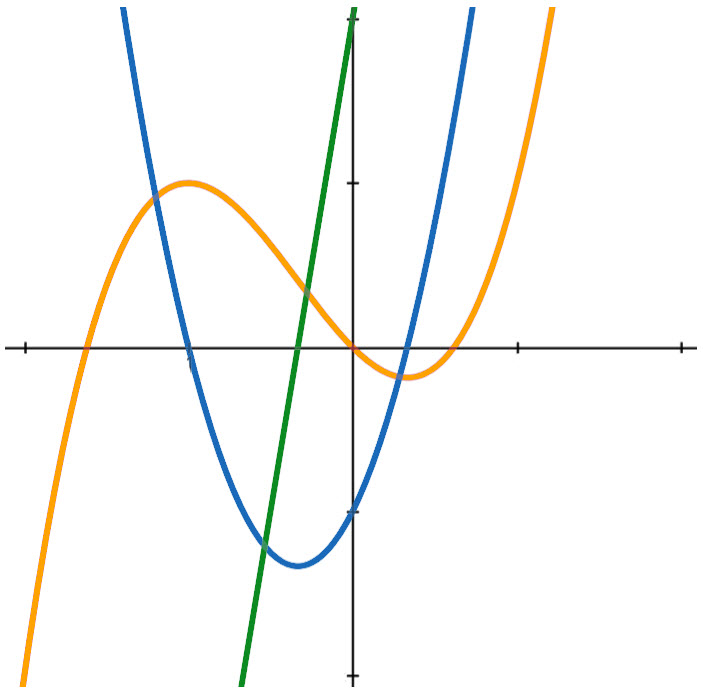
\(\bullet\text{ Graph of f(x), f'(x) and f”(x)}\)
\(\,\,\,\,\,\,\,\,\)
\(\bullet\text{ Newton’s Method}\)
\(\,\,\,\,\,\,\,\,x_{n+1}=x_n – \displaystyle \frac{f(x_n)}{f'(x_n)}\)