

Notes
Questions
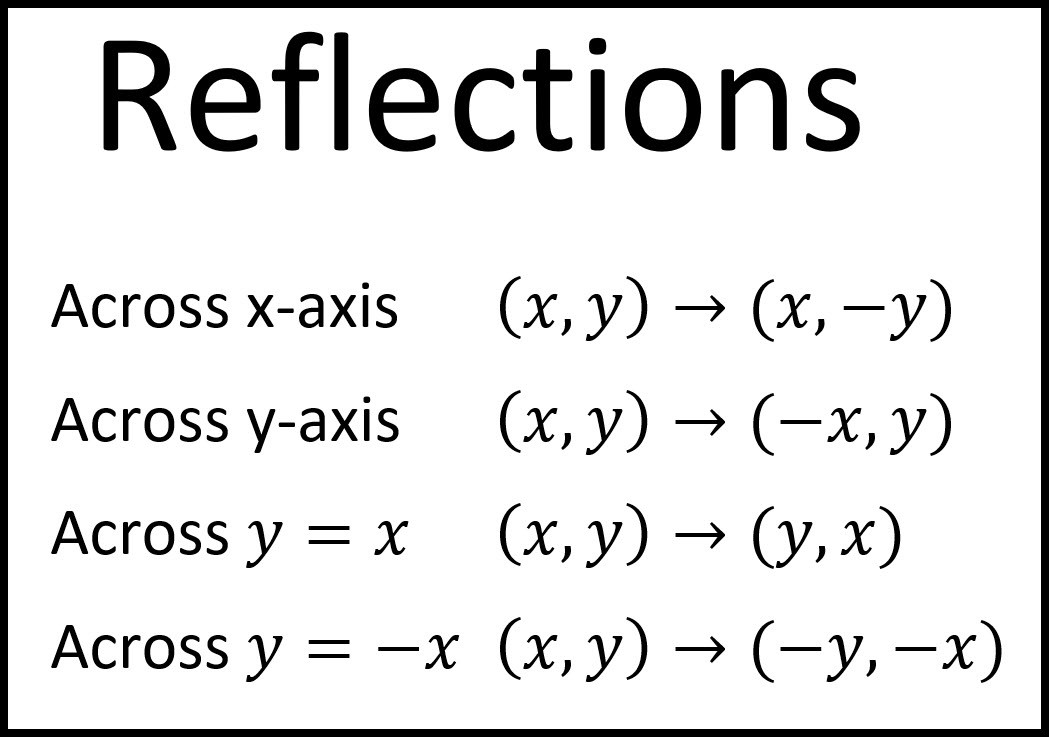
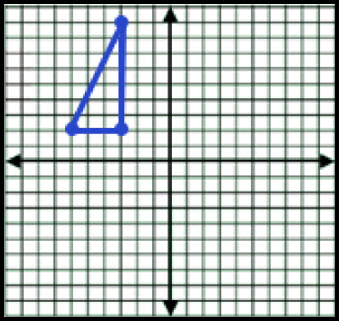
\(\textbf{1)}\) Reflect across x-axis

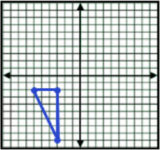
\(\textbf{2)}\) Reflect across y-axis
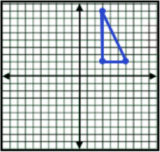
\(\textbf{3)}\) Reflect across y=x
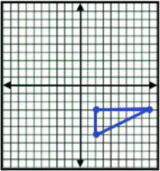
\(\textbf{4)}\) Reflect across y=-x
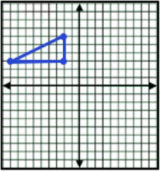
See Related Pages\(\)
\(\bullet\text{ Geometry Homepage}\)
\(\,\,\,\,\,\,\,\,\text{All the Best Topics…}\)
\(\bullet\text{ Translations}\)
\(\,\,\,\,\,\,\,\,\,\,\,\,\,\,\,\,\)
\(\bullet\text{ Rotations}\)
\(\,\,\,\,\,\,\,\,\,\,\,\,\,\,\,\,\)
In Summary
Reflections are a type of transformations. In Geometry, transformations are a fundamental concept in geometry that refer to the process of changing the position, size, or orientation of a figure. Reflections involve flipping a figure over a line or point known as the line of symmetry.
A reflection in geometry is a type of isometry, which means that it preserves distance and angles. This means that the reflection of a figure is congruent to the original figure.
Transformations, including reflections, are typically studied in geometry classes at the high school or college level. They may also be covered in other math classes, such as trigonometry or calculus. We learn about transformations, including reflections, in geometry because they allow us to understand how figures can be manipulated and how to analyze and solve problems involving those manipulations. They also help us to understand symmetry and congruence, which are important concepts in geometry and other areas of math.
Transformations, including reflections, have been studied by mathematicians for centuries. In particular, Euclid’s Elements, which was written around 300 BC, includes a treatment of reflections.
Some other commonly studied types of transformations of geometric figures include rotations, translations, and dilations.