

\(\textbf{1)}\) Find the Surface Area
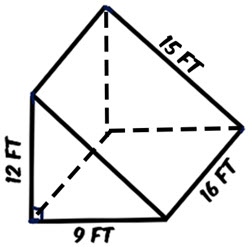
The surface area is \( 54+54+144+240+192=684 \) square feet
\(\textbf{2)}\) Find the Surface Area
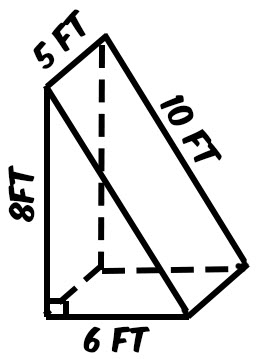
The surface area is \( 24+24+50+40+30=168 \) square feet
\(\textbf{3)}\) Find the Surface Area
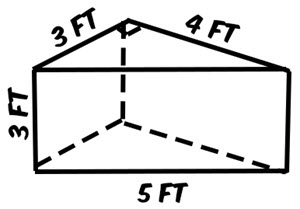
The surface area is \( 6+6+15+12+9=48 \) square feet
See Related Pages\(\)
\(\bullet\text{ Geometry Homepage}\)
\(\,\,\,\,\,\,\,\,\text{All the Best Topics…}\)
\(\bullet\text{ Rectangular Prisms- Volume}\)
\(\,\,\,\,\,\,\,\,\)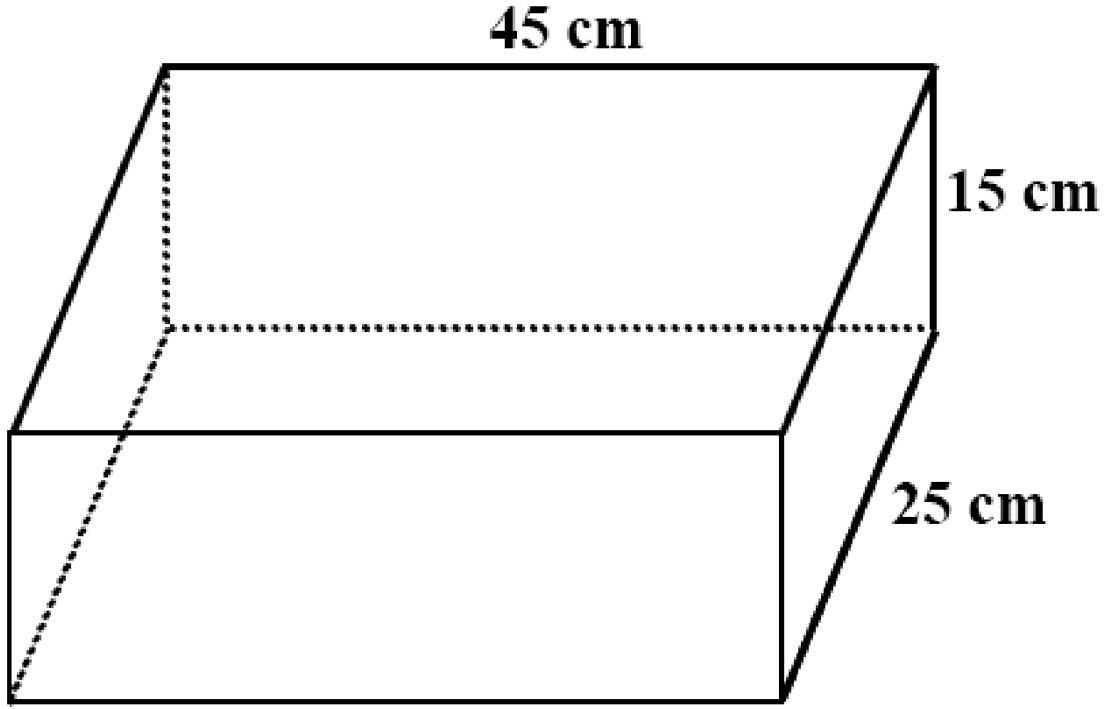 \(V=l \cdot w \cdot h…\)
\(\bullet\text{ Distance Formula 3D}\)
\(\,\,\,\,\,\,\,\,d=\sqrt{(x_2-x_1)^2+(y_2-y_1)^2+(z_2-z_1)^2}…\)
\(\bullet\text{ Diagonal of a Prism}\)
\(\,\,\,\,\,\,\,\,\)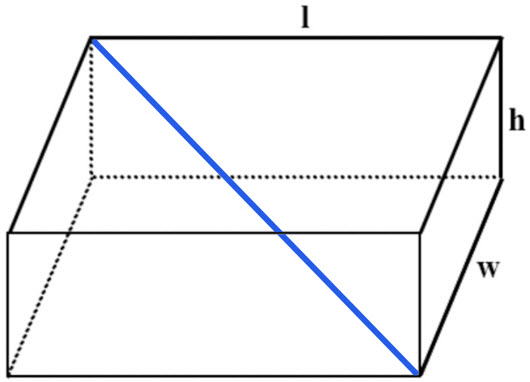 \(d=\sqrt{l^2+w^2+h^2}…\)
\(\bullet\text{ Cylinders- Volume and Surface Area}\)
\(\,\,\,\,\,\,\,\,\)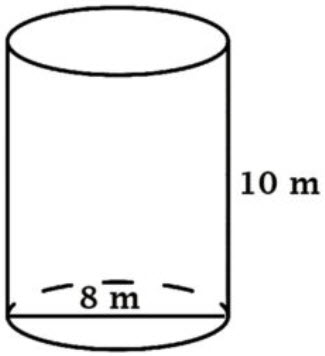 \(V=\pi r^2h\,\,\,SA=2\pi r^2+2 \pi rh…\)
\(\bullet\text{ Pyramids- Volume and Surface Area}\)
\(\,\,\,\,\,\,\,\,\)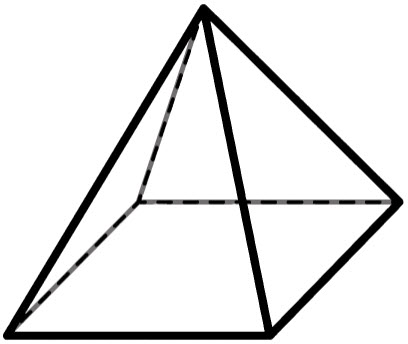 \(V=\frac{1}{3}Bh\,\,\,SA=B+\frac{pl}{2}…\)
\(\bullet\text{ Cones- Volume and Surface Area}\)
\(\,\,\,\,\,\,\,\,\)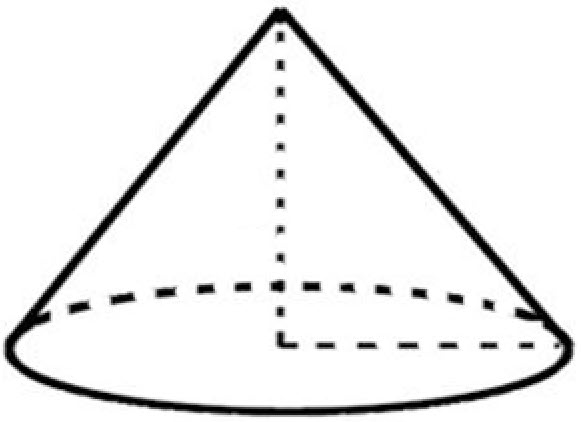 \(V=\frac{1}{3}\pi r^2 h\,\,\,SA=\pi r^2+\pi r l…\)
\(\bullet\text{ Spheres- Volume and Surface Area}\)
\(\,\,\,\,\,\,\,\,\) \(V=\frac{4}{3}\pi r^3 \,\,\,SA=4 \pi r^2…\)
\(\bullet\text{ Similar figures}\)
\(\,\,\,\,\,\,\,\,\text{Similarity ratio } a:b, \text{Area ratio } a^2:b^2, \text{Volume ratio } a^3:b^3\)
\(\bullet\text{ Nets of Polyhedra}\)
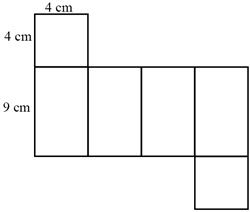
\(\,\,\,\,\,\,\,\,\)
In Summary
A triangular prism is a three-dimensional shape with 5 faces, 2 of which are triangular and 3 are rectangular. It is a type of polyhedron, which is a solid shape with flat faces and straight edges. The surface area of a triangular prism is the total area of all of its faces combined.
We learn about triangular prisms and surface area in geometry class because it helps us to understand the properties of three-dimensional shapes. Understanding these properties is important in many fields, such as architecture, engineering, and design.
Some related topics to triangular prisms and surface area include other three-dimensional shapes, such as cubes, pyramids, and cylinders. Understanding the properties of these shapes is important for solving problems and analyzing the world around us. A triangular tent is a common real world example of a triangular prism.
Math topics that use Triangular Prisms
Volume of a triangular prism: Triangular prisms have a triangular base, and the volume of a triangular prism is calculated by multiplying the base area by the height of the prism.
Diagonal of a triangular prism: The diagonal of a triangular prism is a line segment that connects two non-adjacent vertices of the triangular prism. The length of this diagonal can be calculated using the Pythagorean theorem.
Net of a triangular prism: A net of a triangular prism is a two-dimensional representation of the three-dimensional shape, formed by cutting along certain edges and unfolding the faces of the prism. The net of a triangular prism can be used to visualize the geometry of the prism and to calculate its surface area and volume.