
Lesson
Notes
Questions
\(\textbf{1)}\) Find the volume and surface area of the below cylinder.
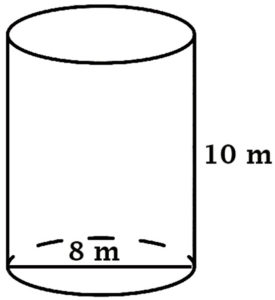
The volume is \( 160\pi\approx502.65\) m\(^3 \) The surface area is \( 112\pi\approx351.86\) m\(^2 \)
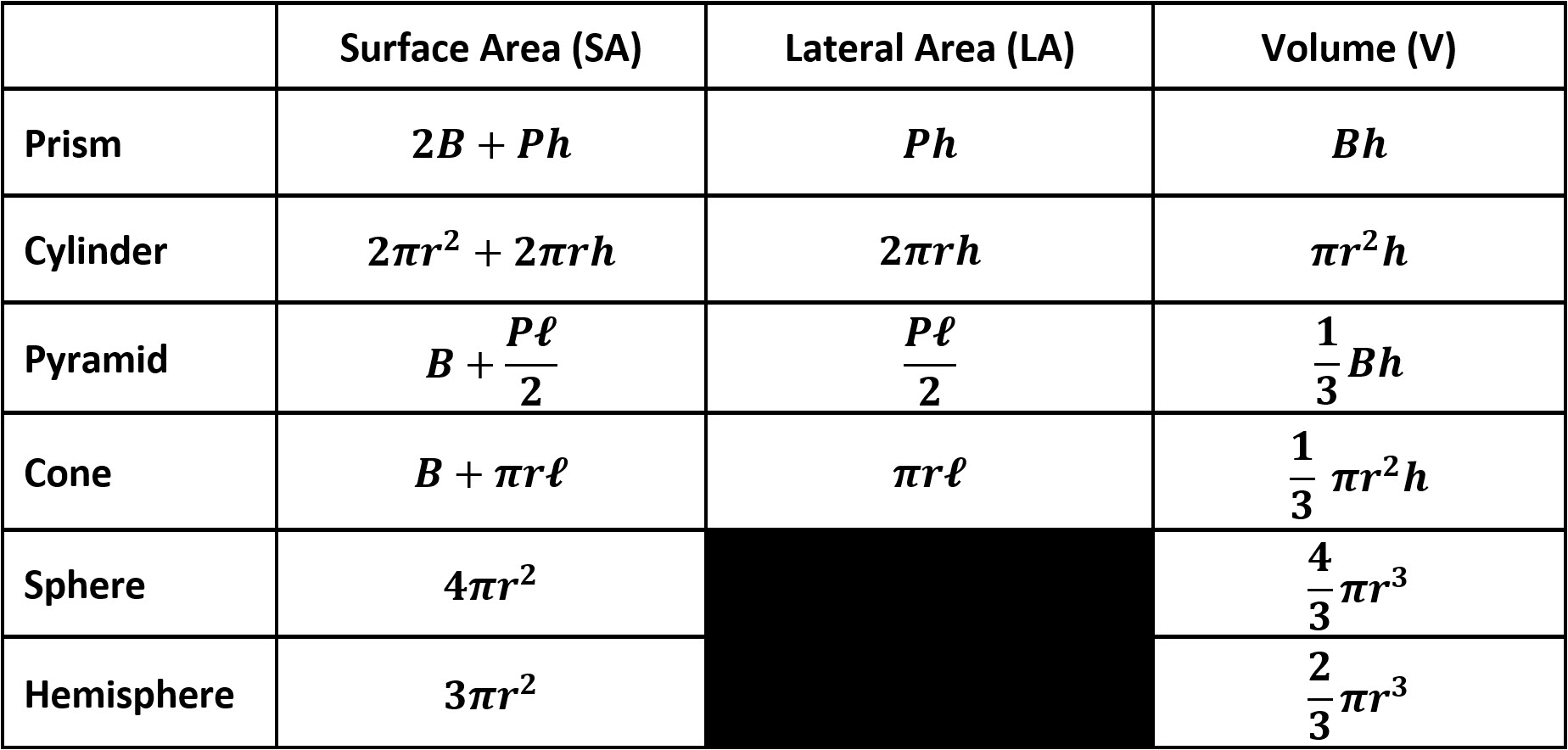
\(\textbf{2)}\) A cylinder has volume \( 32\pi \) ft\(^3\) and height \(8\) ft. What is the radius? The radius is \( 2 \) ft
\(\,\,\,\,\,\,\text{Volume of Cylinder}=\pi r^2 h\)
\(\,\,\,\,\,\,(32\pi)=\pi r^2 (8)\)
\(\,\,\,\,\,\,4=r^2\)
\(\,\,\,\,\,\,2=r\)
\(\,\,\,\,\,\,\text{Volume of Cylinder}=\pi r^2 h\)
\(\,\,\,\,\,\,(32\pi)=\pi r^2 (8)\)
\(\,\,\,\,\,\,4=r^2\)
\(\,\,\,\,\,\,2=r\)
See Related Pages\(\)
\(\bullet\text{ Geometry Homepage}\)
\(\,\,\,\,\,\,\,\,\text{All the Best Topics…}\)
\(\bullet\text{ Rectangular Prisms- Volume}\)
\(\,\,\,\,\,\,\,\,\)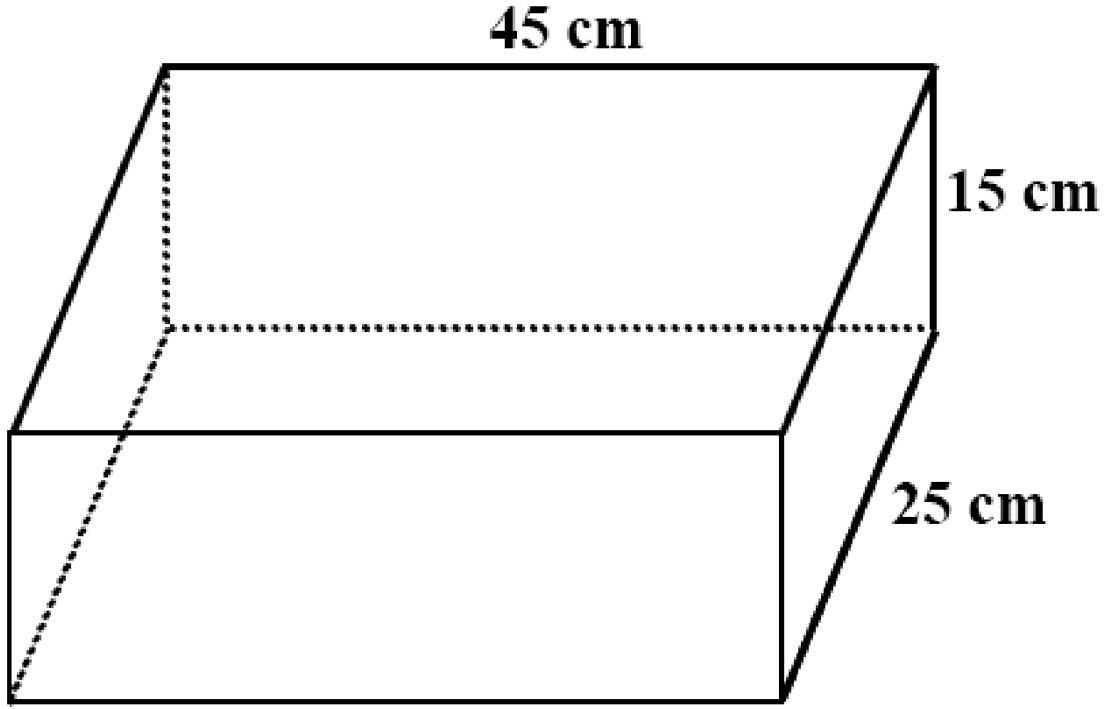 \(V=l \cdot w \cdot h…\)
\(\bullet\text{ Rectangular Prisms- Surface Area}\)
\(\,\,\,\,\,\,\,\,\)\(SA=lw+wh+lh…\)
\(\bullet\text{ Distance Formula 3D}\)
\(\,\,\,\,\,\,\,\,d=\sqrt{(x_2-x_1)^2+(y_2-y_1)^2+(z_2-z_1)^2…}\)
\(\bullet\text{ Diagonal of a Prism}\)
\(\,\,\,\,\,\,\,\,\)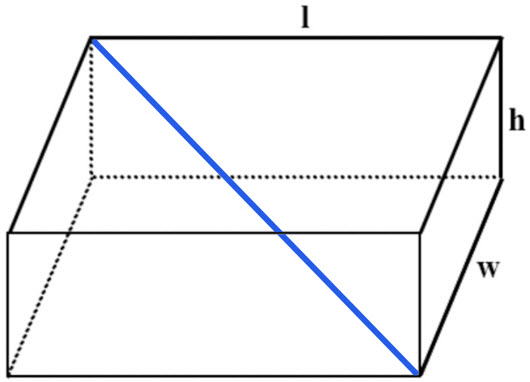 \(d=\sqrt{l^2+w^2+h^2}…\)
\(\bullet\text{ Pyramids- Volume and Surface Area}\)
\(\,\,\,\,\,\,\,\,\)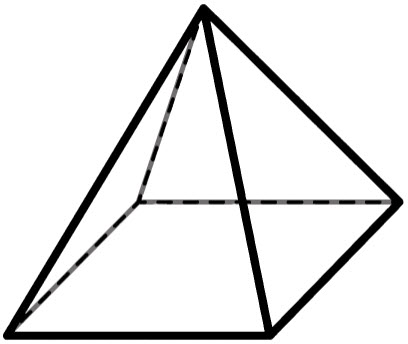 \(V=\frac{1}{3}Bh\,\,\,SA=B+\frac{pl}{2}…\)
\(\bullet\text{ Cones- Volume and Surface Area}\)
\(\,\,\,\,\,\,\,\,\)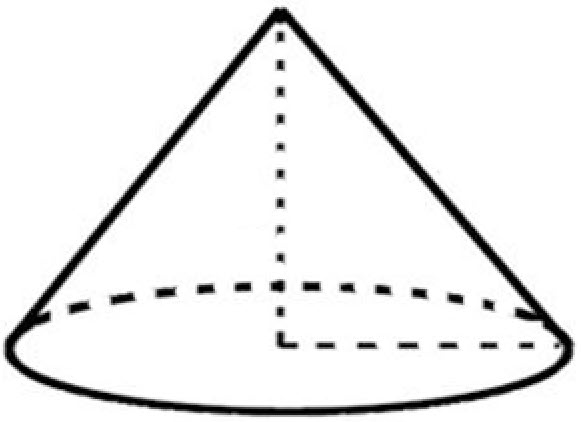 \(V=\frac{1}{3}\pi r^2 h\,\,\,SA=\pi r^2+\pi r l…\)
\(\bullet\text{ Spheres- Volume and Surface Area}\)
\(\,\,\,\,\,\,\,\,\)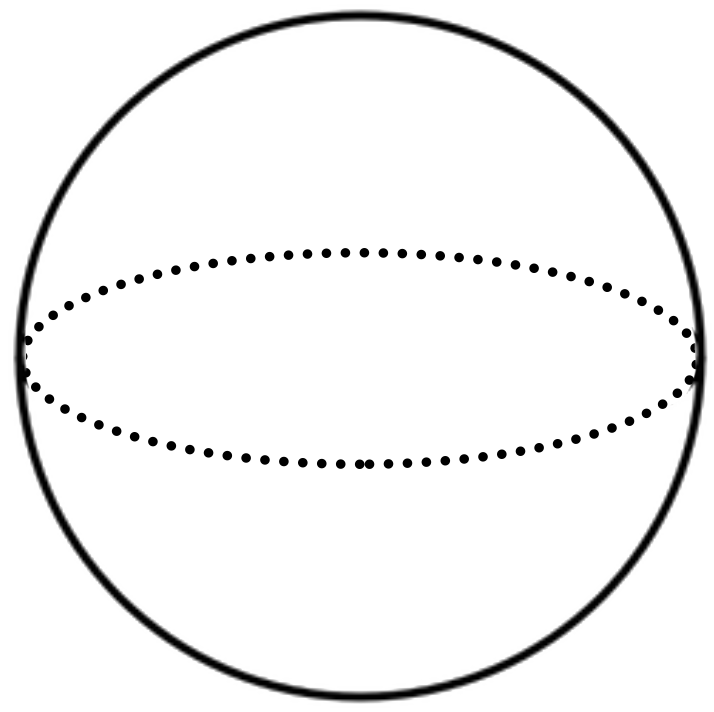 \(V=\frac{4}{3}\pi r^3 \,\,\,SA=4 \pi r^2…\)
\(\bullet\text{ Similar figures}\)
\(\,\,\,\,\,\,\,\,\text{Similarity ratio } a:b, \text{Area ratio } a^2:b^2, \text{Volume ratio } a^3:b^3\)
\(\bullet\text{ Nets of Polyhedra}\)
\(\,\,\,\,\,\,\,\,\)