

Notes
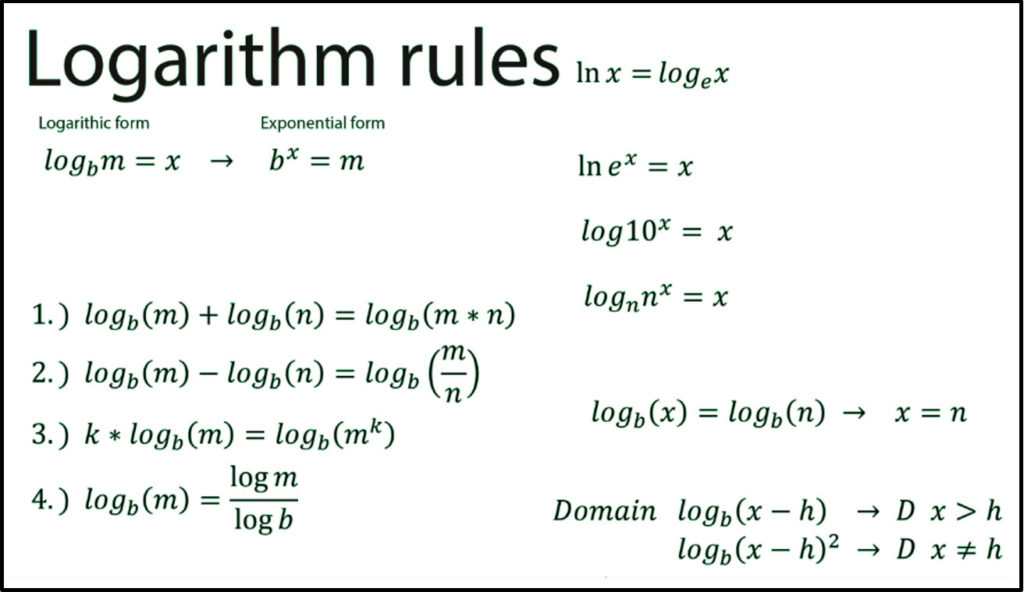

Problems & Videos
\(\textbf{1)}\) Write \(\log_{b}\frac{1}{5}=25\) in exponential form.
The answer is \( b^{25}=\frac{1}{5} \)
\(\textbf{2)}\) Write \(m^5=32\) in logarithmic form.
The answer is \( \log_{m}(32)=5 \)
\(\textbf{3)}\) Write as a single logarithmic expression.
\(2\log_{5}(2)+\frac{1}{2}\log_{5}(x+3)-\log_{5}(x) \)
The answer is \( \displaystyle\log_{5}(\frac{4\sqrt{x+3}}{x}) \)
Expand the following logarithms.
\(\textbf{4)}\) \( \displaystyle\log_{b}(\frac{x^2z}{y^5}) \)
The answer is \( 2\log_{b}(x)+\log_{b}(z)-5\log_{b}(y) \)
\(\textbf{5)}\) \( \displaystyle\log_{5}(\frac{\sqrt[3]{z}}{25y^5}) \)
The answer is \( \frac{1}{3}\log_{5}(z)-5\log_{5}(y)-2 \)
\(\textbf{6)}\) \( \displaystyle\log_{2}(\frac{b\sqrt{n}}{32}) \)
The answer is \( \log_{2}(b)+\frac{1}{2}\log_{2}(n)-5 \)
Evaluate without using a calculator.
\(\textbf{7)}\) \( \log_{3}(1) \)
The answer is \( 0 \)
\(\textbf{8)}\) Use \(\log_{3}(2)\approx 0.6309\) and \(\log_{3}(7)\approx 1.7712\) to approximate \(\log_{3}(\frac{49}{2})\)
The answer is \( 2.9115 \)
Approximate (calculator ok)
\(\textbf{9)}\) \( \log_{3}(5) \)
The answer is \( \approx1.4650 \)
\(\textbf{10)}\) \( \log_{7}(34) \)
The answer is \( \approx1.8122 \)
\(\textbf{11)}\) \( \log(2.3) \)
The answer is \( \approx0.3617 \)
See Related Pages
\(\bullet\text{ Expanding Logarithms}\)
\(\,\,\,\,\,\,\,\,2\log_{b}(x)+\log_{b}(z)-5\log_{b}(y)…\)
\(\bullet\text{ Decibel Problems}\)
\(\,\,\,\,\,\,\,\,N_{dB}=10\log \left(\frac{P}{10^{-12}}\right)…\)
\(\bullet\text{ Earthquake Problems}\)
\(\,\,\,\,\,\,\,\,M=\log\frac{I}{10^{-4}}…\)
\(\bullet\text{ Domain and Range Logarithmic Functions}\)
\(\,\,\,\,\,\,\,\,f(x)=log(x) \rightarrow \text{Domain:} x\gt0… \)
\(\bullet\text{ Graphing Logarithmic Functions}\)
\(\,\,\,\,\,\,\,\,f(x)=log_{2}(x)\) 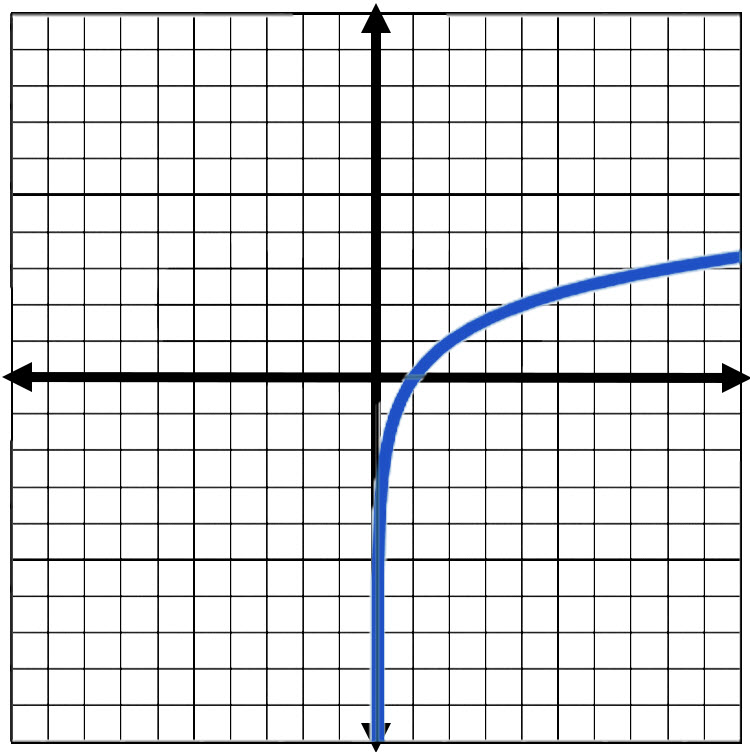
\(\bullet\text{ Solving Logarithmic Equations}\)
\(\,\,\,\,\,\,\,\,\log_{2}(5x)=\log_{2}(2x+12)…\)
\(\bullet\text{ Inverse of Logarithmic Functions}\)
\(\,\,\,\,\,\,\,\,f(x)=log_{2}(x) \rightarrow f^{-1}(x)=2^x\)
In Summary
Defining logarithms can be somewhat complex, but essentially they represent the exponent to which a base number must be raised in order to equal a given number. For example, the logarithm base 10 of 100 is 2, because 10 to the power of 2 equals 100.
There are several reasons why we learn about logarithms in algebra and precalculus classes. One of the main reasons is that they are often used in scientific and mathematical applications to solve problems involving exponential growth or decay. They are also used in finance, engineering, and other fields where it is necessary to understand how quantities change over time. Ultimately anytime the variable is in the exponent, we would us logarithms to solve for the variable.
Real world examples of Logarithms
Sound intensity: The intensity of a sound, or the loudness of a sound, is measured in decibels (dB). The decibel scale is logarithmic, which means that an increase of 10 dB represents a tenfold increase in sound intensity. For example, a sound that is 60 dB is ten times louder than a sound that is 50 dB.
Richter Scale or Earthquake magnitude: The magnitude of an earthquake is a measure of the energy released by the earthquake. The magnitude scale is logarithmic, which means that an increase of 1 magnitude unit represents a tenfold increase in energy. For example, an earthquake with a magnitude of 7 is ten times more powerful than an earthquake with a magnitude of 6.
pH of a solution: The pH of a solution is a measure of the acidity or basicity of the solution. The pH scale is logarithmic, which means that a change of 1 pH unit represents a tenfold change in acidity or basicity. For example, a solution with a pH of 4 is ten times more acidic than a solution with a pH of 5.
Stellar magnitude: The brightness of a star is measured in stellar magnitudes. The magnitude scale is logarithmic, which means that a difference of 1 magnitude unit represents a difference of about 2.5 times in brightness. For example, a star with a magnitude of 2 is about 2.5 times brighter than a star with a magnitude of 3.