

Notes
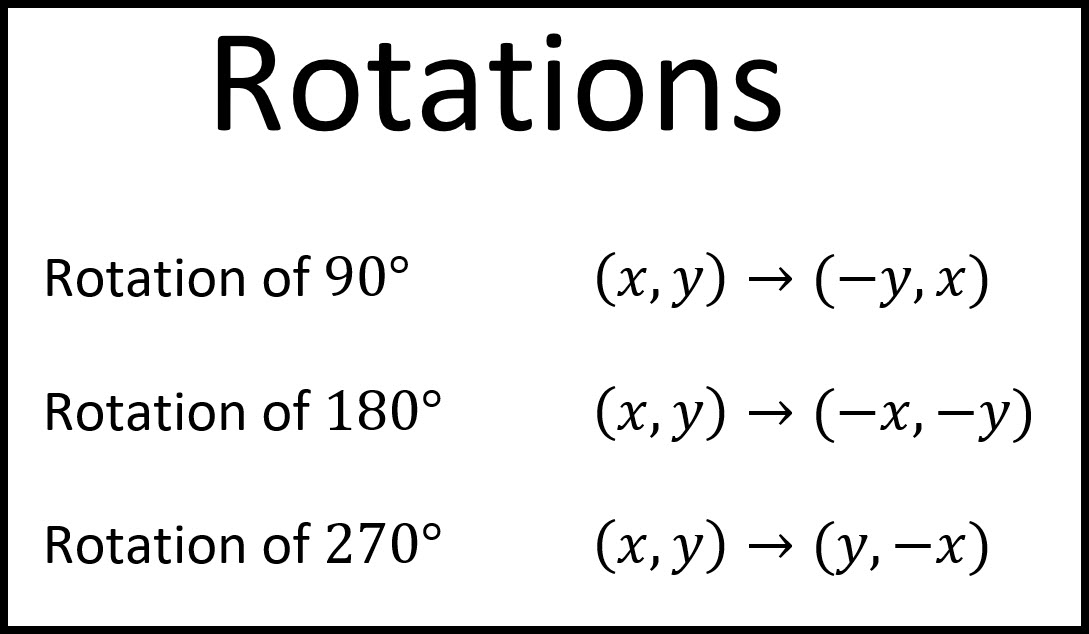
Questions
Perform the following rotations to the figure below.
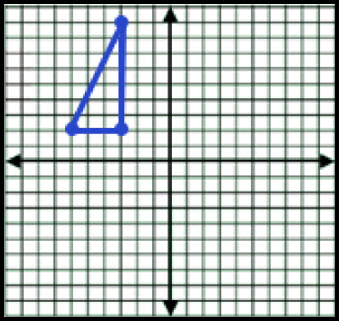
\(\textbf{1)}\) Rotate \(90^{\circ}\)
Before
After
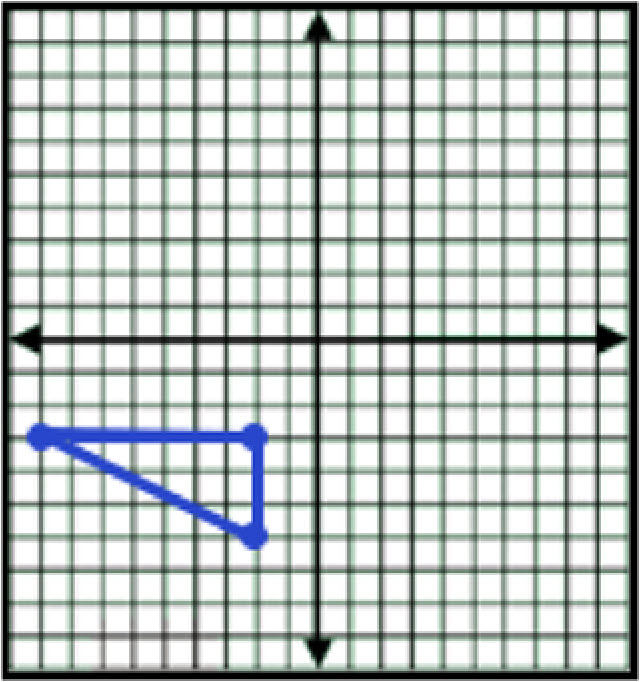

After
\(\textbf{2)}\) Rotate \(180^{\circ}\)
Before
After
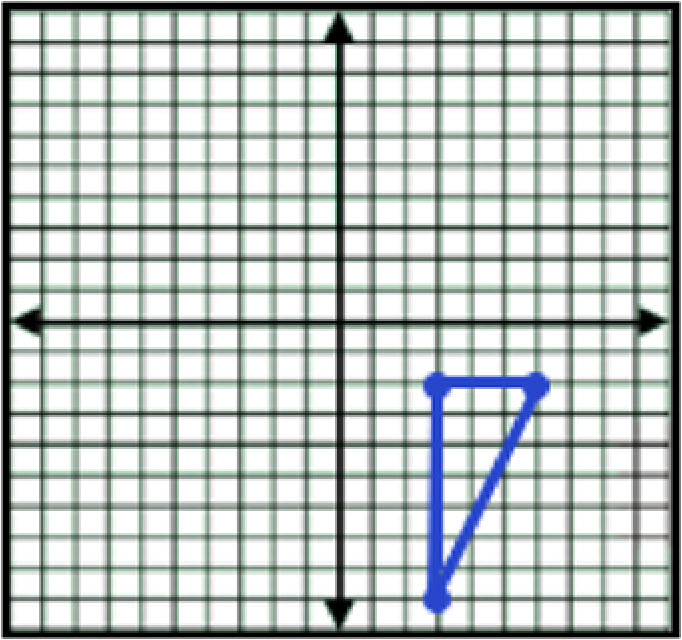
After
\(\textbf{3)}\) Rotate \(270^{\circ}\)
Before
After
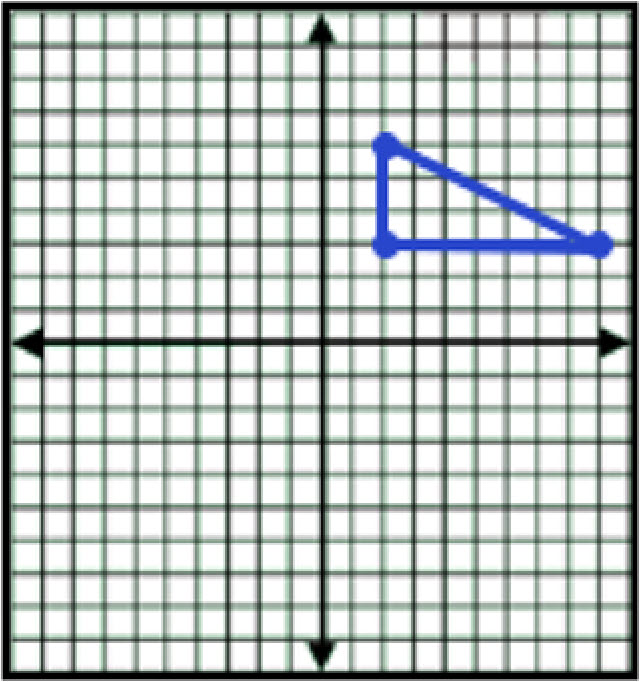
After
\(\textbf{4)}\) Rotate \(-270^{\circ}\)
Before
After
After
\(\textbf{5)}\) Rotate \(-180^{\circ}\)
Before
After
After
\(\textbf{6)}\) Rotate \(-90^{\circ}\)
Before
After
After
See Related Pages\(\)
\(\bullet\text{ Geometry Homepage}\)
\(\,\,\,\,\,\,\,\,\text{All the Best Topics…}\)
\(\bullet\text{ Translations}\)
\(\,\,\,\,\,\,\,\,\,\,\,\,\,\,\,\,\)
\(\bullet\text{ Reflections}\)
\(\,\,\,\,\,\,\,\,\,\,\,\,\,\,\,\,\)
In Summary
Rotations are a type of transformation. In geometry, transformations refer to the movement of geometric figures. Transformations can change the location, orientation or size of a geometric shape.
Transformations and rotations are typically covered in high school geometry classes. In these classes, students learn about different types of transformations, including rotations, translations, reflections, and dilations, as well as how to perform these transformations on geometric figures. Learning about transformations and rotations in geometry is important because it helps us understand how to manipulate and change the position of geometric shapes. This understanding can be applied in fields such as engineering and architecture.
One common mistake when working with rotations is to confuse the direction of rotation. It is important to pay attention to whether a rotation is clockwise or counterclockwise, as this can significantly affect the final position of the rotated figure.
A fun fact about rotations is that they can be used to create tessellations, or repeating patterns of geometric shapes. By rotating a shape around a center point, it is possible to create a pattern that fills an entire plane without any gaps or overlaps.
Other topics related to transformations and rotations in geometry include symmetry, congruence, and similarity.