
Exponential and logarithmic derivatives are major derivative rules used throughout calculus. The derivative of \(e^x\) is itself, while other exponential bases use a factor of \(\ln(a)\). These problems also include logarithmic derivatives, chain rule, product rule, quotient rule, and power rule variations.
Notes
Exponential Derivatives
\( \frac{d}{dx} \left(e^x\right)=e^x\)
\( \frac{d}{dx} \left(a^x\right)=a^x \cdot \ln{a}\)
Logarithmic Derivatives
\( \frac{d}{dx} \left(\ln{x}\right)=\displaystyle\frac{1}{x}\)
\( \frac{d}{dx} \left(\log_a{x} \right)=\frac{1}{x \ln{a}}\)
Practice Problems
Find the derivative
\(\textbf{1)}\) \(f(x)=\displaystyle2e^x\) The answer is \(f'(x)=\displaystyle2e^x \)
\(\,\,\,\,\,\,f(x)=2e^x\)
\(\,\,\,\,\,\,\frac{d}{dx}\left(e^x\right)=e^x\)
\(\,\,\,\,\,\,f'(x)=2e^x\)
\(\,\,\,\,\,\)The answer is \(f'(x)=2e^x\)
\(\,\,\,\,\,\,f(x)=2e^x\)
\(\,\,\,\,\,\,\frac{d}{dx}\left(e^x\right)=e^x\)
\(\,\,\,\,\,\,f'(x)=2e^x\)
\(\,\,\,\,\,\)The answer is \(f'(x)=2e^x\)
\(\textbf{2)}\) \(f(x)=\displaystyle3^x\) The answer is \(f'(x)=\displaystyle3^x \cdot (\ln 3)\)
\(\,\,\,\,\,\,f(x)=3^x\)
\(\,\,\,\,\,\,\frac{d}{dx}\left(a^x\right)=a^x\ln(a)\)
\(\,\,\,\,\,\,f'(x)=3^x\ln(3)\)
\(\,\,\,\,\,\)The answer is \(f'(x)=3^x\ln(3)\)
\(\,\,\,\,\,\,f(x)=3^x\)
\(\,\,\,\,\,\,\frac{d}{dx}\left(a^x\right)=a^x\ln(a)\)
\(\,\,\,\,\,\,f'(x)=3^x\ln(3)\)
\(\,\,\,\,\,\)The answer is \(f'(x)=3^x\ln(3)\)
\(\textbf{3)}\) \(f(x)=\displaystyle 2e^x+3^x\) The answer is \(f'(x)=\displaystyle 2e^x + 3^x \cdot (\ln 3)\)
\(\,\,\,\,\,\,f(x)=2e^x+3^x\)
\(\,\,\,\,\,\,\frac{d}{dx}\left(2e^x\right)=2e^x\)
\(\,\,\,\,\,\,\frac{d}{dx}\left(3^x\right)=3^x\ln(3)\)
\(\,\,\,\,\,\,f'(x)=2e^x+3^x\ln(3)\)
\(\,\,\,\,\,\)The answer is \(f'(x)=2e^x+3^x\ln(3)\)
\(\,\,\,\,\,\,f(x)=2e^x+3^x\)
\(\,\,\,\,\,\,\frac{d}{dx}\left(2e^x\right)=2e^x\)
\(\,\,\,\,\,\,\frac{d}{dx}\left(3^x\right)=3^x\ln(3)\)
\(\,\,\,\,\,\,f'(x)=2e^x+3^x\ln(3)\)
\(\,\,\,\,\,\)The answer is \(f'(x)=2e^x+3^x\ln(3)\)
\(\textbf{4)}\) \(f(x)=\displaystyle\frac{1}{e^x}\) The answer is \(f'(x)=-\displaystyle\frac{1}{e^x}\)
\(\,\,\,\,\,\,f(x)=\frac{1}{e^x}\)
\(\,\,\,\,\,\,f(x)=e^{-x}\)
\(\,\,\,\,\,\,f'(x)=e^{-x}\cdot(-1)\)
\(\,\,\,\,\,\,f'(x)=-e^{-x}\)
\(\,\,\,\,\,\,f'(x)=-\frac{1}{e^x}\)
\(\,\,\,\,\,\)The answer is \(f'(x)=-\displaystyle\frac{1}{e^x}\)
\(\,\,\,\,\,\,f(x)=\frac{1}{e^x}\)
\(\,\,\,\,\,\,f(x)=e^{-x}\)
\(\,\,\,\,\,\,f'(x)=e^{-x}\cdot(-1)\)
\(\,\,\,\,\,\,f'(x)=-e^{-x}\)
\(\,\,\,\,\,\,f'(x)=-\frac{1}{e^x}\)
\(\,\,\,\,\,\)The answer is \(f'(x)=-\displaystyle\frac{1}{e^x}\)
\(\textbf{5)}\) \(f(x)=\displaystyle \frac{1}{3^x}\) The answer is \(f'(x)=-\displaystyle \frac{\ln 3}{3^x}\)
\(\,\,\,\,\,\,f(x)=\frac{1}{3^x}\)
\(\,\,\,\,\,\,f(x)=3^{-x}\)
\(\,\,\,\,\,\,\frac{d}{dx}\left(3^u\right)=3^u\ln(3)\cdot u’\)
\(\,\,\,\,\,\,u=-x,\quad u’=-1\)
\(\,\,\,\,\,\,f'(x)=3^{-x}\ln(3)(-1)\)
\(\,\,\,\,\,\,f'(x)=-\frac{\ln 3}{3^x}\)
\(\,\,\,\,\,\)The answer is \(f'(x)=-\displaystyle \frac{\ln 3}{3^x}\)
\(\,\,\,\,\,\,f(x)=\frac{1}{3^x}\)
\(\,\,\,\,\,\,f(x)=3^{-x}\)
\(\,\,\,\,\,\,\frac{d}{dx}\left(3^u\right)=3^u\ln(3)\cdot u’\)
\(\,\,\,\,\,\,u=-x,\quad u’=-1\)
\(\,\,\,\,\,\,f'(x)=3^{-x}\ln(3)(-1)\)
\(\,\,\,\,\,\,f'(x)=-\frac{\ln 3}{3^x}\)
\(\,\,\,\,\,\)The answer is \(f'(x)=-\displaystyle \frac{\ln 3}{3^x}\)
\(\textbf{6)}\) \(f(x)=\displaystyle e^x \ln x\) The answer is \(f'(x)=\displaystyle e^x \ln x + \frac{e^x}{x}\)
\(\text{Use Product Rule}\)
\(\,\,\,\,\,\,\frac{d}{dx} \left(f(x)\cdot g(x) \right)= f'(x)\cdot g(x) + f(x) \cdot g'(x)\)
\(\,\,\,\,\,\,f(x)= e^x, \,\,\, g(x)=\ln x\)
\(\,\,\,\,\,\,\frac{d}{dx} \left( e^x \cdot \ln x \right)= \left(e^x\right)’\cdot \left(\ln x \right) + \left(e^x\right) \cdot \left( \ln x \right)’\)
\(\,\,\,\,\,\,\frac{d}{dx} \left(e^x \cdot \ln x \right)= \left(e^x\right)\cdot \left(\ln x \right) + \left(e^x\right) \cdot \left( \frac{1}{x} \right)\)
\(\,\,\,\,\,\)The answer is \(f'(x)=\displaystyle e^x \ln x + \frac{e^x}{x}\)
\(\text{Use Product Rule}\)
\(\,\,\,\,\,\,\frac{d}{dx} \left(f(x)\cdot g(x) \right)= f'(x)\cdot g(x) + f(x) \cdot g'(x)\)
\(\,\,\,\,\,\,f(x)= e^x, \,\,\, g(x)=\ln x\)
\(\,\,\,\,\,\,\frac{d}{dx} \left( e^x \cdot \ln x \right)= \left(e^x\right)’\cdot \left(\ln x \right) + \left(e^x\right) \cdot \left( \ln x \right)’\)
\(\,\,\,\,\,\,\frac{d}{dx} \left(e^x \cdot \ln x \right)= \left(e^x\right)\cdot \left(\ln x \right) + \left(e^x\right) \cdot \left( \frac{1}{x} \right)\)
\(\,\,\,\,\,\)The answer is \(f'(x)=\displaystyle e^x \ln x + \frac{e^x}{x}\)
\(\textbf{7)}\) \(f(x)=\displaystyle e^x + \ln x\) The answer is \(f'(x)=\displaystyle e^x + \frac{1}{x}\)
\(\,\,\,\,\,\,f(x)=e^x+\ln x\)
\(\,\,\,\,\,\,\frac{d}{dx}\left(e^x\right)=e^x\)
\(\,\,\,\,\,\,\frac{d}{dx}\left(\ln x\right)=\frac{1}{x}\)
\(\,\,\,\,\,\,f'(x)=e^x+\frac{1}{x}\)
\(\,\,\,\,\,\)The answer is \(f'(x)=\displaystyle e^x + \frac{1}{x}\)
\(\,\,\,\,\,\,f(x)=e^x+\ln x\)
\(\,\,\,\,\,\,\frac{d}{dx}\left(e^x\right)=e^x\)
\(\,\,\,\,\,\,\frac{d}{dx}\left(\ln x\right)=\frac{1}{x}\)
\(\,\,\,\,\,\,f'(x)=e^x+\frac{1}{x}\)
\(\,\,\,\,\,\)The answer is \(f'(x)=\displaystyle e^x + \frac{1}{x}\)
\(\textbf{8)}\) \(f(x)=\displaystyle e^{3x}\) The answer is \(f'(x)=\displaystyle 3 e^{3x}\)
\(\,\,\,\,\,\,f(x)=e^{3x}\)
\(\,\,\,\,\,\,\text{Use the chain rule.}\)
\(\,\,\,\,\,\,u=3x,\quad u’=3\)
\(\,\,\,\,\,\,\frac{d}{dx}\left(e^u\right)=e^u\cdot u’\)
\(\,\,\,\,\,\,f'(x)=e^{3x}\cdot3\)
\(\,\,\,\,\,\,f'(x)=3e^{3x}\)
\(\,\,\,\,\,\)The answer is \(f'(x)=3e^{3x}\)
\(\,\,\,\,\,\,f(x)=e^{3x}\)
\(\,\,\,\,\,\,\text{Use the chain rule.}\)
\(\,\,\,\,\,\,u=3x,\quad u’=3\)
\(\,\,\,\,\,\,\frac{d}{dx}\left(e^u\right)=e^u\cdot u’\)
\(\,\,\,\,\,\,f'(x)=e^{3x}\cdot3\)
\(\,\,\,\,\,\,f'(x)=3e^{3x}\)
\(\,\,\,\,\,\)The answer is \(f'(x)=3e^{3x}\)
\(\textbf{9)}\) \(f(x)=\displaystyle\pi^x\) The answer is \(f'(x)=\displaystyle\pi^x \cdot (\ln \pi)\)
\(\,\,\,\,\,\,f(x)=\pi^x\)
\(\,\,\,\,\,\,\frac{d}{dx}\left(a^x\right)=a^x\ln(a)\)
\(\,\,\,\,\,\,a=\pi\)
\(\,\,\,\,\,\,f'(x)=\pi^x\ln(\pi)\)
\(\,\,\,\,\,\)The answer is \(f'(x)=\pi^x\ln(\pi)\)
\(\,\,\,\,\,\,f(x)=\pi^x\)
\(\,\,\,\,\,\,\frac{d}{dx}\left(a^x\right)=a^x\ln(a)\)
\(\,\,\,\,\,\,a=\pi\)
\(\,\,\,\,\,\,f'(x)=\pi^x\ln(\pi)\)
\(\,\,\,\,\,\)The answer is \(f'(x)=\pi^x\ln(\pi)\)
\(\textbf{10)}\) \(f(x)=\displaystyle x^{\pi}\) The answer is \(f'(x)=\displaystyle \pi x^{\pi -1} \)
\(\,\,\,\,\,\,f(x)=x^\pi\)
\(\,\,\,\,\,\,\pi\text{ is a constant exponent.}\)
\(\,\,\,\,\,\,\frac{d}{dx}\left(x^n\right)=nx^{n-1}\)
\(\,\,\,\,\,\,f'(x)=\pi x^{\pi-1}\)
\(\,\,\,\,\,\)The answer is \(f'(x)=\pi x^{\pi-1}\)
\(\,\,\,\,\,\,f(x)=x^\pi\)
\(\,\,\,\,\,\,\pi\text{ is a constant exponent.}\)
\(\,\,\,\,\,\,\frac{d}{dx}\left(x^n\right)=nx^{n-1}\)
\(\,\,\,\,\,\,f'(x)=\pi x^{\pi-1}\)
\(\,\,\,\,\,\)The answer is \(f'(x)=\pi x^{\pi-1}\)
\(\textbf{11)}\) \(f(x)=5e^{2x}\) The answer is \(f'(x)=10e^{2x}\)
\(\,\,\,\,\,\,f(x)=5e^{2x}\)
\(\,\,\,\,\,\,\text{Use the chain rule.}\)
\(\,\,\,\,\,\,u=2x,\quad u’=2\)
\(\,\,\,\,\,\,f'(x)=5e^{2x}\cdot2\)
\(\,\,\,\,\,\,f'(x)=10e^{2x}\)
\(\,\,\,\,\,\)The answer is \(f'(x)=10e^{2x}\)
\(\,\,\,\,\,\,f(x)=5e^{2x}\)
\(\,\,\,\,\,\,\text{Use the chain rule.}\)
\(\,\,\,\,\,\,u=2x,\quad u’=2\)
\(\,\,\,\,\,\,f'(x)=5e^{2x}\cdot2\)
\(\,\,\,\,\,\,f'(x)=10e^{2x}\)
\(\,\,\,\,\,\)The answer is \(f'(x)=10e^{2x}\)
\(\textbf{12)}\) \(f(x)=4^x+7\ln x\) The answer is \(f'(x)=4^x\ln(4)+\displaystyle\frac{7}{x}\)
\(\,\,\,\,\,\,f(x)=4^x+7\ln x\)
\(\,\,\,\,\,\,\frac{d}{dx}\left(4^x\right)=4^x\ln(4)\)
\(\,\,\,\,\,\,\frac{d}{dx}\left(7\ln x\right)=\frac{7}{x}\)
\(\,\,\,\,\,\,f'(x)=4^x\ln(4)+\frac{7}{x}\)
\(\,\,\,\,\,\)The answer is \(f'(x)=4^x\ln(4)+\displaystyle\frac{7}{x}\)
\(\,\,\,\,\,\,f(x)=4^x+7\ln x\)
\(\,\,\,\,\,\,\frac{d}{dx}\left(4^x\right)=4^x\ln(4)\)
\(\,\,\,\,\,\,\frac{d}{dx}\left(7\ln x\right)=\frac{7}{x}\)
\(\,\,\,\,\,\,f'(x)=4^x\ln(4)+\frac{7}{x}\)
\(\,\,\,\,\,\)The answer is \(f'(x)=4^x\ln(4)+\displaystyle\frac{7}{x}\)
\(\textbf{13)}\) \(f(x)=\ln(5x^2+1)\) The answer is \(f'(x)=\displaystyle\frac{10x}{5x^2+1}\)
\(\,\,\,\,\,\,f(x)=\ln(5x^2+1)\)
\(\,\,\,\,\,\,\text{Use the chain rule.}\)
\(\,\,\,\,\,\,u=5x^2+1,\quad u’=10x\)
\(\,\,\,\,\,\,\frac{d}{dx}\left(\ln u\right)=\frac{u’}{u}\)
\(\,\,\,\,\,\,f'(x)=\frac{10x}{5x^2+1}\)
\(\,\,\,\,\,\)The answer is \(f'(x)=\displaystyle\frac{10x}{5x^2+1}\)
\(\,\,\,\,\,\,f(x)=\ln(5x^2+1)\)
\(\,\,\,\,\,\,\text{Use the chain rule.}\)
\(\,\,\,\,\,\,u=5x^2+1,\quad u’=10x\)
\(\,\,\,\,\,\,\frac{d}{dx}\left(\ln u\right)=\frac{u’}{u}\)
\(\,\,\,\,\,\,f'(x)=\frac{10x}{5x^2+1}\)
\(\,\,\,\,\,\)The answer is \(f'(x)=\displaystyle\frac{10x}{5x^2+1}\)
\(\textbf{14)}\) \(f(x)=e^x\cdot 2^x\) The answer is \(f'(x)=e^x2^x(1+\ln2)\)
\(\,\,\,\,\,\,f(x)=e^x\cdot2^x\)
\(\,\,\,\,\,\,\text{Use the product rule.}\)
\(\,\,\,\,\,\,\frac{d}{dx}\left(e^x\right)=e^x\)
\(\,\,\,\,\,\,\frac{d}{dx}\left(2^x\right)=2^x\ln2\)
\(\,\,\,\,\,\,f'(x)=e^x\cdot2^x+e^x\cdot2^x\ln2\)
\(\,\,\,\,\,\,f'(x)=e^x2^x(1+\ln2)\)
\(\,\,\,\,\,\)The answer is \(f'(x)=e^x2^x(1+\ln2)\)
\(\,\,\,\,\,\,f(x)=e^x\cdot2^x\)
\(\,\,\,\,\,\,\text{Use the product rule.}\)
\(\,\,\,\,\,\,\frac{d}{dx}\left(e^x\right)=e^x\)
\(\,\,\,\,\,\,\frac{d}{dx}\left(2^x\right)=2^x\ln2\)
\(\,\,\,\,\,\,f'(x)=e^x\cdot2^x+e^x\cdot2^x\ln2\)
\(\,\,\,\,\,\,f'(x)=e^x2^x(1+\ln2)\)
\(\,\,\,\,\,\)The answer is \(f'(x)=e^x2^x(1+\ln2)\)
\(\textbf{15)}\) \(f(x)=\displaystyle\frac{e^x}{x}\) The answer is \(f'(x)=\displaystyle\frac{e^x(x-1)}{x^2}\)
\(\,\,\,\,\,\,f(x)=\frac{e^x}{x}\)
\(\,\,\,\,\,\,\text{Use the quotient rule.}\)
\(\,\,\,\,\,\,f'(x)=\displaystyle\frac{x(e^x)-e^x(1)}{x^2}\)
\(\,\,\,\,\,\,f'(x)=\displaystyle\frac{xe^x-e^x}{x^2}\)
\(\,\,\,\,\,\,f'(x)=\displaystyle\frac{e^x(x-1)}{x^2}\)
\(\,\,\,\,\,\)The answer is \(f'(x)=\displaystyle\frac{e^x(x-1)}{x^2}\)
\(\,\,\,\,\,\,f(x)=\frac{e^x}{x}\)
\(\,\,\,\,\,\,\text{Use the quotient rule.}\)
\(\,\,\,\,\,\,f'(x)=\displaystyle\frac{x(e^x)-e^x(1)}{x^2}\)
\(\,\,\,\,\,\,f'(x)=\displaystyle\frac{xe^x-e^x}{x^2}\)
\(\,\,\,\,\,\,f'(x)=\displaystyle\frac{e^x(x-1)}{x^2}\)
\(\,\,\,\,\,\)The answer is \(f'(x)=\displaystyle\frac{e^x(x-1)}{x^2}\)
\(\textbf{16)}\) \(f(x)=\log_2 x\) The answer is \(f'(x)=\displaystyle\frac{1}{x\ln2}\)
\(\,\,\,\,\,\,f(x)=\log_2 x\)
\(\,\,\,\,\,\,\frac{d}{dx}\left(\log_a x\right)=\frac{1}{x\ln a}\)
\(\,\,\,\,\,\,a=2\)
\(\,\,\,\,\,\,f'(x)=\frac{1}{x\ln2}\)
\(\,\,\,\,\,\)The answer is \(f'(x)=\displaystyle\frac{1}{x\ln2}\)
\(\,\,\,\,\,\,f(x)=\log_2 x\)
\(\,\,\,\,\,\,\frac{d}{dx}\left(\log_a x\right)=\frac{1}{x\ln a}\)
\(\,\,\,\,\,\,a=2\)
\(\,\,\,\,\,\,f'(x)=\frac{1}{x\ln2}\)
\(\,\,\,\,\,\)The answer is \(f'(x)=\displaystyle\frac{1}{x\ln2}\)
\(\textbf{17)}\) \(f(x)=\ln(e^x+x^2)\) The answer is \(f'(x)=\displaystyle\frac{e^x+2x}{e^x+x^2}\)
\(\,\,\,\,\,\,f(x)=\ln(e^x+x^2)\)
\(\,\,\,\,\,\,\text{Use the chain rule.}\)
\(\,\,\,\,\,\,u=e^x+x^2,\quad u’=e^x+2x\)
\(\,\,\,\,\,\,\frac{d}{dx}\left(\ln u\right)=\frac{u’}{u}\)
\(\,\,\,\,\,\,f'(x)=\frac{e^x+2x}{e^x+x^2}\)
\(\,\,\,\,\,\)The answer is \(f'(x)=\displaystyle\frac{e^x+2x}{e^x+x^2}\)
\(\,\,\,\,\,\,f(x)=\ln(e^x+x^2)\)
\(\,\,\,\,\,\,\text{Use the chain rule.}\)
\(\,\,\,\,\,\,u=e^x+x^2,\quad u’=e^x+2x\)
\(\,\,\,\,\,\,\frac{d}{dx}\left(\ln u\right)=\frac{u’}{u}\)
\(\,\,\,\,\,\,f'(x)=\frac{e^x+2x}{e^x+x^2}\)
\(\,\,\,\,\,\)The answer is \(f'(x)=\displaystyle\frac{e^x+2x}{e^x+x^2}\)
\(\textbf{18)}\) \(f(x)=e^{x^2}\ln x\) The answer is \(f'(x)=2xe^{x^2}\ln x+\displaystyle\frac{e^{x^2}}{x}\)
\(\,\,\,\,\,\,f(x)=e^{x^2}\ln x\)
\(\,\,\,\,\,\,\text{Use the product rule.}\)
\(\,\,\,\,\,\,\frac{d}{dx}\left(e^{x^2}\right)=2xe^{x^2}\)
\(\,\,\,\,\,\,\frac{d}{dx}\left(\ln x\right)=\frac{1}{x}\)
\(\,\,\,\,\,\,f'(x)=2xe^{x^2}\ln x+e^{x^2}\cdot\frac{1}{x}\)
\(\,\,\,\,\,\,f'(x)=2xe^{x^2}\ln x+\frac{e^{x^2}}{x}\)
\(\,\,\,\,\,\)The answer is \(f'(x)=2xe^{x^2}\ln x+\displaystyle\frac{e^{x^2}}{x}\)
\(\,\,\,\,\,\,f(x)=e^{x^2}\ln x\)
\(\,\,\,\,\,\,\text{Use the product rule.}\)
\(\,\,\,\,\,\,\frac{d}{dx}\left(e^{x^2}\right)=2xe^{x^2}\)
\(\,\,\,\,\,\,\frac{d}{dx}\left(\ln x\right)=\frac{1}{x}\)
\(\,\,\,\,\,\,f'(x)=2xe^{x^2}\ln x+e^{x^2}\cdot\frac{1}{x}\)
\(\,\,\,\,\,\,f'(x)=2xe^{x^2}\ln x+\frac{e^{x^2}}{x}\)
\(\,\,\,\,\,\)The answer is \(f'(x)=2xe^{x^2}\ln x+\displaystyle\frac{e^{x^2}}{x}\)
\(\textbf{19)}\) \(f(x)=\displaystyle\frac{\ln x}{e^x}\) The answer is \(f'(x)=\displaystyle\frac{1-x\ln x}{xe^x}\)
\(\,\,\,\,\,\,f(x)=\frac{\ln x}{e^x}\)
\(\,\,\,\,\,\,\text{Use the quotient rule.}\)
\(\,\,\,\,\,\,f'(x)=\displaystyle\frac{e^x\left(\frac{1}{x}\right)-\ln x(e^x)}{(e^x)^2}\)
\(\,\,\,\,\,\,f'(x)=\displaystyle\frac{e^x\left(\frac{1}{x}-\ln x\right)}{e^{2x}}\)
\(\,\,\,\,\,\,f'(x)=\displaystyle\frac{\frac{1}{x}-\ln x}{e^x}\)
\(\,\,\,\,\,\,f'(x)=\displaystyle\frac{1-x\ln x}{xe^x}\)
\(\,\,\,\,\,\)The answer is \(f'(x)=\displaystyle\frac{1-x\ln x}{xe^x}\)
\(\,\,\,\,\,\,f(x)=\frac{\ln x}{e^x}\)
\(\,\,\,\,\,\,\text{Use the quotient rule.}\)
\(\,\,\,\,\,\,f'(x)=\displaystyle\frac{e^x\left(\frac{1}{x}\right)-\ln x(e^x)}{(e^x)^2}\)
\(\,\,\,\,\,\,f'(x)=\displaystyle\frac{e^x\left(\frac{1}{x}-\ln x\right)}{e^{2x}}\)
\(\,\,\,\,\,\,f'(x)=\displaystyle\frac{\frac{1}{x}-\ln x}{e^x}\)
\(\,\,\,\,\,\,f'(x)=\displaystyle\frac{1-x\ln x}{xe^x}\)
\(\,\,\,\,\,\)The answer is \(f'(x)=\displaystyle\frac{1-x\ln x}{xe^x}\)
\(\textbf{20)}\) \(f(x)=2^{x^2+1}\) The answer is \(f'(x)=2x\ln(2)\cdot2^{x^2+1}\)
\(\,\,\,\,\,\,f(x)=2^{x^2+1}\)
\(\,\,\,\,\,\,\text{Use the chain rule.}\)
\(\,\,\,\,\,\,u=x^2+1,\quad u’=2x\)
\(\,\,\,\,\,\,\frac{d}{dx}\left(2^u\right)=2^u\ln(2)\cdot u’\)
\(\,\,\,\,\,\,f'(x)=2^{x^2+1}\ln(2)\cdot2x\)
\(\,\,\,\,\,\,f'(x)=2x\ln(2)\cdot2^{x^2+1}\)
\(\,\,\,\,\,\)The answer is \(f'(x)=2x\ln(2)\cdot2^{x^2+1}\)
\(\,\,\,\,\,\,f(x)=2^{x^2+1}\)
\(\,\,\,\,\,\,\text{Use the chain rule.}\)
\(\,\,\,\,\,\,u=x^2+1,\quad u’=2x\)
\(\,\,\,\,\,\,\frac{d}{dx}\left(2^u\right)=2^u\ln(2)\cdot u’\)
\(\,\,\,\,\,\,f'(x)=2^{x^2+1}\ln(2)\cdot2x\)
\(\,\,\,\,\,\,f'(x)=2x\ln(2)\cdot2^{x^2+1}\)
\(\,\,\,\,\,\)The answer is \(f'(x)=2x\ln(2)\cdot2^{x^2+1}\)
See Related Pages\(\)
\(\bullet\text{ Calculus Homepage}\)
\(\,\,\,\,\,\,\,\,\text{All the Best Topics…}\)
\(\bullet\text{ Definition of Derivative}\)
\(\,\,\,\,\,\,\,\, \displaystyle \lim_{\Delta x\to 0} \frac{f(x+ \Delta x)-f(x)}{\Delta x} \)
\(\bullet\text{ Equation of the Tangent Line}\)
\(\,\,\,\,\,\,\,\,f(x)=x^3+3x^2−x \text{ at the point } (2,18)\)
\(\bullet\text{ Derivatives- Constant Rule}\)
\(\,\,\,\,\,\,\,\,\displaystyle\frac{d}{dx}(c)=0\)
\(\bullet\text{ Derivatives- Power Rule}\)
\(\,\,\,\,\,\,\,\,\displaystyle\frac{d}{dx}(x^n)=nx^{n-1}\)
\(\bullet\text{ Derivatives- Constant Multiple Rule}\)
\(\,\,\,\,\,\,\,\,\displaystyle\frac{d}{dx}(cf(x))=cf'(x)\)
\(\bullet\text{ Derivatives- Sum and Difference Rules}\)
\(\,\,\,\,\,\,\,\,\displaystyle\frac{d}{dx}[f(x) \pm g(x)]=f'(x) \pm g'(x)\)
\(\bullet\text{ Derivatives- Sin and Cos}\)
\(\,\,\,\,\,\,\,\,\displaystyle\frac{d}{dx}sin(x)=cos(x)\)
\(\bullet\text{ Derivatives- Product Rule}\)
\(\,\,\,\,\,\,\,\,\displaystyle\frac{d}{dx}[f(x) \cdot g(x)]=f(x) \cdot g'(x)+f'(x) \cdot g(x)\)
\(\bullet\text{ Derivatives- Quotient Rule}\)
\(\,\,\,\,\,\,\,\,\displaystyle\frac{d}{dx}\left[\displaystyle\frac{f(x)}{g(x)}\right]=\displaystyle\frac{g(x) \cdot f'(x)-f(x) \cdot g'(x)}{[g(x)]^2}\)
\(\bullet\text{ Derivatives- Chain Rule}\)
\(\,\,\,\,\,\,\,\,\displaystyle\frac{d}{dx}[f(g(x))]= f'(g(x)) \cdot g'(x)\)
\(\bullet\text{ Derivatives- ln(x)}\)
\(\,\,\,\,\,\,\,\,\displaystyle\frac{d}{dx}[ln(x)]= \displaystyle \frac{1}{x}\)
\(\bullet\text{ Implicit Differentiation}\)
\(\,\,\,\,\,\,\,\,\)
\(\bullet\text{ Horizontal Tangent Line}\)
\(\,\,\,\,\,\,\,\,\)
\(\bullet\text{ Mean Value Theorem}\)
\(\,\,\,\,\,\,\,\,\)
\(\bullet\text{ Related Rates}\)
\(\,\,\,\,\,\,\,\,\)
\(\bullet\text{ Increasing and Decreasing Intervals}\)
\(\,\,\,\,\,\,\,\,\)
\(\bullet\text{ Intervals of concave up and down}\)
\(\,\,\,\,\,\,\,\,\)
\(\bullet\text{ Inflection Points}\)
\(\,\,\,\,\,\,\,\,\)
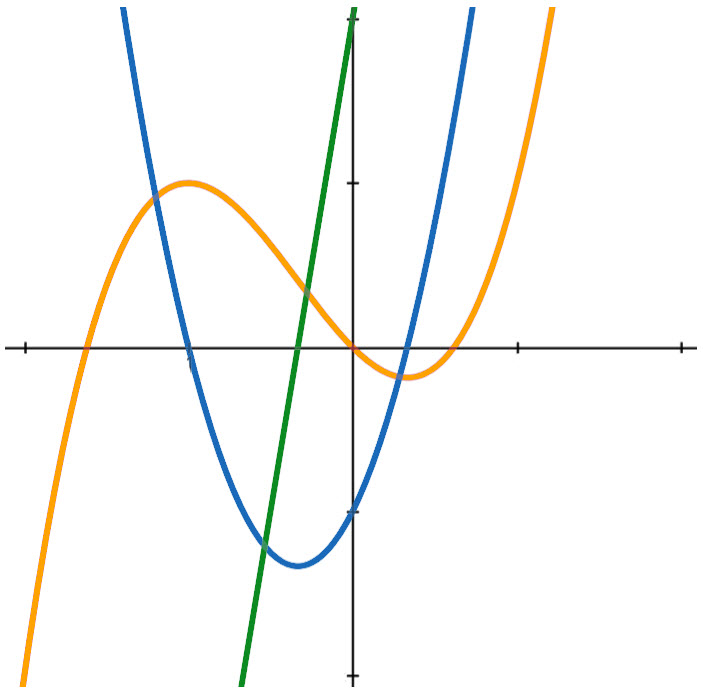
\(\bullet\text{ Graph of f(x), f'(x) and f”(x)}\)
\(\,\,\,\,\,\,\,\,\)
\(\bullet\text{ Newton’s Method}\)
\(\,\,\,\,\,\,\,\,x_{n+1}=x_n – \displaystyle \frac{f(x_n)}{f'(x_n)}\)