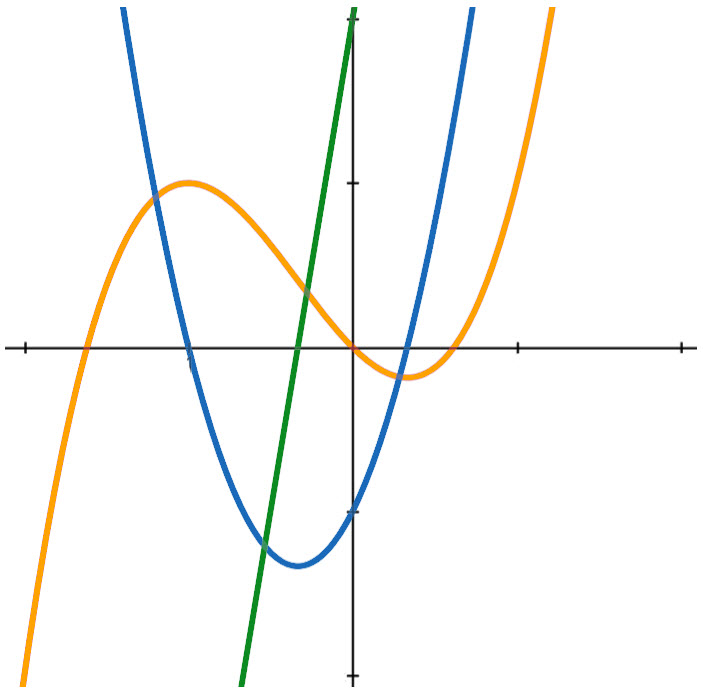

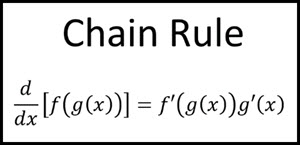
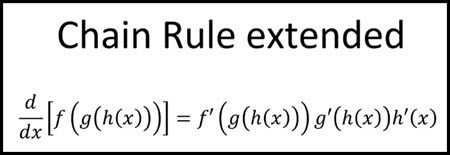
The chain rule is used to find derivatives of composite functions, where one function is inside another function. This page focuses on recognizing the outside and inside functions, differentiating the outside first, and then multiplying by the derivative of the inside. The practice problems include powers, radicals, trigonometric functions, exponential functions, logarithms, and table-based chain rule questions.
Notes
Practice Problems
Find the derivative of each
\(\small{\textbf{1)}}\) Find \(f'(x)\) where \(f(x)=(3x+5)^4\) The derivative is \(f'(x)=12(3x+5)^3\)
\(\,\,\,\,\,\,f(x)=(3x+5)^4\)
\(\,\,\,\,\,\,f'(x)=\left(([3x+5])^4\right)’ \cdot (3x+5)’\)
\(\,\,\,\,\,\,f'(x)=4(3x+5)^3 \cdot 3\)
\(\,\,\,\,\,\,\)The derivative is \(f'(x)=12(3x+5)^3\)
\(\,\,\,\,\,\,f(x)=(3x+5)^4\)
\(\,\,\,\,\,\,f'(x)=\left(([3x+5])^4\right)’ \cdot (3x+5)’\)
\(\,\,\,\,\,\,f'(x)=4(3x+5)^3 \cdot 3\)
\(\,\,\,\,\,\,\)The derivative is \(f'(x)=12(3x+5)^3\)
\(\small{\textbf{2)}}\) Find \(f'(x)\) where \(f(x)=\sqrt{2x-1}\) The derivative is \(f'(x)=\displaystyle\frac{1}{\sqrt{2x-1}}\)
\(\,\,\,\,\,\,f(x)=\sqrt{2x-1}\)
\(\,\,\,\,\,\,\displaystyle f(x)=\left(2x-1\right)^{1/2}\)
\(\,\,\,\,\,\,\displaystyle f'(x)=\left(\left([2x-1]\right)^{1/2}\right)’ \cdot (2x-1)’\)
\(\,\,\,\,\,\, f'(x)=\left(\frac{1}{2}\left(2x-1\right)^{-1/2}\right) \cdot (2)\)
\(\,\,\,\,\,\, f'(x)=\frac{2}{2}\left(2x-1\right)^{-1/2}\)
\(\,\,\,\,\,\, f'(x)=\frac{1}{1}\left(2x-1\right)^{-1/2}\)
\(\,\,\,\,\,\,\displaystyle f'(x)=\frac{1}{\sqrt{2x-1}}\)
\(\,\,\,\,\,\,\)The derivative is \(f'(x)=\displaystyle\frac{1}{\sqrt{2x-1}}\)
\(\,\,\,\,\,\,f(x)=\sqrt{2x-1}\)
\(\,\,\,\,\,\,\displaystyle f(x)=\left(2x-1\right)^{1/2}\)
\(\,\,\,\,\,\,\displaystyle f'(x)=\left(\left([2x-1]\right)^{1/2}\right)’ \cdot (2x-1)’\)
\(\,\,\,\,\,\, f'(x)=\left(\frac{1}{2}\left(2x-1\right)^{-1/2}\right) \cdot (2)\)
\(\,\,\,\,\,\, f'(x)=\frac{2}{2}\left(2x-1\right)^{-1/2}\)
\(\,\,\,\,\,\, f'(x)=\frac{1}{1}\left(2x-1\right)^{-1/2}\)
\(\,\,\,\,\,\,\displaystyle f'(x)=\frac{1}{\sqrt{2x-1}}\)
\(\,\,\,\,\,\,\)The derivative is \(f'(x)=\displaystyle\frac{1}{\sqrt{2x-1}}\)
\(\small{\textbf{3)}}\) Find \(f'(x)\) where \(f(x)=\displaystyle\frac{1}{x^3+3x-2}\) The derivative is \(f'(x)=-\displaystyle\frac{3x^2+3}{(x^3+3x-2)^2}\)
\(\,\,\,\,\,\,f(x)=\displaystyle\frac{1}{x^3+3x-2}\)
\(\,\,\,\,\,\,f(x)=\displaystyle \left(x^3+3x-2\right)^{-1}\)
\(\,\,\,\,\,\,f'(x)=\displaystyle \left(\left(\left[x^3+3x-2\right]\right)^{-1}\right)’ \cdot \left(x^3+3x-2\right)’\)
\(\,\,\,\,\,\,f'(x)=\displaystyle -1\left(\left[x^3+3x-2\right]\right)^{-2} \cdot \left(3x^2+3\right)\)
\(\,\,\,\,\,\,f'(x)=\displaystyle \frac{-1}{\left(x^3+3x-2\right)^{2}} \cdot \left(3x^2+3\right)\)
\(\,\,\,\,\,\,f'(x)=\displaystyle \frac{-1\left(3x^2+3\right)}{\left(x^3+3x-2\right)^{2}} \)
\(\,\,\,\,\,\,\)The derivative is \(f'(x)=-\displaystyle\frac{3x^2+3}{(x^3+3x-2)^2}\)
\(\,\,\,\,\,\,f(x)=\displaystyle\frac{1}{x^3+3x-2}\)
\(\,\,\,\,\,\,f(x)=\displaystyle \left(x^3+3x-2\right)^{-1}\)
\(\,\,\,\,\,\,f'(x)=\displaystyle \left(\left(\left[x^3+3x-2\right]\right)^{-1}\right)’ \cdot \left(x^3+3x-2\right)’\)
\(\,\,\,\,\,\,f'(x)=\displaystyle -1\left(\left[x^3+3x-2\right]\right)^{-2} \cdot \left(3x^2+3\right)\)
\(\,\,\,\,\,\,f'(x)=\displaystyle \frac{-1}{\left(x^3+3x-2\right)^{2}} \cdot \left(3x^2+3\right)\)
\(\,\,\,\,\,\,f'(x)=\displaystyle \frac{-1\left(3x^2+3\right)}{\left(x^3+3x-2\right)^{2}} \)
\(\,\,\,\,\,\,\)The derivative is \(f'(x)=-\displaystyle\frac{3x^2+3}{(x^3+3x-2)^2}\)
\(\small{\textbf{4)}}\) Find \(f'(x)\) where \(f(x)=x^2(2x-1)^3\) \(f'(x)=2x(2x-1)^3+6x^2(2x-1)^2\) or \(f'(x)=2x(2x-1)^2(5x-1)\)
\(\,\,\,\,\,\,f(x)=x^2(2x-1)^3\)
\(\,\,\,\,\,\,f'(x)=\left(x^2\right)’ \cdot \left((2x-1)^3\right)+\left(x^2\right) \cdot \left((2x-1)^3\right)’\)
\(\,\,\,\,\,\,f'(x)=\left(2x\right) \cdot \left((2x-1)^3\right)+\left(x^2\right) \cdot \left(\left(([2x-1])^3\right)’ \cdot \left(2x-1\right)’\right)\)
\(\,\,\,\,\,\,f'(x)=\left(2x\right) \cdot \left((2x-1)^3\right)+\left(x^2\right) \cdot \left(3([2x-1])^2 \cdot \left(2\right)\right)\)
\(\,\,\,\,\,\,f'(x)=2x(2x-1)^3+3x^2(2x-1)^2 \cdot 2\)
\(\,\,\,\,\,\,f'(x)=2x(2x-1)^3+6x^2(2x-1)^2\)
\(\,\,\,\,\,\,\)The answer is \(f'(x)=2x(2x-1)^3+6x^2(2x-1)^2\) or \(f'(x)=2x(2x-1)^2(5x-1)\)
\(\,\,\,\,\,\,f(x)=x^2(2x-1)^3\)
\(\,\,\,\,\,\,f'(x)=\left(x^2\right)’ \cdot \left((2x-1)^3\right)+\left(x^2\right) \cdot \left((2x-1)^3\right)’\)
\(\,\,\,\,\,\,f'(x)=\left(2x\right) \cdot \left((2x-1)^3\right)+\left(x^2\right) \cdot \left(\left(([2x-1])^3\right)’ \cdot \left(2x-1\right)’\right)\)
\(\,\,\,\,\,\,f'(x)=\left(2x\right) \cdot \left((2x-1)^3\right)+\left(x^2\right) \cdot \left(3([2x-1])^2 \cdot \left(2\right)\right)\)
\(\,\,\,\,\,\,f'(x)=2x(2x-1)^3+3x^2(2x-1)^2 \cdot 2\)
\(\,\,\,\,\,\,f'(x)=2x(2x-1)^3+6x^2(2x-1)^2\)
\(\,\,\,\,\,\,\)The answer is \(f'(x)=2x(2x-1)^3+6x^2(2x-1)^2\) or \(f'(x)=2x(2x-1)^2(5x-1)\)
\(\small{\textbf{5)}}\) Find \(f'(x)\) where \(f(x)=\sqrt[3]{x^4-2x+1}\) The derivative is \(f'(x)=\displaystyle\frac{4x^3-2}{3(x^4-2x+1)^{2/3}}\)
\(\,\,\,\,\,\,f(x)=\sqrt[3]{x^4-2x+1}\)
\(\,\,\,\,\,\,f(x)=\left(x^4-2x+1\right)^{1/3}\)
\(\,\,\,\,\,\,f'(x)=1/3\left(x^4-2x+1\right)^{-2/3} \cdot \left(4x^3-2\right)\)
\(\,\,\,\,\,\,f'(x)=\displaystyle\frac{4x^3-2}{3(x^4-2x+1)^{2/3}}\)
\(\,\,\,\,\,\,f(x)=\sqrt[3]{x^4-2x+1}\)
\(\,\,\,\,\,\,f(x)=\left(x^4-2x+1\right)^{1/3}\)
\(\,\,\,\,\,\,f'(x)=1/3\left(x^4-2x+1\right)^{-2/3} \cdot \left(4x^3-2\right)\)
\(\,\,\,\,\,\,f'(x)=\displaystyle\frac{4x^3-2}{3(x^4-2x+1)^{2/3}}\)
\(\small{\textbf{6)}}\) Find \(f'(x)\) where \(f(x)=(x^3-2)^4\) The derivative is \(f'(x)=12x^2(x^3-2)^3\)
\(\small{\textbf{7)}}\) Find \(f'(x)\) where \(f(x) = (3x^2 + 5)^6\) The derivative is \(f'(x) = 36x(3x^2+5)^5\)
\(f(x) = (3x^2 + 5)^6\)
\(f'(x) = 6(3x^2 + 5)^5 \cdot 6x\)
\(f'(x) = 36x(3x^2 + 5)^5\)
\(f(x) = (3x^2 + 5)^6\)
\(f'(x) = 6(3x^2 + 5)^5 \cdot 6x\)
\(f'(x) = 36x(3x^2 + 5)^5\)
\(\small{\textbf{8)}}\) Find \(f'(x)\) where \(f(x) = \displaystyle\frac{1}{\left( x^2 + 2x – 5 \right)^ 3}\) The derivative is \(f'(x) =- \displaystyle\frac{6(x+1)}{(x^2+2x-5)^4}\)
\(\,\,\,\,\,f(x) = \displaystyle\frac{1}{\left( x^2 + 2x – 5 \right)^ 3}\)
\(\,\,\,\,\,f(x) = \left( x^2 + 2x – 5 \right)^{ – 3}\)
\(\,\,\,\,\,f'(x) = -3\left( x^2 + 2x – 5 \right)^{ – 4} \cdot \left(2x+2\right)\)
\(\,\,\,\,\,f'(x) =- \displaystyle\frac{3(2x+2)}{(x^2+2x-5)^4}\)
\(\,\,\,\,\,f'(x) =- \displaystyle\frac{6(x+1)}{(x^2+2x-5)^4}\)
\(\,\,\,\,\,f(x) = \displaystyle\frac{1}{\left( x^2 + 2x – 5 \right)^ 3}\)
\(\,\,\,\,\,f(x) = \left( x^2 + 2x – 5 \right)^{ – 3}\)
\(\,\,\,\,\,f'(x) = -3\left( x^2 + 2x – 5 \right)^{ – 4} \cdot \left(2x+2\right)\)
\(\,\,\,\,\,f'(x) =- \displaystyle\frac{3(2x+2)}{(x^2+2x-5)^4}\)
\(\,\,\,\,\,f'(x) =- \displaystyle\frac{6(x+1)}{(x^2+2x-5)^4}\)
\(\small{\textbf{9)}}\) Find \(f'(x)\) where \(f(x) = \sqrt[5]{{1 – x}}\) The derivative is \(f'(x) = -\displaystyle\frac{1}{5\sqrt[5]{(1-x)^4}}\)
\(\,\,\,\,\,f(x) = \sqrt[5]{1 – x}\)
\(\,\,\,\,\,f(x) = (1 – x)^{\frac{1}{5}}\)
\(\,\,\,\,\,f'(x) = \frac{1}{5}(1 – x)^{-\frac{4}{5}} \cdot (-1)\)
\(\,\,\,\,\,f'(x) = -\displaystyle\frac{1}{5\sqrt[5]{(1 – x)^4}}\)
\(\,\,\,\,\,f(x) = \sqrt[5]{1 – x}\)
\(\,\,\,\,\,f(x) = (1 – x)^{\frac{1}{5}}\)
\(\,\,\,\,\,f'(x) = \frac{1}{5}(1 – x)^{-\frac{4}{5}} \cdot (-1)\)
\(\,\,\,\,\,f'(x) = -\displaystyle\frac{1}{5\sqrt[5]{(1 – x)^4}}\)
\(\small{\textbf{10)}}\) Find \(f'(x)\) where \(f(x) = \csc \left( {2x} \right)\) The hint is \( \frac{d}{dx} \csc x = -\csc x \cot x \) The derivative is \(f'(x) = -2 \csc (2x) \cot(2x) \)
\(\small{\textbf{11)}}\) Find \(f'(x)\) where \(f(x) = 3\cos \left( {\tan \left( 4x \right)} \right)\) The hint is \( \frac{d}{dx} \tan x = \sec^2 (x)\) The derivative is \(f'(x) = -12 \sec^2(4x)\sin(\tan(4x))\)
\(\small{\textbf{12)}}\) Find \(f'(x)\) where \(f(x) = \tan \left( {15x + 14} \right)\) The hint is \( \frac{d}{dx} \tan x = \sec^2 (x)\) The derivative is \(f'(x) = 15 \sec^2(15x+14)\)
\(\small{\textbf{13)}}\) Find \(f'(x)\) where \(f(x) = e^{(x^2 + 2)}\) The derivative is \(f'(x) = 2xe^{(x^2 + 2)}\)
\(\small{\textbf{14)}}\) Find \(f'(x)\) where \(f(x) = e^{1 – \sin \left( x \right)}\) The derivative is \(f'(x) = -{e^{1 – \sin \left( x \right)}} \cos{(x)}\)
\(\small{\textbf{15)}}\) Find \(f'(x)\) where \(f(x) = {3^{1 + 4x}}\) The derivative is \(f'(x) = 4 \ln(3) (3^{1 + 4x})\)
\(\small{\textbf{16)}}\) Find \(f'(x)\) where \(f(x) = {\tan ^{ – 1}}\left( {5x + 2} \right)\) The hint is \( \frac{d}{dx} \arctan x = \displaystyle\frac{1}{1+x^2}\) The derivative is \(f'(x) = \displaystyle\frac{1}{5x^2+4x+1}\)
\(\small{\textbf{17)}}\) Find \(f'(x)\) where \(f(x) = \ln \left({2x^3 +3x +6} \right)\) The derivative is \(f'(x) = \displaystyle\frac{6x^2+3}{2x^3+3x+6}\)
\(\small{\textbf{18)}}\) Find \(f'(x)\) where \(f(x) = \ln \left( {\sin \left( x \right) + \cos \left( x \right)} \right)\) The derivative is \(f'(x) = \displaystyle\frac{\cos{(x)}-\sin{(x)}}{\cos{(x)}+\sin{(x)}}\)
\(\small{\textbf{19)}}\) Find \(f'(x)\) where \(f(x) = \ln \left( {\tan \left( x \right) + \cot \left( x \right)} \right)\) The hint is \( \frac{d}{dx} \tan x = \sec^2 (x),\,\frac{d}{dx} \cot x = -\csc^2 (x) \) The derivative is \(f'(x) = \displaystyle\frac{\sec^2{(x)}-\csc^2{(x)}}{\tan{(x)}+\cot{(x)}}\)
\(\small{\textbf{20)}}\) Find \(f'(x)\) where \(f(x) = {\sin ^2}\left( x \right) + \sin \left( {{x^2}} \right)\) The derivative is \(f'(x) = 2 \sin{(x)}\cos{(x)} + 2x \cos{(x^2)}\)
\(\small{\textbf{21)}}\) Find \(f'(x)\) where \(f(x) = {e^{ – x}}+e^x\) The derivative is \(f'(x) = e^x-e^{-x}\)
\(\small{\textbf{22)}}\) Find \(f'(x)\) where \(f(x) = 2x^3 + \left(4x^5 – 6x \right)^7\) The derivative is \(f'(x) = 6x^2 + 7 \left(4x^5 – 6x \right)^6 \left(20x^4-6 \right)\)
\(\small{\textbf{23)}}\) Find \(f'(x)\) where \(f(x) = \ln \left( {\sin \left( x \right)} \right) – \sin \left( \ln x \right) \) The derivative is \(f'(x) = \cot{(x)}-\displaystyle\frac{cos{( \ln{x})}}{x}\)
\(\small{\textbf{24)}}\) Find \(f'(x)\) where \(f(x) = x^2\ln(x^2)\) The derivative is \(f'(x) = 2x \ln(x^2)+2x\)
\(\small{\textbf{25)}}\) Find \(f'(x)\) where \(f(x) = \sin \left( {2x} \right)\cos \left( {2x} \right)\) The derivative is \(f'(x) = 2\left[\cos^2{(2x)}-\sin^2{(2x)}\right]\)
\(\small{\textbf{26)}}\) Find \(f'(x)\) where \( f(x) = \sin \left( {\cos \left( {2x} \right)} \right)\) The derivative is \(f'(x) = -2 \cos{(\cos{(2x)})} \sin{(2x)}\)
\(\small{\textbf{27)}}\) Find \(f'(x)\) where \(f(x) = \displaystyle\frac{\sin {2x} }{\cos{2x}}\) The hint is \( \frac{\sin x}{\cos x} =\tan x\) The derivative is \(f'(x) = 2 \sec^2{(2x)}\)
\(\small{\textbf{28)}}\) Find \(f'(x)\) where \(f(x) = \sin \left( e^x \right)\) The derivative is \(f'(x) = e^x \cos{(e^x)}\)
\(\small{\textbf{29)}}\) Find \(f'(x)\) where \(f(x) = \sqrt {\tan \left( {2x} \right)}\) The hint is \( \frac{d}{dx} \tan x = \sec^2 (x)\) The derivative is \(f'(x) = \displaystyle\frac{\sec^2{(2x)}}{\sqrt{tan{(2x)}}}\)
\(\small{\textbf{30)}}\) Find \(f'(x)\) where \(f(x) = {\tan ^3}\left( {{x^3}} \right)\) The hint is \( \frac{d}{dx} \tan x = \sec^2 (x)\) The derivative is \(f'(x) = 9x^2 \tan^2{(x^3)} \sec^2{(x^3)}\)
\(\small{\textbf{31)}}\) Find \(f'(x)\) where \(f(x)=\ln(\ln x)\) The answer is \(f'(x)=\displaystyle\frac{1}{x \ln x }\)
\(\small{\textbf{32)}}\) Find \(f'(x)\) where \(f(x)=\displaystyle 3^{\sin^4(x^3)}\) The answer is \(f'(x)=\displaystyle 3^{\sin^4 \left( x^3 \right)} (\ln 3) \cdot 4 \left( \sin (x^3) \right)^3 \cdot \left( \cos (x^3) \right) \cdot 3x^2 \)
\(\small{\textbf{33)}}\) Find \(f'(x)\) where \(f(x)=\displaystyle \sec{\left(\sin(x)\right)}\) The answer is \(f'(x)=\displaystyle \sec{\left(\sin{(x)}\right)} \tan{\left(\sin{(x)}\right)} \cdot \cos{(x)}\)
\(\small{\textbf{34)}}\) Find \(f'(x)\) where \(f(x)=\displaystyle \ln{\sqrt{x}}\) The answer is \(f'(x)=\displaystyle \frac{1}{2x}\)
\(\small{\textbf{35)}}\) Find \(f'(3)\) where \(f(x)=g(h(x))\)
| \(1\) | \(2\) | \(3\) | \(4\) | |
| \(9\) | \(4\) | \(6\) | \(2\) | |
| \(8\) | \(3\) | \(5\) | \(2\) | |
| \(1\) | \(3\) | \(4\) | \(2\) | |
| \(4\) | \(-2\) | \(7\) | \(3\) |
\(f'(3)=14\)
\(\,\,\,\,\,f(x)=g(h(x))\)
\(\,\,\,\,\,f'(x)=g'(h(x))*h'(x)\)
\(\,\,\,\,\,f'(3)=g'(h(3))*h'(3)\)
\(\,\,\,\,\,h(3)=4\)
\(\,\,\,\,\,f'(3)=g'(4)*h'(3)\)
\(\,\,\,\,\,f'(3)=2*7\)
\(\,\,\,\,\,f'(3)=14\)
\(\small{\textbf{36)}}\) Find \(f'(1)\) where \(f(x)=g(h(x))\)
| \(1\) | \(2\) | \(3\) | \(4\) | |
| \(9\) | \(4\) | \(6\) | \(2\) | |
| \(8\) | \(3\) | \(5\) | \(2\) | |
| \(1\) | \(3\) | \(4\) | \(2\) | |
| \(4\) | \(-2\) | \(7\) | \(3\) |
\(f'(1)=32\)
\(\,\,\,\,\,f(x)=g(h(x))\)
\(\,\,\,\,\,f'(x)=g'(h(x))*h'(x)\)
\(\,\,\,\,\,f'(1)=g'(h(1))*h'(1)\)
\(\,\,\,\,\,h(1)=1\)
\(\,\,\,\,\,f'(1)=g'(1)*h'(1)\)
\(\,\,\,\,\,f'(1)=8*4\)
\(\,\,\,\,\,f'(1)=32\)
\(\small{\textbf{37)}}\) Find \(f'(2)\) where \(f(x)=g(h(x))\)
| \(1\) | \(2\) | \(3\) | \(4\) | |
| \(9\) | \(4\) | \(6\) | \(2\) | |
| \(8\) | \(3\) | \(5\) | \(2\) | |
| \(1\) | \(3\) | \(4\) | \(2\) | |
| \(4\) | \(-2\) | \(7\) | \(3\) |
\(f'(2)=-10\)
\(\,\,\,\,\,f(x)=g(h(x))\)
\(\,\,\,\,\,f'(x)=g'(h(x))*h'(x)\)
\(\,\,\,\,\,f'(2)=g'(h(2))*h'(2)\)
\(\,\,\,\,\,h(2)=3\)
\(\,\,\,\,\,f'(2)=g'(3)*h'(2)\)
\(\,\,\,\,\,f'(2)=5*(-2)\)
\(\,\,\,\,\,f'(2)=-10\)
\(\small{\textbf{38)}}\) Find \(f'(4)\) where \(f(x)=g(h(x))\)
| \(1\) | \(2\) | \(3\) | \(4\) | |
| \(9\) | \(4\) | \(6\) | \(2\) | |
| \(8\) | \(3\) | \(5\) | \(2\) | |
| \(1\) | \(3\) | \(4\) | \(2\) | |
| \(4\) | \(-2\) | \(7\) | \(3\) |
\(f'(4)=9\)
\(\,\,\,\,\,f(x)=g(h(x))\)
\(\,\,\,\,\,f'(x)=g'(h(x))*h'(x)\)
\(\,\,\,\,\,f'(4)=g'(h(4))*h'(4)\)
\(\,\,\,\,\,h(4)=2\)
\(\,\,\,\,\,f'(4)=g'(2)*h'(4)\)
\(\,\,\,\,\,f'(4)=3*3\)
\(\,\,\,\,\,f'(4)=9\)