

Practice Problems
\(\textbf{1)}\) Two dice are rolled, find P (sum \(=6\)) The answer is P (sum \(=6\)) \(= \frac{5}{36} \)
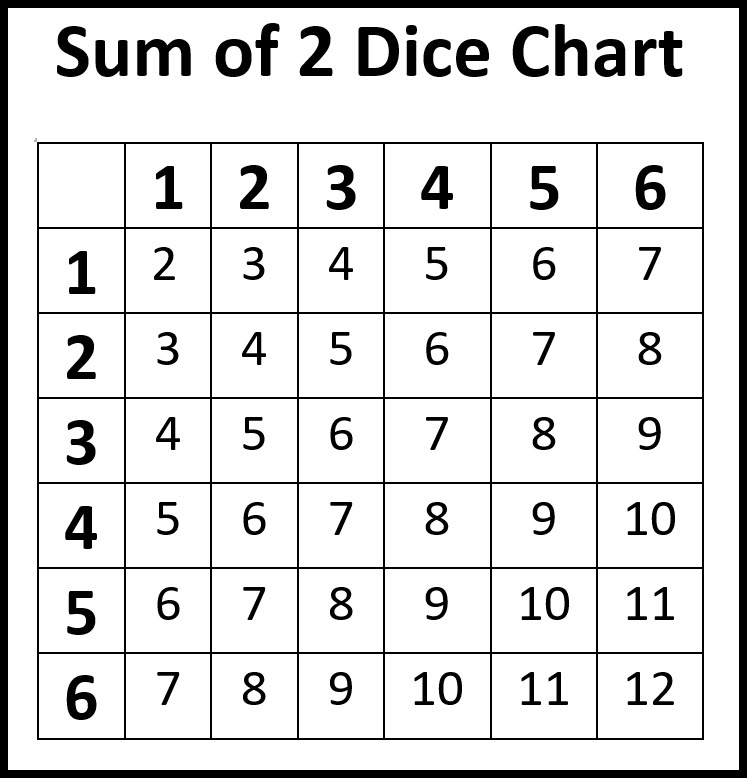
\(\textbf{2)}\) Two dice are rolled, find P (sum \(=2\)) Use the box up above under notes, count how many boxes have 2’s in them and then divide by the 36 total possibilities. The answer is P (sum \(=2\)) \(= \frac{1}{36}\)
\(\textbf{3)}\) Two dice are rolled, find P (sum\(=11\)) The answer is P (sum\(=11\)) \(= \frac{2}{36}=\frac{1}{18} \)
\(\textbf{4)}\) Two dice are rolled, find P (sum is even) The answer is P (sum is even) \(= \frac{18}{36}=\frac{1}{2} \)
\(\textbf{5)}\) Two dice are rolled, find P (sum\(\gt8\)) The answer is P (sum\(\gt8\)) \(= \frac{10}{36}=\frac{5}{18} \)
\(\textbf{6)}\) Two dice are rolled, find P (sum \(\le8\)) The answer is P (sum \(\le8\)) \(= \frac{26}{36}=\frac{13}{18} \)
\(\textbf{7)}\) Two dice are rolled, find P (\(6\lt\) sum \(\le 9\) ) The answer is P (\(6\lt\) sum \(\le 9\) ) \(= \frac{15}{36}=\frac{5}{12} \)
\(\textbf{8)}\) Two dice are rolled, find P (sum\(=6|\) sum is even) The answer is P (sum\(=6|\) sum is even)\(= \frac{5}{18} \)
\(\textbf{9)}\) Two dice are rolled, find P (sum is even\(|\)sum\(=6\)) The answer is P (sum is even\(|\)sum\(=6\))\(= \frac{6}{6}=100\)%
\(\textbf{10)}\) Two dice are rolled, find P (rolling at least one 5) The answer is P (rolling at least one 5)\(= \frac{11}{36} \) (hint this isn’t looking at the sum)
See Related Pages\(\)
\(\bullet\text{ Statistics Homepage}\)
\(\,\,\,\,\,\,\,\,\text{All the Best Topics…}\)
\(\bullet\text{ Probability with Coin Tosses}\)
\(\,\,\,\,\,\,\,\,\text{Prob(3 heads)}=\frac{1}{8}\)
\(\bullet\text{ Probability with Marbles }\)
\(\,\,\,\,\,\,\,\,\text{Prob(3 red)}=\frac{7}{20}…\)
\(\bullet\text{ Probability with Dice}\)
\(\,\,\,\,\,\,\,\,\text{Prob(Two 6’s)}=\frac{1}{36}…\)
\(\bullet\text{ Probability with Round Tables}\)
\(\,\,\,\,\,\,\,\,(n-1)!…\)
\(\bullet\text{ Probability with Poker Hands}\)
\(\,\,\,\,\,\,\,\,\text{P(Full House)}=…\)
In Summary
Probability is a measure of how likely an event is to occur. The probability of rolling a specific number on a die is 1/6, since there are 6 possible outcomes (numbers 1-6) and each outcome is equally likely to occur.
If you are rolling 2 dice, there are 36 possible outcomes. The sums of these outcomes range from 2-12, with varying probabilities for each sum. If you use a table like the one on the top of this page, you can easily see where all the various sums and their distributions come from.
A lot of games and board games are designed around this distribution of different sums of 2 dice. Craps for example, gives greater returns when people bet on less likely outcomes and win.
Probability is useful tool for analyzing possible outcomes of situations. You can make better predictions and decisions if you understand the likelihood of certain events occurring. Using dice is a great way to introduce people to more complex probability concepts. By calculating the probabilities of different outcomes,