

Notes
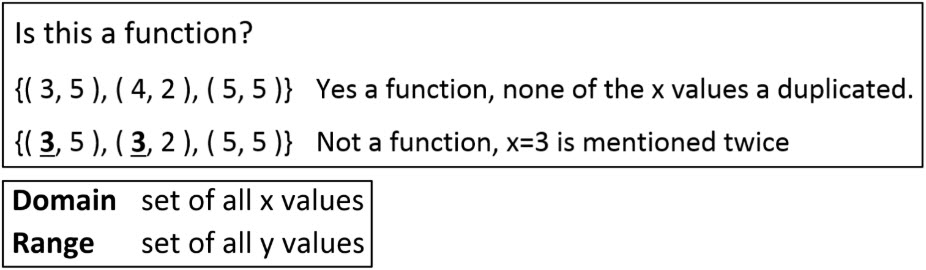
Problems & Videos
\(\textbf{1)}\) \(\text{Does this represent a function? } {(1{,}2),(2{,}4),(2{,}5),(5{,}8)} \) No, not a function
\(\textbf{2)}\) Does this represent a function?
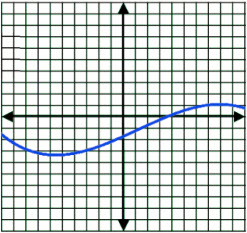 Yes, it is a function
\(\textbf{3)}\) Does this represent a function?
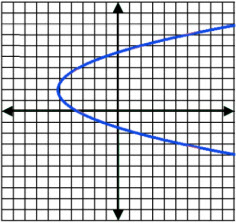 No, not a function
For problems \(3-9\), use \(f(x)=3x+5\). Find the following.
\(\textbf{4)}\) \(f(5)\) The answer is 20
\(\textbf{5)}\) \(f(-4)\) The answer is -7
\(\textbf{6)}\) \(f(0)\) The answer is 5
\(\textbf{7)}\) \(f(y)\) The answer is 3y+5
\(\textbf{8)}\) \(f(2z)\) The answer is 6z+5
In Summary
The vertical line test is a graphical method used to determine whether a curve in the plane represents the graph of a function. The test is performed by drawing a vertical line anywhere on the graph and observing the number of times that the line intersects the curve.
If the line intersects the curve in exactly one point, then the curve represents the graph of a function. This is because a function must have exactly one output value for each input value, and a vertical line can only intersect a graph in one point if the graph represents a function.
On the other hand, if the vertical line intersects the curve in more than one point, then the curve does not represent the graph of a function. This is because a function cannot have more than one output value for a given input value, and a vertical line that intersects a graph in multiple points indicates that the graph does not represent a function.
The vertical line test is a simple and effective method for determining whether a curve in the plane represents the graph of a function. It is based on the fundamental property of functions that they must have exactly one output value for each input value.