

Notes
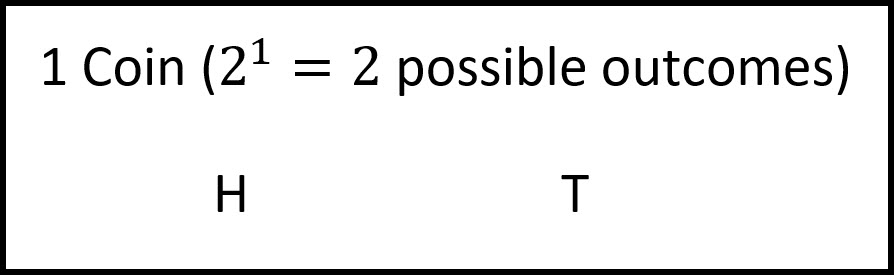
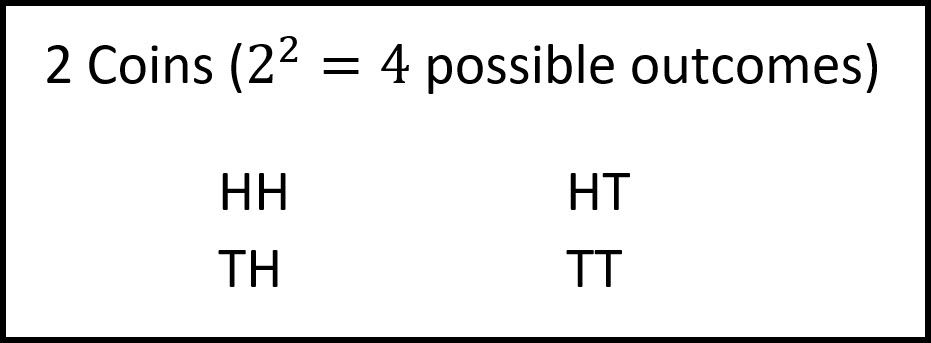
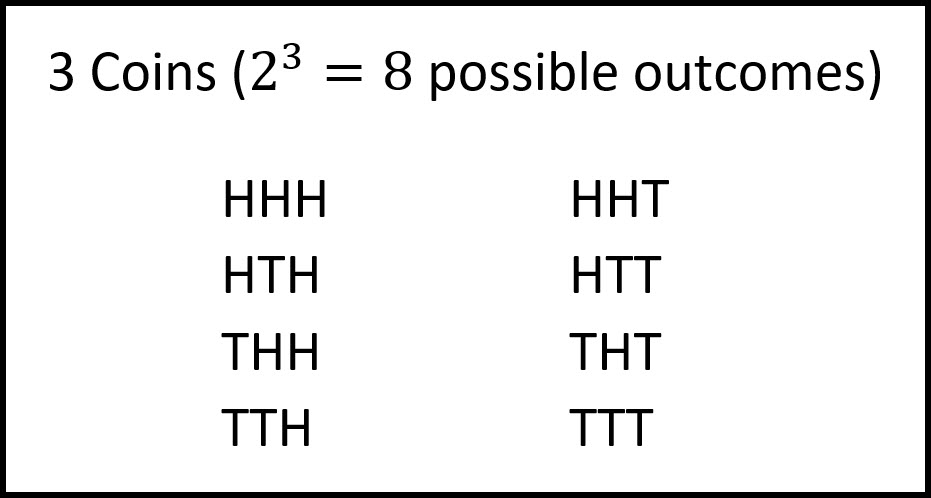
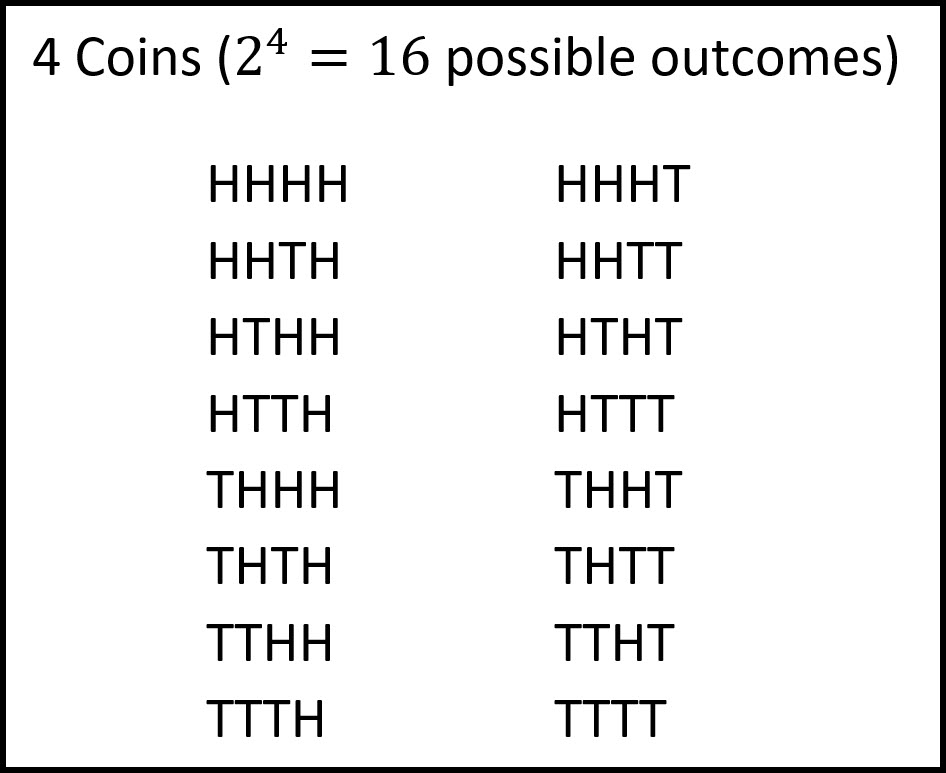
Problems
You flip a coin 1 time. Find the following probabilities.
\(\textbf{1)}\) \( P\)(heads)
The answer is \(\displaystyle\frac{1}{2} = 50\% \)
\(\textbf{2)}\) \( P\)(tails)
The answer is \(\displaystyle\frac{1}{2} = 50\% \)
You flip a coin 2 times. Find the following probabilities.
\(\textbf{3)}\) \( P\)( 1 heads)
The answer is \(\displaystyle\frac{2}{4} = 50\% \)
\(\textbf{4)}\) \( P\)(2 heads)
The answer is \(\displaystyle\frac{1}{4} = 25\% \)
\(\textbf{5)}\) \( P\)(No heads)
The answer is \(\displaystyle\frac{1}{4} = 25\% \)
\(\textbf{6)}\) \( P\)(2 tails)
The answer is \(\displaystyle\frac{1}{4} = 25\% \)
You flip a coin 3 times. Find the following probabilities.
\(\textbf{7)}\) \( P\)(2 heads)
The answer is \(\displaystyle\frac{3}{8} = 37.5\% \)
\(\textbf{8)}\) \( P\)(1 tails)
The answer is \(\displaystyle\frac{3}{8} = 37.5\% \)
\(\textbf{9)}\) \( P\)(3 tails)
The answer is \(\displaystyle\frac{1}{8} = 12.5\% \)
\(\textbf{10)}\) \( P\)(no tails)
The answer is \(\displaystyle\frac{1}{8} = 12.5\% \)
\(\textbf{11)}\) \( P\)(no heads)
The answer is \(\displaystyle\frac{1}{8} = 12.5\% \)
You flip a coin 4 times. Find the following probabilities.
\(\textbf{12)}\) \( P\)(3 heads)
The answer is \(\displaystyle\frac{4}{16} = 25\% \)
\(\textbf{13)}\) \( P\)(4 tails)
The answer is \(\displaystyle\frac{1}{16} = 6.25\% \)
\(\textbf{14)}\) \( P\)(at least 3 heads)
The answer is \(\displaystyle\frac{5}{16} = 31.25\% \)
\(\textbf{15)}\) \( P\)(at most 2 tails)
The answer is \(\displaystyle\frac{11}{16} = 68.75\% \)
\(\textbf{16)}\) \( P\)(no tails)
The answer is \(\displaystyle\frac{1}{16} = 6.25\% \)
\(\textbf{17)}\) \( P\)(more than 3 tails)
The answer is \(\displaystyle\frac{1}{16} = 6.25% \)
\(\textbf{18)}\) \( P\)(at least 1 head)
The answer is \(\displaystyle\frac{15}{16} = 93.75\% \)
See Related Pages\(\)
\(\bullet\text{ Statistics Homepage}\)
\(\,\,\,\,\,\,\,\,\text{All the Best Topics…}\)
\(\bullet\text{ Probability with Coin Tosses}\)
\(\,\,\,\,\,\,\,\,\text{Prob(3 heads)}=\frac{1}{8}\)
\(\bullet\text{ Probability with Marbles }\)
\(\,\,\,\,\,\,\,\,\text{Prob(3 red)}=\frac{7}{20}…\)
\(\bullet\text{ Probability with Dice}\)
\(\,\,\,\,\,\,\,\,\text{Prob(Two 6’s)}=\frac{1}{36}…\)
\(\bullet\text{ Probability with Round Tables}\)
\(\,\,\,\,\,\,\,\,(n-1)!…\)
\(\bullet\text{ Probability with Poker Hands}\)
\(\,\,\,\,\,\,\,\,\text{P(Full House)}=…\)
\(\bullet\text{ Andymath Homepage}\)
In Summary
Probability is a measure of how likely an event is to occur. The probability of a coin toss resulting in heads or tails is always \(1/2\), or \(0.5\). This is because there are only two possible outcomes for a coin toss (heads or tails) and each outcome is equally likely to occur.
For example, if you toss a coin \(10\) times, you might expect to get \(5\) heads and \(5\) tails, but it is also possible to get \(6\) heads and \(4\) tails, or any other combination of heads and tails. The probability of getting any specific combination of heads and tails in 10 tosses is \(\left(1/2\right)^{10}\), or \(1/1024\), since there are \(2^{10} \, (1024)\) possible combinations of heads and tails for \(10\) coin tosses.
Probability can be a useful tool for analyzing situations involving coin tosses or other random processes. By calculating the probabilities of different outcomes, you can make predictions and decisions based on the likelihood of certain events occurring.