

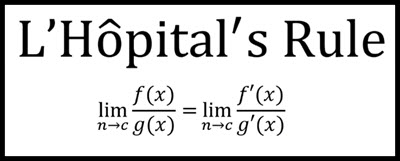
L’Hôpital’s Rule is a calculus technique for evaluating limits that produce indeterminate forms. Instead of trying to simplify the original expression directly, you take the derivative of the numerator and denominator separately and then evaluate the new limit. It is especially helpful for limits involving logarithms, exponentials, trigonometric functions, and rational expressions.
Notes
Questions
\(\textbf{1)}\) \( \displaystyle \lim_{x\to1} \displaystyle \frac{\ln{x}}{x-1} \) The answer is \(1\)
\(\,\,\,\,\,\,\text{Verify }\displaystyle \frac {\ln{(1)}}{1-1}= \frac{0}{0}\)
\(\,\,\,\,\,\,\displaystyle \lim_{x\to c} \displaystyle \frac{f(x)}{g(x)} = \lim_{x\to c} \displaystyle \frac{f'(x)}{g'(x)}\)
\(\,\,\,\,\,\,\displaystyle \lim_{x\to 1} \displaystyle \frac{\ln{x}}{x-1} = \lim_{x\to 1} \displaystyle \frac{1/x}{1}\)
\(\,\,\,\,\,\, \lim_{x\to 1} \frac{1/x}{1}=\frac{1/(1)}{1}=1\)
\(\,\,\,\,\,\,\,\text{The answer is } 1\)
\(\,\,\,\,\,\,\text{Verify }\displaystyle \frac {\ln{(1)}}{1-1}= \frac{0}{0}\)
\(\,\,\,\,\,\,\displaystyle \lim_{x\to c} \displaystyle \frac{f(x)}{g(x)} = \lim_{x\to c} \displaystyle \frac{f'(x)}{g'(x)}\)
\(\,\,\,\,\,\,\displaystyle \lim_{x\to 1} \displaystyle \frac{\ln{x}}{x-1} = \lim_{x\to 1} \displaystyle \frac{1/x}{1}\)
\(\,\,\,\,\,\, \lim_{x\to 1} \frac{1/x}{1}=\frac{1/(1)}{1}=1\)
\(\,\,\,\,\,\,\,\text{The answer is } 1\)
\(\textbf{2)}\) \( \displaystyle \lim_{x\to\infty} \displaystyle \frac{\ln{x}}{x} \) The answer is \(0\)
\(\,\,\,\,\,\text{Verify this has the form }\displaystyle \frac{\infty}{\infty}\)
\(\,\,\,\,\,\displaystyle \lim_{x\to\infty}\frac{\ln{x}}{x}=\lim_{x\to\infty}\frac{1/x}{1}\)
\(\,\,\,\,\,\displaystyle \lim_{x\to\infty}\frac{1}{x}=0\)
\(\,\,\,\,\,\text{The answer is }0\)
\(\,\,\,\,\,\text{Verify this has the form }\displaystyle \frac{\infty}{\infty}\)
\(\,\,\,\,\,\displaystyle \lim_{x\to\infty}\frac{\ln{x}}{x}=\lim_{x\to\infty}\frac{1/x}{1}\)
\(\,\,\,\,\,\displaystyle \lim_{x\to\infty}\frac{1}{x}=0\)
\(\,\,\,\,\,\text{The answer is }0\)
\(\textbf{3)}\) \( \displaystyle \lim_{x\to\infty} xe^{-x} \) The answer is \(0\)
\(\,\,\,\,\,\displaystyle \lim_{x\to\infty}xe^{-x}=\lim_{x\to\infty}\frac{x}{e^x}\)
\(\,\,\,\,\,\text{Verify this has the form }\displaystyle \frac{\infty}{\infty}\)
\(\,\,\,\,\,\displaystyle \lim_{x\to\infty}\frac{x}{e^x}=\lim_{x\to\infty}\frac{1}{e^x}\)
\(\,\,\,\,\,\displaystyle \lim_{x\to\infty}\frac{1}{e^x}=0\)
\(\,\,\,\,\,\text{The answer is }0\)
\(\,\,\,\,\,\displaystyle \lim_{x\to\infty}xe^{-x}=\lim_{x\to\infty}\frac{x}{e^x}\)
\(\,\,\,\,\,\text{Verify this has the form }\displaystyle \frac{\infty}{\infty}\)
\(\,\,\,\,\,\displaystyle \lim_{x\to\infty}\frac{x}{e^x}=\lim_{x\to\infty}\frac{1}{e^x}\)
\(\,\,\,\,\,\displaystyle \lim_{x\to\infty}\frac{1}{e^x}=0\)
\(\,\,\,\,\,\text{The answer is }0\)
\(\textbf{4)}\) \( \displaystyle \lim_{x\to0} (\sin x)^x \) The answer is \(1\)
\(\,\,\,\,\,\text{Let }L=\displaystyle \lim_{x\to0^+}(\sin x)^x\)
\(\,\,\,\,\,\ln L=\displaystyle \lim_{x\to0^+}x\ln(\sin x)\)
\(\,\,\,\,\,\ln L=\displaystyle \lim_{x\to0^+}\frac{\ln(\sin x)}{1/x}\)
\(\,\,\,\,\,\text{This has the form }\displaystyle \frac{-\infty}{\infty}\)
\(\,\,\,\,\,\ln L=\displaystyle \lim_{x\to0^+}\frac{\cot x}{-1/x^2}\)
\(\,\,\,\,\,\ln L=\displaystyle \lim_{x\to0^+}-x^2\cot x\)
\(\,\,\,\,\,\ln L=\displaystyle \lim_{x\to0^+}\frac{-x^2\cos x}{\sin x}=0\)
\(\,\,\,\,\,L=e^0=1\)
\(\,\,\,\,\,\text{The answer is }1\)
\(\,\,\,\,\,\text{Let }L=\displaystyle \lim_{x\to0^+}(\sin x)^x\)
\(\,\,\,\,\,\ln L=\displaystyle \lim_{x\to0^+}x\ln(\sin x)\)
\(\,\,\,\,\,\ln L=\displaystyle \lim_{x\to0^+}\frac{\ln(\sin x)}{1/x}\)
\(\,\,\,\,\,\text{This has the form }\displaystyle \frac{-\infty}{\infty}\)
\(\,\,\,\,\,\ln L=\displaystyle \lim_{x\to0^+}\frac{\cot x}{-1/x^2}\)
\(\,\,\,\,\,\ln L=\displaystyle \lim_{x\to0^+}-x^2\cot x\)
\(\,\,\,\,\,\ln L=\displaystyle \lim_{x\to0^+}\frac{-x^2\cos x}{\sin x}=0\)
\(\,\,\,\,\,L=e^0=1\)
\(\,\,\,\,\,\text{The answer is }1\)
\(\textbf{5)}\) \( \displaystyle \lim_{x\to\infty} \displaystyle \frac{e^x}{x^3} \) The answer is \(\infty\)
\(\,\,\,\,\,\text{Verify this has the form }\displaystyle \frac{\infty}{\infty}\)
\(\,\,\,\,\,\displaystyle \lim_{x\to\infty}\frac{e^x}{x^3}=\lim_{x\to\infty}\frac{e^x}{3x^2}\)
\(\,\,\,\,\,\displaystyle =\lim_{x\to\infty}\frac{e^x}{6x}\)
\(\,\,\,\,\,\displaystyle =\lim_{x\to\infty}\frac{e^x}{6}=\infty\)
\(\,\,\,\,\,\text{The answer is }\infty\)
\(\,\,\,\,\,\text{Verify this has the form }\displaystyle \frac{\infty}{\infty}\)
\(\,\,\,\,\,\displaystyle \lim_{x\to\infty}\frac{e^x}{x^3}=\lim_{x\to\infty}\frac{e^x}{3x^2}\)
\(\,\,\,\,\,\displaystyle =\lim_{x\to\infty}\frac{e^x}{6x}\)
\(\,\,\,\,\,\displaystyle =\lim_{x\to\infty}\frac{e^x}{6}=\infty\)
\(\,\,\,\,\,\text{The answer is }\infty\)
\(\textbf{6)}\) \( \displaystyle \lim_{x\to\infty} \displaystyle \frac{5x^2+2x-3}{4x^2-10x+7} \) The answer is \(\displaystyle\frac{5}{4}\)
\(\,\,\,\,\,\text{Verify this has the form }\displaystyle \frac{\infty}{\infty}\)
\(\,\,\,\,\,\displaystyle \lim_{x\to\infty}\frac{5x^2+2x-3}{4x^2-10x+7}=\lim_{x\to\infty}\frac{10x+2}{8x-10}\)
\(\,\,\,\,\,\displaystyle =\lim_{x\to\infty}\frac{10}{8}\)
\(\,\,\,\,\,\displaystyle \frac{10}{8}=\frac{5}{4}\)
\(\,\,\,\,\,\text{The answer is }\frac{5}{4}\)
\(\,\,\,\,\,\text{Verify this has the form }\displaystyle \frac{\infty}{\infty}\)
\(\,\,\,\,\,\displaystyle \lim_{x\to\infty}\frac{5x^2+2x-3}{4x^2-10x+7}=\lim_{x\to\infty}\frac{10x+2}{8x-10}\)
\(\,\,\,\,\,\displaystyle =\lim_{x\to\infty}\frac{10}{8}\)
\(\,\,\,\,\,\displaystyle \frac{10}{8}=\frac{5}{4}\)
\(\,\,\,\,\,\text{The answer is }\frac{5}{4}\)
\(\textbf{7)}\) \( \displaystyle \lim_{x\to\infty} (1+ \frac{1}{x})^x \) The answer is \(e\)
\(\,\,\,\,\,\text{Let }L=\displaystyle \lim_{x\to\infty}\left(1+\frac{1}{x}\right)^x\)
\(\,\,\,\,\,\ln L=\displaystyle \lim_{x\to\infty}x\ln\left(1+\frac{1}{x}\right)\)
\(\,\,\,\,\,\ln L=\displaystyle \lim_{x\to\infty}\frac{\ln\left(1+\frac{1}{x}\right)}{1/x}\)
\(\,\,\,\,\,\text{This has the form }\displaystyle \frac{0}{0}\)
\(\,\,\,\,\,\ln L=\displaystyle \lim_{x\to\infty}\frac{\frac{-1/x^2}{1+1/x}}{-1/x^2}\)
\(\,\,\,\,\,\ln L=\displaystyle \lim_{x\to\infty}\frac{1}{1+1/x}=1\)
\(\,\,\,\,\,L=e^1=e\)
\(\,\,\,\,\,\text{The answer is }e\)
\(\,\,\,\,\,\text{Let }L=\displaystyle \lim_{x\to\infty}\left(1+\frac{1}{x}\right)^x\)
\(\,\,\,\,\,\ln L=\displaystyle \lim_{x\to\infty}x\ln\left(1+\frac{1}{x}\right)\)
\(\,\,\,\,\,\ln L=\displaystyle \lim_{x\to\infty}\frac{\ln\left(1+\frac{1}{x}\right)}{1/x}\)
\(\,\,\,\,\,\text{This has the form }\displaystyle \frac{0}{0}\)
\(\,\,\,\,\,\ln L=\displaystyle \lim_{x\to\infty}\frac{\frac{-1/x^2}{1+1/x}}{-1/x^2}\)
\(\,\,\,\,\,\ln L=\displaystyle \lim_{x\to\infty}\frac{1}{1+1/x}=1\)
\(\,\,\,\,\,L=e^1=e\)
\(\,\,\,\,\,\text{The answer is }e\)
\(\textbf{8)}\) \( \displaystyle \lim _{x\to 0}\frac{\sin x}{x} \) The answer is \(1\)
\(\,\,\,\,\,\text{Verify }\displaystyle \frac{\sin(0)}{0}=\frac{0}{0}\)
\(\,\,\,\,\,\displaystyle \lim_{x\to0}\frac{\sin x}{x}=\lim_{x\to0}\frac{\cos x}{1}\)
\(\,\,\,\,\,\displaystyle \frac{\cos(0)}{1}=1\)
\(\,\,\,\,\,\text{The answer is }1\)
\(\,\,\,\,\,\text{Verify }\displaystyle \frac{\sin(0)}{0}=\frac{0}{0}\)
\(\,\,\,\,\,\displaystyle \lim_{x\to0}\frac{\sin x}{x}=\lim_{x\to0}\frac{\cos x}{1}\)
\(\,\,\,\,\,\displaystyle \frac{\cos(0)}{1}=1\)
\(\,\,\,\,\,\text{The answer is }1\)
\(\textbf{9)}\) \( \displaystyle \lim_{x\to0}\frac{e^x-1}{x} \) The answer is \(1\)
\(\,\,\,\,\,\text{Verify }\displaystyle \frac{e^0-1}{0}=\frac{0}{0}\)
\(\,\,\,\,\,\displaystyle \lim_{x\to0}\frac{e^x-1}{x}=\lim_{x\to0}\frac{e^x}{1}\)
\(\,\,\,\,\,\displaystyle \frac{e^0}{1}=1\)
\(\,\,\,\,\,\text{The answer is }1\)
\(\,\,\,\,\,\text{Verify }\displaystyle \frac{e^0-1}{0}=\frac{0}{0}\)
\(\,\,\,\,\,\displaystyle \lim_{x\to0}\frac{e^x-1}{x}=\lim_{x\to0}\frac{e^x}{1}\)
\(\,\,\,\,\,\displaystyle \frac{e^0}{1}=1\)
\(\,\,\,\,\,\text{The answer is }1\)
\(\textbf{10)}\) \( \displaystyle \lim_{x\to0}\frac{1-\cos x}{x^2} \) The answer is \(\frac{1}{2}\)
\(\,\,\,\,\,\text{Verify }\displaystyle \frac{1-\cos(0)}{0^2}=\frac{0}{0}\)
\(\,\,\,\,\,\displaystyle \lim_{x\to0}\frac{1-\cos x}{x^2}=\lim_{x\to0}\frac{\sin x}{2x}\)
\(\,\,\,\,\,\text{This is still }\displaystyle \frac{0}{0}\text{, so use L’Hôpital’s Rule again.}\)
\(\,\,\,\,\,\displaystyle \lim_{x\to0}\frac{\sin x}{2x}=\lim_{x\to0}\frac{\cos x}{2}\)
\(\,\,\,\,\,\displaystyle \frac{\cos(0)}{2}=\frac{1}{2}\)
\(\,\,\,\,\,\text{The answer is }\frac{1}{2}\)
\(\,\,\,\,\,\text{Verify }\displaystyle \frac{1-\cos(0)}{0^2}=\frac{0}{0}\)
\(\,\,\,\,\,\displaystyle \lim_{x\to0}\frac{1-\cos x}{x^2}=\lim_{x\to0}\frac{\sin x}{2x}\)
\(\,\,\,\,\,\text{This is still }\displaystyle \frac{0}{0}\text{, so use L’Hôpital’s Rule again.}\)
\(\,\,\,\,\,\displaystyle \lim_{x\to0}\frac{\sin x}{2x}=\lim_{x\to0}\frac{\cos x}{2}\)
\(\,\,\,\,\,\displaystyle \frac{\cos(0)}{2}=\frac{1}{2}\)
\(\,\,\,\,\,\text{The answer is }\frac{1}{2}\)
\(\textbf{11)}\) \( \displaystyle \lim_{x\to\infty}\frac{x^2}{e^x} \) The answer is \(0\)
\(\,\,\,\,\,\text{Verify this has the form }\displaystyle \frac{\infty}{\infty}\)
\(\,\,\,\,\,\displaystyle \lim_{x\to\infty}\frac{x^2}{e^x}=\lim_{x\to\infty}\frac{2x}{e^x}\)
\(\,\,\,\,\,\text{This is still }\displaystyle \frac{\infty}{\infty}\text{, so use L’Hôpital’s Rule again.}\)
\(\,\,\,\,\,\displaystyle \lim_{x\to\infty}\frac{2x}{e^x}=\lim_{x\to\infty}\frac{2}{e^x}=0\)
\(\,\,\,\,\,\text{The answer is }0\)
\(\,\,\,\,\,\text{Verify this has the form }\displaystyle \frac{\infty}{\infty}\)
\(\,\,\,\,\,\displaystyle \lim_{x\to\infty}\frac{x^2}{e^x}=\lim_{x\to\infty}\frac{2x}{e^x}\)
\(\,\,\,\,\,\text{This is still }\displaystyle \frac{\infty}{\infty}\text{, so use L’Hôpital’s Rule again.}\)
\(\,\,\,\,\,\displaystyle \lim_{x\to\infty}\frac{2x}{e^x}=\lim_{x\to\infty}\frac{2}{e^x}=0\)
\(\,\,\,\,\,\text{The answer is }0\)
\(\textbf{12)}\) \( \displaystyle \lim_{x\to0}\frac{\ln(1+x)}{x} \) The answer is \(1\)
\(\,\,\,\,\,\text{Verify }\displaystyle \frac{\ln(1+0)}{0}=\frac{0}{0}\)
\(\,\,\,\,\,\displaystyle \lim_{x\to0}\frac{\ln(1+x)}{x}=\lim_{x\to0}\frac{1/(1+x)}{1}\)
\(\,\,\,\,\,\displaystyle \frac{1/(1+0)}{1}=1\)
\(\,\,\,\,\,\text{The answer is }1\)
\(\,\,\,\,\,\text{Verify }\displaystyle \frac{\ln(1+0)}{0}=\frac{0}{0}\)
\(\,\,\,\,\,\displaystyle \lim_{x\to0}\frac{\ln(1+x)}{x}=\lim_{x\to0}\frac{1/(1+x)}{1}\)
\(\,\,\,\,\,\displaystyle \frac{1/(1+0)}{1}=1\)
\(\,\,\,\,\,\text{The answer is }1\)
\(\textbf{13)}\) \( \displaystyle \lim_{x\to\infty}\frac{3x^3+2}{5x^3-x} \) The answer is \(\frac{3}{5}\)
\(\,\,\,\,\,\text{Verify this has the form }\displaystyle \frac{\infty}{\infty}\)
\(\,\,\,\,\,\displaystyle \lim_{x\to\infty}\frac{3x^3+2}{5x^3-x}=\lim_{x\to\infty}\frac{9x^2}{15x^2-1}\)
\(\,\,\,\,\,\displaystyle =\lim_{x\to\infty}\frac{18x}{30x}\)
\(\,\,\,\,\,\displaystyle =\lim_{x\to\infty}\frac{18}{30}=\frac{3}{5}\)
\(\,\,\,\,\,\text{The answer is }\frac{3}{5}\)
\(\,\,\,\,\,\text{Verify this has the form }\displaystyle \frac{\infty}{\infty}\)
\(\,\,\,\,\,\displaystyle \lim_{x\to\infty}\frac{3x^3+2}{5x^3-x}=\lim_{x\to\infty}\frac{9x^2}{15x^2-1}\)
\(\,\,\,\,\,\displaystyle =\lim_{x\to\infty}\frac{18x}{30x}\)
\(\,\,\,\,\,\displaystyle =\lim_{x\to\infty}\frac{18}{30}=\frac{3}{5}\)
\(\,\,\,\,\,\text{The answer is }\frac{3}{5}\)
\(\textbf{14)}\) \( \displaystyle \lim_{x\to0}\frac{\tan x-x}{x^3} \) The answer is \(\frac{1}{3}\)
\(\,\,\,\,\,\text{Verify }\displaystyle \frac{\tan(0)-0}{0^3}=\frac{0}{0}\)
\(\,\,\,\,\,\displaystyle \lim_{x\to0}\frac{\tan x-x}{x^3}=\lim_{x\to0}\frac{\sec^2 x-1}{3x^2}\)
\(\,\,\,\,\,\text{This is still }\displaystyle \frac{0}{0}\text{, so use L’Hôpital’s Rule again.}\)
\(\,\,\,\,\,\displaystyle \lim_{x\to0}\frac{\sec^2 x-1}{3x^2}=\lim_{x\to0}\frac{2\sec^2 x\tan x}{6x}\)
\(\,\,\,\,\,\text{This is still }\displaystyle \frac{0}{0}\text{, so use L’Hôpital’s Rule again.}\)
\(\,\,\,\,\,\displaystyle \lim_{x\to0}\frac{2\sec^2 x\tan x}{6x}=\lim_{x\to0}\frac{4\sec^2 x\tan^2 x+2\sec^4 x}{6}\)
\(\,\,\,\,\,\displaystyle \frac{4(1)(0)^2+2(1)^2}{6}=\frac{1}{3}\)
\(\,\,\,\,\,\text{The answer is }\frac{1}{3}\)
\(\,\,\,\,\,\text{Verify }\displaystyle \frac{\tan(0)-0}{0^3}=\frac{0}{0}\)
\(\,\,\,\,\,\displaystyle \lim_{x\to0}\frac{\tan x-x}{x^3}=\lim_{x\to0}\frac{\sec^2 x-1}{3x^2}\)
\(\,\,\,\,\,\text{This is still }\displaystyle \frac{0}{0}\text{, so use L’Hôpital’s Rule again.}\)
\(\,\,\,\,\,\displaystyle \lim_{x\to0}\frac{\sec^2 x-1}{3x^2}=\lim_{x\to0}\frac{2\sec^2 x\tan x}{6x}\)
\(\,\,\,\,\,\text{This is still }\displaystyle \frac{0}{0}\text{, so use L’Hôpital’s Rule again.}\)
\(\,\,\,\,\,\displaystyle \lim_{x\to0}\frac{2\sec^2 x\tan x}{6x}=\lim_{x\to0}\frac{4\sec^2 x\tan^2 x+2\sec^4 x}{6}\)
\(\,\,\,\,\,\displaystyle \frac{4(1)(0)^2+2(1)^2}{6}=\frac{1}{3}\)
\(\,\,\,\,\,\text{The answer is }\frac{1}{3}\)
\(\textbf{15)}\) \( \displaystyle \lim_{x\to0}\frac{e^x-1-x}{x^2} \) The answer is \(\frac{1}{2}\)
\(\,\,\,\,\,\text{Verify }\displaystyle \frac{e^0-1-0}{0^2}=\frac{0}{0}\)
\(\,\,\,\,\,\displaystyle \lim_{x\to0}\frac{e^x-1-x}{x^2}=\lim_{x\to0}\frac{e^x-1}{2x}\)
\(\,\,\,\,\,\text{This is still }\displaystyle \frac{0}{0}\text{, so use L’Hôpital’s Rule again.}\)
\(\,\,\,\,\,\displaystyle \lim_{x\to0}\frac{e^x-1}{2x}=\lim_{x\to0}\frac{e^x}{2}\)
\(\,\,\,\,\,\displaystyle \frac{e^0}{2}=\frac{1}{2}\)
\(\,\,\,\,\,\text{The answer is }\frac{1}{2}\)
\(\,\,\,\,\,\text{Verify }\displaystyle \frac{e^0-1-0}{0^2}=\frac{0}{0}\)
\(\,\,\,\,\,\displaystyle \lim_{x\to0}\frac{e^x-1-x}{x^2}=\lim_{x\to0}\frac{e^x-1}{2x}\)
\(\,\,\,\,\,\text{This is still }\displaystyle \frac{0}{0}\text{, so use L’Hôpital’s Rule again.}\)
\(\,\,\,\,\,\displaystyle \lim_{x\to0}\frac{e^x-1}{2x}=\lim_{x\to0}\frac{e^x}{2}\)
\(\,\,\,\,\,\displaystyle \frac{e^0}{2}=\frac{1}{2}\)
\(\,\,\,\,\,\text{The answer is }\frac{1}{2}\)
\(\textbf{16)}\) \( \displaystyle \lim_{x\to0}\frac{\sin(3x)}{\sin(5x)} \) The answer is \(\frac{3}{5}\)
\(\,\,\,\,\,\text{Verify }\displaystyle \frac{\sin(0)}{\sin(0)}=\frac{0}{0}\)
\(\,\,\,\,\,\displaystyle \lim_{x\to0}\frac{\sin(3x)}{\sin(5x)}=\lim_{x\to0}\frac{3\cos(3x)}{5\cos(5x)}\)
\(\,\,\,\,\,\displaystyle \frac{3\cos(0)}{5\cos(0)}=\frac{3}{5}\)
\(\,\,\,\,\,\text{The answer is }\frac{3}{5}\)
\(\,\,\,\,\,\text{Verify }\displaystyle \frac{\sin(0)}{\sin(0)}=\frac{0}{0}\)
\(\,\,\,\,\,\displaystyle \lim_{x\to0}\frac{\sin(3x)}{\sin(5x)}=\lim_{x\to0}\frac{3\cos(3x)}{5\cos(5x)}\)
\(\,\,\,\,\,\displaystyle \frac{3\cos(0)}{5\cos(0)}=\frac{3}{5}\)
\(\,\,\,\,\,\text{The answer is }\frac{3}{5}\)
\(\textbf{17)}\) \( \displaystyle \lim_{x\to\infty}\frac{\ln(x^2)}{x} \) The answer is \(0\)
\(\,\,\,\,\,\text{Verify this has the form }\displaystyle \frac{\infty}{\infty}\)
\(\,\,\,\,\,\displaystyle \lim_{x\to\infty}\frac{\ln(x^2)}{x}=\lim_{x\to\infty}\frac{2/x}{1}\)
\(\,\,\,\,\,\displaystyle \lim_{x\to\infty}\frac{2}{x}=0\)
\(\,\,\,\,\,\text{The answer is }0\)
\(\,\,\,\,\,\text{Verify this has the form }\displaystyle \frac{\infty}{\infty}\)
\(\,\,\,\,\,\displaystyle \lim_{x\to\infty}\frac{\ln(x^2)}{x}=\lim_{x\to\infty}\frac{2/x}{1}\)
\(\,\,\,\,\,\displaystyle \lim_{x\to\infty}\frac{2}{x}=0\)
\(\,\,\,\,\,\text{The answer is }0\)
\(\textbf{18)}\) \( \displaystyle \lim_{x\to0^+}x\ln x \) The answer is \(0\)
\(\,\,\,\,\,\displaystyle \lim_{x\to0^+}x\ln x=\lim_{x\to0^+}\frac{\ln x}{1/x}\)
\(\,\,\,\,\,\text{This has the form }\displaystyle \frac{-\infty}{\infty}\)
\(\,\,\,\,\,\displaystyle \lim_{x\to0^+}\frac{\ln x}{1/x}=\lim_{x\to0^+}\frac{1/x}{-1/x^2}\)
\(\,\,\,\,\,\displaystyle \lim_{x\to0^+}(-x)=0\)
\(\,\,\,\,\,\text{The answer is }0\)
\(\,\,\,\,\,\displaystyle \lim_{x\to0^+}x\ln x=\lim_{x\to0^+}\frac{\ln x}{1/x}\)
\(\,\,\,\,\,\text{This has the form }\displaystyle \frac{-\infty}{\infty}\)
\(\,\,\,\,\,\displaystyle \lim_{x\to0^+}\frac{\ln x}{1/x}=\lim_{x\to0^+}\frac{1/x}{-1/x^2}\)
\(\,\,\,\,\,\displaystyle \lim_{x\to0^+}(-x)=0\)
\(\,\,\,\,\,\text{The answer is }0\)
\(\textbf{19)}\) \( \displaystyle \lim_{x\to0}\frac{e^{2x}-1}{\sin x} \) The answer is \(2\)
\(\,\,\,\,\,\text{Verify }\displaystyle \frac{e^0-1}{\sin(0)}=\frac{0}{0}\)
\(\,\,\,\,\,\displaystyle \lim_{x\to0}\frac{e^{2x}-1}{\sin x}=\lim_{x\to0}\frac{2e^{2x}}{\cos x}\)
\(\,\,\,\,\,\displaystyle \frac{2e^0}{\cos(0)}=2\)
\(\,\,\,\,\,\text{The answer is }2\)
\(\,\,\,\,\,\text{Verify }\displaystyle \frac{e^0-1}{\sin(0)}=\frac{0}{0}\)
\(\,\,\,\,\,\displaystyle \lim_{x\to0}\frac{e^{2x}-1}{\sin x}=\lim_{x\to0}\frac{2e^{2x}}{\cos x}\)
\(\,\,\,\,\,\displaystyle \frac{2e^0}{\cos(0)}=2\)
\(\,\,\,\,\,\text{The answer is }2\)
\(\textbf{20)}\) \( \displaystyle \lim_{x\to\infty}\frac{x}{e^x} \) The answer is \(0\)
\(\,\,\,\,\,\text{Verify this has the form }\displaystyle \frac{\infty}{\infty}\)
\(\,\,\,\,\,\displaystyle \lim_{x\to\infty}\frac{x}{e^x}=\lim_{x\to\infty}\frac{1}{e^x}\)
\(\,\,\,\,\,\displaystyle \lim_{x\to\infty}\frac{1}{e^x}=0\)
\(\,\,\,\,\,\text{The answer is }0\)
\(\,\,\,\,\,\text{Verify this has the form }\displaystyle \frac{\infty}{\infty}\)
\(\,\,\,\,\,\displaystyle \lim_{x\to\infty}\frac{x}{e^x}=\lim_{x\to\infty}\frac{1}{e^x}\)
\(\,\,\,\,\,\displaystyle \lim_{x\to\infty}\frac{1}{e^x}=0\)
\(\,\,\,\,\,\text{The answer is }0\)
See Related Pages\(\)
\(\bullet\text{ Absolute Value Integral Calculator }\)
\(\,\,\,\,\,\,\,\,\text{(Symbolab.com)}\)
\(\bullet\text{ Calculus Homepage}\)
\(\,\,\,\,\,\,\,\,\text{All the Best Topics…}\)
\(\bullet\text{ Trapezoidal Rule}\)
\(\,\,\,\,\,\,\,\,\displaystyle\frac{b-a}{2n}\left[f(a)+2f(x_1)+2f(x_2)+…+2fx_{n-1}+f(b)\right]…\)
\(\bullet\text{ Properties of Integrals}\)
\(\,\,\,\,\,\,\,\,\displaystyle \int_{a}^{b}cf(x) \, dx=c\displaystyle \int_{a}^{b}f(x) \,dx…\)
\(\bullet\text{ Indefinite Integrals- Power Rule}\)
\(\,\,\,\,\,\,\,\,\displaystyle \int x^n \, dx = \displaystyle \frac{x^{n+1}}{n+1}+C…\)
\(\bullet\text{ Indefinite Integrals- Trig Functions}\)
\(\,\,\,\,\,\,\,\,\displaystyle \int \cos{x} \, dx=\sin{x}+C…\)
\(\bullet\text{ Definite Integrals}\)
\(\,\,\,\,\,\,\,\,\displaystyle \int_{5}^{7} x^3 \, dx…\)
\(\bullet\text{ Integration by Substitution}\)
\(\,\,\,\,\,\,\,\,\displaystyle \int (x^2+3)^3(2x) \,dx…\)
\(\bullet\text{ Area of Region Between Two Curves}\)
\(\,\,\,\,\,\,\,\,A=\displaystyle \int_{a}^{b}\left[f(x)-g(x)\right]\,dx…\)
\(\bullet\text{ Arc Length}\)
\(\,\,\,\,\,\,\,\,\displaystyle \int_{a}^{b}\sqrt{1+\left[f'(x)\right]^2} \,dx…\)
\(\bullet\text{ Average Function Value}\)
\(\,\,\,\,\,\,\,\,\displaystyle\frac{1}{b-a} \int_{a}^{b}f(x) \,dx\)
\(\bullet\text{ Volume by Cross Sections}\)
\(\,\,\,\,\,\,\,\,\)
\(\bullet\text{ Disk Method}\)
\(\,\,\,\,\,\,\,\,V=\displaystyle \int_{a}^{b}\left[f(x)\right]^2\,dx…\)
\(\bullet\text{ Cylindrical Shells}\)
\(\,\,\,\,\,\,\,\,V=2 \pi \displaystyle \int_{a}^{b} y f(y) \, dy…\)