

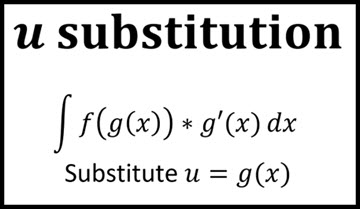
Integration by Substitution, also called u-substitution, is a method for rewriting a complicated integral in a simpler form. The goal is to choose a new variable \(u\) so that part of the integral becomes \(du\). This technique is especially useful with composite functions, powers, roots, trigonometric functions, exponential functions, and logarithmic expressions.
Notes
Practice Problems
Find the integral
\(\textbf{1)}\)\(\displaystyle \int (x^2+3)^3(2x) \,dx\)\(\text{The answer is } \frac{1}{4} (x^2+3)^4+C\)
\(\,\,\,\,\,u=x^2+3\)
\(\,\,\,\,\,du=2x \,dx\)
\(\,\,\,\,\,\displaystyle \int u^3 \,du\)
\(\,\,\,\,\,\displaystyle \frac{u^4}{4}+C\)
\(\,\,\,\,\,\)The answer is \(\frac{1}{4} (x^2+3)^4+C\)
\(\,\,\,\,\,u=x^2+3\)
\(\,\,\,\,\,du=2x \,dx\)
\(\,\,\,\,\,\displaystyle \int u^3 \,du\)
\(\,\,\,\,\,\displaystyle \frac{u^4}{4}+C\)
\(\,\,\,\,\,\)The answer is \(\frac{1}{4} (x^2+3)^4+C\)
\(\textbf{2)}\)\(\displaystyle \int x^2(5x^3+3)^2 \,dx\)\(\text{The answer is } \frac{1}{45}(5x^3+3)^3+C\)
\(\,\,\,\,\,u=5x^3+3\)
\(\,\,\,\,\,du=15x^2 \,dx\)
\(\,\,\,\,\,\frac{1}{15}du=x^2\, dx\)
\(\,\,\,\,\,\displaystyle \frac{1}{15}\int u^2 \,du\)
\(\,\,\,\,\,\displaystyle \frac{1}{15}\cdot\frac{u^3}{3}+C\)
\(\,\,\,\,\,\displaystyle \frac{u^3}{45}+C\)
\(\,\,\,\,\,\)The answer is \(\frac{1}{45}(5x^3+3)^3+C\)
\(\,\,\,\,\,u=5x^3+3\)
\(\,\,\,\,\,du=15x^2 \,dx\)
\(\,\,\,\,\,\frac{1}{15}du=x^2\, dx\)
\(\,\,\,\,\,\displaystyle \frac{1}{15}\int u^2 \,du\)
\(\,\,\,\,\,\displaystyle \frac{1}{15}\cdot\frac{u^3}{3}+C\)
\(\,\,\,\,\,\displaystyle \frac{u^3}{45}+C\)
\(\,\,\,\,\,\)The answer is \(\frac{1}{45}(5x^3+3)^3+C\)
\(\textbf{3)}\)\(\displaystyle \int \frac{\sin x}{\cos^4 x} \,dx\)\(\text{The answer is } \displaystyle \frac{1}{3 \cos^3 x }+C\)
\(\,\,\,\,\,u=\cos x\)
\(\,\,\,\,\,du=-\sin x \, dx\)
\(\,\,\,\,\,-du=\sin x \, dx\)
\(\,\,\,\,\,\displaystyle -\int \frac{1}{u^4} \,du\)
\(\,\,\,\,\,\displaystyle -\int u^{-4} \,du\)
\(\,\,\,\,\,\displaystyle -\frac{u^{-3}}{-3}+C\)
\(\,\,\,\,\,\displaystyle \frac{u^{-3}}{3}+C\)
\(\,\,\,\,\,\)The answer is \(\displaystyle \frac{1}{3 \cos^3 x }+C\)
\(\,\,\,\,\,u=\cos x\)
\(\,\,\,\,\,du=-\sin x \, dx\)
\(\,\,\,\,\,-du=\sin x \, dx\)
\(\,\,\,\,\,\displaystyle -\int \frac{1}{u^4} \,du\)
\(\,\,\,\,\,\displaystyle -\int u^{-4} \,du\)
\(\,\,\,\,\,\displaystyle -\frac{u^{-3}}{-3}+C\)
\(\,\,\,\,\,\displaystyle \frac{u^{-3}}{3}+C\)
\(\,\,\,\,\,\)The answer is \(\displaystyle \frac{1}{3 \cos^3 x }+C\)
\(\textbf{4)}\)\(\displaystyle \int x \sin (x^2) \,dx\)\(\text{The answer is } \displaystyle -\frac{1}{2} \cos(x^2)+C\)
\(\,\,\,\,\,u=x^2\)
\(\,\,\,\,\,du=2x \,dx\)
\(\,\,\,\,\,\frac{1}{2}du= x \, dx\)
\(\,\,\,\,\,\displaystyle \frac{1}{2} \int \sin u \,du\)
\(\,\,\,\,\,\displaystyle \frac{1}{2} (-\cos u) +C\)
\(\,\,\,\,\,\)The answer is \(-\frac{1}{2} \cos(x^2)+C\)
\(\,\,\,\,\,u=x^2\)
\(\,\,\,\,\,du=2x \,dx\)
\(\,\,\,\,\,\frac{1}{2}du= x \, dx\)
\(\,\,\,\,\,\displaystyle \frac{1}{2} \int \sin u \,du\)
\(\,\,\,\,\,\displaystyle \frac{1}{2} (-\cos u) +C\)
\(\,\,\,\,\,\)The answer is \(-\frac{1}{2} \cos(x^2)+C\)
\(\textbf{5)}\)\(\displaystyle \int \frac{8x^4}{\sqrt{x^5-2}} \,dx\)\(\text{The answer is } \displaystyle \frac{16}{5} \sqrt{x^5-2}+C\)
\(\,\,\,\,\,u=x^5-2\)
\(\,\,\,\,\,du=5x^4 \,dx\)
\(\,\,\,\,\,\frac{1}{5}du= x^4 \, dx\)
\(\,\,\,\,\,\displaystyle \frac{1}{5} \int \frac{8}{\sqrt{u}} \,du\)
\(\,\,\,\,\,\displaystyle \frac{8}{5} \int u^{-1/2} \,du\)
\(\,\,\,\,\,\displaystyle \frac{8}{5} \cdot 2u^{1/2} +C\)
\(\,\,\,\,\,\displaystyle \frac{16}{5} \sqrt{u} +C\)
\(\,\,\,\,\,\)The answer is \(\frac{16}{5} \sqrt{x^5-2}+C\)
\(\,\,\,\,\,u=x^5-2\)
\(\,\,\,\,\,du=5x^4 \,dx\)
\(\,\,\,\,\,\frac{1}{5}du= x^4 \, dx\)
\(\,\,\,\,\,\displaystyle \frac{1}{5} \int \frac{8}{\sqrt{u}} \,du\)
\(\,\,\,\,\,\displaystyle \frac{8}{5} \int u^{-1/2} \,du\)
\(\,\,\,\,\,\displaystyle \frac{8}{5} \cdot 2u^{1/2} +C\)
\(\,\,\,\,\,\displaystyle \frac{16}{5} \sqrt{u} +C\)
\(\,\,\,\,\,\)The answer is \(\frac{16}{5} \sqrt{x^5-2}+C\)
\(\textbf{6)}\)\(\displaystyle \int 5x^2 \sqrt{x^3+10} \,dx\)\(\text{The answer is } \displaystyle \frac{10}{9} (x^3+10)^{3/2}+C\)
\(\,\,\,\,\,u=x^3+10\)
\(\,\,\,\,\,du=3x^2 \,dx\)
\(\,\,\,\,\,\frac{1}{3}du= x^2 \, dx\)
\(\,\,\,\,\,\displaystyle \frac{1}{3} \int 5 \sqrt{u} \,du\)
\(\,\,\,\,\,\displaystyle \frac{5}{3} \int u^{1/2} \,du\)
\(\,\,\,\,\,\displaystyle \frac{5}{3} \cdot \frac{2}{3} u^{3/2} +C\)
\(\,\,\,\,\,\displaystyle \frac{10}{9} u^{3/2} +C\)
\(\,\,\,\,\,\)The answer is \(\frac{10}{9} (x^3+10)^{3/2}+C\)
\(\,\,\,\,\,u=x^3+10\)
\(\,\,\,\,\,du=3x^2 \,dx\)
\(\,\,\,\,\,\frac{1}{3}du= x^2 \, dx\)
\(\,\,\,\,\,\displaystyle \frac{1}{3} \int 5 \sqrt{u} \,du\)
\(\,\,\,\,\,\displaystyle \frac{5}{3} \int u^{1/2} \,du\)
\(\,\,\,\,\,\displaystyle \frac{5}{3} \cdot \frac{2}{3} u^{3/2} +C\)
\(\,\,\,\,\,\displaystyle \frac{10}{9} u^{3/2} +C\)
\(\,\,\,\,\,\)The answer is \(\frac{10}{9} (x^3+10)^{3/2}+C\)
\(\textbf{7)}\)\(\displaystyle \int \frac{\sec^2 (\frac{1}{x^6})}{x^7} \,dx\)\(\text{The answer is } \displaystyle -\frac{1}{6} \tan \left(\frac{1}{x^6}\right)+C\)
\(\,\,\,\,\,u=\displaystyle \frac{1}{x^6}\)
\(\,\,\,\,\,u=\displaystyle x^{-6}\)
\(\,\,\,\,\,du=-6x^{-7} \,dx\)
\(\,\,\,\,\,\displaystyle -\frac{1}{6}du=x^{-7} \, dx\)
\(\,\,\,\,\,\displaystyle -\frac{1}{6} \int \sec^2 u \,du\)
\(\,\,\,\,\,\displaystyle -\frac{1}{6} \tan u +C\)
\(\,\,\,\,\,\)The answer is \(-\frac{1}{6} \tan \left(\frac{1}{x^6}\right)+C\)
\(\,\,\,\,\,u=\displaystyle \frac{1}{x^6}\)
\(\,\,\,\,\,u=\displaystyle x^{-6}\)
\(\,\,\,\,\,du=-6x^{-7} \,dx\)
\(\,\,\,\,\,\displaystyle -\frac{1}{6}du=x^{-7} \, dx\)
\(\,\,\,\,\,\displaystyle -\frac{1}{6} \int \sec^2 u \,du\)
\(\,\,\,\,\,\displaystyle -\frac{1}{6} \tan u +C\)
\(\,\,\,\,\,\)The answer is \(-\frac{1}{6} \tan \left(\frac{1}{x^6}\right)+C\)
\(\textbf{8)}\)\(\displaystyle \int \sec^2 x \tan^2 x \,dx\)\(\text{The answer is } \displaystyle \frac{1}{3} \tan^3(x) +C\)
\(\,\,\,\,\,u=\tan x\)
\(\,\,\,\,\,du= \sec^2 x \,dx\)
\(\,\,\,\,\,\displaystyle \int u^2 \,du\)
\(\,\,\,\,\,\displaystyle \frac{u^3}{3} +C\)
\(\,\,\,\,\,\)The answer is \(\frac{1}{3} \tan^3(x) +C\)
\(\,\,\,\,\,u=\tan x\)
\(\,\,\,\,\,du= \sec^2 x \,dx\)
\(\,\,\,\,\,\displaystyle \int u^2 \,du\)
\(\,\,\,\,\,\displaystyle \frac{u^3}{3} +C\)
\(\,\,\,\,\,\)The answer is \(\frac{1}{3} \tan^3(x) +C\)
\(\textbf{9)}\)\(\displaystyle \int e^x \sqrt{15+e^x} \,dx\)\(\text{The answer is } \displaystyle \frac{2}{3} (15+e^x )^{3/2} +C\)
\(\,\,\,\,\,u=15+e^x\)
\(\,\,\,\,\,du= e^x \,dx\)
\(\,\,\,\,\,\displaystyle \int \sqrt{u} \,du\)
\(\,\,\,\,\,\displaystyle \int u^{1/2} \,du\)
\(\,\,\,\,\,\displaystyle \frac{2u^{3/2}}{3} +C\)
\(\,\,\,\,\,\)The answer is \(\frac{2}{3} (15+e^x )^{3/2} +C\)
\(\,\,\,\,\,u=15+e^x\)
\(\,\,\,\,\,du= e^x \,dx\)
\(\,\,\,\,\,\displaystyle \int \sqrt{u} \,du\)
\(\,\,\,\,\,\displaystyle \int u^{1/2} \,du\)
\(\,\,\,\,\,\displaystyle \frac{2u^{3/2}}{3} +C\)
\(\,\,\,\,\,\)The answer is \(\frac{2}{3} (15+e^x )^{3/2} +C\)
\(\textbf{10)}\)\(\displaystyle \int e^{\cos 5 \theta} \sin 5\theta \,d\theta\)\(\text{The answer is } \displaystyle -\frac{1}{5} e^{\cos(5\theta)} +C\)
\(\,\,\,\,\,u=\cos (5 \theta)\)
\(\,\,\,\,\,du= -5\sin (5\theta) \,d\theta\)
\(\,\,\,\,\,-\frac{1}{5}du= \sin (5\theta) \, d\theta\)
\(\,\,\,\,\,\displaystyle -\frac{1}{5} \int e^u \,du\)
\(\,\,\,\,\,\displaystyle -\frac{1}{5}e^u +C\)
\(\,\,\,\,\,\)The answer is \(-\frac{1}{5} e^{\cos(5\theta)} +C\)
\(\,\,\,\,\,u=\cos (5 \theta)\)
\(\,\,\,\,\,du= -5\sin (5\theta) \,d\theta\)
\(\,\,\,\,\,-\frac{1}{5}du= \sin (5\theta) \, d\theta\)
\(\,\,\,\,\,\displaystyle -\frac{1}{5} \int e^u \,du\)
\(\,\,\,\,\,\displaystyle -\frac{1}{5}e^u +C\)
\(\,\,\,\,\,\)The answer is \(-\frac{1}{5} e^{\cos(5\theta)} +C\)
\(\textbf{11)}\)\(\displaystyle \int \frac{\sin (\ln(4x))}{x} \,dx\)\(\text{The answer is } \displaystyle -\cos(\ln(4x))+C\)
\(\,\,\,\,\,u=\ln(4x)\)
\(\,\,\,\,\,du=\displaystyle \frac{1}{x} \,dx\)
\(\,\,\,\,\,\displaystyle \int \sin u \,du\)
\(\,\,\,\,\,\displaystyle -\cos u +C\)
\(\,\,\,\,\,\)The answer is \(-\cos(\ln(4x))+C\)
\(\,\,\,\,\,u=\ln(4x)\)
\(\,\,\,\,\,du=\displaystyle \frac{1}{x} \,dx\)
\(\,\,\,\,\,\displaystyle \int \sin u \,du\)
\(\,\,\,\,\,\displaystyle -\cos u +C\)
\(\,\,\,\,\,\)The answer is \(-\cos(\ln(4x))+C\)
\(\textbf{12)}\)\(\displaystyle \int x e^{x^2} \,dx\)\(\text{The answer is } \displaystyle \frac{1}{2} e^{x^2} +C\)
\(\,\,\,\,\,u=x^2\)
\(\,\,\,\,\,du=2x \,dx\)
\(\,\,\,\,\,\frac{1}{2}du= x \, dx\)
\(\,\,\,\,\,\displaystyle \frac{1}{2} \int e^u \,du\)
\(\,\,\,\,\,\displaystyle \frac{1}{2} e^u +C\)
\(\,\,\,\,\,\)The answer is \(\frac{1}{2} e^{x^2} +C\)
\(\,\,\,\,\,u=x^2\)
\(\,\,\,\,\,du=2x \,dx\)
\(\,\,\,\,\,\frac{1}{2}du= x \, dx\)
\(\,\,\,\,\,\displaystyle \frac{1}{2} \int e^u \,du\)
\(\,\,\,\,\,\displaystyle \frac{1}{2} e^u +C\)
\(\,\,\,\,\,\)The answer is \(\frac{1}{2} e^{x^2} +C\)
\(\textbf{13)}\)\(\displaystyle \int \frac{x}{\sqrt{x^2-7}} \,dx\)\(\text{The answer is } \sqrt{x^2-7}+C\)
\(\,\,\,\,\,u=x^2-7\)
\(\,\,\,\,\,du=2x \,dx\)
\(\,\,\,\,\,\frac{1}{2}du=x \,dx\)
\(\,\,\,\,\,\displaystyle \frac{1}{2} \int \frac{1}{\sqrt{u}} \,du\)
\(\,\,\,\,\,\displaystyle \frac{1}{2}\int u^{-1/2}\,du\)
\(\,\,\,\,\,\displaystyle \frac{1}{2}\cdot 2u^{1/2}+C\)
\(\,\,\,\,\,\displaystyle \sqrt{u}+C\)
\(\,\,\,\,\,\)The answer is \(\sqrt{x^2-7}+C\)
\(\,\,\,\,\,u=x^2-7\)
\(\,\,\,\,\,du=2x \,dx\)
\(\,\,\,\,\,\frac{1}{2}du=x \,dx\)
\(\,\,\,\,\,\displaystyle \frac{1}{2} \int \frac{1}{\sqrt{u}} \,du\)
\(\,\,\,\,\,\displaystyle \frac{1}{2}\int u^{-1/2}\,du\)
\(\,\,\,\,\,\displaystyle \frac{1}{2}\cdot 2u^{1/2}+C\)
\(\,\,\,\,\,\displaystyle \sqrt{u}+C\)
\(\,\,\,\,\,\)The answer is \(\sqrt{x^2-7}+C\)
\(\textbf{14)}\)\(\displaystyle \int \frac{3x^2}{x^3+5}\,dx\)\(\text{The answer is } \ln|x^3+5|+C\)
\(\,\,\,\,\,u=x^3+5\)
\(\,\,\,\,\,du=3x^2\,dx\)
\(\,\,\,\,\,\displaystyle \int \frac{1}{u}\,du\)
\(\,\,\,\,\,\displaystyle \ln|u|+C\)
\(\,\,\,\,\,\)The answer is \(\ln|x^3+5|+C\)
\(\,\,\,\,\,u=x^3+5\)
\(\,\,\,\,\,du=3x^2\,dx\)
\(\,\,\,\,\,\displaystyle \int \frac{1}{u}\,du\)
\(\,\,\,\,\,\displaystyle \ln|u|+C\)
\(\,\,\,\,\,\)The answer is \(\ln|x^3+5|+C\)
\(\textbf{15)}\)\(\displaystyle \int \cos(7x)\,dx\)\(\text{The answer is } \frac{1}{7}\sin(7x)+C\)
\(\,\,\,\,\,u=7x\)
\(\,\,\,\,\,du=7\,dx\)
\(\,\,\,\,\,\frac{1}{7}du=dx\)
\(\,\,\,\,\,\displaystyle \frac{1}{7}\int \cos u\,du\)
\(\,\,\,\,\,\displaystyle \frac{1}{7}\sin u+C\)
\(\,\,\,\,\,\)The answer is \(\frac{1}{7}\sin(7x)+C\)
\(\,\,\,\,\,u=7x\)
\(\,\,\,\,\,du=7\,dx\)
\(\,\,\,\,\,\frac{1}{7}du=dx\)
\(\,\,\,\,\,\displaystyle \frac{1}{7}\int \cos u\,du\)
\(\,\,\,\,\,\displaystyle \frac{1}{7}\sin u+C\)
\(\,\,\,\,\,\)The answer is \(\frac{1}{7}\sin(7x)+C\)
\(\textbf{16)}\)\(\displaystyle \int \frac{1}{2x+1}\,dx\)\(\text{The answer is } \frac{1}{2}\ln|2x+1|+C\)
\(\,\,\,\,\,u=2x+1\)
\(\,\,\,\,\,du=2\,dx\)
\(\,\,\,\,\,\frac{1}{2}du=dx\)
\(\,\,\,\,\,\displaystyle \frac{1}{2}\int \frac{1}{u}\,du\)
\(\,\,\,\,\,\displaystyle \frac{1}{2}\ln|u|+C\)
\(\,\,\,\,\,\)The answer is \(\frac{1}{2}\ln|2x+1|+C\)
\(\,\,\,\,\,u=2x+1\)
\(\,\,\,\,\,du=2\,dx\)
\(\,\,\,\,\,\frac{1}{2}du=dx\)
\(\,\,\,\,\,\displaystyle \frac{1}{2}\int \frac{1}{u}\,du\)
\(\,\,\,\,\,\displaystyle \frac{1}{2}\ln|u|+C\)
\(\,\,\,\,\,\)The answer is \(\frac{1}{2}\ln|2x+1|+C\)
\(\textbf{17)}\)\(\displaystyle \int \frac{x}{x^2+4}\,dx\)\(\text{The answer is } \frac{1}{2}\ln(x^2+4)+C\)
\(\,\,\,\,\,u=x^2+4\)
\(\,\,\,\,\,du=2x\,dx\)
\(\,\,\,\,\,\frac{1}{2}du=x\,dx\)
\(\,\,\,\,\,\displaystyle \frac{1}{2}\int \frac{1}{u}\,du\)
\(\,\,\,\,\,\displaystyle \frac{1}{2}\ln|u|+C\)
\(\,\,\,\,\,\)The answer is \(\frac{1}{2}\ln(x^2+4)+C\)
\(\,\,\,\,\,u=x^2+4\)
\(\,\,\,\,\,du=2x\,dx\)
\(\,\,\,\,\,\frac{1}{2}du=x\,dx\)
\(\,\,\,\,\,\displaystyle \frac{1}{2}\int \frac{1}{u}\,du\)
\(\,\,\,\,\,\displaystyle \frac{1}{2}\ln|u|+C\)
\(\,\,\,\,\,\)The answer is \(\frac{1}{2}\ln(x^2+4)+C\)
\(\textbf{18)}\)\(\displaystyle \int_0^2 x(x^2+1)^4\,dx\)\(\text{The answer is } \frac{3124}{10}=\frac{1562}{5}\)
\(\,\,\,\,\,u=x^2+1\)
\(\,\,\,\,\,du=2x\,dx\)
\(\,\,\,\,\,\frac{1}{2}du=x\,dx\)
\(\,\,\,\,\,x=0 \rightarrow u=1\)
\(\,\,\,\,\,x=2 \rightarrow u=5\)
\(\,\,\,\,\,\displaystyle \frac{1}{2}\int_1^5 u^4\,du\)
\(\,\,\,\,\,\displaystyle \frac{1}{2}\left[\frac{u^5}{5}\right]_1^5\)
\(\,\,\,\,\,\displaystyle \frac{1}{10}(5^5-1^5)\)
\(\,\,\,\,\,\)The answer is \(\frac{3124}{10}=\frac{1562}{5}\)
\(\,\,\,\,\,u=x^2+1\)
\(\,\,\,\,\,du=2x\,dx\)
\(\,\,\,\,\,\frac{1}{2}du=x\,dx\)
\(\,\,\,\,\,x=0 \rightarrow u=1\)
\(\,\,\,\,\,x=2 \rightarrow u=5\)
\(\,\,\,\,\,\displaystyle \frac{1}{2}\int_1^5 u^4\,du\)
\(\,\,\,\,\,\displaystyle \frac{1}{2}\left[\frac{u^5}{5}\right]_1^5\)
\(\,\,\,\,\,\displaystyle \frac{1}{10}(5^5-1^5)\)
\(\,\,\,\,\,\)The answer is \(\frac{3124}{10}=\frac{1562}{5}\)
\(\textbf{19)}\)\(\displaystyle \int_1^3 \frac{2x}{x^2+1}\,dx\)\(\text{The answer is } \ln 5\)
\(\,\,\,\,\,u=x^2+1\)
\(\,\,\,\,\,du=2x\,dx\)
\(\,\,\,\,\,x=1 \rightarrow u=2\)
\(\,\,\,\,\,x=3 \rightarrow u=10\)
\(\,\,\,\,\,\displaystyle \int_2^{10}\frac{1}{u}\,du\)
\(\,\,\,\,\,\displaystyle \left[\ln|u|\right]_2^{10}\)
\(\,\,\,\,\,\displaystyle \ln 10-\ln 2\)
\(\,\,\,\,\,\)The answer is \(\ln 5\)
\(\,\,\,\,\,u=x^2+1\)
\(\,\,\,\,\,du=2x\,dx\)
\(\,\,\,\,\,x=1 \rightarrow u=2\)
\(\,\,\,\,\,x=3 \rightarrow u=10\)
\(\,\,\,\,\,\displaystyle \int_2^{10}\frac{1}{u}\,du\)
\(\,\,\,\,\,\displaystyle \left[\ln|u|\right]_2^{10}\)
\(\,\,\,\,\,\displaystyle \ln 10-\ln 2\)
\(\,\,\,\,\,\)The answer is \(\ln 5\)
\(\textbf{20)}\)\(\displaystyle \int \frac{e^{1/x}}{x^2}\,dx\)\(\text{The answer is } -e^{1/x}+C\)
\(\,\,\,\,\,u=\frac{1}{x}\)
\(\,\,\,\,\,u=x^{-1}\)
\(\,\,\,\,\,du=-x^{-2}\,dx\)
\(\,\,\,\,\,-du=\frac{1}{x^2}\,dx\)
\(\,\,\,\,\,\displaystyle -\int e^u\,du\)
\(\,\,\,\,\,\displaystyle -e^u+C\)
\(\,\,\,\,\,\)The answer is \(-e^{1/x}+C\)
\(\,\,\,\,\,u=\frac{1}{x}\)
\(\,\,\,\,\,u=x^{-1}\)
\(\,\,\,\,\,du=-x^{-2}\,dx\)
\(\,\,\,\,\,-du=\frac{1}{x^2}\,dx\)
\(\,\,\,\,\,\displaystyle -\int e^u\,du\)
\(\,\,\,\,\,\displaystyle -e^u+C\)
\(\,\,\,\,\,\)The answer is \(-e^{1/x}+C\)
See Related Pages\(\)
\(\bullet\text{ Calculus Homepage}\)
\(\,\,\,\,\,\,\,\,\text{All the Best Topics…}\)
\(\bullet\text{ Trapezoidal Rule}\)
\(\,\,\,\,\,\,\,\,\displaystyle\frac{b-a}{2n}\left[f(a)+2f(x_1)+2f(x_2)+…+2fx_{n-1}+f(b)\right]…\)
\(\bullet\text{ Properties of Integrals}\)
\(\,\,\,\,\,\,\,\,\displaystyle \int_{a}^{b}cf(x) \, dx=c\displaystyle \int_{a}^{b}f(x) \,dx…\)
\(\bullet\text{ Indefinite Integrals- Power Rule}\)
\(\,\,\,\,\,\,\,\,\displaystyle \int x^n \, dx = \displaystyle \frac{x^{n+1}}{n+1}+C…\)
\(\bullet\text{ Indefinite Integrals- Trig Functions}\)
\(\,\,\,\,\,\,\,\,\displaystyle \int \cos{x} \, dx=\sin{x}+C…\)
\(\bullet\text{ Definite Integrals}\)
\(\,\,\,\,\,\,\,\,\displaystyle \int_{5}^{7} x^3 \, dx…\)
\(\bullet\text{ Integration by Substitution}\)
\(\,\,\,\,\,\,\,\,\displaystyle \int (x^2+3)^3(2x) \,dx…\)
\(\bullet\text{ Area of Region Between Two Curves}\)
\(\,\,\,\,\,\,\,\,A=\displaystyle \int_{a}^{b}\left[f(x)-g(x)\right]\,dx…\)
\(\bullet\text{ Arc Length}\)
\(\,\,\,\,\,\,\,\,\displaystyle \int_{a}^{b}\sqrt{1+\left[f'(x)\right]^2} \,dx…\)
\(\bullet\text{ Average Function Value}\)
\(\,\,\,\,\,\,\,\,\displaystyle\frac{1}{b-a} \int_{a}^{b}f(x) \,dx\)
\(\bullet\text{ Volume by Cross Sections}\)
\(\,\,\,\,\,\,\,\,\)
\(\bullet\text{ Disk Method}\)
\(\,\,\,\,\,\,\,\,V=\displaystyle \int_{a}^{b}\left[f(x)\right]^2\,dx…\)
\(\bullet\text{ Cylindrical Shells}\)
\(\,\,\,\,\,\,\,\,V=2 \pi \displaystyle \int_{a}^{b} y f(y) \, dy…\)