

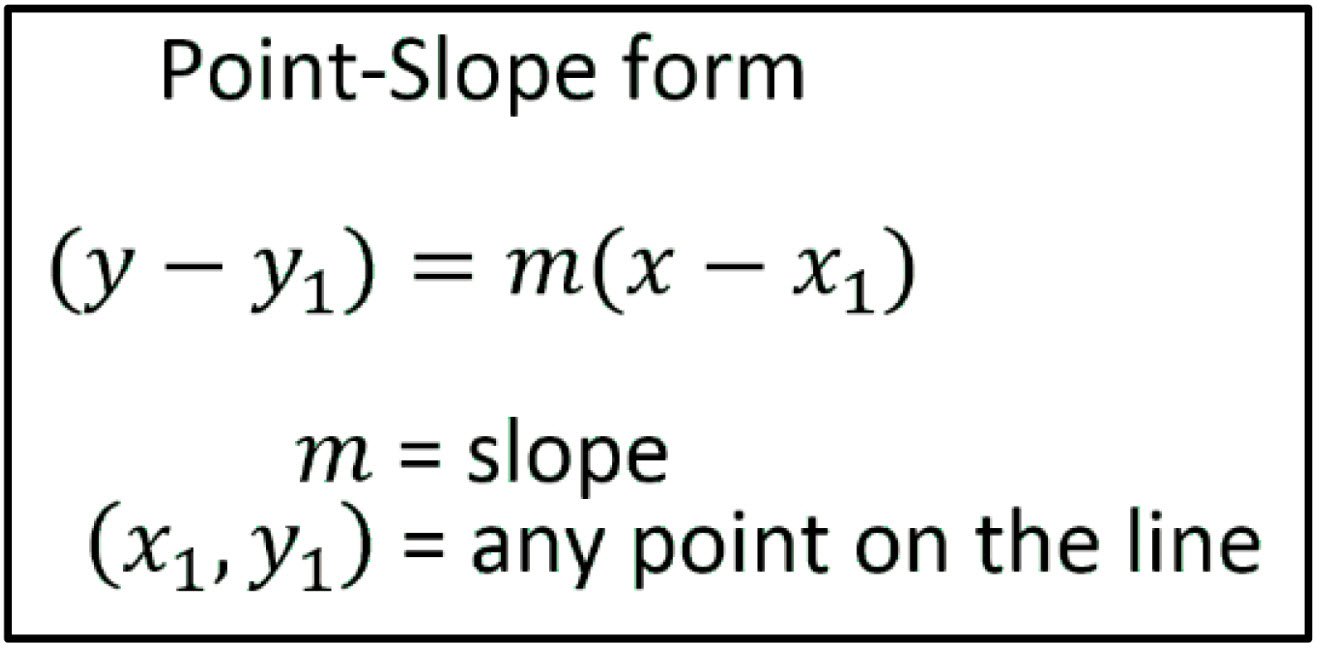
Point-slope form is used to write the equation of a line when you know its slope and any point on the line. Substitute the slope and point into \(y-y_1=m(x-x_1)\), then simplify when slope-intercept form is needed. This form is also useful for writing equations from intercepts, two points, parallel lines, perpendicular lines, and tangent-line information.
Lesson
Notes
Practice Problems
\(\textbf{1)}\) Find the equation of the line with slope \(3\) that goes through the point \((6,4)\).Point-slope form is \(y-4=3(x-6)\).Slope-intercept form is \(y=3x-14\).
\(y-y_1=m(x-x_1)\)
\(y-4=3(x-6)\)
\(y-4=3x-18\)
\(y=3x-14\)
\(y-y_1=m(x-x_1)\)
\(y-4=3(x-6)\)
\(y-4=3x-18\)
\(y=3x-14\)
\(\textbf{2)}\) Find the equation of the line with slope \(-2\) that goes through the point \((-1,5)\).Point-slope form is \(y-5=-2(x+1)\).Slope-intercept form is \(y=-2x+3\).
\(y-y_1=m(x-x_1)\)
\(y-5=-2(x-(-1))\)
\(y-5=-2(x+1)\)
\(y-5=-2x-2\)
\(y=-2x+3\)
\(y-y_1=m(x-x_1)\)
\(y-5=-2(x-(-1))\)
\(y-5=-2(x+1)\)
\(y-5=-2x-2\)
\(y=-2x+3\)
\(\textbf{3)}\) Find the equation of the line with slope \(\displaystyle\frac{1}{3}\) that goes through the point \((3,8)\).Point-slope form is \(y-8=\frac{1}{3}(x-3)\).Slope-intercept form is \(y=\frac{1}{3}x+7\).
\(y-y_1=m(x-x_1)\)
\(y-8=\frac{1}{3}(x-3)\)
\(y-8=\frac{1}{3}x-1\)
\(y=\frac{1}{3}x+7\)
\(y-y_1=m(x-x_1)\)
\(y-8=\frac{1}{3}(x-3)\)
\(y-8=\frac{1}{3}x-1\)
\(y=\frac{1}{3}x+7\)
\(\textbf{4)}\) Find the equation of the line with slope \(1\) that goes through the point \((-6,-4)\).Point-slope form is \(y+4=1(x+6)\).Slope-intercept form is \(y=x+2\).
\(y-y_1=m(x-x_1)\)
\(y-(-4)=1(x-(-6))\)
\(y+4=x+6\)
\(y=x+2\)
\(y-y_1=m(x-x_1)\)
\(y-(-4)=1(x-(-6))\)
\(y+4=x+6\)
\(y=x+2\)
\(\textbf{5)}\) Find the equation of the line with slope \(\frac{1}{2}\) and x-intercept \(4\).An x-intercept of \(4\) means \((4,0)\) is a point on the line.Point-slope form is \(y-0=\frac{1}{2}(x-4)\).Slope-intercept form is \(y=\frac{1}{2}x-2\).
\(\text{x-intercept }4\longrightarrow(4,0)\)
\(y-y_1=m(x-x_1)\)
\(y-0=\frac{1}{2}(x-4)\)
\(y=\frac{1}{2}x-2\)
\(\text{x-intercept }4\longrightarrow(4,0)\)
\(y-y_1=m(x-x_1)\)
\(y-0=\frac{1}{2}(x-4)\)
\(y=\frac{1}{2}x-2\)
\(\textbf{6)}\) Find the equation of the line with slope \(-5\) and y-intercept \(-2\).A y-intercept of \(-2\) means \((0,-2)\) is a point on the line.Point-slope form is \(y+2=-5(x-0)\).Slope-intercept form is \(y=-5x-2\).
\(\text{y-intercept }-2\longrightarrow(0,-2)\)
\(y-y_1=m(x-x_1)\)
\(y-(-2)=-5(x-0)\)
\(y+2=-5x\)
\(y=-5x-2\)
\(\text{y-intercept }-2\longrightarrow(0,-2)\)
\(y-y_1=m(x-x_1)\)
\(y-(-2)=-5(x-0)\)
\(y+2=-5x\)
\(y=-5x-2\)
\(\textbf{7)}\) Find the equation of the line with slope \(-4\) that goes through the point \((2,-3)\).Point-slope form is \(y+3=-4(x-2)\).Slope-intercept form is \(y=-4x+5\).
\(y-y_1=m(x-x_1)\)
\(y-(-3)=-4(x-2)\)
\(y+3=-4x+8\)
\(y=-4x+5\)
\(y-y_1=m(x-x_1)\)
\(y-(-3)=-4(x-2)\)
\(y+3=-4x+8\)
\(y=-4x+5\)
\(\textbf{8)}\) Find the equation of the line with slope \(\frac{3}{4}\) that goes through the point \((-4,1)\).Point-slope form is \(y-1=\frac{3}{4}(x+4)\).Slope-intercept form is \(y=\frac{3}{4}x+4\).
\(y-y_1=m(x-x_1)\)
\(y-1=\frac{3}{4}(x-(-4))\)
\(y-1=\frac{3}{4}(x+4)\)
\(y-1=\frac{3}{4}x+3\)
\(y=\frac{3}{4}x+4\)
\(y-y_1=m(x-x_1)\)
\(y-1=\frac{3}{4}(x-(-4))\)
\(y-1=\frac{3}{4}(x+4)\)
\(y-1=\frac{3}{4}x+3\)
\(y=\frac{3}{4}x+4\)
\(\textbf{9)}\) Find the equation of the line that goes through the points \((1,2)\) and \((5,10)\).Point-slope form is \(y-2=2(x-1)\).Slope-intercept form is \(y=2x\).
\(m=\frac{y_2-y_1}{x_2-x_1}\)
\(m=\frac{10-2}{5-1}\)
\(m=\frac{8}{4}=2\)
\(y-2=2(x-1)\)
\(y-2=2x-2\)
\(y=2x\)
\(m=\frac{y_2-y_1}{x_2-x_1}\)
\(m=\frac{10-2}{5-1}\)
\(m=\frac{8}{4}=2\)
\(y-2=2(x-1)\)
\(y-2=2x-2\)
\(y=2x\)
\(\textbf{10)}\) Find the equation of the line that goes through the points \((-2,7)\) and \((4,-5)\).Point-slope form is \(y-7=-2(x+2)\).Slope-intercept form is \(y=-2x+3\).
\(m=\frac{y_2-y_1}{x_2-x_1}\)
\(m=\frac{-5-7}{4-(-2)}\)
\(m=\frac{-12}{6}=-2\)
\(y-7=-2(x-(-2))\)
\(y-7=-2(x+2)\)
\(y-7=-2x-4\)
\(y=-2x+3\)
\(m=\frac{y_2-y_1}{x_2-x_1}\)
\(m=\frac{-5-7}{4-(-2)}\)
\(m=\frac{-12}{6}=-2\)
\(y-7=-2(x-(-2))\)
\(y-7=-2(x+2)\)
\(y-7=-2x-4\)
\(y=-2x+3\)
\(\textbf{11)}\) Find the equation of the line that goes through the points \((3,-1)\) and \((9,2)\).Point-slope form is \(y+1=\frac{1}{2}(x-3)\).Slope-intercept form is \(y=\frac{1}{2}x-\frac{5}{2}\).
\(m=\frac{y_2-y_1}{x_2-x_1}\)
\(m=\frac{2-(-1)}{9-3}\)
\(m=\frac{3}{6}=\frac{1}{2}\)
\(y-(-1)=\frac{1}{2}(x-3)\)
\(y+1=\frac{1}{2}x-\frac{3}{2}\)
\(y=\frac{1}{2}x-\frac{5}{2}\)
\(m=\frac{y_2-y_1}{x_2-x_1}\)
\(m=\frac{2-(-1)}{9-3}\)
\(m=\frac{3}{6}=\frac{1}{2}\)
\(y-(-1)=\frac{1}{2}(x-3)\)
\(y+1=\frac{1}{2}x-\frac{3}{2}\)
\(y=\frac{1}{2}x-\frac{5}{2}\)
\(\textbf{12)}\) Find the equation of the line parallel to \(y=4x-7\) that goes through the point \((-3,5)\).Point-slope form is \(y-5=4(x+3)\).Slope-intercept form is \(y=4x+17\).
\(\text{Parallel lines have the same slope.}\)
\(m=4\)
\(y-5=4(x-(-3))\)
\(y-5=4(x+3)\)
\(y-5=4x+12\)
\(y=4x+17\)
\(\text{Parallel lines have the same slope.}\)
\(m=4\)
\(y-5=4(x-(-3))\)
\(y-5=4(x+3)\)
\(y-5=4x+12\)
\(y=4x+17\)
\(\textbf{13)}\) Find the equation of the line parallel to \(2x+5y=15\) that goes through the point \((5,-2)\).Point-slope form is \(y+2=-\frac{2}{5}(x-5)\).Slope-intercept form is \(y=-\frac{2}{5}x\).
\(2x+5y=15\)
\(5y=-2x+15\)
\(y=-\frac{2}{5}x+3\)
\(\text{The parallel slope is }m=-\frac{2}{5}.\)
\(y-(-2)=-\frac{2}{5}(x-5)\)
\(y+2=-\frac{2}{5}x+2\)
\(y=-\frac{2}{5}x\)
\(2x+5y=15\)
\(5y=-2x+15\)
\(y=-\frac{2}{5}x+3\)
\(\text{The parallel slope is }m=-\frac{2}{5}.\)
\(y-(-2)=-\frac{2}{5}(x-5)\)
\(y+2=-\frac{2}{5}x+2\)
\(y=-\frac{2}{5}x\)
\(\textbf{14)}\) Find the equation of the line perpendicular to \(y=2x+9\) that goes through the point \((4,3)\).Point-slope form is \(y-3=-\frac{1}{2}(x-4)\).Slope-intercept form is \(y=-\frac{1}{2}x+5\).
\(\text{The original slope is }2.\)
\(\text{The perpendicular slope is }-\frac{1}{2}.\)
\(y-3=-\frac{1}{2}(x-4)\)
\(y-3=-\frac{1}{2}x+2\)
\(y=-\frac{1}{2}x+5\)
\(\text{The original slope is }2.\)
\(\text{The perpendicular slope is }-\frac{1}{2}.\)
\(y-3=-\frac{1}{2}(x-4)\)
\(y-3=-\frac{1}{2}x+2\)
\(y=-\frac{1}{2}x+5\)
\(\textbf{15)}\) Find the equation of the line perpendicular to \(3x-4y=12\) that goes through the point \((-6,1)\).Point-slope form is \(y-1=-\frac{4}{3}(x+6)\).Slope-intercept form is \(y=-\frac{4}{3}x-7\).
\(3x-4y=12\)
\(-4y=-3x+12\)
\(y=\frac{3}{4}x-3\)
\(\text{The original slope is }\frac{3}{4}.\)
\(\text{The perpendicular slope is }-\frac{4}{3}.\)
\(y-1=-\frac{4}{3}(x-(-6))\)
\(y-1=-\frac{4}{3}(x+6)\)
\(y-1=-\frac{4}{3}x-8\)
\(y=-\frac{4}{3}x-7\)
\(3x-4y=12\)
\(-4y=-3x+12\)
\(y=\frac{3}{4}x-3\)
\(\text{The original slope is }\frac{3}{4}.\)
\(\text{The perpendicular slope is }-\frac{4}{3}.\)
\(y-1=-\frac{4}{3}(x-(-6))\)
\(y-1=-\frac{4}{3}(x+6)\)
\(y-1=-\frac{4}{3}x-8\)
\(y=-\frac{4}{3}x-7\)
\(\textbf{16)}\) A taxi charges a fixed starting fee plus \(\$2.50\) per mile. A \(6\)-mile trip costs \(\$19\). Write an equation for the total cost \(y\) of a trip of \(x\) miles.Point-slope form is \(y-19=2.5(x-6)\).Slope-intercept form is \(y=2.5x+4\).
\(\text{The cost per mile is the slope, so }m=2.5.\)
\(\text{A 6-mile trip costing $19 gives the point }(6,19).\)
\(y-19=2.5(x-6)\)
\(y-19=2.5x-15\)
\(y=2.5x+4\)
\(\text{The cost per mile is the slope, so }m=2.5.\)
\(\text{A 6-mile trip costing $19 gives the point }(6,19).\)
\(y-19=2.5(x-6)\)
\(y-19=2.5x-15\)
\(y=2.5x+4\)
Challenge Problems
\(\textbf{17)}\) Find the equation of the perpendicular bisector of the segment with endpoints \((-2,1)\) and \((4,5)\).Point-slope form is \(y-3=-\frac{3}{2}(x-1)\).Slope-intercept form is \(y=-\frac{3}{2}x+\frac{9}{2}\).
\(m=\frac{5-1}{4-(-2)}\)
\(m=\frac{4}{6}=\frac{2}{3}\)
\(\text{The perpendicular slope is }-\frac{3}{2}.\)
\(\text{Midpoint}=\left(\frac{-2+4}{2},\frac{1+5}{2}\right)\)
\(\text{Midpoint}=(1,3)\)
\(y-3=-\frac{3}{2}(x-1)\)
\(y-3=-\frac{3}{2}x+\frac{3}{2}\)
\(y=-\frac{3}{2}x+\frac{9}{2}\)
\(m=\frac{5-1}{4-(-2)}\)
\(m=\frac{4}{6}=\frac{2}{3}\)
\(\text{The perpendicular slope is }-\frac{3}{2}.\)
\(\text{Midpoint}=\left(\frac{-2+4}{2},\frac{1+5}{2}\right)\)
\(\text{Midpoint}=(1,3)\)
\(y-3=-\frac{3}{2}(x-1)\)
\(y-3=-\frac{3}{2}x+\frac{3}{2}\)
\(y=-\frac{3}{2}x+\frac{9}{2}\)
\(\textbf{18)}\) Find the equation of the line that passes through the intersection of \(y=2x-1\) and \(y=-x+8\) and has slope \(-4\).Point-slope form is \(y-5=-4(x-3)\).Slope-intercept form is \(y=-4x+17\).
\(2x-1=-x+8\)
\(3x=9\)
\(x=3\)
\(y=2(3)-1=5\)
\(\text{The lines intersect at }(3,5).\)
\(y-5=-4(x-3)\)
\(y-5=-4x+12\)
\(y=-4x+17\)
\(2x-1=-x+8\)
\(3x=9\)
\(x=3\)
\(y=2(3)-1=5\)
\(\text{The lines intersect at }(3,5).\)
\(y-5=-4(x-3)\)
\(y-5=-4x+12\)
\(y=-4x+17\)
\(\textbf{19)}\) A line passes through \((k,7)\) and \((5,-1)\) and has slope \(-2\). Find \(k\), then write the equation of the line.\(k=1\), point-slope form is \(y-7=-2(x-1)\), and slope-intercept form is \(y=-2x+9\).
\(-2=\frac{-1-7}{5-k}\)
\(-2=\frac{-8}{5-k}\)
\(-2(5-k)=-8\)
\(-10+2k=-8\)
\(2k=2\)
\(k=1\)
\(y-7=-2(x-1)\)
\(y-7=-2x+2\)
\(y=-2x+9\)
\(-2=\frac{-1-7}{5-k}\)
\(-2=\frac{-8}{5-k}\)
\(-2(5-k)=-8\)
\(-10+2k=-8\)
\(2k=2\)
\(k=1\)
\(y-7=-2(x-1)\)
\(y-7=-2x+2\)
\(y=-2x+9\)
\(\textbf{20)}\) The graph of a linear function passes through \((a,4)\) and \((a+6,-5)\). Find its slope and write the equation of the line when \(a=2\).The slope is \(-\frac{3}{2}\), point-slope form is \(y-4=-\frac{3}{2}(x-2)\), and slope-intercept form is \(y=-\frac{3}{2}x+7\).
\(m=\frac{-5-4}{(a+6)-a}\)
\(m=\frac{-9}{6}\)
\(m=-\frac{3}{2}\)
\(a=2\longrightarrow(a,4)=(2,4)\)
\(y-4=-\frac{3}{2}(x-2)\)
\(y-4=-\frac{3}{2}x+3\)
\(y=-\frac{3}{2}x+7\)
\(m=\frac{-5-4}{(a+6)-a}\)
\(m=\frac{-9}{6}\)
\(m=-\frac{3}{2}\)
\(a=2\longrightarrow(a,4)=(2,4)\)
\(y-4=-\frac{3}{2}(x-2)\)
\(y-4=-\frac{3}{2}x+3\)
\(y=-\frac{3}{2}x+7\)
Related Pages
\(\bullet\text{ Graphing Linear Equations}\)
\(\,\,\,\,\,\,\,\,2x-3y=6\) 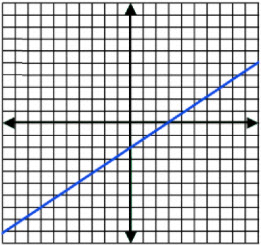
\(\bullet\text{ Slope Formula}\)
\(\,\,\,\,\,\,\,\,m=\frac{y_2-y_1}{x_2-x_1}\)
\(\bullet\text{ Net Change}\)
\(\,\,\,\,\,\,\,\,y_2-y_1\)
\(\bullet\text{ Slope-Intercept Form}\)
\(\,\,\,\,\,\,\,\,y=mx+b\)
\(\bullet\text{ Parallel and Perpendicular Slope}\)
\(\,\,\,\,\,\,\,\,m_1=m_2,\,\,\,m_1=-\frac{1}{m_2}\)
\(\bullet\text{ Distance Between a Point and a Line}\)
\(\,\,\,\,\,\,\,\,(3,4)\text{ and }y=\frac{3}{4}x-2\)
\(\bullet\text{ Finding x- and y-intercepts}\)
\(\,\,\,\,\,\,\,\,y=2x+4\)