
The x- and y-intercepts show where a graph crosses the coordinate axes. To find an x-intercept algebraically, substitute \(y=0\); to find a y-intercept, substitute \(x=0\). A graph may have one intercept, multiple intercepts, or no intercept on a particular axis.
The \(x\)-intercept occurs when \(y=0\).
And the \(y\)-intercept occurs when \(x=0\).
Practice Questions
Find the x and y intercepts for each of the following.
\(\textbf{1)}\) \(y=2x+4\) x-intercept \((-2,0), \enspace\) y-intercept \((0,4)\)
\(\textbf{x-intercept:}\)
\(\,\,\,\,\,\,y=0\)
\(\,\,\,\,\,\,0=2x+4\)
\(\,\,\,\,\,\,-4=2x\)
\(\,\,\,\,\,\,x=-2\)
x-intercept: \((-2,0)\)
\(\textbf{y-intercept:}\)
\(\,\,\,\,\,\,x=0\)
\(\,\,\,\,\,\,y=2(0)+4\)
\(\,\,\,\,\,\,y=4\)
y-intercept: \((0,4)\)

\(\textbf{x-intercept:}\)
\(\,\,\,\,\,\,y=0\)
\(\,\,\,\,\,\,0=2x+4\)
\(\,\,\,\,\,\,-4=2x\)
\(\,\,\,\,\,\,x=-2\)
x-intercept: \((-2,0)\)
\(\textbf{y-intercept:}\)
\(\,\,\,\,\,\,x=0\)
\(\,\,\,\,\,\,y=2(0)+4\)
\(\,\,\,\,\,\,y=4\)
y-intercept: \((0,4)\)
\(\textbf{2)}\) \(2x+4y=8\) x-intercept \((4,0), \enspace\) y-intercept \((0,2)\)
\(\textbf{x-intercept:}\)
\(\,\,\,\,\,\,y=0\)
\(\,\,\,\,\,\,2x+4(0)=8\)
\(\,\,\,\,\,\,2x=8\)
\(\,\,\,\,\,\,x=4\)
x-intercept: \((4,0)\)
\(\textbf{y-intercept:}\)
\(\,\,\,\,\,\,x=0\)
\(\,\,\,\,\,\,2(0)+4y=8\)
\(\,\,\,\,\,\,4y=8\)
\(\,\,\,\,\,\,y=2\)
y-intercept: \((0,2)\)

\(\textbf{x-intercept:}\)
\(\,\,\,\,\,\,y=0\)
\(\,\,\,\,\,\,2x+4(0)=8\)
\(\,\,\,\,\,\,2x=8\)
\(\,\,\,\,\,\,x=4\)
x-intercept: \((4,0)\)
\(\textbf{y-intercept:}\)
\(\,\,\,\,\,\,x=0\)
\(\,\,\,\,\,\,2(0)+4y=8\)
\(\,\,\,\,\,\,4y=8\)
\(\,\,\,\,\,\,y=2\)
y-intercept: \((0,2)\)
\(\textbf{3)}\) \(y=-3x+7\) x-intercept \((\frac{7}{3},0), \enspace\) y-intercept \((0,7)\)
\(\textbf{x-intercept:}\)
\(\,\,\,\,\,\,y=0\)
\(\,\,\,\,\,\,0=-3x+7\)
\(\,\,\,\,\,\,3x=7\)
\(\,\,\,\,\,\,x=\frac{7}{3}\)
x-intercept: \((\frac{7}{3},0)\)
\(\textbf{y-intercept:}\)
\(\,\,\,\,\,\,x=0\)
\(\,\,\,\,\,\,y=-3(0)+7\)
\(\,\,\,\,\,\,y=7\)
y-intercept: \((0,7)\)
\(\textbf{x-intercept:}\)
\(\,\,\,\,\,\,y=0\)
\(\,\,\,\,\,\,0=-3x+7\)
\(\,\,\,\,\,\,3x=7\)
\(\,\,\,\,\,\,x=\frac{7}{3}\)
x-intercept: \((\frac{7}{3},0)\)
\(\textbf{y-intercept:}\)
\(\,\,\,\,\,\,x=0\)
\(\,\,\,\,\,\,y=-3(0)+7\)
\(\,\,\,\,\,\,y=7\)
y-intercept: \((0,7)\)
\(\textbf{4)}\) \(y=\frac{1}{2}x+1\) x-intercept \((-2,0), \enspace\) y-intercept \((0,1)\)
\(\textbf{x-intercept:}\)
\(\,\,\,\,\,\,y=0\)
\(\,\,\,\,\,\,0=\frac{1}{2}x+1\)
\(\,\,\,\,\,\,-1=\frac{1}{2}x\)
\(\,\,\,\,\,\,x=-2\)
x-intercept: \((-2,0)\)
\(\textbf{y-intercept:}\)
\(\,\,\,\,\,\,x=0\)
\(\,\,\,\,\,\,y=\frac{1}{2}(0)+1\)
\(\,\,\,\,\,\,y=1\)
y-intercept: \((0,1)\)
\(\textbf{x-intercept:}\)
\(\,\,\,\,\,\,y=0\)
\(\,\,\,\,\,\,0=\frac{1}{2}x+1\)
\(\,\,\,\,\,\,-1=\frac{1}{2}x\)
\(\,\,\,\,\,\,x=-2\)
x-intercept: \((-2,0)\)
\(\textbf{y-intercept:}\)
\(\,\,\,\,\,\,x=0\)
\(\,\,\,\,\,\,y=\frac{1}{2}(0)+1\)
\(\,\,\,\,\,\,y=1\)
y-intercept: \((0,1)\)
\(\textbf{5)}\) \(y=-5x+3\) x-intercept \((\frac{3}{5},0), \enspace\) y-intercept \((0,3)\)
\(\textbf{x-intercept:}\)
\(\,\,\,\,\,\,y=0\)
\(\,\,\,\,\,\,0=-5x+3\)
\(\,\,\,\,\,\,5x=3\)
\(\,\,\,\,\,\,x=\frac{3}{5}\)
x-intercept: \((\frac{3}{5},0)\)
\(\textbf{y-intercept:}\)
\(\,\,\,\,\,\,x=0\)
\(\,\,\,\,\,\,y=-5(0)+3\)
\(\,\,\,\,\,\,y=3\)
y-intercept: \((0,3)\)
\(\textbf{x-intercept:}\)
\(\,\,\,\,\,\,y=0\)
\(\,\,\,\,\,\,0=-5x+3\)
\(\,\,\,\,\,\,5x=3\)
\(\,\,\,\,\,\,x=\frac{3}{5}\)
x-intercept: \((\frac{3}{5},0)\)
\(\textbf{y-intercept:}\)
\(\,\,\,\,\,\,x=0\)
\(\,\,\,\,\,\,y=-5(0)+3\)
\(\,\,\,\,\,\,y=3\)
y-intercept: \((0,3)\)
\(\textbf{6)}\) \(y=x+6\) x-intercept \((-6,0), \enspace\) y-intercept \((0,6)\)
\(\textbf{x-intercept:}\)
\(\,\,\,\,\,\,y=0\)
\(\,\,\,\,\,\,0=x+6\)
\(\,\,\,\,\,\,x=-6\)
x-intercept: \((-6,0)\)
\(\textbf{y-intercept:}\)
\(\,\,\,\,\,\,x=0\)
\(\,\,\,\,\,\,y=0+6\)
\(\,\,\,\,\,\,y=6\)
y-intercept: \((0,6)\)
\(\textbf{x-intercept:}\)
\(\,\,\,\,\,\,y=0\)
\(\,\,\,\,\,\,0=x+6\)
\(\,\,\,\,\,\,x=-6\)
x-intercept: \((-6,0)\)
\(\textbf{y-intercept:}\)
\(\,\,\,\,\,\,x=0\)
\(\,\,\,\,\,\,y=0+6\)
\(\,\,\,\,\,\,y=6\)
y-intercept: \((0,6)\)
\(\textbf{7)}\) \({\begin{array}{|c|c|c|c|c|c|}
\hline
\textbf{x} & 0 & 1 & 2 & 3 & 4 \\
\hline
\textbf{y} & 8 & 6 & 4 & 2 & 0 \\
\hline
\end{array} }
\) x-intercept \((4,0), \enspace\) y-intercept \((0,8)\)
Look for the ordered pair in which \(y=0\).
The table contains the ordered pair \((4,0)\).
x-intercept: \((4,0)\)
Look for the ordered pair in which \(x=0\).
The table contains the ordered pair \((0,8)\).
y-intercept: \((0,8)\)
Look for the ordered pair in which \(y=0\).
The table contains the ordered pair \((4,0)\).
x-intercept: \((4,0)\)
Look for the ordered pair in which \(x=0\).
The table contains the ordered pair \((0,8)\).
y-intercept: \((0,8)\)
\(\textbf{8)}\) \({\begin{array}{|c|c|c|c|c|c|}
\hline
\textbf{x} & -1 & 0 & 1 & 2 & 3 \\
\hline
\textbf{y} & 0 & 4 & 6 & 4 & 0 \\
\hline
\end{array} }
\) x-intercepts \((-1,0) \text{ and } (3,0), \enspace\) y-intercept \((0,4)\)
Look for every ordered pair in which \(y=0\).
The table contains \((-1,0)\) and \((3,0)\).
x-intercepts: \((-1,0)\) and \((3,0)\)
Look for the ordered pair in which \(x=0\).
The table contains the ordered pair \((0,4)\).
y-intercept: \((0,4)\)
Look for every ordered pair in which \(y=0\).
The table contains \((-1,0)\) and \((3,0)\).
x-intercepts: \((-1,0)\) and \((3,0)\)
Look for the ordered pair in which \(x=0\).
The table contains the ordered pair \((0,4)\).
y-intercept: \((0,4)\)
\(\textbf{9)}\) \(3x-2y=12\) x-intercept \((4,0), \enspace\) y-intercept \((0,-6)\)
\(\textbf{x-intercept:}\)
\(\,\,\,\,\,\,y=0\)
\(\,\,\,\,\,\,3x-2(0)=12\)
\(\,\,\,\,\,\,3x=12\)
\(\,\,\,\,\,\,x=4\)
x-intercept: \((4,0)\)
\(\textbf{y-intercept:}\)
\(\,\,\,\,\,\,x=0\)
\(\,\,\,\,\,\,3(0)-2y=12\)
\(\,\,\,\,\,\,-2y=12\)
\(\,\,\,\,\,\,y=-6\)
y-intercept: \((0,-6)\)
\(\textbf{x-intercept:}\)
\(\,\,\,\,\,\,y=0\)
\(\,\,\,\,\,\,3x-2(0)=12\)
\(\,\,\,\,\,\,3x=12\)
\(\,\,\,\,\,\,x=4\)
x-intercept: \((4,0)\)
\(\textbf{y-intercept:}\)
\(\,\,\,\,\,\,x=0\)
\(\,\,\,\,\,\,3(0)-2y=12\)
\(\,\,\,\,\,\,-2y=12\)
\(\,\,\,\,\,\,y=-6\)
y-intercept: \((0,-6)\)
\(\textbf{10)}\) \(5x+3y=-15\) x-intercept \((-3,0), \enspace\) y-intercept \((0,-5)\)
\(\textbf{x-intercept:}\)
\(\,\,\,\,\,\,y=0\)
\(\,\,\,\,\,\,5x+3(0)=-15\)
\(\,\,\,\,\,\,5x=-15\)
\(\,\,\,\,\,\,x=-3\)
x-intercept: \((-3,0)\)
\(\textbf{y-intercept:}\)
\(\,\,\,\,\,\,x=0\)
\(\,\,\,\,\,\,5(0)+3y=-15\)
\(\,\,\,\,\,\,3y=-15\)
\(\,\,\,\,\,\,y=-5\)
y-intercept: \((0,-5)\)
\(\textbf{x-intercept:}\)
\(\,\,\,\,\,\,y=0\)
\(\,\,\,\,\,\,5x+3(0)=-15\)
\(\,\,\,\,\,\,5x=-15\)
\(\,\,\,\,\,\,x=-3\)
x-intercept: \((-3,0)\)
\(\textbf{y-intercept:}\)
\(\,\,\,\,\,\,x=0\)
\(\,\,\,\,\,\,5(0)+3y=-15\)
\(\,\,\,\,\,\,3y=-15\)
\(\,\,\,\,\,\,y=-5\)
y-intercept: \((0,-5)\)
\(\textbf{11)}\) \(y=-\frac{3}{4}x-6\) x-intercept \((-8,0), \enspace\) y-intercept \((0,-6)\)
\(\textbf{x-intercept:}\)
\(\,\,\,\,\,\,y=0\)
\(\,\,\,\,\,\,0=-\frac{3}{4}x-6\)
\(\,\,\,\,\,\,6=-\frac{3}{4}x\)
\(\,\,\,\,\,\,x=-8\)
x-intercept: \((-8,0)\)
\(\textbf{y-intercept:}\)
\(\,\,\,\,\,\,x=0\)
\(\,\,\,\,\,\,y=-\frac{3}{4}(0)-6\)
\(\,\,\,\,\,\,y=-6\)
y-intercept: \((0,-6)\)
\(\textbf{x-intercept:}\)
\(\,\,\,\,\,\,y=0\)
\(\,\,\,\,\,\,0=-\frac{3}{4}x-6\)
\(\,\,\,\,\,\,6=-\frac{3}{4}x\)
\(\,\,\,\,\,\,x=-8\)
x-intercept: \((-8,0)\)
\(\textbf{y-intercept:}\)
\(\,\,\,\,\,\,x=0\)
\(\,\,\,\,\,\,y=-\frac{3}{4}(0)-6\)
\(\,\,\,\,\,\,y=-6\)
y-intercept: \((0,-6)\)
\(\textbf{12)}\) \(4x+5y=20\) x-intercept \((5,0), \enspace\) y-intercept \((0,4)\)
\(\textbf{x-intercept:}\)
\(\,\,\,\,\,\,y=0\)
\(\,\,\,\,\,\,4x+5(0)=20\)
\(\,\,\,\,\,\,4x=20\)
\(\,\,\,\,\,\,x=5\)
x-intercept: \((5,0)\)
\(\textbf{y-intercept:}\)
\(\,\,\,\,\,\,x=0\)
\(\,\,\,\,\,\,4(0)+5y=20\)
\(\,\,\,\,\,\,5y=20\)
\(\,\,\,\,\,\,y=4\)
y-intercept: \((0,4)\)
\(\textbf{x-intercept:}\)
\(\,\,\,\,\,\,y=0\)
\(\,\,\,\,\,\,4x+5(0)=20\)
\(\,\,\,\,\,\,4x=20\)
\(\,\,\,\,\,\,x=5\)
x-intercept: \((5,0)\)
\(\textbf{y-intercept:}\)
\(\,\,\,\,\,\,x=0\)
\(\,\,\,\,\,\,4(0)+5y=20\)
\(\,\,\,\,\,\,5y=20\)
\(\,\,\,\,\,\,y=4\)
y-intercept: \((0,4)\)
\(\textbf{13)}\) \(y=5\) There is no x-intercept. The y-intercept is \((0,5)\).
\(\textbf{x-intercept:}\)
An x-intercept requires \(y=0\).
However, every point on this line has \(y=5\).
Therefore, there is no x-intercept.
\(\textbf{y-intercept:}\)
\(\,\,\,\,\,\,x=0\)
The point on the line with \(x=0\) is \((0,5)\).
y-intercept: \((0,5)\)
\(\textbf{x-intercept:}\)
An x-intercept requires \(y=0\).
However, every point on this line has \(y=5\).
Therefore, there is no x-intercept.
\(\textbf{y-intercept:}\)
\(\,\,\,\,\,\,x=0\)
The point on the line with \(x=0\) is \((0,5)\).
y-intercept: \((0,5)\)
\(\textbf{14)}\) \(x=-3\) The x-intercept is \((-3,0)\). There is no y-intercept.
\(\textbf{x-intercept:}\)
\(\,\,\,\,\,\,y=0\)
The vertical line \(x=-3\) contains the point \((-3,0)\).
x-intercept: \((-3,0)\)
\(\textbf{y-intercept:}\)
A y-intercept requires \(x=0\).
However, every point on this line has \(x=-3\).
Therefore, there is no y-intercept.
\(\textbf{x-intercept:}\)
\(\,\,\,\,\,\,y=0\)
The vertical line \(x=-3\) contains the point \((-3,0)\).
x-intercept: \((-3,0)\)
\(\textbf{y-intercept:}\)
A y-intercept requires \(x=0\).
However, every point on this line has \(x=-3\).
Therefore, there is no y-intercept.
\(\textbf{15)}\) \(6x-y=18\) x-intercept \((3,0), \enspace\) y-intercept \((0,-18)\)
\(\textbf{x-intercept:}\)
\(\,\,\,\,\,\,y=0\)
\(\,\,\,\,\,\,6x-0=18\)
\(\,\,\,\,\,\,6x=18\)
\(\,\,\,\,\,\,x=3\)
x-intercept: \((3,0)\)
\(\textbf{y-intercept:}\)
\(\,\,\,\,\,\,x=0\)
\(\,\,\,\,\,\,6(0)-y=18\)
\(\,\,\,\,\,\,-y=18\)
\(\,\,\,\,\,\,y=-18\)
y-intercept: \((0,-18)\)
\(\textbf{x-intercept:}\)
\(\,\,\,\,\,\,y=0\)
\(\,\,\,\,\,\,6x-0=18\)
\(\,\,\,\,\,\,6x=18\)
\(\,\,\,\,\,\,x=3\)
x-intercept: \((3,0)\)
\(\textbf{y-intercept:}\)
\(\,\,\,\,\,\,x=0\)
\(\,\,\,\,\,\,6(0)-y=18\)
\(\,\,\,\,\,\,-y=18\)
\(\,\,\,\,\,\,y=-18\)
y-intercept: \((0,-18)\)
\(\textbf{16)}\) \(\frac{x}{3}+\frac{y}{4}=1\) x-intercept \((3,0), \enspace\) y-intercept \((0,4)\)
\(\textbf{x-intercept:}\)
\(\,\,\,\,\,\,y=0\)
\(\,\,\,\,\,\,\frac{x}{3}+\frac{0}{4}=1\)
\(\,\,\,\,\,\,\frac{x}{3}=1\)
\(\,\,\,\,\,\,x=3\)
x-intercept: \((3,0)\)
\(\textbf{y-intercept:}\)
\(\,\,\,\,\,\,x=0\)
\(\,\,\,\,\,\,\frac{0}{3}+\frac{y}{4}=1\)
\(\,\,\,\,\,\,\frac{y}{4}=1\)
\(\,\,\,\,\,\,y=4\)
y-intercept: \((0,4)\)
\(\textbf{x-intercept:}\)
\(\,\,\,\,\,\,y=0\)
\(\,\,\,\,\,\,\frac{x}{3}+\frac{0}{4}=1\)
\(\,\,\,\,\,\,\frac{x}{3}=1\)
\(\,\,\,\,\,\,x=3\)
x-intercept: \((3,0)\)
\(\textbf{y-intercept:}\)
\(\,\,\,\,\,\,x=0\)
\(\,\,\,\,\,\,\frac{0}{3}+\frac{y}{4}=1\)
\(\,\,\,\,\,\,\frac{y}{4}=1\)
\(\,\,\,\,\,\,y=4\)
y-intercept: \((0,4)\)
Challenge Problems
\(\textbf{17)}\) \(y=x^2-4\) x-intercepts \((-2,0) \text{ and } (2,0), \enspace\) y-intercept \((0,-4)\)
\(\textbf{x-intercepts:}\)
\(\,\,\,\,\,\,y=0\)
\(\,\,\,\,\,\,0=x^2-4\)
\(\,\,\,\,\,\,4=x^2\)
\(\,\,\,\,\,\,x=\pm2\)
x-intercepts: \((-2,0)\) and \((2,0)\)
\(\textbf{y-intercept:}\)
\(\,\,\,\,\,\,x=0\)
\(\,\,\,\,\,\,y=(0)^2-4\)
\(\,\,\,\,\,\,y=-4\)
y-intercept: \((0,-4)\)
\(\textbf{x-intercepts:}\)
\(\,\,\,\,\,\,y=0\)
\(\,\,\,\,\,\,0=x^2-4\)
\(\,\,\,\,\,\,4=x^2\)
\(\,\,\,\,\,\,x=\pm2\)
x-intercepts: \((-2,0)\) and \((2,0)\)
\(\textbf{y-intercept:}\)
\(\,\,\,\,\,\,x=0\)
\(\,\,\,\,\,\,y=(0)^2-4\)
\(\,\,\,\,\,\,y=-4\)
y-intercept: \((0,-4)\)
\(\textbf{18)}\) \(y=(x-1)(x+5)\) x-intercepts \((-5,0) \text{ and } (1,0), \enspace\) y-intercept \((0,-5)\)
\(\textbf{x-intercepts:}\)
\(\,\,\,\,\,\,y=0\)
\(\,\,\,\,\,\,0=(x-1)(x+5)\)
Set each factor equal to zero.
\(\,\,\,\,\,\,x-1=0 \quad \text{or} \quad x+5=0\)
\(\,\,\,\,\,\,x=1 \quad \text{or} \quad x=-5\)
x-intercepts: \((1,0)\) and \((-5,0)\)
\(\textbf{y-intercept:}\)
\(\,\,\,\,\,\,x=0\)
\(\,\,\,\,\,\,y=(0-1)(0+5)\)
\(\,\,\,\,\,\,y=(-1)(5)\)
\(\,\,\,\,\,\,y=-5\)
y-intercept: \((0,-5)\)
\(\textbf{x-intercepts:}\)
\(\,\,\,\,\,\,y=0\)
\(\,\,\,\,\,\,0=(x-1)(x+5)\)
Set each factor equal to zero.
\(\,\,\,\,\,\,x-1=0 \quad \text{or} \quad x+5=0\)
\(\,\,\,\,\,\,x=1 \quad \text{or} \quad x=-5\)
x-intercepts: \((1,0)\) and \((-5,0)\)
\(\textbf{y-intercept:}\)
\(\,\,\,\,\,\,x=0\)
\(\,\,\,\,\,\,y=(0-1)(0+5)\)
\(\,\,\,\,\,\,y=(-1)(5)\)
\(\,\,\,\,\,\,y=-5\)
y-intercept: \((0,-5)\)
\(\textbf{19)}\) \(y=\frac{x-6}{x+2}\) x-intercept \((6,0), \enspace\) y-intercept \((0,-3)\)
\(\textbf{x-intercept:}\)
A fraction equals zero when its numerator equals zero and its denominator does not equal zero.
\(\,\,\,\,\,\,x-6=0\)
\(\,\,\,\,\,\,x=6\)
Check the denominator.
\(\,\,\,\,\,\,6+2=8\)
Since the denominator is not zero, the x-intercept is \((6,0)\).
\(\textbf{y-intercept:}\)
\(\,\,\,\,\,\,x=0\)
\(\,\,\,\,\,\,y=\frac{0-6}{0+2}\)
\(\,\,\,\,\,\,y=\frac{-6}{2}\)
\(\,\,\,\,\,\,y=-3\)
y-intercept: \((0,-3)\)
\(\textbf{x-intercept:}\)
A fraction equals zero when its numerator equals zero and its denominator does not equal zero.
\(\,\,\,\,\,\,x-6=0\)
\(\,\,\,\,\,\,x=6\)
Check the denominator.
\(\,\,\,\,\,\,6+2=8\)
Since the denominator is not zero, the x-intercept is \((6,0)\).
\(\textbf{y-intercept:}\)
\(\,\,\,\,\,\,x=0\)
\(\,\,\,\,\,\,y=\frac{0-6}{0+2}\)
\(\,\,\,\,\,\,y=\frac{-6}{2}\)
\(\,\,\,\,\,\,y=-3\)
y-intercept: \((0,-3)\)
\(\textbf{20)}\) \(x^2+y^2=25\) x-intercepts \((-5,0) \text{ and } (5,0), \enspace\) y-intercepts \((0,-5) \text{ and } (0,5)\)
\(\textbf{x-intercepts:}\)
\(\,\,\,\,\,\,y=0\)
\(\,\,\,\,\,\,x^2+(0)^2=25\)
\(\,\,\,\,\,\,x^2=25\)
\(\,\,\,\,\,\,x=\pm5\)
x-intercepts: \((-5,0)\) and \((5,0)\)
\(\textbf{y-intercepts:}\)
\(\,\,\,\,\,\,x=0\)
\(\,\,\,\,\,\,(0)^2+y^2=25\)
\(\,\,\,\,\,\,y^2=25\)
\(\,\,\,\,\,\,y=\pm5\)
y-intercepts: \((0,-5)\) and \((0,5)\)
\(\textbf{x-intercepts:}\)
\(\,\,\,\,\,\,y=0\)
\(\,\,\,\,\,\,x^2+(0)^2=25\)
\(\,\,\,\,\,\,x^2=25\)
\(\,\,\,\,\,\,x=\pm5\)
x-intercepts: \((-5,0)\) and \((5,0)\)
\(\textbf{y-intercepts:}\)
\(\,\,\,\,\,\,x=0\)
\(\,\,\,\,\,\,(0)^2+y^2=25\)
\(\,\,\,\,\,\,y^2=25\)
\(\,\,\,\,\,\,y=\pm5\)
y-intercepts: \((0,-5)\) and \((0,5)\)
See Related Pages\(\)
\(\bullet\text{ Graphing Linear Equations}\)
\(\,\,\,\,\,\,\,\,2x-3y=6\) 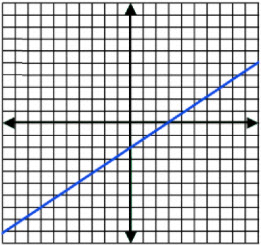
\(\bullet\text{ Slope Formula}\)
\(\,\,\,\,\,\,\,\,m=\frac{y_2-y_1}{x_2-x_1}\)
\(\bullet\text{ Net Change}\)
\(\,\,\,\,\,\,\,\,y_2-y_1\)
\(\bullet\text{ Slope Intercept Form}\)
\(\,\,\,\,\,\,\,\,y=mx+b\)
\(\bullet\text{ Point Slope Form}\)
\(\,\,\,\,\,\,\,\,y-y_1=m(x-x_1)\)
\(\bullet\text{ Parallel and Perpendicular Slope}\)
\(\,\,\,\,\,\,\,\,m_1=m+2,\,\,\,m_1=\frac{1}{m_2}\)
\(\bullet\text{ Distance Between a Point and a Line}\)
\(\,\,\,\,\,\,\,\,(3,4) \text{ and } y=\frac{3}{4}x-2\)
\(\bullet\text{Finding x- and y- intercepts}\)
\(\,\,\,\,\,\,\,\,y=2x+4\)
\(\bullet\text{ Andymath Homepage}\)