

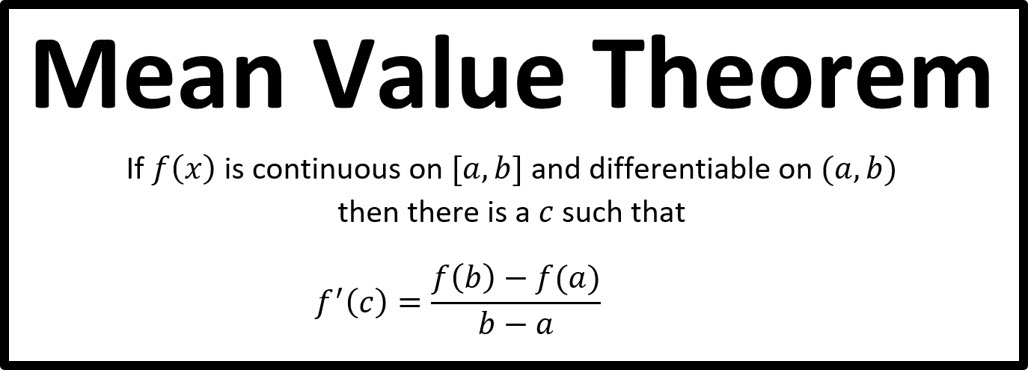
The Mean Value Theorem says that if a function is continuous on a closed interval and differentiable on the open interval, then at least one tangent slope matches the average rate of change over the interval. In practice, this means we set \(f'(c)\) equal to the slope of the secant line from \(a\) to \(b\). These problems focus on finding all values of \(c\) that satisfy the conclusion of the Mean Value Theorem.
Notes
Practice Problems
Find all numbers c that satisfy the conclusions of the mean value theorem.
\(\textbf{1)}\) \( f(x)=x^2 \, \) on \( \, [-3,2] \)The answer is \( c=-1/2 \)
\(\text{Step 1: Notes}\)
\(\,\,\,\,\,\,f'(c)=\displaystyle \frac{f(b)-f(a)}{b-a}\)
\(\text{Step 2: Plug in }a=-3 \text{ and }b=2\)
\(\,\,\,\,\,\,f'(c)=\displaystyle \frac{f(2)-f(-3)}{(2)-(-3)}\)
\(\,\,\,\,\,\,f'(c)=\displaystyle \frac{(2)^2-(-3)^2}{2+3}\)
\(\,\,\,\,\,\,f'(c)=\displaystyle \frac{4-9}{5}\)
\(\,\,\,\,\,\,f'(c)=-1\)
\(\text{Step 3: Find }f'(c)\)
\(\,\,\,\,\,\,f(x)=x^2\)
\(\,\,\,\,\,\,f'(x)=2x\)
\(\,\,\,\,\,\,f'(c)=2c\)
\(\text{Step 4: Set the derivative equal to the secant slope}\)
\(\,\,\,\,\,\,2c=-1\)
\(\,\,\,\,\,\,c=-\frac{1}{2}\)
\(\,\,\,\,\,\,\)The answer is \( c=-1/2 \)
\(\text{Step 1: Notes}\)
\(\,\,\,\,\,\,f'(c)=\displaystyle \frac{f(b)-f(a)}{b-a}\)
\(\text{Step 2: Plug in }a=-3 \text{ and }b=2\)
\(\,\,\,\,\,\,f'(c)=\displaystyle \frac{f(2)-f(-3)}{(2)-(-3)}\)
\(\,\,\,\,\,\,f'(c)=\displaystyle \frac{(2)^2-(-3)^2}{2+3}\)
\(\,\,\,\,\,\,f'(c)=\displaystyle \frac{4-9}{5}\)
\(\,\,\,\,\,\,f'(c)=-1\)
\(\text{Step 3: Find }f'(c)\)
\(\,\,\,\,\,\,f(x)=x^2\)
\(\,\,\,\,\,\,f'(x)=2x\)
\(\,\,\,\,\,\,f'(c)=2c\)
\(\text{Step 4: Set the derivative equal to the secant slope}\)
\(\,\,\,\,\,\,2c=-1\)
\(\,\,\,\,\,\,c=-\frac{1}{2}\)
\(\,\,\,\,\,\,\)The answer is \( c=-1/2 \)
\(\textbf{2)}\) \( f(x)=x^3+2x+4 \,\) on \( \, [0,2] \) The answer is \( c=\displaystyle\frac{2\sqrt{3}}{3} \)
\(\text{Step 1: Notes}\)
\(\,\,\,\,\,\,f'(c)=\displaystyle \frac{f(b)-f(a)}{b-a}\)
\(\text{Step 2: Plug in }a=0 \text{ and }b=2\)
\(\,\,\,\,\,\,f'(c)=\displaystyle \frac{f(2)-f(0)}{2-0}\)
\(\,\,\,\,\,\,f'(c)=\displaystyle \frac{\left(2^3+2(2)+4\right)-\left(0^3+2(0)+4\right)}{2}\)
\(\,\,\,\,\,\,f'(c)=\displaystyle \frac{16-4}{2}\)
\(\,\,\,\,\,\,f'(c)=6\)
\(\text{Step 3: Find }f'(c)\)
\(\,\,\,\,\,\,f(x)=x^3+2x+4\)
\(\,\,\,\,\,\,f'(x)=3x^2+2\)
\(\,\,\,\,\,\,f'(c)=3c^2+2\)
\(\text{Step 4: Set the derivative equal to the secant slope}\)
\(\,\,\,\,\,\,3c^2+2=6\)
\(\,\,\,\,\,\,3c^2=4\)
\(\,\,\,\,\,\,c=\pm\frac{2\sqrt{3}}{3}\)
\(\text{Step 5: Keep only values in }(0,2)\)
\(\,\,\,\,\,\,c=\frac{2\sqrt{3}}{3}\)
\(\,\,\,\,\,\,\)The answer is \( c=\displaystyle\frac{2\sqrt{3}}{3} \)
\(\text{Step 1: Notes}\)
\(\,\,\,\,\,\,f'(c)=\displaystyle \frac{f(b)-f(a)}{b-a}\)
\(\text{Step 2: Plug in }a=0 \text{ and }b=2\)
\(\,\,\,\,\,\,f'(c)=\displaystyle \frac{f(2)-f(0)}{2-0}\)
\(\,\,\,\,\,\,f'(c)=\displaystyle \frac{\left(2^3+2(2)+4\right)-\left(0^3+2(0)+4\right)}{2}\)
\(\,\,\,\,\,\,f'(c)=\displaystyle \frac{16-4}{2}\)
\(\,\,\,\,\,\,f'(c)=6\)
\(\text{Step 3: Find }f'(c)\)
\(\,\,\,\,\,\,f(x)=x^3+2x+4\)
\(\,\,\,\,\,\,f'(x)=3x^2+2\)
\(\,\,\,\,\,\,f'(c)=3c^2+2\)
\(\text{Step 4: Set the derivative equal to the secant slope}\)
\(\,\,\,\,\,\,3c^2+2=6\)
\(\,\,\,\,\,\,3c^2=4\)
\(\,\,\,\,\,\,c=\pm\frac{2\sqrt{3}}{3}\)
\(\text{Step 5: Keep only values in }(0,2)\)
\(\,\,\,\,\,\,c=\frac{2\sqrt{3}}{3}\)
\(\,\,\,\,\,\,\)The answer is \( c=\displaystyle\frac{2\sqrt{3}}{3} \)
\(\textbf{3)}\) \( f(x)=\sin x \,\) on \( \, [0,\pi] \) The answer is \( c=\displaystyle\frac{\pi}{2} \)
\(\text{Step 1: Notes}\)
\(\,\,\,\,\,\,f'(c)=\displaystyle \frac{f(b)-f(a)}{b-a}\)
\(\text{Step 2: Plug in }a=0 \text{ and }b=\pi\)
\(\,\,\,\,\,\,f'(c)=\displaystyle \frac{f(\pi)-f(0)}{\pi-0}\)
\(\,\,\,\,\,\,f'(c)=\displaystyle \frac{\sin(\pi)-\sin(0)}{\pi}\)
\(\,\,\,\,\,\,f'(c)=0\)
\(\text{Step 3: Find }f'(c)\)
\(\,\,\,\,\,\,f(x)=\sin{x}\)
\(\,\,\,\,\,\,f'(x)=\cos{x}\)
\(\,\,\,\,\,\,f'(c)=\cos{c}\)
\(\text{Step 4: Set the derivative equal to the secant slope}\)
\(\,\,\,\,\,\,\cos{c}=0\)
\(\,\,\,\,\,\,c=\frac{\pi}{2}\)
\(\,\,\,\,\,\,\)The answer is \( c=\displaystyle\frac{\pi}{2} \)
\(\text{Step 1: Notes}\)
\(\,\,\,\,\,\,f'(c)=\displaystyle \frac{f(b)-f(a)}{b-a}\)
\(\text{Step 2: Plug in }a=0 \text{ and }b=\pi\)
\(\,\,\,\,\,\,f'(c)=\displaystyle \frac{f(\pi)-f(0)}{\pi-0}\)
\(\,\,\,\,\,\,f'(c)=\displaystyle \frac{\sin(\pi)-\sin(0)}{\pi}\)
\(\,\,\,\,\,\,f'(c)=0\)
\(\text{Step 3: Find }f'(c)\)
\(\,\,\,\,\,\,f(x)=\sin{x}\)
\(\,\,\,\,\,\,f'(x)=\cos{x}\)
\(\,\,\,\,\,\,f'(c)=\cos{c}\)
\(\text{Step 4: Set the derivative equal to the secant slope}\)
\(\,\,\,\,\,\,\cos{c}=0\)
\(\,\,\,\,\,\,c=\frac{\pi}{2}\)
\(\,\,\,\,\,\,\)The answer is \( c=\displaystyle\frac{\pi}{2} \)
\(\textbf{4)}\) \( f(x)=x^2 \,\) on \( \, [-1,1] \) The answer is \( c=0 \)
\(\text{Step 1: Notes}\)
\(\,\,\,\,\,\,f'(c)=\displaystyle \frac{f(b)-f(a)}{b-a}\)
\(\text{Step 2: Plug in }a=-1 \text{ and }b=1\)
\(\,\,\,\,\,\,f'(c)=\displaystyle \frac{f(1)-f(-1)}{1-(-1)}\)
\(\,\,\,\,\,\,f'(c)=\displaystyle \frac{1^2-(-1)^2}{2}\)
\(\,\,\,\,\,\,f'(c)=0\)
\(\text{Step 3: Find }f'(c)\)
\(\,\,\,\,\,\,f(x)=x^2\)
\(\,\,\,\,\,\,f'(x)=2x\)
\(\,\,\,\,\,\,f'(c)=2c\)
\(\text{Step 4: Set the derivative equal to the secant slope}\)
\(\,\,\,\,\,\,2c=0\)
\(\,\,\,\,\,\,c=0\)
\(\,\,\,\,\,\,\)The answer is \( c=0 \)
\(\text{Step 1: Notes}\)
\(\,\,\,\,\,\,f'(c)=\displaystyle \frac{f(b)-f(a)}{b-a}\)
\(\text{Step 2: Plug in }a=-1 \text{ and }b=1\)
\(\,\,\,\,\,\,f'(c)=\displaystyle \frac{f(1)-f(-1)}{1-(-1)}\)
\(\,\,\,\,\,\,f'(c)=\displaystyle \frac{1^2-(-1)^2}{2}\)
\(\,\,\,\,\,\,f'(c)=0\)
\(\text{Step 3: Find }f'(c)\)
\(\,\,\,\,\,\,f(x)=x^2\)
\(\,\,\,\,\,\,f'(x)=2x\)
\(\,\,\,\,\,\,f'(c)=2c\)
\(\text{Step 4: Set the derivative equal to the secant slope}\)
\(\,\,\,\,\,\,2c=0\)
\(\,\,\,\,\,\,c=0\)
\(\,\,\,\,\,\,\)The answer is \( c=0 \)
\(\textbf{5)}\) \( f(x)=x^3 \) on \([1,3]\) The answer is \(c=\displaystyle\frac{\sqrt{13}}{3}\)
\(\text{Step 1: Notes}\)
\(\,\,\,\,\,\,f'(c)=\displaystyle \frac{f(b)-f(a)}{b-a}\)
\(\text{Step 2: Find the secant slope}\)
\(\,\,\,\,\,\,f'(c)=\displaystyle\frac{f(3)-f(1)}{3-1}\)
\(\,\,\,\,\,\,f'(c)=\displaystyle\frac{27-1}{2}=13\)
\(\text{Step 3: Find }f'(c)\)
\(\,\,\,\,\,\,f'(x)=3x^2\)
\(\,\,\,\,\,\,f'(c)=3c^2\)
\(\text{Step 4: Solve}\)
\(\,\,\,\,\,\,3c^2=13\)
\(\,\,\,\,\,\,c=\pm\sqrt{\frac{13}{3}}\)
\(\text{Step 5: Keep only values in }(1,3)\)
\(\,\,\,\,\,\,c=\frac{\sqrt{13}}{\sqrt{3}}=\frac{\sqrt{39}}{3}\)
\(\,\,\,\,\,\,\)The answer is \(c=\displaystyle\frac{\sqrt{39}}{3}\)
\(\text{Step 1: Notes}\)
\(\,\,\,\,\,\,f'(c)=\displaystyle \frac{f(b)-f(a)}{b-a}\)
\(\text{Step 2: Find the secant slope}\)
\(\,\,\,\,\,\,f'(c)=\displaystyle\frac{f(3)-f(1)}{3-1}\)
\(\,\,\,\,\,\,f'(c)=\displaystyle\frac{27-1}{2}=13\)
\(\text{Step 3: Find }f'(c)\)
\(\,\,\,\,\,\,f'(x)=3x^2\)
\(\,\,\,\,\,\,f'(c)=3c^2\)
\(\text{Step 4: Solve}\)
\(\,\,\,\,\,\,3c^2=13\)
\(\,\,\,\,\,\,c=\pm\sqrt{\frac{13}{3}}\)
\(\text{Step 5: Keep only values in }(1,3)\)
\(\,\,\,\,\,\,c=\frac{\sqrt{13}}{\sqrt{3}}=\frac{\sqrt{39}}{3}\)
\(\,\,\,\,\,\,\)The answer is \(c=\displaystyle\frac{\sqrt{39}}{3}\)
\(\textbf{6)}\) \( f(x)=x^2+4x \) on \([-2,4]\) The answer is \(c=1\)
\(\text{Step 1: Notes}\)
\(\,\,\,\,\,\,f'(c)=\displaystyle \frac{f(b)-f(a)}{b-a}\)
\(\text{Step 2: Find the secant slope}\)
\(\,\,\,\,\,\,f'(c)=\displaystyle\frac{f(4)-f(-2)}{4-(-2)}\)
\(\,\,\,\,\,\,f(4)=4^2+4(4)=32\)
\(\,\,\,\,\,\,f(-2)=(-2)^2+4(-2)=-4\)
\(\,\,\,\,\,\,f'(c)=\displaystyle\frac{32-(-4)}{6}=6\)
\(\text{Step 3: Find }f'(c)\)
\(\,\,\,\,\,\,f'(x)=2x+4\)
\(\,\,\,\,\,\,f'(c)=2c+4\)
\(\text{Step 4: Solve}\)
\(\,\,\,\,\,\,2c+4=6\)
\(\,\,\,\,\,\,c=1\)
\(\,\,\,\,\,\,\)The answer is \(c=1\)
\(\text{Step 1: Notes}\)
\(\,\,\,\,\,\,f'(c)=\displaystyle \frac{f(b)-f(a)}{b-a}\)
\(\text{Step 2: Find the secant slope}\)
\(\,\,\,\,\,\,f'(c)=\displaystyle\frac{f(4)-f(-2)}{4-(-2)}\)
\(\,\,\,\,\,\,f(4)=4^2+4(4)=32\)
\(\,\,\,\,\,\,f(-2)=(-2)^2+4(-2)=-4\)
\(\,\,\,\,\,\,f'(c)=\displaystyle\frac{32-(-4)}{6}=6\)
\(\text{Step 3: Find }f'(c)\)
\(\,\,\,\,\,\,f'(x)=2x+4\)
\(\,\,\,\,\,\,f'(c)=2c+4\)
\(\text{Step 4: Solve}\)
\(\,\,\,\,\,\,2c+4=6\)
\(\,\,\,\,\,\,c=1\)
\(\,\,\,\,\,\,\)The answer is \(c=1\)
\(\textbf{7)}\) \( f(x)=x^3-3x \) on \([-2,2]\) The answers are \(c=-1\) and \(c=1\)
\(\text{Step 1: Notes}\)
\(\,\,\,\,\,\,f'(c)=\displaystyle \frac{f(b)-f(a)}{b-a}\)
\(\text{Step 2: Find the secant slope}\)
\(\,\,\,\,\,\,f'(c)=\displaystyle\frac{f(2)-f(-2)}{2-(-2)}\)
\(\,\,\,\,\,\,f(2)=8-6=2\)
\(\,\,\,\,\,\,f(-2)=-8+6=-2\)
\(\,\,\,\,\,\,f'(c)=\displaystyle\frac{2-(-2)}{4}=1\)
\(\text{Step 3: Find }f'(c)\)
\(\,\,\,\,\,\,f'(x)=3x^2-3\)
\(\,\,\,\,\,\,f'(c)=3c^2-3\)
\(\text{Step 4: Solve}\)
\(\,\,\,\,\,\,3c^2-3=1\)
\(\,\,\,\,\,\,3c^2=4\)
\(\,\,\,\,\,\,c=\pm\frac{2\sqrt{3}}{3}\)
\(\,\,\,\,\,\,\)The answers are \(c=-\frac{2\sqrt{3}}{3}\) and \(c=\frac{2\sqrt{3}}{3}\)
\(\text{Step 1: Notes}\)
\(\,\,\,\,\,\,f'(c)=\displaystyle \frac{f(b)-f(a)}{b-a}\)
\(\text{Step 2: Find the secant slope}\)
\(\,\,\,\,\,\,f'(c)=\displaystyle\frac{f(2)-f(-2)}{2-(-2)}\)
\(\,\,\,\,\,\,f(2)=8-6=2\)
\(\,\,\,\,\,\,f(-2)=-8+6=-2\)
\(\,\,\,\,\,\,f'(c)=\displaystyle\frac{2-(-2)}{4}=1\)
\(\text{Step 3: Find }f'(c)\)
\(\,\,\,\,\,\,f'(x)=3x^2-3\)
\(\,\,\,\,\,\,f'(c)=3c^2-3\)
\(\text{Step 4: Solve}\)
\(\,\,\,\,\,\,3c^2-3=1\)
\(\,\,\,\,\,\,3c^2=4\)
\(\,\,\,\,\,\,c=\pm\frac{2\sqrt{3}}{3}\)
\(\,\,\,\,\,\,\)The answers are \(c=-\frac{2\sqrt{3}}{3}\) and \(c=\frac{2\sqrt{3}}{3}\)
\(\textbf{8)}\) \( f(x)=\sqrt{x} \) on \([1,9]\) The answer is \(c=4\)
\(\text{Step 1: Notes}\)
\(\,\,\,\,\,\,f'(c)=\displaystyle \frac{f(b)-f(a)}{b-a}\)
\(\text{Step 2: Find the secant slope}\)
\(\,\,\,\,\,\,f'(c)=\displaystyle\frac{f(9)-f(1)}{9-1}\)
\(\,\,\,\,\,\,f'(c)=\displaystyle\frac{3-1}{8}=\frac{1}{4}\)
\(\text{Step 3: Find }f'(c)\)
\(\,\,\,\,\,\,f'(x)=\frac{1}{2\sqrt{x}}\)
\(\,\,\,\,\,\,f'(c)=\frac{1}{2\sqrt{c}}\)
\(\text{Step 4: Solve}\)
\(\,\,\,\,\,\,\frac{1}{2\sqrt{c}}=\frac{1}{4}\)
\(\,\,\,\,\,\,2\sqrt{c}=4\)
\(\,\,\,\,\,\,\sqrt{c}=2\)
\(\,\,\,\,\,\,c=4\)
\(\,\,\,\,\,\,\)The answer is \(c=4\)
\(\text{Step 1: Notes}\)
\(\,\,\,\,\,\,f'(c)=\displaystyle \frac{f(b)-f(a)}{b-a}\)
\(\text{Step 2: Find the secant slope}\)
\(\,\,\,\,\,\,f'(c)=\displaystyle\frac{f(9)-f(1)}{9-1}\)
\(\,\,\,\,\,\,f'(c)=\displaystyle\frac{3-1}{8}=\frac{1}{4}\)
\(\text{Step 3: Find }f'(c)\)
\(\,\,\,\,\,\,f'(x)=\frac{1}{2\sqrt{x}}\)
\(\,\,\,\,\,\,f'(c)=\frac{1}{2\sqrt{c}}\)
\(\text{Step 4: Solve}\)
\(\,\,\,\,\,\,\frac{1}{2\sqrt{c}}=\frac{1}{4}\)
\(\,\,\,\,\,\,2\sqrt{c}=4\)
\(\,\,\,\,\,\,\sqrt{c}=2\)
\(\,\,\,\,\,\,c=4\)
\(\,\,\,\,\,\,\)The answer is \(c=4\)
\(\textbf{9)}\) \( f(x)=\ln{x} \) on \([1,e^2]\) The answer is \(c=\displaystyle\frac{e^2-1}{2}\)
\(\text{Step 1: Notes}\)
\(\,\,\,\,\,\,f'(c)=\displaystyle \frac{f(b)-f(a)}{b-a}\)
\(\text{Step 2: Find the secant slope}\)
\(\,\,\,\,\,\,f'(c)=\displaystyle\frac{f(e^2)-f(1)}{e^2-1}\)
\(\,\,\,\,\,\,f'(c)=\displaystyle\frac{2-0}{e^2-1}=\frac{2}{e^2-1}\)
\(\text{Step 3: Find }f'(c)\)
\(\,\,\,\,\,\,f'(x)=\frac{1}{x}\)
\(\,\,\,\,\,\,f'(c)=\frac{1}{c}\)
\(\text{Step 4: Solve}\)
\(\,\,\,\,\,\,\frac{1}{c}=\frac{2}{e^2-1}\)
\(\,\,\,\,\,\,c=\frac{e^2-1}{2}\)
\(\,\,\,\,\,\,\)The answer is \(c=\displaystyle\frac{e^2-1}{2}\)
\(\text{Step 1: Notes}\)
\(\,\,\,\,\,\,f'(c)=\displaystyle \frac{f(b)-f(a)}{b-a}\)
\(\text{Step 2: Find the secant slope}\)
\(\,\,\,\,\,\,f'(c)=\displaystyle\frac{f(e^2)-f(1)}{e^2-1}\)
\(\,\,\,\,\,\,f'(c)=\displaystyle\frac{2-0}{e^2-1}=\frac{2}{e^2-1}\)
\(\text{Step 3: Find }f'(c)\)
\(\,\,\,\,\,\,f'(x)=\frac{1}{x}\)
\(\,\,\,\,\,\,f'(c)=\frac{1}{c}\)
\(\text{Step 4: Solve}\)
\(\,\,\,\,\,\,\frac{1}{c}=\frac{2}{e^2-1}\)
\(\,\,\,\,\,\,c=\frac{e^2-1}{2}\)
\(\,\,\,\,\,\,\)The answer is \(c=\displaystyle\frac{e^2-1}{2}\)
\(\textbf{10)}\) \( f(x)=e^x \) on \([0,\ln 4]\) The answer is \(c=\ln\left(\frac{3}{\ln 4}\right)\)
\(\text{Step 1: Notes}\)
\(\,\,\,\,\,\,f'(c)=\displaystyle \frac{f(b)-f(a)}{b-a}\)
\(\text{Step 2: Find the secant slope}\)
\(\,\,\,\,\,\,f'(c)=\displaystyle\frac{f(\ln4)-f(0)}{\ln4-0}\)
\(\,\,\,\,\,\,f'(c)=\displaystyle\frac{4-1}{\ln4}=\frac{3}{\ln4}\)
\(\text{Step 3: Find }f'(c)\)
\(\,\,\,\,\,\,f'(x)=e^x\)
\(\,\,\,\,\,\,f'(c)=e^c\)
\(\text{Step 4: Solve}\)
\(\,\,\,\,\,\,e^c=\frac{3}{\ln4}\)
\(\,\,\,\,\,\,c=\ln\left(\frac{3}{\ln4}\right)\)
\(\,\,\,\,\,\,\)The answer is \(c=\ln\left(\frac{3}{\ln4}\right)\)
\(\text{Step 1: Notes}\)
\(\,\,\,\,\,\,f'(c)=\displaystyle \frac{f(b)-f(a)}{b-a}\)
\(\text{Step 2: Find the secant slope}\)
\(\,\,\,\,\,\,f'(c)=\displaystyle\frac{f(\ln4)-f(0)}{\ln4-0}\)
\(\,\,\,\,\,\,f'(c)=\displaystyle\frac{4-1}{\ln4}=\frac{3}{\ln4}\)
\(\text{Step 3: Find }f'(c)\)
\(\,\,\,\,\,\,f'(x)=e^x\)
\(\,\,\,\,\,\,f'(c)=e^c\)
\(\text{Step 4: Solve}\)
\(\,\,\,\,\,\,e^c=\frac{3}{\ln4}\)
\(\,\,\,\,\,\,c=\ln\left(\frac{3}{\ln4}\right)\)
\(\,\,\,\,\,\,\)The answer is \(c=\ln\left(\frac{3}{\ln4}\right)\)
\(\textbf{11)}\) \( f(x)=\frac{1}{x} \) on \([1,4]\) The answer is \(c=2\)
\(\text{Step 1: Notes}\)
\(\,\,\,\,\,\,f'(c)=\displaystyle \frac{f(b)-f(a)}{b-a}\)
\(\text{Step 2: Find the secant slope}\)
\(\,\,\,\,\,\,f'(c)=\displaystyle\frac{f(4)-f(1)}{4-1}\)
\(\,\,\,\,\,\,f'(c)=\displaystyle\frac{\frac{1}{4}-1}{3}=-\frac{1}{4}\)
\(\text{Step 3: Find }f'(c)\)
\(\,\,\,\,\,\,f'(x)=-\frac{1}{x^2}\)
\(\,\,\,\,\,\,f'(c)=-\frac{1}{c^2}\)
\(\text{Step 4: Solve}\)
\(\,\,\,\,\,\,-\frac{1}{c^2}=-\frac{1}{4}\)
\(\,\,\,\,\,\,c^2=4\)
\(\text{Step 5: Keep only values in }(1,4)\)
\(\,\,\,\,\,\,c=2\)
\(\,\,\,\,\,\,\)The answer is \(c=2\)
\(\text{Step 1: Notes}\)
\(\,\,\,\,\,\,f'(c)=\displaystyle \frac{f(b)-f(a)}{b-a}\)
\(\text{Step 2: Find the secant slope}\)
\(\,\,\,\,\,\,f'(c)=\displaystyle\frac{f(4)-f(1)}{4-1}\)
\(\,\,\,\,\,\,f'(c)=\displaystyle\frac{\frac{1}{4}-1}{3}=-\frac{1}{4}\)
\(\text{Step 3: Find }f'(c)\)
\(\,\,\,\,\,\,f'(x)=-\frac{1}{x^2}\)
\(\,\,\,\,\,\,f'(c)=-\frac{1}{c^2}\)
\(\text{Step 4: Solve}\)
\(\,\,\,\,\,\,-\frac{1}{c^2}=-\frac{1}{4}\)
\(\,\,\,\,\,\,c^2=4\)
\(\text{Step 5: Keep only values in }(1,4)\)
\(\,\,\,\,\,\,c=2\)
\(\,\,\,\,\,\,\)The answer is \(c=2\)
\(\textbf{12)}\) \( f(x)=x^4 \) on \([-1,1]\) The answer is \(c=0\)
\(\text{Step 1: Notes}\)
\(\,\,\,\,\,\,f'(c)=\displaystyle \frac{f(b)-f(a)}{b-a}\)
\(\text{Step 2: Find the secant slope}\)
\(\,\,\,\,\,\,f'(c)=\displaystyle\frac{f(1)-f(-1)}{1-(-1)}\)
\(\,\,\,\,\,\,f'(c)=\displaystyle\frac{1-1}{2}=0\)
\(\text{Step 3: Find }f'(c)\)
\(\,\,\,\,\,\,f'(x)=4x^3\)
\(\,\,\,\,\,\,f'(c)=4c^3\)
\(\text{Step 4: Solve}\)
\(\,\,\,\,\,\,4c^3=0\)
\(\,\,\,\,\,\,c=0\)
\(\,\,\,\,\,\,\)The answer is \(c=0\)
\(\text{Step 1: Notes}\)
\(\,\,\,\,\,\,f'(c)=\displaystyle \frac{f(b)-f(a)}{b-a}\)
\(\text{Step 2: Find the secant slope}\)
\(\,\,\,\,\,\,f'(c)=\displaystyle\frac{f(1)-f(-1)}{1-(-1)}\)
\(\,\,\,\,\,\,f'(c)=\displaystyle\frac{1-1}{2}=0\)
\(\text{Step 3: Find }f'(c)\)
\(\,\,\,\,\,\,f'(x)=4x^3\)
\(\,\,\,\,\,\,f'(c)=4c^3\)
\(\text{Step 4: Solve}\)
\(\,\,\,\,\,\,4c^3=0\)
\(\,\,\,\,\,\,c=0\)
\(\,\,\,\,\,\,\)The answer is \(c=0\)
\(\textbf{13)}\) \( f(x)=x^2-6x+1 \) on \([0,5]\) The answer is \(c=\frac{5}{2}\)
\(\text{Step 1: Notes}\)
\(\,\,\,\,\,\,f'(c)=\displaystyle \frac{f(b)-f(a)}{b-a}\)
\(\text{Step 2: Find the secant slope}\)
\(\,\,\,\,\,\,f'(c)=\displaystyle\frac{f(5)-f(0)}{5-0}\)
\(\,\,\,\,\,\,f(5)=25-30+1=-4\)
\(\,\,\,\,\,\,f(0)=1\)
\(\,\,\,\,\,\,f'(c)=\displaystyle\frac{-4-1}{5}=-1\)
\(\text{Step 3: Find }f'(c)\)
\(\,\,\,\,\,\,f'(x)=2x-6\)
\(\,\,\,\,\,\,f'(c)=2c-6\)
\(\text{Step 4: Solve}\)
\(\,\,\,\,\,\,2c-6=-1\)
\(\,\,\,\,\,\,2c=5\)
\(\,\,\,\,\,\,c=\frac{5}{2}\)
\(\,\,\,\,\,\,\)The answer is \(c=\frac{5}{2}\)
\(\text{Step 1: Notes}\)
\(\,\,\,\,\,\,f'(c)=\displaystyle \frac{f(b)-f(a)}{b-a}\)
\(\text{Step 2: Find the secant slope}\)
\(\,\,\,\,\,\,f'(c)=\displaystyle\frac{f(5)-f(0)}{5-0}\)
\(\,\,\,\,\,\,f(5)=25-30+1=-4\)
\(\,\,\,\,\,\,f(0)=1\)
\(\,\,\,\,\,\,f'(c)=\displaystyle\frac{-4-1}{5}=-1\)
\(\text{Step 3: Find }f'(c)\)
\(\,\,\,\,\,\,f'(x)=2x-6\)
\(\,\,\,\,\,\,f'(c)=2c-6\)
\(\text{Step 4: Solve}\)
\(\,\,\,\,\,\,2c-6=-1\)
\(\,\,\,\,\,\,2c=5\)
\(\,\,\,\,\,\,c=\frac{5}{2}\)
\(\,\,\,\,\,\,\)The answer is \(c=\frac{5}{2}\)
\(\textbf{14)}\) \( f(x)=\cos{x} \) on \([0,\pi]\) The answer is \(c=\displaystyle\frac{\pi}{2}\)
\(\text{Step 1: Notes}\)
\(\,\,\,\,\,\,f'(c)=\displaystyle \frac{f(b)-f(a)}{b-a}\)
\(\text{Step 2: Find the secant slope}\)
\(\,\,\,\,\,\,f'(c)=\displaystyle\frac{f(\pi)-f(0)}{\pi-0}\)
\(\,\,\,\,\,\,f'(c)=\displaystyle\frac{-1-1}{\pi}=-\frac{2}{\pi}\)
\(\text{Step 3: Find }f'(c)\)
\(\,\,\,\,\,\,f'(x)=-\sin{x}\)
\(\,\,\,\,\,\,f'(c)=-\sin{c}\)
\(\text{Step 4: Solve}\)
\(\,\,\,\,\,\,-\sin{c}=-\frac{2}{\pi}\)
\(\,\,\,\,\,\,\sin{c}=\frac{2}{\pi}\)
\(\,\,\,\,\,\,c=\sin^{-1}\left(\frac{2}{\pi}\right)\text{ or }c=\pi-\sin^{-1}\left(\frac{2}{\pi}\right)\)
\(\,\,\,\,\,\,\)The answers are \(c=\sin^{-1}\left(\frac{2}{\pi}\right)\) and \(c=\pi-\sin^{-1}\left(\frac{2}{\pi}\right)\)
\(\text{Step 1: Notes}\)
\(\,\,\,\,\,\,f'(c)=\displaystyle \frac{f(b)-f(a)}{b-a}\)
\(\text{Step 2: Find the secant slope}\)
\(\,\,\,\,\,\,f'(c)=\displaystyle\frac{f(\pi)-f(0)}{\pi-0}\)
\(\,\,\,\,\,\,f'(c)=\displaystyle\frac{-1-1}{\pi}=-\frac{2}{\pi}\)
\(\text{Step 3: Find }f'(c)\)
\(\,\,\,\,\,\,f'(x)=-\sin{x}\)
\(\,\,\,\,\,\,f'(c)=-\sin{c}\)
\(\text{Step 4: Solve}\)
\(\,\,\,\,\,\,-\sin{c}=-\frac{2}{\pi}\)
\(\,\,\,\,\,\,\sin{c}=\frac{2}{\pi}\)
\(\,\,\,\,\,\,c=\sin^{-1}\left(\frac{2}{\pi}\right)\text{ or }c=\pi-\sin^{-1}\left(\frac{2}{\pi}\right)\)
\(\,\,\,\,\,\,\)The answers are \(c=\sin^{-1}\left(\frac{2}{\pi}\right)\) and \(c=\pi-\sin^{-1}\left(\frac{2}{\pi}\right)\)
\(\textbf{15)}\) \( f(x)=x+\frac{4}{x} \) on \([1,4]\) The answer is \(c=2\)
\(\text{Step 1: Notes}\)
\(\,\,\,\,\,\,f'(c)=\displaystyle \frac{f(b)-f(a)}{b-a}\)
\(\text{Step 2: Find the secant slope}\)
\(\,\,\,\,\,\,f'(c)=\displaystyle\frac{f(4)-f(1)}{4-1}\)
\(\,\,\,\,\,\,f(4)=4+\frac{4}{4}=5\)
\(\,\,\,\,\,\,f(1)=1+4=5\)
\(\,\,\,\,\,\,f'(c)=0\)
\(\text{Step 3: Find }f'(c)\)
\(\,\,\,\,\,\,f'(x)=1-\frac{4}{x^2}\)
\(\,\,\,\,\,\,f'(c)=1-\frac{4}{c^2}\)
\(\text{Step 4: Solve}\)
\(\,\,\,\,\,\,1-\frac{4}{c^2}=0\)
\(\,\,\,\,\,\,c^2=4\)
\(\text{Step 5: Keep only values in }(1,4)\)
\(\,\,\,\,\,\,c=2\)
\(\,\,\,\,\,\,\)The answer is \(c=2\)
\(\text{Step 1: Notes}\)
\(\,\,\,\,\,\,f'(c)=\displaystyle \frac{f(b)-f(a)}{b-a}\)
\(\text{Step 2: Find the secant slope}\)
\(\,\,\,\,\,\,f'(c)=\displaystyle\frac{f(4)-f(1)}{4-1}\)
\(\,\,\,\,\,\,f(4)=4+\frac{4}{4}=5\)
\(\,\,\,\,\,\,f(1)=1+4=5\)
\(\,\,\,\,\,\,f'(c)=0\)
\(\text{Step 3: Find }f'(c)\)
\(\,\,\,\,\,\,f'(x)=1-\frac{4}{x^2}\)
\(\,\,\,\,\,\,f'(c)=1-\frac{4}{c^2}\)
\(\text{Step 4: Solve}\)
\(\,\,\,\,\,\,1-\frac{4}{c^2}=0\)
\(\,\,\,\,\,\,c^2=4\)
\(\text{Step 5: Keep only values in }(1,4)\)
\(\,\,\,\,\,\,c=2\)
\(\,\,\,\,\,\,\)The answer is \(c=2\)
\(\textbf{16)}\) \( f(x)=\sqrt{x+1} \) on \([0,8]\) The answer is \(c=3\)
\(\text{Step 1: Notes}\)
\(\,\,\,\,\,\,f'(c)=\displaystyle \frac{f(b)-f(a)}{b-a}\)
\(\text{Step 2: Find the secant slope}\)
\(\,\,\,\,\,\,f'(c)=\displaystyle\frac{f(8)-f(0)}{8-0}\)
\(\,\,\,\,\,\,f'(c)=\displaystyle\frac{3-1}{8}=\frac{1}{4}\)
\(\text{Step 3: Find }f'(c)\)
\(\,\,\,\,\,\,f'(x)=\frac{1}{2\sqrt{x+1}}\)
\(\,\,\,\,\,\,f'(c)=\frac{1}{2\sqrt{c+1}}\)
\(\text{Step 4: Solve}\)
\(\,\,\,\,\,\,\frac{1}{2\sqrt{c+1}}=\frac{1}{4}\)
\(\,\,\,\,\,\,2\sqrt{c+1}=4\)
\(\,\,\,\,\,\,c+1=4\)
\(\,\,\,\,\,\,c=3\)
\(\,\,\,\,\,\,\)The answer is \(c=3\)
\(\text{Step 1: Notes}\)
\(\,\,\,\,\,\,f'(c)=\displaystyle \frac{f(b)-f(a)}{b-a}\)
\(\text{Step 2: Find the secant slope}\)
\(\,\,\,\,\,\,f'(c)=\displaystyle\frac{f(8)-f(0)}{8-0}\)
\(\,\,\,\,\,\,f'(c)=\displaystyle\frac{3-1}{8}=\frac{1}{4}\)
\(\text{Step 3: Find }f'(c)\)
\(\,\,\,\,\,\,f'(x)=\frac{1}{2\sqrt{x+1}}\)
\(\,\,\,\,\,\,f'(c)=\frac{1}{2\sqrt{c+1}}\)
\(\text{Step 4: Solve}\)
\(\,\,\,\,\,\,\frac{1}{2\sqrt{c+1}}=\frac{1}{4}\)
\(\,\,\,\,\,\,2\sqrt{c+1}=4\)
\(\,\,\,\,\,\,c+1=4\)
\(\,\,\,\,\,\,c=3\)
\(\,\,\,\,\,\,\)The answer is \(c=3\)
\(\textbf{17)}\) \( f(x)=x^3+x^2 \) on \([-1,2]\) The answer is \(c=\displaystyle\frac{-2+\sqrt{31}}{6}\)
\(\text{Step 1: Notes}\)
\(\,\,\,\,\,\,f'(c)=\displaystyle \frac{f(b)-f(a)}{b-a}\)
\(\text{Step 2: Find the secant slope}\)
\(\,\,\,\,\,\,f'(c)=\displaystyle\frac{f(2)-f(-1)}{2-(-1)}\)
\(\,\,\,\,\,\,f(2)=8+4=12\)
\(\,\,\,\,\,\,f(-1)=-1+1=0\)
\(\,\,\,\,\,\,f'(c)=\displaystyle\frac{12}{3}=4\)
\(\text{Step 3: Find }f'(c)\)
\(\,\,\,\,\,\,f'(x)=3x^2+2x\)
\(\,\,\,\,\,\,f'(c)=3c^2+2c\)
\(\text{Step 4: Solve}\)
\(\,\,\,\,\,\,3c^2+2c=4\)
\(\,\,\,\,\,\,3c^2+2c-4=0\)
\(\,\,\,\,\,\,c=\displaystyle\frac{-2\pm\sqrt{4+48}}{6}\)
\(\,\,\,\,\,\,c=\displaystyle\frac{-2\pm2\sqrt{13}}{6}\)
\(\text{Step 5: Keep only values in }(-1,2)\)
\(\,\,\,\,\,\,c=\displaystyle\frac{-1+\sqrt{13}}{3}\)
\(\,\,\,\,\,\,\)The answer is \(c=\displaystyle\frac{-1+\sqrt{13}}{3}\)
\(\text{Step 1: Notes}\)
\(\,\,\,\,\,\,f'(c)=\displaystyle \frac{f(b)-f(a)}{b-a}\)
\(\text{Step 2: Find the secant slope}\)
\(\,\,\,\,\,\,f'(c)=\displaystyle\frac{f(2)-f(-1)}{2-(-1)}\)
\(\,\,\,\,\,\,f(2)=8+4=12\)
\(\,\,\,\,\,\,f(-1)=-1+1=0\)
\(\,\,\,\,\,\,f'(c)=\displaystyle\frac{12}{3}=4\)
\(\text{Step 3: Find }f'(c)\)
\(\,\,\,\,\,\,f'(x)=3x^2+2x\)
\(\,\,\,\,\,\,f'(c)=3c^2+2c\)
\(\text{Step 4: Solve}\)
\(\,\,\,\,\,\,3c^2+2c=4\)
\(\,\,\,\,\,\,3c^2+2c-4=0\)
\(\,\,\,\,\,\,c=\displaystyle\frac{-2\pm\sqrt{4+48}}{6}\)
\(\,\,\,\,\,\,c=\displaystyle\frac{-2\pm2\sqrt{13}}{6}\)
\(\text{Step 5: Keep only values in }(-1,2)\)
\(\,\,\,\,\,\,c=\displaystyle\frac{-1+\sqrt{13}}{3}\)
\(\,\,\,\,\,\,\)The answer is \(c=\displaystyle\frac{-1+\sqrt{13}}{3}\)
\(\textbf{18)}\) \( f(x)=x^3-6x^2+9x \) on \([0,4]\) The answers are \(c=1\) and \(c=3\)
\(\text{Step 1: Notes}\)
\(\,\,\,\,\,\,f'(c)=\displaystyle \frac{f(b)-f(a)}{b-a}\)
\(\text{Step 2: Find the secant slope}\)
\(\,\,\,\,\,\,f'(c)=\displaystyle\frac{f(4)-f(0)}{4-0}\)
\(\,\,\,\,\,\,f(4)=64-96+36=4\)
\(\,\,\,\,\,\,f(0)=0\)
\(\,\,\,\,\,\,f'(c)=1\)
\(\text{Step 3: Find }f'(c)\)
\(\,\,\,\,\,\,f'(x)=3x^2-12x+9\)
\(\,\,\,\,\,\,f'(c)=3c^2-12c+9\)
\(\text{Step 4: Solve}\)
\(\,\,\,\,\,\,3c^2-12c+9=1\)
\(\,\,\,\,\,\,3c^2-12c+8=0\)
\(\,\,\,\,\,\,c=\displaystyle\frac{12\pm\sqrt{144-96}}{6}\)
\(\,\,\,\,\,\,c=\displaystyle\frac{12\pm4\sqrt{3}}{6}\)
\(\,\,\,\,\,\,c=2\pm\frac{2\sqrt{3}}{3}\)
\(\,\,\,\,\,\,\)The answers are \(c=2-\frac{2\sqrt{3}}{3}\) and \(c=2+\frac{2\sqrt{3}}{3}\)
\(\text{Step 1: Notes}\)
\(\,\,\,\,\,\,f'(c)=\displaystyle \frac{f(b)-f(a)}{b-a}\)
\(\text{Step 2: Find the secant slope}\)
\(\,\,\,\,\,\,f'(c)=\displaystyle\frac{f(4)-f(0)}{4-0}\)
\(\,\,\,\,\,\,f(4)=64-96+36=4\)
\(\,\,\,\,\,\,f(0)=0\)
\(\,\,\,\,\,\,f'(c)=1\)
\(\text{Step 3: Find }f'(c)\)
\(\,\,\,\,\,\,f'(x)=3x^2-12x+9\)
\(\,\,\,\,\,\,f'(c)=3c^2-12c+9\)
\(\text{Step 4: Solve}\)
\(\,\,\,\,\,\,3c^2-12c+9=1\)
\(\,\,\,\,\,\,3c^2-12c+8=0\)
\(\,\,\,\,\,\,c=\displaystyle\frac{12\pm\sqrt{144-96}}{6}\)
\(\,\,\,\,\,\,c=\displaystyle\frac{12\pm4\sqrt{3}}{6}\)
\(\,\,\,\,\,\,c=2\pm\frac{2\sqrt{3}}{3}\)
\(\,\,\,\,\,\,\)The answers are \(c=2-\frac{2\sqrt{3}}{3}\) and \(c=2+\frac{2\sqrt{3}}{3}\)
\(\textbf{19)}\) \( f(x)=\frac{x}{x+1} \) on \([1,3]\) The answer is \(c=\sqrt{6}-1\)
\(\text{Step 1: Notes}\)
\(\,\,\,\,\,\,f'(c)=\displaystyle \frac{f(b)-f(a)}{b-a}\)
\(\text{Step 2: Find the secant slope}\)
\(\,\,\,\,\,\,f'(c)=\displaystyle\frac{f(3)-f(1)}{3-1}\)
\(\,\,\,\,\,\,f(3)=\frac{3}{4}\)
\(\,\,\,\,\,\,f(1)=\frac{1}{2}\)
\(\,\,\,\,\,\,f'(c)=\displaystyle\frac{\frac{3}{4}-\frac{1}{2}}{2}=\frac{1}{8}\)
\(\text{Step 3: Find }f'(c)\)
\(\,\,\,\,\,\,f'(x)=\frac{(x+1)-x}{(x+1)^2}\)
\(\,\,\,\,\,\,f'(x)=\frac{1}{(x+1)^2}\)
\(\,\,\,\,\,\,f'(c)=\frac{1}{(c+1)^2}\)
\(\text{Step 4: Solve}\)
\(\,\,\,\,\,\,\frac{1}{(c+1)^2}=\frac{1}{8}\)
\(\,\,\,\,\,\,(c+1)^2=8\)
\(\,\,\,\,\,\,c+1=2\sqrt{2}\)
\(\,\,\,\,\,\,c=2\sqrt{2}-1\)
\(\,\,\,\,\,\,\)The answer is \(c=2\sqrt{2}-1\)
\(\text{Step 1: Notes}\)
\(\,\,\,\,\,\,f'(c)=\displaystyle \frac{f(b)-f(a)}{b-a}\)
\(\text{Step 2: Find the secant slope}\)
\(\,\,\,\,\,\,f'(c)=\displaystyle\frac{f(3)-f(1)}{3-1}\)
\(\,\,\,\,\,\,f(3)=\frac{3}{4}\)
\(\,\,\,\,\,\,f(1)=\frac{1}{2}\)
\(\,\,\,\,\,\,f'(c)=\displaystyle\frac{\frac{3}{4}-\frac{1}{2}}{2}=\frac{1}{8}\)
\(\text{Step 3: Find }f'(c)\)
\(\,\,\,\,\,\,f'(x)=\frac{(x+1)-x}{(x+1)^2}\)
\(\,\,\,\,\,\,f'(x)=\frac{1}{(x+1)^2}\)
\(\,\,\,\,\,\,f'(c)=\frac{1}{(c+1)^2}\)
\(\text{Step 4: Solve}\)
\(\,\,\,\,\,\,\frac{1}{(c+1)^2}=\frac{1}{8}\)
\(\,\,\,\,\,\,(c+1)^2=8\)
\(\,\,\,\,\,\,c+1=2\sqrt{2}\)
\(\,\,\,\,\,\,c=2\sqrt{2}-1\)
\(\,\,\,\,\,\,\)The answer is \(c=2\sqrt{2}-1\)
\(\textbf{20)}\) \( f(x)=x^{2/3} \) on \([-1,1]\) The Mean Value Theorem does not apply.
\(\text{Step 1: Check the conditions of the Mean Value Theorem}\)
\(\,\,\,\,\,\,f(x)=x^{2/3}\)
\(\,\,\,\,\,\,f(x)\text{ is continuous on }[-1,1].\)
\(\,\,\,\,\,\,f'(x)=\frac{2}{3}x^{-1/3}\)
\(\,\,\,\,\,\,f'(x)=\frac{2}{3\sqrt[3]{x}}\)
\(\,\,\,\,\,\,f'(x)\text{ is undefined at }x=0.\)
\(\,\,\,\,\,\,0\text{ is inside }(-1,1).\)
\(\,\,\,\,\,\,\text{The function is not differentiable on the entire open interval.}\)
\(\,\,\,\,\,\,\)The Mean Value Theorem does not apply.
\(\text{Step 1: Check the conditions of the Mean Value Theorem}\)
\(\,\,\,\,\,\,f(x)=x^{2/3}\)
\(\,\,\,\,\,\,f(x)\text{ is continuous on }[-1,1].\)
\(\,\,\,\,\,\,f'(x)=\frac{2}{3}x^{-1/3}\)
\(\,\,\,\,\,\,f'(x)=\frac{2}{3\sqrt[3]{x}}\)
\(\,\,\,\,\,\,f'(x)\text{ is undefined at }x=0.\)
\(\,\,\,\,\,\,0\text{ is inside }(-1,1).\)
\(\,\,\,\,\,\,\text{The function is not differentiable on the entire open interval.}\)
\(\,\,\,\,\,\,\)The Mean Value Theorem does not apply.
See Related Pages\(\)
\(\bullet\text{Mean Value Theorem Calculator }\)
\(\,\,\,\,\,\,\,\,\text{(emathhelp.net)}\)
\(\bullet\text{ Calculus Homepage}\)
\(\,\,\,\,\,\,\,\,\text{All the Best Topics…}\)
\(\bullet\text{ Definition of Derivative}\)
\(\,\,\,\,\,\,\,\, \displaystyle \lim_{\Delta x\to 0} \frac{f(x+ \Delta x)-f(x)}{\Delta x} \)
\(\bullet\text{ Equation of the Tangent Line}\)
\(\,\,\,\,\,\,\,\,f(x)=x^3+3x^2−x \text{ at the point } (2,18)\)
\(\bullet\text{ Derivatives- Constant Rule}\)
\(\,\,\,\,\,\,\,\,\displaystyle\frac{d}{dx}(c)=0\)
\(\bullet\text{ Derivatives- Power Rule}\)
\(\,\,\,\,\,\,\,\,\displaystyle\frac{d}{dx}(x^n)=nx^{n-1}\)
\(\bullet\text{ Derivatives- Constant Multiple Rule}\)
\(\,\,\,\,\,\,\,\,\displaystyle\frac{d}{dx}(cf(x))=cf'(x)\)
\(\bullet\text{ Derivatives- Sum and Difference Rules}\)
\(\,\,\,\,\,\,\,\,\displaystyle\frac{d}{dx}[f(x) \pm g(x)]=f'(x) \pm g'(x)\)
\(\bullet\text{ Derivatives- Sin and Cos}\)
\(\,\,\,\,\,\,\,\,\displaystyle\frac{d}{dx}sin(x)=cos(x)\)
\(\bullet\text{ Derivatives- Product Rule}\)
\(\,\,\,\,\,\,\,\,\displaystyle\frac{d}{dx}[f(x) \cdot g(x)]=f(x) \cdot g'(x)+f'(x) \cdot g(x)\)
\(\bullet\text{ Derivatives- Quotient Rule}\)
\(\,\,\,\,\,\,\,\,\displaystyle\frac{d}{dx}\left[\displaystyle\frac{f(x)}{g(x)}\right]=\displaystyle\frac{g(x) \cdot f'(x)-f(x) \cdot g'(x)}{[g(x)]^2}\)
\(\bullet\text{ Derivatives- Chain Rule}\)
\(\,\,\,\,\,\,\,\,\displaystyle\frac{d}{dx}[f(g(x))]= f'(g(x)) \cdot g'(x)\)
\(\bullet\text{ Derivatives- ln(x)}\)
\(\,\,\,\,\,\,\,\,\displaystyle\frac{d}{dx}[ln(x)]= \displaystyle \frac{1}{x}\)
\(\bullet\text{ Implicit Differentiation}\)
\(\,\,\,\,\,\,\,\,\)
\(\bullet\text{ Horizontal Tangent Line}\)
\(\,\,\,\,\,\,\,\,\)
\(\bullet\text{ Mean Value Theorem}\)
\(\,\,\,\,\,\,\,\,\)
\(\bullet\text{ Related Rates}\)
\(\,\,\,\,\,\,\,\,\)
\(\bullet\text{ Increasing and Decreasing Intervals}\)
\(\,\,\,\,\,\,\,\,\)
\(\bullet\text{ Intervals of concave up and down}\)
\(\,\,\,\,\,\,\,\,\)
\(\bullet\text{ Inflection Points}\)
\(\,\,\,\,\,\,\,\,\)
\(\bullet\text{ Graph of f(x), f'(x) and f”(x)}\)
\(\,\,\,\,\,\,\,\,\)
\(\bullet\text{ Newton’s Method}\)
\(\,\,\,\,\,\,\,\,x_{n+1}=x_n – \displaystyle \frac{f(x_n)}{f'(x_n)}\)