

Summary
In short, parameters describe populations, while statistics describe samples.
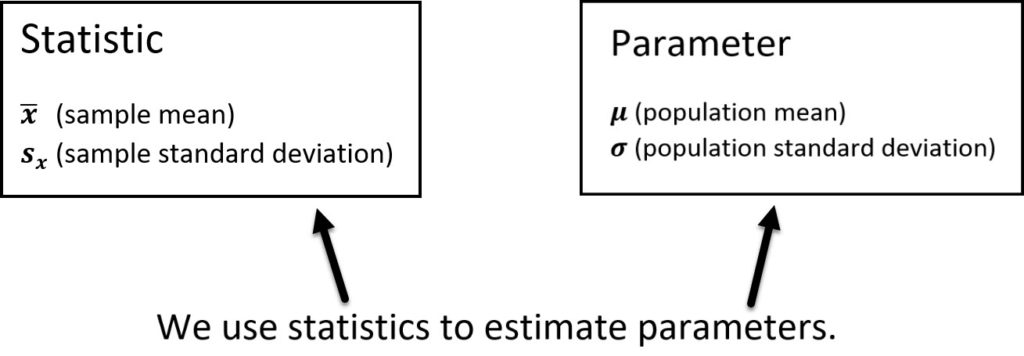
A parameter is a numerical value that describes some characteristic of a population. It is a fixed value that is used to describe a population as a whole.
A statistic, on the other hand, is a numerical value that describes some characteristic of a sample. It is a calculated value that is used to describe a sample drawn from a population. They are not necessarily the same values as the population parameters.
For example, if you have a population of 100 people, and you take a sample of 10 people from that population, the mean and standard deviation of the sample are statistics. They are calculated values that describe the sample, but they are not necessarily the same as the mean and standard deviation of the population as a whole.
Practice Problems
\(\small{\textbf{1)}}\) A poll of 200 college students found that 62% prefer studying at night. Is this a statistic or a parameter? \(\textbf{Statistic —}~\text{based on a sample of 200 students}\)
\(\small{\textbf{2)}}\) According to the U.S. Census, 13.4% of the population identifies as Black or African American. Is this a statistic or a parameter? \(\textbf{Parameter —}~\text{this value comes from a census of the population}\)
\(\small{\textbf{3)}}\) A scientist randomly selects 40 fish from a lake and records an average weight of 2.1 lbs. Is this a statistic or a parameter? \(\textbf{Statistic —}~\text{calculated from a sample, not the entire lake}\)
\(\small{\textbf{4)}}\) The average life expectancy for all people in Japan is 84 years. Is this a statistic or a parameter? \(\textbf{Parameter —}~\text{refers to the entire population of Japan}\)
\(\small{\textbf{5)}}\) In a study, 15 out of 30 patients improved after a new treatment. Is this a statistic or a parameter? \(\textbf{Statistic —}~\text{describes a result from a sample of patients}\)