
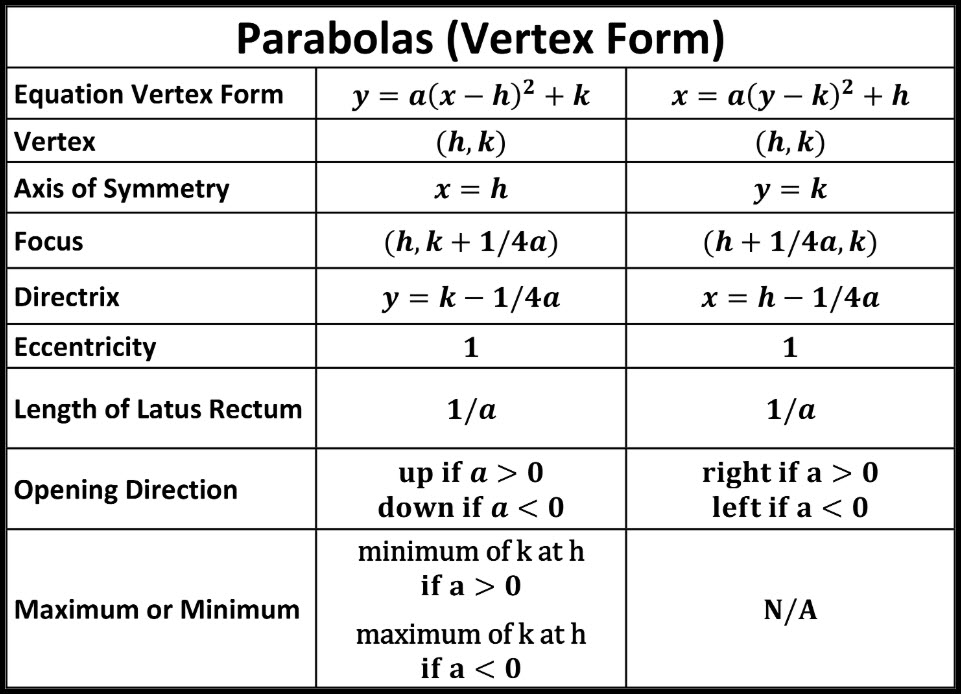
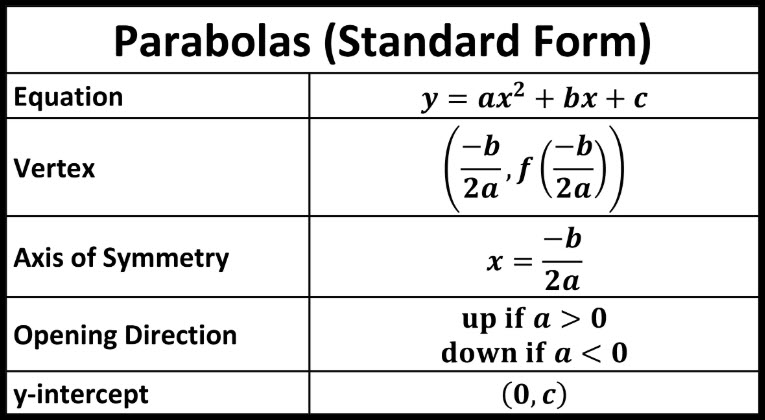
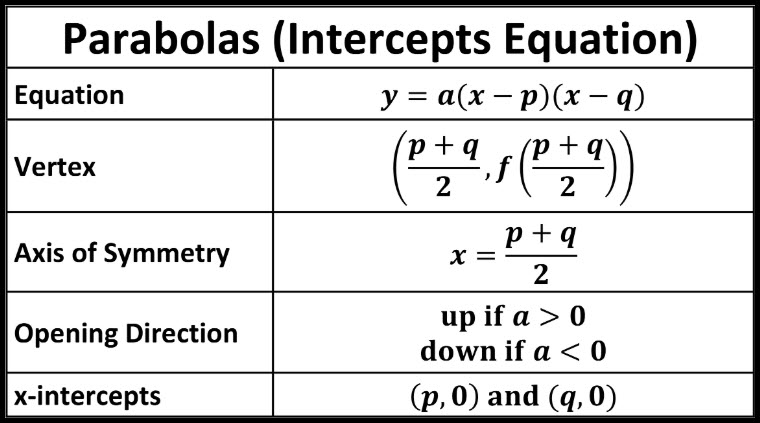
Parabolas can be expressed in a couple different forms. Each form has a different way to identify the vertex and the other parts of the parabola. Use the following notes to find the formulas for each form. Try out some practice problems!
Notes
| \({\text{Parabolas (Alternative Vertex Form)}}\) | ||
| \({\text{Equation Vertex Form}}\) | \((x-h)^2=4p(y-k)\) | \((y-k)^2=4p(x-h)\) |
|---|---|---|
| \({\text{Focus}}\) | ||
| \({\text{Directrix}}\) | ||
| \({\text{Opening Direction}}\) | \text{ down if } p \lt 0\) |
|
Problems
\(\textbf{1)}\) Graph \( f(x)=(x-4)^2+2 \) 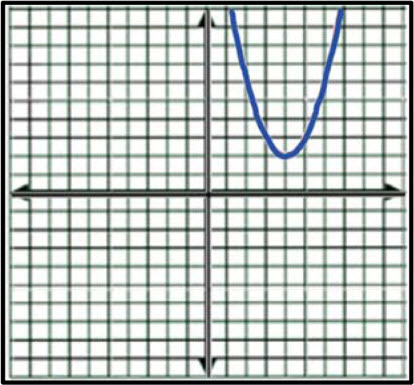

\(\textbf{2)}\) Graph \( f(x)=2(x+3)^2-1 \) 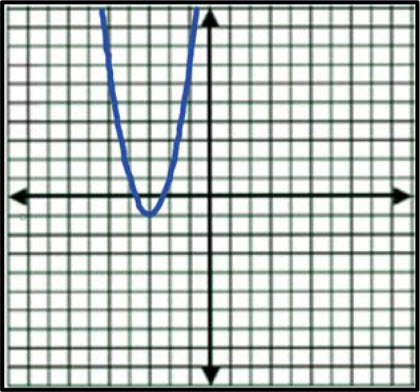
\(\textbf{3)}\) Find the axis of symmetry of \(y=2(x+3)^2-1\) The axis of symmetry is \( x=-3 \)
\(\,\,\,\,\,\,y=2(x+3)^2-1\)
\(\,\,\,\,\,\,a=2,\,\,\,h=-3,\,\,\,k=-1\)
\(\,\,\,\,\,\,\text{Axis of Symmetry: }x=h\)
\(\,\,\,\,\,\,\text{Axis of Symmetry: }x=-3\)
\(\,\,\,\,\,\,y=2(x+3)^2-1\)
\(\,\,\,\,\,\,a=2,\,\,\,h=-3,\,\,\,k=-1\)
\(\,\,\,\,\,\,\text{Axis of Symmetry: }x=h\)
\(\,\,\,\,\,\,\text{Axis of Symmetry: }x=-3\)
\(\textbf{4)}\) Find the directrix of \(y=2(x+3)^2-1\) The directrix is \( y=-\frac{9}{8}\)
\(\,\,\,\,\,\,y=2(x+3)^2-1\)
\(\,\,\,\,\,\,a=2,\,\,\,h=-3,\,\,\,k=-1\)
\(\,\,\,\,\,\,\text{Directrix: }y=k-\displaystyle\frac{1}{4a}\)
\(\,\,\,\,\,\,\text{Directrix: }y=(-1)-\displaystyle\frac{1}{4(2)}\)
\(\,\,\,\,\,\,\text{Directrix: }y=-1-\displaystyle\frac{1}{8}\)
\(\,\,\,\,\,\,\text{Directrix: }y=-\frac{9}{8}\)
\(\,\,\,\,\,\,y=2(x+3)^2-1\)
\(\,\,\,\,\,\,a=2,\,\,\,h=-3,\,\,\,k=-1\)
\(\,\,\,\,\,\,\text{Directrix: }y=k-\displaystyle\frac{1}{4a}\)
\(\,\,\,\,\,\,\text{Directrix: }y=(-1)-\displaystyle\frac{1}{4(2)}\)
\(\,\,\,\,\,\,\text{Directrix: }y=-1-\displaystyle\frac{1}{8}\)
\(\,\,\,\,\,\,\text{Directrix: }y=-\frac{9}{8}\)
\(\textbf{5)}\) Find the Focus of \(y=2(x+3)^2-1\) The focus is \( \left(-3,-\frac{7}{8}\right) \)
\(\,\,\,\,\,\,y=2(x+3)^2-1\)
\(\,\,\,\,\,\,a=2,\,\,\,h=-3,\,\,\,k=-1\)
\(\,\,\,\,\,\,\text{Focus: }\left(h,k+\frac{1}{4a}\right)\)
\(\,\,\,\,\,\,\text{Focus: }\left((-3),(-1)+\frac{1}{4(2)}\right)\)
\(\,\,\,\,\,\,\text{Focus: }\left(-3,-1+\frac{1}{8}\right)\)
\(\,\,\,\,\,\,\text{Focus: }\left(-3,-\frac{7}{8}\right)\)
\(\,\,\,\,\,\,y=2(x+3)^2-1\)
\(\,\,\,\,\,\,a=2,\,\,\,h=-3,\,\,\,k=-1\)
\(\,\,\,\,\,\,\text{Focus: }\left(h,k+\frac{1}{4a}\right)\)
\(\,\,\,\,\,\,\text{Focus: }\left((-3),(-1)+\frac{1}{4(2)}\right)\)
\(\,\,\,\,\,\,\text{Focus: }\left(-3,-1+\frac{1}{8}\right)\)
\(\,\,\,\,\,\,\text{Focus: }\left(-3,-\frac{7}{8}\right)\)
\(\textbf{6)}\) Find the x-intercepts of \(y=2(x+3)^2-1\) The x-intercepts are \( (-3-\frac{\sqrt{2}}{2},0) \text{ & } (-3+\frac{\sqrt{2}}{2},0)\)
\(\,\,\,\,\,\,y=2(x+3)^2-1\)
\(\,\,\,\,\,\,0=2(x+3)^2-1\)
\(\,\,\,\,\,\,0=2\left(x^2+6x+9\right)-1\)
\(\,\,\,\,\,\,0=2x^2+12x+18-1\)
\(\,\,\,\,\,\,0=2x^2+12x+17\)
\(\,\,\,\,\,\,a=2,\,\,\,b=12,\,\,\,c=17\)
\(\,\,\,\,\,\,\displaystyle x=\frac{-b \pm \sqrt{b^2-4ac}}{2a}\)
\(\,\,\,\,\,\,\displaystyle x=\frac{-(12) \pm \sqrt{(12)^2-4(2)(17)}}{2(2)}\)
\(\,\,\,\,\,\,\displaystyle x=\frac{-(12) \pm \sqrt{144-136}}{4}\)
\(\,\,\,\,\,\,\displaystyle x=\frac{-(12) \pm \sqrt{8}}{4}\)
\(\,\,\,\,\,\,\displaystyle x=\frac{-(12) \pm 2\sqrt{2}}{4}\)
\(\,\,\,\,\,\,\displaystyle x=\frac{-(6) \pm \sqrt{2}}{2}\)
\(\,\,\,\,\,\,(-3-\frac{\sqrt{2}}{2},0) \text{ & } (-3+\frac{\sqrt{2}}{2},0)\)
\(\,\,\,\,\,\,y=2(x+3)^2-1\)
\(\,\,\,\,\,\,0=2(x+3)^2-1\)
\(\,\,\,\,\,\,0=2\left(x^2+6x+9\right)-1\)
\(\,\,\,\,\,\,0=2x^2+12x+18-1\)
\(\,\,\,\,\,\,0=2x^2+12x+17\)
\(\,\,\,\,\,\,a=2,\,\,\,b=12,\,\,\,c=17\)
\(\,\,\,\,\,\,\displaystyle x=\frac{-b \pm \sqrt{b^2-4ac}}{2a}\)
\(\,\,\,\,\,\,\displaystyle x=\frac{-(12) \pm \sqrt{(12)^2-4(2)(17)}}{2(2)}\)
\(\,\,\,\,\,\,\displaystyle x=\frac{-(12) \pm \sqrt{144-136}}{4}\)
\(\,\,\,\,\,\,\displaystyle x=\frac{-(12) \pm \sqrt{8}}{4}\)
\(\,\,\,\,\,\,\displaystyle x=\frac{-(12) \pm 2\sqrt{2}}{4}\)
\(\,\,\,\,\,\,\displaystyle x=\frac{-(6) \pm \sqrt{2}}{2}\)
\(\,\,\,\,\,\,(-3-\frac{\sqrt{2}}{2},0) \text{ & } (-3+\frac{\sqrt{2}}{2},0)\)
\(\textbf{7)}\) Find the y-intercept of \(y=2(x+3)^2-1\) The y-intercept is \( (0,17) \)
\(\,\,\,\,\,\,y=2(x+3)^2-1\)
\(\,\,\,\,\,\,y=2((0)+3)^2-1\)
\(\,\,\,\,\,\,y=2(3)^2-1\)
\(\,\,\,\,\,\,y=2(9)-1\)
\(\,\,\,\,\,\,y=18-1\)
\(\,\,\,\,\,\,y=17\)
The y-intercept is \( (0,17) \)
\(\,\,\,\,\,\,y=2(x+3)^2-1\)
\(\,\,\,\,\,\,y=2((0)+3)^2-1\)
\(\,\,\,\,\,\,y=2(3)^2-1\)
\(\,\,\,\,\,\,y=2(9)-1\)
\(\,\,\,\,\,\,y=18-1\)
\(\,\,\,\,\,\,y=17\)
The y-intercept is \( (0,17) \)
\(\textbf{8)}\) Use completing the square to rewrite the equation in standard form.\( 2x^2-12x-y+22=0 \) The equation is \( y=2(x-3)^2+4 \)
\(\textbf{9)}\) \(y=2x^2+k \) contains the points \((2,0)\) and \((3,a).\) What is the value of a? The answer is \( a=10\)
\(\text{Given }\)
\(\,\,\,\,\,\,y=2x^2+k\)
\(\text{Plug in }(2,0)\)
\(\,\,\,\,\,\,(0)=2(2)^2+k\)
\(\,\,\,\,\,\,(0)=2(4)+k\)
\(\,\,\,\,\,\,0=8+k\)
\(\,\,\,\,\,\,-8=k\)
\(\text{Update equation}\)
\(\,\,\,\,\,\,y=2x^2-8\)
\(\text{Plug in }(3,a)\)
\(\,\,\,\,\,\,(a)=2(3)^2-8\)
\(\,\,\,\,\,\,a=2(9)-8\)
\(\,\,\,\,\,\,a=18-8\)
\(\,\,\,\,\,\,a=10\)
\(\text{Given }\)
\(\,\,\,\,\,\,y=2x^2+k\)
\(\text{Plug in }(2,0)\)
\(\,\,\,\,\,\,(0)=2(2)^2+k\)
\(\,\,\,\,\,\,(0)=2(4)+k\)
\(\,\,\,\,\,\,0=8+k\)
\(\,\,\,\,\,\,-8=k\)
\(\text{Update equation}\)
\(\,\,\,\,\,\,y=2x^2-8\)
\(\text{Plug in }(3,a)\)
\(\,\,\,\,\,\,(a)=2(3)^2-8\)
\(\,\,\,\,\,\,a=2(9)-8\)
\(\,\,\,\,\,\,a=18-8\)
\(\,\,\,\,\,\,a=10\)
\(\textbf{10)}\) What is the equation of the parabola that has vertex \((-2,4) \) and contains the point \((0,8)\)? The answer is \( y=\left(x+2\right)^2+4\)
\(\,\,\,\,\,\,y=a(x-h)^2+k\)
\(\,\,\,\,\,\,h=-2,\,\,\,k=4,\,\,\,x=0,\,\,\,y=8\)
\(\,\,\,\,\,\,(8)=a\left((0)-(-2)\right)^2+(4)\)
\(\,\,\,\,\,\,8=a\left(2\right)^2+4\)
\(\,\,\,\,\,\,8=4a+4\)
\(\,\,\,\,\,\,4=4a\)
\(\,\,\,\,\,\,1=a\)
\(\,\,\,\,\,\,y=\left(x+2\right)^2+4\)
\(\,\,\,\,\,\,y=a(x-h)^2+k\)
\(\,\,\,\,\,\,h=-2,\,\,\,k=4,\,\,\,x=0,\,\,\,y=8\)
\(\,\,\,\,\,\,(8)=a\left((0)-(-2)\right)^2+(4)\)
\(\,\,\,\,\,\,8=a\left(2\right)^2+4\)
\(\,\,\,\,\,\,8=4a+4\)
\(\,\,\,\,\,\,4=4a\)
\(\,\,\,\,\,\,1=a\)
\(\,\,\,\,\,\,y=\left(x+2\right)^2+4\)
\(\textbf{11)}\) What is the equation of the parabola that has vertex \((1,-4) \) and contains the point \((-1,12)\)? The answer is \( y=4\left(x-1\right)^2-4\)
\(\,\,\,\,\,\,y=a(x-h)^2+k\)
\(\,\,\,\,\,\,h=1,\,\,\,k=-4,\,\,\,x=-1,\,\,\,y=12\)
\(\,\,\,\,\,\,(12)=a\left((-1)-(1)\right)^2+(-4)\)
\(\,\,\,\,\,\,12=a\left(-2\right)^2-4\)
\(\,\,\,\,\,\,12=4a-4\)
\(\,\,\,\,\,\,16=4a\)
\(\,\,\,\,\,\,4=a\)
\(\,\,\,\,\,\,y=4\left(x-1\right)^2-4\)
\(\,\,\,\,\,\,y=a(x-h)^2+k\)
\(\,\,\,\,\,\,h=1,\,\,\,k=-4,\,\,\,x=-1,\,\,\,y=12\)
\(\,\,\,\,\,\,(12)=a\left((-1)-(1)\right)^2+(-4)\)
\(\,\,\,\,\,\,12=a\left(-2\right)^2-4\)
\(\,\,\,\,\,\,12=4a-4\)
\(\,\,\,\,\,\,16=4a\)
\(\,\,\,\,\,\,4=a\)
\(\,\,\,\,\,\,y=4\left(x-1\right)^2-4\)
\(\textbf{12)}\) What is the equation of the parabola that has vertex \((5,8) \) and contains the point \((7,11)\)? The answer is \( y=\frac{3}{4}\left(x-5\right)^2+8\)
\(\,\,\,\,\,\,y=a(x-h)^2+k\)
\(\,\,\,\,\,\,h=5,\,\,\,k=8,\,\,\,x=7,\,\,\,y=11\)
\(\,\,\,\,\,\,(11)=a\left((7)-(5)\right)^2+(8)\)
\(\,\,\,\,\,\,11=a\left(2\right)^2+8\)
\(\,\,\,\,\,\,11=4a+8\)
\(\,\,\,\,\,\,3=4a\)
\(\,\,\,\,\,\,\displaystyle{3}{4}=a\)
\(\,\,\,\,\,\,y=\frac{3}{4}\left(x-5\right)^2+8\)
\(\,\,\,\,\,\,y=a(x-h)^2+k\)
\(\,\,\,\,\,\,h=5,\,\,\,k=8,\,\,\,x=7,\,\,\,y=11\)
\(\,\,\,\,\,\,(11)=a\left((7)-(5)\right)^2+(8)\)
\(\,\,\,\,\,\,11=a\left(2\right)^2+8\)
\(\,\,\,\,\,\,11=4a+8\)
\(\,\,\,\,\,\,3=4a\)
\(\,\,\,\,\,\,\displaystyle{3}{4}=a\)
\(\,\,\,\,\,\,y=\frac{3}{4}\left(x-5\right)^2+8\)
\(\textbf{13)}\) Express \(y=x^2-6x \) in vertex form. The answer is \( y=\left(x-3\right)^2-9\)
\(\textbf{14)}\) Find the axis of symmetry of \(y=x^2-8x \). The answer is \( x=4\)
\(\,\,\,\,\,\,y=x^2-8x\)
\(\,\,\,\,\,\,a=1,\,\,\,b=-8,\,\,\,c=0\)
\(\,\,\,\,\,\,\text{Axis of Symmetry: }\displaystyle x=\frac{-b}{2a}\)
\(\,\,\,\,\,\,\text{Axis of Symmetry: }\displaystyle x=\frac{-(-8)}{2(1)}\)
\(\,\,\,\,\,\,\text{Axis of Symmetry: }\displaystyle x=\frac{8}{2}\)
\(\,\,\,\,\,\,\text{Axis of Symmetry: }\displaystyle x=4\)
\(\,\,\,\,\,\,y=x^2-8x\)
\(\,\,\,\,\,\,a=1,\,\,\,b=-8,\,\,\,c=0\)
\(\,\,\,\,\,\,\text{Axis of Symmetry: }\displaystyle x=\frac{-b}{2a}\)
\(\,\,\,\,\,\,\text{Axis of Symmetry: }\displaystyle x=\frac{-(-8)}{2(1)}\)
\(\,\,\,\,\,\,\text{Axis of Symmetry: }\displaystyle x=\frac{8}{2}\)
\(\,\,\,\,\,\,\text{Axis of Symmetry: }\displaystyle x=4\)
\(\textbf{15)}\) Identify the x-intercepts of \(y=x^2-14x+54 \). There are no x-intercepts
See Related Pages\(\)
\(\bullet\text{ Parabola Grapher}\)
\(\,\,\,\,\,\,\,\,\text{(Desmos.com)}\)
\(\bullet\text{ All Conic Section Notes}\)
\(\,\,\,\,\,\,\,\,\)
\(\bullet\text{ Equation of a Circle}\)
\(\,\,\,\,\,\,\,\,(x-h)^2+(y-k)^2=r^2…\)
\(\bullet\text{ Parabolas}\)
\(\,\,\,\,\,\,\,\,y=a(x-h)^2+k…\)
\(\bullet\text{ Axis of Symmetry}\)
\(\,\,\,\,\,\,\,\,x=-\frac{b}{2a}…\)
\(\bullet\text{ Ellipses}\)
\(\,\,\,\,\,\,\,\,\frac{(x-h)^2}{a^2}+\frac{(y-k)^2}{b^2}=1…\)
\(\bullet\text{ Area of Ellipses}\)
\(\,\,\,\,\,\,\,\,\text{Area}=\pi a b…\)
\(\bullet\text{ Hyperbolas}\)
\(\,\,\,\,\,\,\,\,\frac{(x-h)^2}{a^2}-\frac{(y-k)^2}{b^2}=1…\)
\(\bullet\text{ Conic Sections- Completing the Square}\)
\(\,\,\,\,\,\,\,\,x^2+8x+y^2−6y=11 \Rightarrow (x+4)^2+(y−3)^2=36…\)
\(\bullet\text{ Conic Sections- Parametric Equations}\)
\(\,\,\,\,\,\,\,\,x=h+r \cos{t}\)
\(\,\,\,\,\,\,\,\,y=k+r \sin{t}…\)
\(\bullet\text{ Degenerate Conics}\)
\(\,\,\,\,\,\,\,\,x^2−y^2=0…\)
\(\bullet\text{ Andymath Homepage}\)