

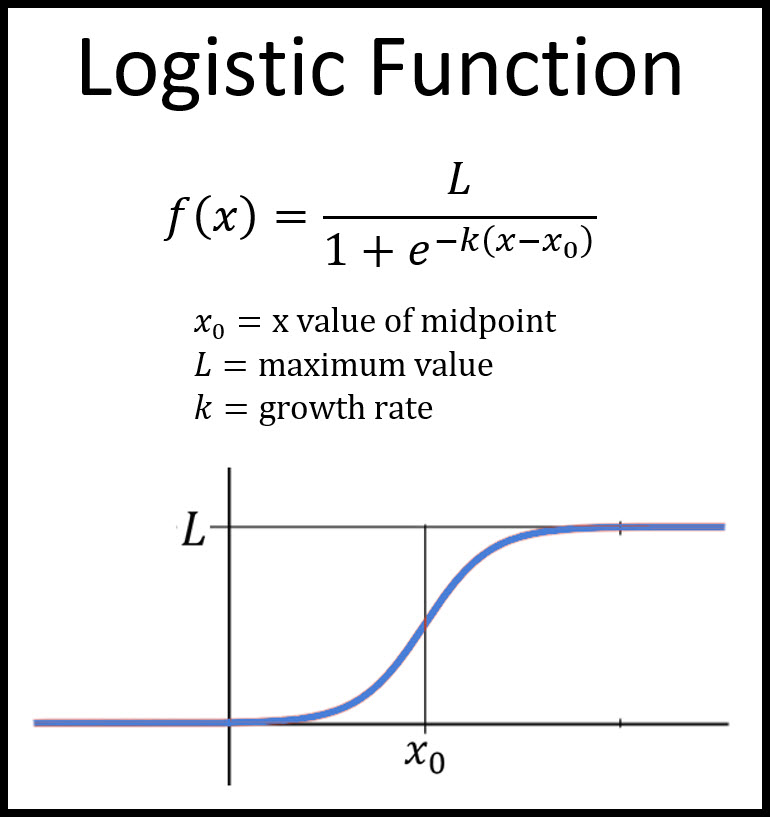
The logistic function is a growth model that increases quickly at first and then levels off near a maximum value called the carrying capacity. It is often used when exponential growth would be unrealistic because real populations, infections, or resources usually have limits. These problems practice evaluating logistic functions, identifying asymptotes and intercepts, finding carrying capacity, and solving for time.
Notes
Practice Questions
\(\textbf{1)}\) The number of people infected with dance fever after t days at the beach is modeled by the following function, \(P(t)= \frac{2200}{1+99e^{-0.5t}}\), how many people were infected at time \(t=0\)? The answer is \( 22 \) people.
\(\,\,\,\,\,P(t)= \frac{2200}{1+99e^{-0.5t}}\)
\(\,\,\,\,\,P(0)= \frac{2200}{1+99e^{-0.5(0)}}\)
\(\,\,\,\,\,P(0)= \frac{2200}{1+99e^0}\)
\(\,\,\,\,\,P(0)= \frac{2200}{1+99(1)}\)
\(\,\,\,\,\,P(0)= \frac{2200}{100}\)
\(\,\,\,\,\,P(0)=22\)
\(\,\,\,\,\,P(t)= \frac{2200}{1+99e^{-0.5t}}\)
\(\,\,\,\,\,P(0)= \frac{2200}{1+99e^{-0.5(0)}}\)
\(\,\,\,\,\,P(0)= \frac{2200}{1+99e^0}\)
\(\,\,\,\,\,P(0)= \frac{2200}{1+99(1)}\)
\(\,\,\,\,\,P(0)= \frac{2200}{100}\)
\(\,\,\,\,\,P(0)=22\)
\(\textbf{2)}\) The number of people infected with dance fever after t days at the beach is modeled by the following function, \(P(t)= \frac{2200}{1+99e^{-0.5t}}\), after 4 days, about how many people will be infected? The answer is \( 153 \) people.
\(\,\,\,\,\,P(t)= \frac{2200}{1+99e^{-0.5t}}\)
\(\,\,\,\,\,P(4)= \frac{2200}{1+99e^{-0.5(4)}}\)
\(\,\,\,\,\,P(4)= \frac{2200}{1+99e^{-2}}\)
\(\,\,\,\,\,P(4)\approx \frac{2200}{1+99(0.1353)}\)
\(\,\,\,\,\,P(4)\approx \frac{2200}{14.397}\)
\(\,\,\,\,\,P(4)\approx 153\)
\(\,\,\,\,\,P(t)= \frac{2200}{1+99e^{-0.5t}}\)
\(\,\,\,\,\,P(4)= \frac{2200}{1+99e^{-0.5(4)}}\)
\(\,\,\,\,\,P(4)= \frac{2200}{1+99e^{-2}}\)
\(\,\,\,\,\,P(4)\approx \frac{2200}{1+99(0.1353)}\)
\(\,\,\,\,\,P(4)\approx \frac{2200}{14.397}\)
\(\,\,\,\,\,P(4)\approx 153\)
\(\textbf{3)}\) The number of people infected with dance fever after t days at the beach is modeled by the following function, \(P(t)= \frac{2200}{1+99e^{-0.5t}}\), what is the maximum number of people to be infected with dance fever? The answer is \( 2200 \) people.
\(\,\,\,\,\,P(t)= \frac{2200}{1+99e^{-0.5t}}\)
\(\,\,\,\,\,\text{A logistic model has the form }P(t)=\frac{L}{1+Ae^{-kt}}\)
\(\,\,\,\,\,L=2200\)
\(\,\,\,\,\,\text{The carrying capacity is }2200\)
\(\,\,\,\,\,\text{So the maximum number of people is }2200\)
\(\,\,\,\,\,P(t)= \frac{2200}{1+99e^{-0.5t}}\)
\(\,\,\,\,\,\text{A logistic model has the form }P(t)=\frac{L}{1+Ae^{-kt}}\)
\(\,\,\,\,\,L=2200\)
\(\,\,\,\,\,\text{The carrying capacity is }2200\)
\(\,\,\,\,\,\text{So the maximum number of people is }2200\)
\(\textbf{4)}\) The number of people infected with dance fever after t days at the beach is modeled by the following function, \(P(t)= \frac{2200}{1+99e^{-0.5t}}\), at what time will 1000 people be infected with dance fever? The answer is \( 8.8 \) days.
\(\,\,\,\,\,1000= \frac{2200}{1+99e^{-0.5t}}\)
\(\,\,\,\,\,1000(1+99e^{-0.5t})=2200\)
\(\,\,\,\,\,1+99e^{-0.5t}=2.2\)
\(\,\,\,\,\,99e^{-0.5t}=1.2\)
\(\,\,\,\,\,e^{-0.5t}=\frac{1.2}{99}\)
\(\,\,\,\,\,-0.5t=\ln\left(\frac{1.2}{99}\right)\)
\(\,\,\,\,\,t=\frac{\ln\left(\frac{1.2}{99}\right)}{-0.5}\)
\(\,\,\,\,\,t\approx 8.8\)
\(\,\,\,\,\,1000= \frac{2200}{1+99e^{-0.5t}}\)
\(\,\,\,\,\,1000(1+99e^{-0.5t})=2200\)
\(\,\,\,\,\,1+99e^{-0.5t}=2.2\)
\(\,\,\,\,\,99e^{-0.5t}=1.2\)
\(\,\,\,\,\,e^{-0.5t}=\frac{1.2}{99}\)
\(\,\,\,\,\,-0.5t=\ln\left(\frac{1.2}{99}\right)\)
\(\,\,\,\,\,t=\frac{\ln\left(\frac{1.2}{99}\right)}{-0.5}\)
\(\,\,\,\,\,t\approx 8.8\)
\(\textbf{5)}\) Find the following for the graph of \(f(x)= \frac{2200}{1+99e^{-0.5x}}\)? There is no x-intercept. The y-intercept is \(22\). The horizontal asymptotes are \(y=0\) and \(y=2200\). There are no vertical asymptotes.
\(\,\,\,\,\,f(x)= \frac{2200}{1+99e^{-0.5x}}\)
\(\,\,\,\,\,\text{The numerator is positive and the denominator is always positive, so there is no x-intercept.}\)
\(\,\,\,\,\,f(0)=\frac{2200}{1+99e^0}\)
\(\,\,\,\,\,f(0)=\frac{2200}{100}=22\)
\(\,\,\,\,\,\text{The y-intercept is }22\)
\(\,\,\,\,\,\text{For }f(x)=\frac{L}{1+Ae^{-kx}},\text{ the horizontal asymptotes are }y=0\text{ and }y=L\)
\(\,\,\,\,\,\text{So the horizontal asymptotes are }y=0\text{ and }y=2200\)
\(\,\,\,\,\,\text{There are no vertical asymptotes.}\)
\(\,\,\,\,\,f(x)= \frac{2200}{1+99e^{-0.5x}}\)
\(\,\,\,\,\,\text{The numerator is positive and the denominator is always positive, so there is no x-intercept.}\)
\(\,\,\,\,\,f(0)=\frac{2200}{1+99e^0}\)
\(\,\,\,\,\,f(0)=\frac{2200}{100}=22\)
\(\,\,\,\,\,\text{The y-intercept is }22\)
\(\,\,\,\,\,\text{For }f(x)=\frac{L}{1+Ae^{-kx}},\text{ the horizontal asymptotes are }y=0\text{ and }y=L\)
\(\,\,\,\,\,\text{So the horizontal asymptotes are }y=0\text{ and }y=2200\)
\(\,\,\,\,\,\text{There are no vertical asymptotes.}\)
\(\textbf{6)}\) Find the following for the graph of \(f(x)= \frac{10}{1+e^{-x}}\)? There is no x-intercept. The y-intercept is \(5\). The horizontal asymptotes are \(y=0\) and \(y=10\). There are no vertical asymptotes.
\(\,\,\,\,\,f(x)= \frac{10}{1+e^{-x}}\)
\(\,\,\,\,\,\text{The numerator is positive and the denominator is always positive, so there is no x-intercept.}\)
\(\,\,\,\,\,f(0)=\frac{10}{1+e^0}\)
\(\,\,\,\,\,f(0)=\frac{10}{1+1}\)
\(\,\,\,\,\,f(0)=5\)
\(\,\,\,\,\,\text{The y-intercept is }5\)
\(\,\,\,\,\,L=10\)
\(\,\,\,\,\,\text{The horizontal asymptotes are }y=0\text{ and }y=10\)
\(\,\,\,\,\,\text{There are no vertical asymptotes.}\)
\(\,\,\,\,\,f(x)= \frac{10}{1+e^{-x}}\)
\(\,\,\,\,\,\text{The numerator is positive and the denominator is always positive, so there is no x-intercept.}\)
\(\,\,\,\,\,f(0)=\frac{10}{1+e^0}\)
\(\,\,\,\,\,f(0)=\frac{10}{1+1}\)
\(\,\,\,\,\,f(0)=5\)
\(\,\,\,\,\,\text{The y-intercept is }5\)
\(\,\,\,\,\,L=10\)
\(\,\,\,\,\,\text{The horizontal asymptotes are }y=0\text{ and }y=10\)
\(\,\,\,\,\,\text{There are no vertical asymptotes.}\)
\(\textbf{7)}\) Find the following for the graph of \(f(x)= \frac{10}{1+4e^{-x}}\)? There is no x-intercept. The y-intercept is \(2\). The horizontal asymptotes are \(y=0\) and \(y=10\). There are no vertical asymptotes.
\(\,\,\,\,\,f(x)= \frac{10}{1+4e^{-x}}\)
\(\,\,\,\,\,\text{The numerator is positive and the denominator is always positive, so there is no x-intercept.}\)
\(\,\,\,\,\,f(0)=\frac{10}{1+4e^0}\)
\(\,\,\,\,\,f(0)=\frac{10}{1+4(1)}\)
\(\,\,\,\,\,f(0)=\frac{10}{5}\)
\(\,\,\,\,\,f(0)=2\)
\(\,\,\,\,\,L=10\)
\(\,\,\,\,\,\text{The horizontal asymptotes are }y=0\text{ and }y=10\)
\(\,\,\,\,\,\text{There are no vertical asymptotes.}\)
\(\,\,\,\,\,f(x)= \frac{10}{1+4e^{-x}}\)
\(\,\,\,\,\,\text{The numerator is positive and the denominator is always positive, so there is no x-intercept.}\)
\(\,\,\,\,\,f(0)=\frac{10}{1+4e^0}\)
\(\,\,\,\,\,f(0)=\frac{10}{1+4(1)}\)
\(\,\,\,\,\,f(0)=\frac{10}{5}\)
\(\,\,\,\,\,f(0)=2\)
\(\,\,\,\,\,L=10\)
\(\,\,\,\,\,\text{The horizontal asymptotes are }y=0\text{ and }y=10\)
\(\,\,\,\,\,\text{There are no vertical asymptotes.}\)
\(\textbf{8)}\) A population is modeled by \(P(t)=\frac{500}{1+24e^{-0.4t}}\). Find \(P(0)\). The answer is \(20\).
\(\,\,\,\,\,P(t)=\frac{500}{1+24e^{-0.4t}}\)
\(\,\,\,\,\,P(0)=\frac{500}{1+24e^{-0.4(0)}}\)
\(\,\,\,\,\,P(0)=\frac{500}{1+24e^0}\)
\(\,\,\,\,\,P(0)=\frac{500}{1+24(1)}\)
\(\,\,\,\,\,P(0)=\frac{500}{25}\)
\(\,\,\,\,\,P(0)=20\)
\(\,\,\,\,\,P(t)=\frac{500}{1+24e^{-0.4t}}\)
\(\,\,\,\,\,P(0)=\frac{500}{1+24e^{-0.4(0)}}\)
\(\,\,\,\,\,P(0)=\frac{500}{1+24e^0}\)
\(\,\,\,\,\,P(0)=\frac{500}{1+24(1)}\)
\(\,\,\,\,\,P(0)=\frac{500}{25}\)
\(\,\,\,\,\,P(0)=20\)
\(\textbf{9)}\) A population is modeled by \(P(t)=\frac{500}{1+24e^{-0.4t}}\). Find \(P(5)\), rounded to the nearest whole number. The answer is about \(118\).
\(\,\,\,\,\,P(t)=\frac{500}{1+24e^{-0.4t}}\)
\(\,\,\,\,\,P(5)=\frac{500}{1+24e^{-0.4(5)}}\)
\(\,\,\,\,\,P(5)=\frac{500}{1+24e^{-2}}\)
\(\,\,\,\,\,P(5)\approx\frac{500}{1+24(0.1353)}\)
\(\,\,\,\,\,P(5)\approx\frac{500}{4.248}\)
\(\,\,\,\,\,P(5)\approx118\)
\(\,\,\,\,\,P(t)=\frac{500}{1+24e^{-0.4t}}\)
\(\,\,\,\,\,P(5)=\frac{500}{1+24e^{-0.4(5)}}\)
\(\,\,\,\,\,P(5)=\frac{500}{1+24e^{-2}}\)
\(\,\,\,\,\,P(5)\approx\frac{500}{1+24(0.1353)}\)
\(\,\,\,\,\,P(5)\approx\frac{500}{4.248}\)
\(\,\,\,\,\,P(5)\approx118\)
\(\textbf{10)}\) A population is modeled by \(P(t)=\frac{500}{1+24e^{-0.4t}}\). What is the carrying capacity? The answer is \(500\).
\(\,\,\,\,\,P(t)=\frac{500}{1+24e^{-0.4t}}\)
\(\,\,\,\,\,\text{A logistic model has the form }P(t)=\frac{L}{1+Ae^{-kt}}\)
\(\,\,\,\,\,L=500\)
\(\,\,\,\,\,\text{The carrying capacity is }500\)
\(\,\,\,\,\,P(t)=\frac{500}{1+24e^{-0.4t}}\)
\(\,\,\,\,\,\text{A logistic model has the form }P(t)=\frac{L}{1+Ae^{-kt}}\)
\(\,\,\,\,\,L=500\)
\(\,\,\,\,\,\text{The carrying capacity is }500\)
\(\textbf{11)}\) A population is modeled by \(P(t)=\frac{500}{1+24e^{-0.4t}}\). When will the population reach \(300\)? The answer is about \(9.0\).
\(\,\,\,\,\,300=\frac{500}{1+24e^{-0.4t}}\)
\(\,\,\,\,\,300(1+24e^{-0.4t})=500\)
\(\,\,\,\,\,1+24e^{-0.4t}=\frac{5}{3}\)
\(\,\,\,\,\,24e^{-0.4t}=\frac{2}{3}\)
\(\,\,\,\,\,e^{-0.4t}=\frac{1}{36}\)
\(\,\,\,\,\,-0.4t=\ln\left(\frac{1}{36}\right)\)
\(\,\,\,\,\,t=\frac{\ln\left(\frac{1}{36}\right)}{-0.4}\)
\(\,\,\,\,\,t\approx9.0\)
\(\,\,\,\,\,300=\frac{500}{1+24e^{-0.4t}}\)
\(\,\,\,\,\,300(1+24e^{-0.4t})=500\)
\(\,\,\,\,\,1+24e^{-0.4t}=\frac{5}{3}\)
\(\,\,\,\,\,24e^{-0.4t}=\frac{2}{3}\)
\(\,\,\,\,\,e^{-0.4t}=\frac{1}{36}\)
\(\,\,\,\,\,-0.4t=\ln\left(\frac{1}{36}\right)\)
\(\,\,\,\,\,t=\frac{\ln\left(\frac{1}{36}\right)}{-0.4}\)
\(\,\,\,\,\,t\approx9.0\)
\(\textbf{12)}\) A population is modeled by \(P(t)=\frac{1200}{1+19e^{-0.25t}}\). Find \(P(8)\), rounded to the nearest whole number. The answer is about \(336\).
\(\,\,\,\,\,P(t)=\frac{1200}{1+19e^{-0.25t}}\)
\(\,\,\,\,\,P(8)=\frac{1200}{1+19e^{-0.25(8)}}\)
\(\,\,\,\,\,P(8)=\frac{1200}{1+19e^{-2}}\)
\(\,\,\,\,\,P(8)\approx\frac{1200}{1+19(0.1353)}\)
\(\,\,\,\,\,P(8)\approx\frac{1200}{3.571}\)
\(\,\,\,\,\,P(8)\approx336\)
\(\,\,\,\,\,P(t)=\frac{1200}{1+19e^{-0.25t}}\)
\(\,\,\,\,\,P(8)=\frac{1200}{1+19e^{-0.25(8)}}\)
\(\,\,\,\,\,P(8)=\frac{1200}{1+19e^{-2}}\)
\(\,\,\,\,\,P(8)\approx\frac{1200}{1+19(0.1353)}\)
\(\,\,\,\,\,P(8)\approx\frac{1200}{3.571}\)
\(\,\,\,\,\,P(8)\approx336\)
\(\textbf{13)}\) A population is modeled by \(P(t)=\frac{1200}{1+19e^{-0.25t}}\). When will the population reach \(900\)? The answer is about \(16.2\).
\(\,\,\,\,\,900=\frac{1200}{1+19e^{-0.25t}}\)
\(\,\,\,\,\,900(1+19e^{-0.25t})=1200\)
\(\,\,\,\,\,1+19e^{-0.25t}=\frac{4}{3}\)
\(\,\,\,\,\,19e^{-0.25t}=\frac{1}{3}\)
\(\,\,\,\,\,e^{-0.25t}=\frac{1}{57}\)
\(\,\,\,\,\,-0.25t=\ln\left(\frac{1}{57}\right)\)
\(\,\,\,\,\,t=\frac{\ln\left(\frac{1}{57}\right)}{-0.25}\)
\(\,\,\,\,\,t\approx16.2\)
\(\,\,\,\,\,900=\frac{1200}{1+19e^{-0.25t}}\)
\(\,\,\,\,\,900(1+19e^{-0.25t})=1200\)
\(\,\,\,\,\,1+19e^{-0.25t}=\frac{4}{3}\)
\(\,\,\,\,\,19e^{-0.25t}=\frac{1}{3}\)
\(\,\,\,\,\,e^{-0.25t}=\frac{1}{57}\)
\(\,\,\,\,\,-0.25t=\ln\left(\frac{1}{57}\right)\)
\(\,\,\,\,\,t=\frac{\ln\left(\frac{1}{57}\right)}{-0.25}\)
\(\,\,\,\,\,t\approx16.2\)
\(\textbf{14)}\) Find \(f(3)\) for \(f(x)=\frac{100}{1+9e^{-0.6x}}\), rounded to the nearest whole number. The answer is about \(40\).
\(\,\,\,\,\,f(x)=\frac{100}{1+9e^{-0.6x}}\)
\(\,\,\,\,\,f(3)=\frac{100}{1+9e^{-0.6(3)}}\)
\(\,\,\,\,\,f(3)=\frac{100}{1+9e^{-1.8}}\)
\(\,\,\,\,\,f(3)\approx\frac{100}{1+9(0.1653)}\)
\(\,\,\,\,\,f(3)\approx\frac{100}{2.488}\)
\(\,\,\,\,\,f(3)\approx40\)
\(\,\,\,\,\,f(x)=\frac{100}{1+9e^{-0.6x}}\)
\(\,\,\,\,\,f(3)=\frac{100}{1+9e^{-0.6(3)}}\)
\(\,\,\,\,\,f(3)=\frac{100}{1+9e^{-1.8}}\)
\(\,\,\,\,\,f(3)\approx\frac{100}{1+9(0.1653)}\)
\(\,\,\,\,\,f(3)\approx\frac{100}{2.488}\)
\(\,\,\,\,\,f(3)\approx40\)
\(\textbf{15)}\) Find the y-intercept and horizontal asymptotes of \(f(x)=\frac{100}{1+9e^{-0.6x}}\). The y-intercept is \(10\). The horizontal asymptotes are \(y=0\) and \(y=100\).
\(\,\,\,\,\,f(x)=\frac{100}{1+9e^{-0.6x}}\)
\(\,\,\,\,\,f(0)=\frac{100}{1+9e^0}\)
\(\,\,\,\,\,f(0)=\frac{100}{1+9(1)}\)
\(\,\,\,\,\,f(0)=\frac{100}{10}\)
\(\,\,\,\,\,f(0)=10\)
\(\,\,\,\,\,\text{The y-intercept is }10\)
\(\,\,\,\,\,L=100\)
\(\,\,\,\,\,\text{The horizontal asymptotes are }y=0\text{ and }y=100\)
\(\,\,\,\,\,f(x)=\frac{100}{1+9e^{-0.6x}}\)
\(\,\,\,\,\,f(0)=\frac{100}{1+9e^0}\)
\(\,\,\,\,\,f(0)=\frac{100}{1+9(1)}\)
\(\,\,\,\,\,f(0)=\frac{100}{10}\)
\(\,\,\,\,\,f(0)=10\)
\(\,\,\,\,\,\text{The y-intercept is }10\)
\(\,\,\,\,\,L=100\)
\(\,\,\,\,\,\text{The horizontal asymptotes are }y=0\text{ and }y=100\)
\(\textbf{16)}\) Find the carrying capacity and initial value for \(P(t)=\frac{800}{1+15e^{-0.3t}}\). The carrying capacity is \(800\), and the initial value is \(50\).
\(\,\,\,\,\,P(t)=\frac{800}{1+15e^{-0.3t}}\)
\(\,\,\,\,\,\text{The carrying capacity is the numerator, so }L=800\)
\(\,\,\,\,\,P(0)=\frac{800}{1+15e^0}\)
\(\,\,\,\,\,P(0)=\frac{800}{1+15(1)}\)
\(\,\,\,\,\,P(0)=\frac{800}{16}\)
\(\,\,\,\,\,P(0)=50\)
\(\,\,\,\,\,P(t)=\frac{800}{1+15e^{-0.3t}}\)
\(\,\,\,\,\,\text{The carrying capacity is the numerator, so }L=800\)
\(\,\,\,\,\,P(0)=\frac{800}{1+15e^0}\)
\(\,\,\,\,\,P(0)=\frac{800}{1+15(1)}\)
\(\,\,\,\,\,P(0)=\frac{800}{16}\)
\(\,\,\,\,\,P(0)=50\)
\(\textbf{17)}\) A population is modeled by \(P(t)=\frac{800}{1+15e^{-0.3t}}\). When will the population reach \(400\)? The answer is about \(9.0\).
\(\,\,\,\,\,400=\frac{800}{1+15e^{-0.3t}}\)
\(\,\,\,\,\,400(1+15e^{-0.3t})=800\)
\(\,\,\,\,\,1+15e^{-0.3t}=2\)
\(\,\,\,\,\,15e^{-0.3t}=1\)
\(\,\,\,\,\,e^{-0.3t}=\frac{1}{15}\)
\(\,\,\,\,\,-0.3t=\ln\left(\frac{1}{15}\right)\)
\(\,\,\,\,\,t=\frac{\ln\left(\frac{1}{15}\right)}{-0.3}\)
\(\,\,\,\,\,t\approx9.0\)
\(\,\,\,\,\,400=\frac{800}{1+15e^{-0.3t}}\)
\(\,\,\,\,\,400(1+15e^{-0.3t})=800\)
\(\,\,\,\,\,1+15e^{-0.3t}=2\)
\(\,\,\,\,\,15e^{-0.3t}=1\)
\(\,\,\,\,\,e^{-0.3t}=\frac{1}{15}\)
\(\,\,\,\,\,-0.3t=\ln\left(\frac{1}{15}\right)\)
\(\,\,\,\,\,t=\frac{\ln\left(\frac{1}{15}\right)}{-0.3}\)
\(\,\,\,\,\,t\approx9.0\)
\(\textbf{18)}\) Find the horizontal asymptotes of \(f(x)=\frac{75}{1+2e^{-x}}\). The horizontal asymptotes are \(y=0\) and \(y=75\).
\(\,\,\,\,\,f(x)=\frac{75}{1+2e^{-x}}\)
\(\,\,\,\,\,\text{A logistic model has horizontal asymptotes }y=0\text{ and }y=L\)
\(\,\,\,\,\,L=75\)
\(\,\,\,\,\,\text{The horizontal asymptotes are }y=0\text{ and }y=75\)
\(\,\,\,\,\,f(x)=\frac{75}{1+2e^{-x}}\)
\(\,\,\,\,\,\text{A logistic model has horizontal asymptotes }y=0\text{ and }y=L\)
\(\,\,\,\,\,L=75\)
\(\,\,\,\,\,\text{The horizontal asymptotes are }y=0\text{ and }y=75\)
\(\textbf{19)}\) Find \(f(0)\) for \(f(x)=\frac{75}{1+2e^{-x}}\). The answer is \(25\).
\(\,\,\,\,\,f(x)=\frac{75}{1+2e^{-x}}\)
\(\,\,\,\,\,f(0)=\frac{75}{1+2e^0}\)
\(\,\,\,\,\,f(0)=\frac{75}{1+2(1)}\)
\(\,\,\,\,\,f(0)=\frac{75}{3}\)
\(\,\,\,\,\,f(0)=25\)
\(\,\,\,\,\,f(x)=\frac{75}{1+2e^{-x}}\)
\(\,\,\,\,\,f(0)=\frac{75}{1+2e^0}\)
\(\,\,\,\,\,f(0)=\frac{75}{1+2(1)}\)
\(\,\,\,\,\,f(0)=\frac{75}{3}\)
\(\,\,\,\,\,f(0)=25\)
\(\textbf{20)}\) Find the following for the graph of \(f(x)=\frac{30}{1+5e^{-2x}}\): y-intercept, horizontal asymptotes, and whether there is an x-intercept. The y-intercept is \(5\). The horizontal asymptotes are \(y=0\) and \(y=30\). There is no x-intercept.
\(\,\,\,\,\,f(x)=\frac{30}{1+5e^{-2x}}\)
\(\,\,\,\,\,f(0)=\frac{30}{1+5e^0}\)
\(\,\,\,\,\,f(0)=\frac{30}{1+5(1)}\)
\(\,\,\,\,\,f(0)=\frac{30}{6}\)
\(\,\,\,\,\,f(0)=5\)
\(\,\,\,\,\,L=30\)
\(\,\,\,\,\,\text{The horizontal asymptotes are }y=0\text{ and }y=30\)
\(\,\,\,\,\,\text{The numerator and denominator are always positive, so there is no x-intercept.}\)
\(\,\,\,\,\,f(x)=\frac{30}{1+5e^{-2x}}\)
\(\,\,\,\,\,f(0)=\frac{30}{1+5e^0}\)
\(\,\,\,\,\,f(0)=\frac{30}{1+5(1)}\)
\(\,\,\,\,\,f(0)=\frac{30}{6}\)
\(\,\,\,\,\,f(0)=5\)
\(\,\,\,\,\,L=30\)
\(\,\,\,\,\,\text{The horizontal asymptotes are }y=0\text{ and }y=30\)
\(\,\,\,\,\,\text{The numerator and denominator are always positive, so there is no x-intercept.}\)
See Related Pages\(\)
\(\bullet\text{ Interactive Logistic Function Graph}\)
\(\,\,\,\,\,\,\,\,\text{(desmos.com)}\)
\(\bullet\text{ Algebra2/Precalculus Homepage}\)
\(\,\,\,\,\,\,\,\,\text{All the Best Topics…}\)