
\(\textbf{1)}\) If \(\frac{2}{x}=8\), then \(3x= \)
\(\,\,\,\,\,\,\,\,\,\) a. \(12\)
\(\,\,\,\,\,\,\,\,\,\) b. \(6\)
\(\,\,\,\,\,\,\,\,\,\) c. \(\frac{3}{4}\)
\(\,\,\,\,\,\,\,\,\,\) d. \(\frac{7}{8}\)
The answer is c. \( \frac{3}{4} \) 
\(\textbf{2)}\) What is the slope of the line that contains the points \((-3,4)\) and \((2,6)\)?
\(\,\,\,\,\,\,\,\,\,\) a. \(-\frac{2}{5}\)
\(\,\,\,\,\,\,\,\,\,\) b. \(\frac{2}{5}\)
\(\,\,\,\,\,\,\,\,\,\) c. \(-2\)
\(\,\,\,\,\,\,\,\,\,\) d. \(\frac{1}{2}\)
HINT: The slope formula is \( \displaystyle\frac{y_2-y_1}{x_2-x_1} \) The answer is b. \( \frac{2}{5} \)
Click here for more Slope Practice
Click here for more Slope Practice
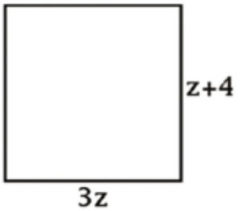
\(\textbf{3)}\) For the following square, solve for z.
\(\,\,\,\,\,\,\,\,\,\)
\(\,\,\,\,\,\,\,\,\,\) a. \(3\)
\(\,\,\,\,\,\,\,\,\,\) b. \(4\)
\(\,\,\,\,\,\,\,\,\,\) c. \(2\)
\(\,\,\,\,\,\,\,\,\,\) d. \(7\)
HINT: All sides of a square are congruent. The answer is c. \( 2 \)
\(\textbf{4)}\) \(n+4\) is positive and odd, what is a possible value for \(n\)?
\(\,\,\,\,\,\,\,\,\,\) a. \(-2\)
\(\,\,\,\,\,\,\,\,\,\) b. \(-3\)
\(\,\,\,\,\,\,\,\,\,\) c. \(-4\)
\(\,\,\,\,\,\,\,\,\,\) d. \(-5\)
The answer is b. \( -3 \)
\(\textbf{5)}\) What are all the solutions for \(x\)? \(x(x-1)(x+2)=0 \)
\(\,\,\,\,\,\,\,\,\,\) a. \(0,1,2\)
\(\,\,\,\,\,\,\,\,\,\) b. \(0,-1,-2\)
\(\,\,\,\,\,\,\,\,\,\) c. \(0,1,-2\)
\(\,\,\,\,\,\,\,\,\,\) d. \(0,-1,2\)
The answer is c. \( 0,1,-2 \)
Click here for more Practice
Click here for more Practice
\(\textbf{6)}\) What is the midpoint of \((3.5, 6.5)\) and \((-2.5, 3.5)\)?
\(\,\,\,\,\,\,\,\,\,\) a. \((3,4)\)
\(\,\,\,\,\,\,\,\,\,\) b. \((.5,5)\)
\(\,\,\,\,\,\,\,\,\,\) c. \((.5,4.5)\)
\(\,\,\,\,\,\,\,\,\,\) d. \((1,4.5)\)
HINT: The midpoint formula is \( \left(\displaystyle\frac{x_1+x_2}{2},\frac{y_1+y_2}{2}\right) \) The answer is b. \( (.5,5) \)
Click here for more Midpoint Formula Practice
Click here for more Midpoint Formula Practice
\(\textbf{7)}\) The sum of five numbers is \(45\). What is the average of the numbers?
\(\,\,\,\,\,\,\,\,\,\) a. \(40\)
\(\,\,\,\,\,\,\,\,\,\) b. \(9\)
\(\,\,\,\,\,\,\,\,\,\) c. \(15\)
\(\,\,\,\,\,\,\,\,\,\) d. \(10\)
The answer is b. \( 9 \)
Click here for more Averages Practice
Click here for more Averages Practice
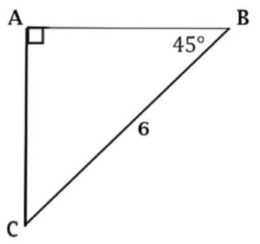
\(\textbf{8)}\) What is the area of this triangle?
\(\,\,\,\,\,\,\,\,\,\)
\(\,\,\,\,\,\,\,\,\,\) a. \(6\) units\(^2\)
\(\,\,\,\,\,\,\,\,\,\) b. \(18\) units\(^2\)
\(\,\,\,\,\,\,\,\,\,\) c. \(12\) units\(^2\)
\(\,\,\,\,\,\,\,\,\,\) d. \(9\) units\(^2\)
The answer is d. \( 9 \) units\(^2 \)
Click here for more 45-45-90 Triangle Practice
Click here for more 45-45-90 Triangle Practice
\(\textbf{9)}\) What is the x-intercept of this line? \(y=3x-4 \)
\(\,\,\,\,\,\,\,\,\,\) a. \((3,0)\)
\(\,\,\,\,\,\,\,\,\,\) b. \((4,0)\)
\(\,\,\,\,\,\,\,\,\,\) c. \((\frac{3}{4},0)\)
\(\,\,\,\,\,\,\,\,\,\) d. \((\frac{4}{3},0)\)
HINT: The x-axis is when \(y=0.\) The answer is d. \( (\frac{4}{3},0) \)
Click here for more Linear Equations Practice
Click here for more Linear Equations Practice
\(\textbf{10)}\) Jessica collects rocks. She started the week with 20 rocks. Later in the week she traded 3 of her rocks to Steve for 12 of his rocks. She then sold 5 to her brother. After all of this, what is the percent of increase in Jessica’s rock collection?
\(\,\,\,\,\,\,\,\,\,\) a. \(20 \% \)
\(\,\,\,\,\,\,\,\,\,\) b. \(33 \frac{1}{3} \% \)
\(\,\,\,\,\,\,\,\,\,\) c. \(15 \% \)
\(\,\,\,\,\,\,\,\,\,\) d. \(140 \% \)
The answer is a. \( 20\% \)
Click here for more Percent Word Problem Practice
Click here for more Percent Word Problem Practice
\(\textbf{11)}\) Simplify \(\frac{9x^2 y^3 z^5}{27x^3 z^4} \)
\(\,\,\,\,\,\,\,\,\,\) a. \(\frac{1yz}{3x}\)
\(\,\,\,\,\,\,\,\,\,\) b. \(\frac{1y^3z}{9x}\)
\(\,\,\,\,\,\,\,\,\,\) c. \(\frac{1y^3z}{3x}\)
\(\,\,\,\,\,\,\,\,\,\) d. \(\frac{1xy^3}{18z}\)
The answer is c. \( \frac{1y^3z}{3x} \)
Click here for more Dividing Monomials Practice
Click here for more Dividing Monomials Practice
\(\textbf{12)}\) If \(4p+3q=7b\), what is \(q\) in terms of \(b\) and \(p? \)
\(\,\,\,\,\,\,\,\,\,\) a. \(q=7b-4p\)
\(\,\,\,\,\,\,\,\,\,\) b. \(q=\frac{7}{3}b-\frac{4}{3}p\)
\(\,\,\,\,\,\,\,\,\,\) c. \(q=\frac{7b+4p}{3}\)
\(\,\,\,\,\,\,\,\,\,\) d. \(q=\frac{4}{3}b-\frac{7}{3}p\)
The answer is b. \( q=\frac{7}{3}b-\frac{4}{3}p \)
Click here for more Isolating Variables Practice
Click here for more Isolating Variables Practice
\(\textbf{13)}\) For the set \(2, 3, 4, 5, 6, 7, 7\). What is the mode?
\(\,\,\,\,\,\,\,\,\,\) a. \(2\)
\(\,\,\,\,\,\,\,\,\,\) b. \(3\)
\(\,\,\,\,\,\,\,\,\,\) c. \(5\)
\(\,\,\,\,\,\,\,\,\,\) d. \(7\)
HINT: The mode is the most common number in the data. The answer is d. \( 7 \)
Click here for more Mean, Median and Mode Practice
Click here for more Mean, Median and Mode Practice
\(\textbf{14)}\) The average of \(x,y,z\), and \(w\) is \(14\). The average of \(x\) and \(z\) is \(10\), what is the average of \(y\) and \(w? \)
\(\,\,\,\,\,\,\,\,\,\) a. \(14\)
\(\,\,\,\,\,\,\,\,\,\) b. \(10\)
\(\,\,\,\,\,\,\,\,\,\) c. \(18\)
\(\,\,\,\,\,\,\,\,\,\) d. \(20\)
The answer is c. \( 18 \)
Click here for more Averages Practice
Click here for more Averages Practice
\(\textbf{15)}\) If \( \cos \theta =\frac{3}{5}\), and the terminal side of the angle is in quadrant IV, what is \( \sin \theta\)?
\(\,\,\,\,\,\,\,\,\,\) a. \(\frac{4}{5}\)
\(\,\,\,\,\,\,\,\,\,\) b. \(-\frac{4}{5}\)
\(\,\,\,\,\,\,\,\,\,\) c. \(\frac{2}{5}\)
\(\,\,\,\,\,\,\,\,\,\) d. \(\frac{5}{4}\)
The answer is b. \( -\frac{4}{5} \)
Click here for more Trigonometry Practice
Click here for more Trigonometry Practice
Good Job! Try Another One?