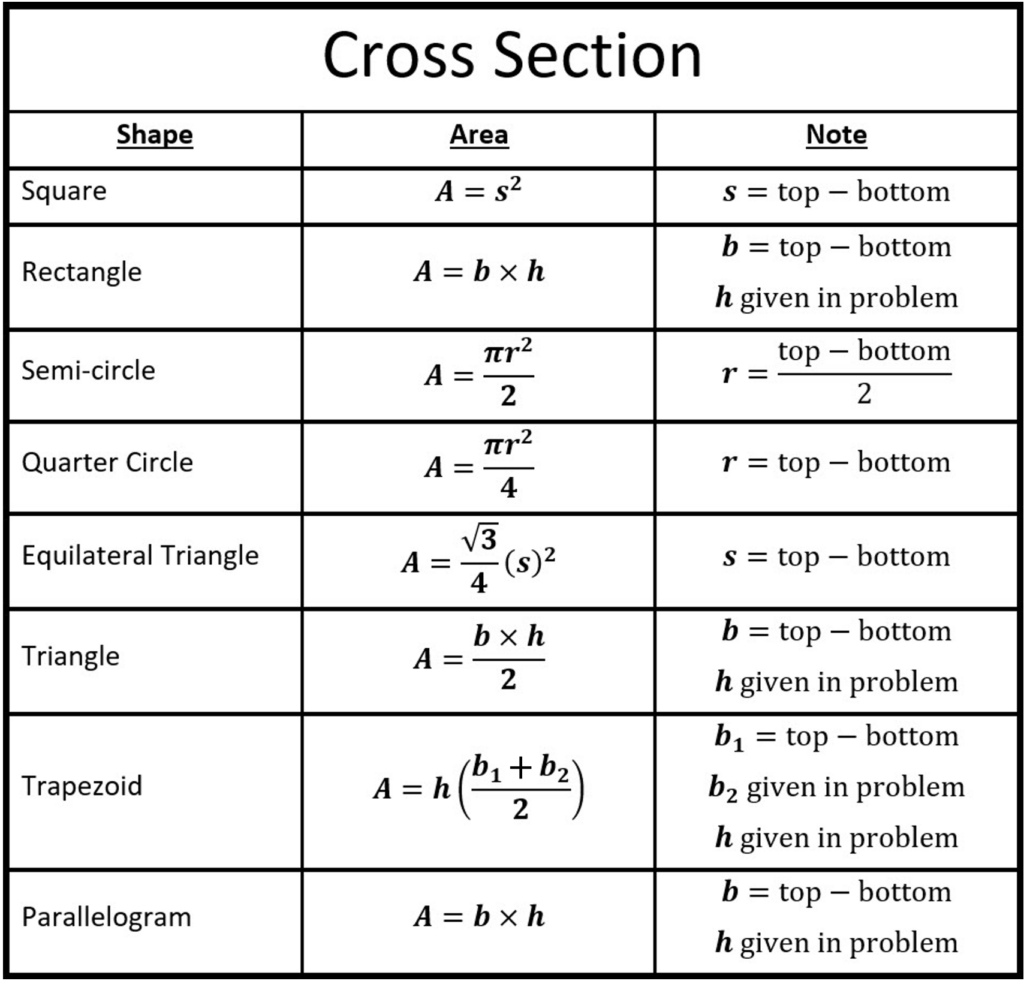
Volume by cross sections is a calculus method where the volume of a solid is found by adding up the areas of many thin slices. The base region is usually bounded by two curves, and each slice has a known shape such as a square, semicircle, or equilateral triangle. The main setup is \(\text{Volume}=\displaystyle \int_a^b \text{Area}\,dx\), where the cross-sectional area depends on the distance between the curves.
Notes
Practice Problems
\(\textbf{1)}\) Find the volume of the solid whose base is the region between \(f(x)=x^2+4\) and \(g(x)=\frac{1}{2}x+1\) from \(x=0\) to \(x=2\) and cross sections taken perpendicular to the x-axis are squares. Volume\(=31\frac{1}{15} = 31.0\overline{6}\)
\(\,\,\,\,\,\,\text{Volume}=\displaystyle \int_{a}^{b}\left(\text{Area}\right) \, dx\)
\(\,\,\,\,\,\,\text{Area of Square}=s^2=\left(f(x)-g(x)\right)^2\)
\(\,\,\,\,\,\,\displaystyle \int_{0}^{2}\left( x^2+4-\left(\frac{1}{2}x+1\right)\right)^2 dx\)
\(\,\,\,\,\,\,\displaystyle \int_{0}^{2}\left( x^2-\frac{1}{2}x+3\right)^2 dx\)
\(\,\,\,\,\,\,\displaystyle \int_{0}^{2}\left( x^4-x^3+\frac{25x^2}{4}-3x+9\right) dx\)
\(\,\,\,\,\,\,\displaystyle \left(\frac{x^5}{5}-\frac{x^4}{4}+\frac{25x^3}{12}-\frac{3x^2}{2}+9x\right) \, \big|_0^2\)
\(\,\,\,\,\,\,\displaystyle \frac{32}{5}-4+\frac{50}{3}-6+18\)
\(\,\,\,\,\,\,\)Volume\(=31\frac{1}{15} = 31.0\overline{6}\)
\(\,\,\,\,\,\,\text{Volume}=\displaystyle \int_{a}^{b}\left(\text{Area}\right) \, dx\)
\(\,\,\,\,\,\,\text{Area of Square}=s^2=\left(f(x)-g(x)\right)^2\)
\(\,\,\,\,\,\,\displaystyle \int_{0}^{2}\left( x^2+4-\left(\frac{1}{2}x+1\right)\right)^2 dx\)
\(\,\,\,\,\,\,\displaystyle \int_{0}^{2}\left( x^2-\frac{1}{2}x+3\right)^2 dx\)
\(\,\,\,\,\,\,\displaystyle \int_{0}^{2}\left( x^4-x^3+\frac{25x^2}{4}-3x+9\right) dx\)
\(\,\,\,\,\,\,\displaystyle \left(\frac{x^5}{5}-\frac{x^4}{4}+\frac{25x^3}{12}-\frac{3x^2}{2}+9x\right) \, \big|_0^2\)
\(\,\,\,\,\,\,\displaystyle \frac{32}{5}-4+\frac{50}{3}-6+18\)
\(\,\,\,\,\,\,\)Volume\(=31\frac{1}{15} = 31.0\overline{6}\)
\(\textbf{2)}\) Find the volume of the solid whose base is the region between \(f(x)=x^2+4\) and \(g(x)=\frac{1}{2}x+1\) from \(x=0\) to \(x=2\) and cross sections taken perpendicular to the x-axis are semi-circles. Volume\( \approx 12.1999\)
\(\,\,\,\,\,\,\text{Volume}=\displaystyle \int_{a}^{b}\left(\text{Area}\right) \, dx\)
\(\,\,\,\,\,\,\text{Area of Semicircle}=\displaystyle\frac{\pi r^2}{2}\)
\(\,\,\,\,\,\,r=\frac{f(x)-g(x)}{2}\)
\(\,\,\,\,\,\,\text{Area}=\displaystyle\frac{\pi}{8}\left(f(x)-g(x)\right)^2\)
\(\,\,\,\,\,\,\text{Area}=\displaystyle\frac{\pi}{8}\left(x^2-\frac{1}{2}x+3\right)^2\)
\(\,\,\,\,\,\,\)Volume\(=\displaystyle \int_{0}^{2} \frac{\pi}{8} \left( x^2-\frac{1}{2}x+3\right)^2 \, dx\)
\(\,\,\,\,\,\,\)Volume\(=\frac{\pi}{8}\left(31\frac{1}{15}\right)\approx 12.1999\)
\(\,\,\,\,\,\,\text{Volume}=\displaystyle \int_{a}^{b}\left(\text{Area}\right) \, dx\)
\(\,\,\,\,\,\,\text{Area of Semicircle}=\displaystyle\frac{\pi r^2}{2}\)
\(\,\,\,\,\,\,r=\frac{f(x)-g(x)}{2}\)
\(\,\,\,\,\,\,\text{Area}=\displaystyle\frac{\pi}{8}\left(f(x)-g(x)\right)^2\)
\(\,\,\,\,\,\,\text{Area}=\displaystyle\frac{\pi}{8}\left(x^2-\frac{1}{2}x+3\right)^2\)
\(\,\,\,\,\,\,\)Volume\(=\displaystyle \int_{0}^{2} \frac{\pi}{8} \left( x^2-\frac{1}{2}x+3\right)^2 \, dx\)
\(\,\,\,\,\,\,\)Volume\(=\frac{\pi}{8}\left(31\frac{1}{15}\right)\approx 12.1999\)
\(\textbf{3)}\) Find the volume of the solid whose base is the region between \(f(x)=x^2+4\) and \(g(x)=\frac{1}{2}x+1\) from \(x=0\) to \(x=2\) and cross sections taken perpendicular to the x-axis are equilateral triangles. Volume\(\approx 13.4523\)
\(\,\,\,\,\,\,\text{Volume}=\displaystyle \int_{a}^{b}\left(\text{Area}\right) \, dx\)
\(\,\,\,\,\,\,\text{Area of Equilateral Triangle}=\displaystyle\frac{\sqrt{3}}{4}s^2\)
\(\,\,\,\,\,\,s=f(x)-g(x)\)
\(\,\,\,\,\,\,s=x^2-\frac{1}{2}x+3\)
\(\,\,\,\,\,\,\)Volume\(=\displaystyle \int_{0}^{2} \frac{\sqrt{3}}{4} \left( x^2-\frac{1}{2}x+3\right)^2 \, dx\)
\(\,\,\,\,\,\,\)Volume\(=\frac{\sqrt{3}}{4}\left(31\frac{1}{15}\right)\approx 13.4523\)
\(\,\,\,\,\,\,\text{Volume}=\displaystyle \int_{a}^{b}\left(\text{Area}\right) \, dx\)
\(\,\,\,\,\,\,\text{Area of Equilateral Triangle}=\displaystyle\frac{\sqrt{3}}{4}s^2\)
\(\,\,\,\,\,\,s=f(x)-g(x)\)
\(\,\,\,\,\,\,s=x^2-\frac{1}{2}x+3\)
\(\,\,\,\,\,\,\)Volume\(=\displaystyle \int_{0}^{2} \frac{\sqrt{3}}{4} \left( x^2-\frac{1}{2}x+3\right)^2 \, dx\)
\(\,\,\,\,\,\,\)Volume\(=\frac{\sqrt{3}}{4}\left(31\frac{1}{15}\right)\approx 13.4523\)
\(\textbf{4)}\) Find the volume of the solid whose base is the region between \(f(x)=\sqrt{x}\) and \(g(x)=x\) from \(x=0\) to \(x=1\) and cross sections taken perpendicular to the x-axis are squares. Volume\(=\displaystyle\frac{1}{30} \approx 0.0333\)
\(\,\,\,\,\,\,\text{Volume}=\displaystyle \int_{a}^{b}\left(\text{Area}\right) \, dx\)
\(\,\,\,\,\,\,\text{Area of Square}=s^2\)
\(\,\,\,\,\,\,s=\sqrt{x}-x\)
\(\,\,\,\,\,\,\)Volume\(=\displaystyle \int_{0}^{1}\left( \sqrt{x}-x \right)^2 dx\)
\(\,\,\,\,\,\,\)Volume\(=\displaystyle \int_{0}^{1}\left(x-2x^{3/2}+x^2\right)dx\)
\(\,\,\,\,\,\,\)Volume\(=\left[\frac{x^2}{2}-\frac{4x^{5/2}}{5}+\frac{x^3}{3}\right]_0^1\)
\(\,\,\,\,\,\,\)Volume\(=\frac{1}{2}-\frac{4}{5}+\frac{1}{3}=\frac{1}{30}\)
\(\,\,\,\,\,\,\text{Volume}=\displaystyle \int_{a}^{b}\left(\text{Area}\right) \, dx\)
\(\,\,\,\,\,\,\text{Area of Square}=s^2\)
\(\,\,\,\,\,\,s=\sqrt{x}-x\)
\(\,\,\,\,\,\,\)Volume\(=\displaystyle \int_{0}^{1}\left( \sqrt{x}-x \right)^2 dx\)
\(\,\,\,\,\,\,\)Volume\(=\displaystyle \int_{0}^{1}\left(x-2x^{3/2}+x^2\right)dx\)
\(\,\,\,\,\,\,\)Volume\(=\left[\frac{x^2}{2}-\frac{4x^{5/2}}{5}+\frac{x^3}{3}\right]_0^1\)
\(\,\,\,\,\,\,\)Volume\(=\frac{1}{2}-\frac{4}{5}+\frac{1}{3}=\frac{1}{30}\)
\(\textbf{5)}\) Find the volume of the solid whose base is the region between \(f(x)=\sqrt{x}\) and \(g(x)=x\) from \(x=0\) to \(x=1\) and cross sections taken perpendicular to the x-axis are semi-circles. Volume\(=\displaystyle\frac{\pi}{240} \approx 0.0131\)
\(\,\,\,\,\,\,\text{Volume}=\displaystyle \int_{a}^{b}\left(\text{Area}\right) \, dx\)
\(\,\,\,\,\,\,\text{Area of Semicircle}=\displaystyle\frac{\pi}{8}s^2\)
\(\,\,\,\,\,\,s=\sqrt{x}-x\)
\(\,\,\,\,\,\)Volume\(=\displaystyle \int_{0}^{1} \frac{\pi}{8} \left( \sqrt{x}-x \right)^2 \, dx\)
\(\,\,\,\,\,\)Volume\(=\frac{\pi}{8}\cdot\frac{1}{30}\)
\(\,\,\,\,\,\)Volume\(=\frac{\pi}{240}\approx 0.0131\)
\(\,\,\,\,\,\,\text{Volume}=\displaystyle \int_{a}^{b}\left(\text{Area}\right) \, dx\)
\(\,\,\,\,\,\,\text{Area of Semicircle}=\displaystyle\frac{\pi}{8}s^2\)
\(\,\,\,\,\,\,s=\sqrt{x}-x\)
\(\,\,\,\,\,\)Volume\(=\displaystyle \int_{0}^{1} \frac{\pi}{8} \left( \sqrt{x}-x \right)^2 \, dx\)
\(\,\,\,\,\,\)Volume\(=\frac{\pi}{8}\cdot\frac{1}{30}\)
\(\,\,\,\,\,\)Volume\(=\frac{\pi}{240}\approx 0.0131\)
\(\textbf{6)}\) Find the volume of the solid whose base is the region between \(f(x)=\sqrt{x}\) and \(g(x)=x\) from \(x=0\) to \(x=1\) and cross sections taken perpendicular to the x-axis are equilateral triangles. Volume\(= \displaystyle\frac{1}{40 \sqrt{3}} \approx 0.0144\)
\(\,\,\,\,\,\,\text{Volume}=\displaystyle \int_{a}^{b}\left(\text{Area}\right) \, dx\)
\(\,\,\,\,\,\,\text{Area of Equilateral Triangle}=\displaystyle\frac{\sqrt{3}}{4}s^2\)
\(\,\,\,\,\,\,s=\sqrt{x}-x\)
\(\,\,\,\,\,\)Volume\(=\displaystyle \int_{0}^{1} \frac{\sqrt{3}}{4} \left( \sqrt{x}-x\right)^2 \, dx\)
\(\,\,\,\,\,\)Volume\(=\frac{\sqrt{3}}{4}\cdot\frac{1}{30}\)
\(\,\,\,\,\,\)Volume\(=\frac{\sqrt{3}}{120}=\frac{1}{40\sqrt{3}}\approx 0.0144\)
\(\,\,\,\,\,\,\text{Volume}=\displaystyle \int_{a}^{b}\left(\text{Area}\right) \, dx\)
\(\,\,\,\,\,\,\text{Area of Equilateral Triangle}=\displaystyle\frac{\sqrt{3}}{4}s^2\)
\(\,\,\,\,\,\,s=\sqrt{x}-x\)
\(\,\,\,\,\,\)Volume\(=\displaystyle \int_{0}^{1} \frac{\sqrt{3}}{4} \left( \sqrt{x}-x\right)^2 \, dx\)
\(\,\,\,\,\,\)Volume\(=\frac{\sqrt{3}}{4}\cdot\frac{1}{30}\)
\(\,\,\,\,\,\)Volume\(=\frac{\sqrt{3}}{120}=\frac{1}{40\sqrt{3}}\approx 0.0144\)
\(\textbf{7)}\) Find the volume of the solid whose base is the region between \(f(x)=4-x\) and \(g(x)=0\) from \(x=0\) to \(x=4\) and cross sections taken perpendicular to the x-axis are squares. Volume\(=\displaystyle\frac{64}{3}\)
\(\,\,\,\,\,\,\text{Volume}=\displaystyle \int_a^b \text{Area}\,dx\)
\(\,\,\,\,\,\,\text{Area of Square}=s^2\)
\(\,\,\,\,\,\,s=4-x\)
\(\,\,\,\,\,\,V=\displaystyle\int_0^4(4-x)^2\,dx\)
\(\,\,\,\,\,\,V=\displaystyle\int_0^4(16-8x+x^2)\,dx\)
\(\,\,\,\,\,\,V=\left[16x-4x^2+\frac{x^3}{3}\right]_0^4\)
\(\,\,\,\,\,\,V=64-64+\frac{64}{3}\)
\(\,\,\,\,\,\,V=\frac{64}{3}\)
\(\,\,\,\,\,\,\text{Volume}=\displaystyle \int_a^b \text{Area}\,dx\)
\(\,\,\,\,\,\,\text{Area of Square}=s^2\)
\(\,\,\,\,\,\,s=4-x\)
\(\,\,\,\,\,\,V=\displaystyle\int_0^4(4-x)^2\,dx\)
\(\,\,\,\,\,\,V=\displaystyle\int_0^4(16-8x+x^2)\,dx\)
\(\,\,\,\,\,\,V=\left[16x-4x^2+\frac{x^3}{3}\right]_0^4\)
\(\,\,\,\,\,\,V=64-64+\frac{64}{3}\)
\(\,\,\,\,\,\,V=\frac{64}{3}\)
\(\textbf{8)}\) Find the volume of the solid whose base is the region between \(f(x)=4-x\) and \(g(x)=0\) from \(x=0\) to \(x=4\) and cross sections taken perpendicular to the x-axis are semi-circles. Volume\(=\displaystyle\frac{8\pi}{3}\)
\(\,\,\,\,\,\,\text{Volume}=\displaystyle \int_a^b \text{Area}\,dx\)
\(\,\,\,\,\,\,\text{Area of Semicircle}=\displaystyle\frac{\pi}{8}s^2\)
\(\,\,\,\,\,\,s=4-x\)
\(\,\,\,\,\,\,V=\displaystyle\int_0^4\frac{\pi}{8}(4-x)^2\,dx\)
\(\,\,\,\,\,\,V=\frac{\pi}{8}\displaystyle\int_0^4(4-x)^2\,dx\)
\(\,\,\,\,\,\,V=\frac{\pi}{8}\cdot\frac{64}{3}\)
\(\,\,\,\,\,\,V=\frac{8\pi}{3}\)
\(\,\,\,\,\,\,\text{Volume}=\displaystyle \int_a^b \text{Area}\,dx\)
\(\,\,\,\,\,\,\text{Area of Semicircle}=\displaystyle\frac{\pi}{8}s^2\)
\(\,\,\,\,\,\,s=4-x\)
\(\,\,\,\,\,\,V=\displaystyle\int_0^4\frac{\pi}{8}(4-x)^2\,dx\)
\(\,\,\,\,\,\,V=\frac{\pi}{8}\displaystyle\int_0^4(4-x)^2\,dx\)
\(\,\,\,\,\,\,V=\frac{\pi}{8}\cdot\frac{64}{3}\)
\(\,\,\,\,\,\,V=\frac{8\pi}{3}\)
\(\textbf{9)}\) Find the volume of the solid whose base is the region between \(f(x)=4-x\) and \(g(x)=0\) from \(x=0\) to \(x=4\) and cross sections taken perpendicular to the x-axis are equilateral triangles. Volume\(=\displaystyle\frac{16\sqrt{3}}{3}\)
\(\,\,\,\,\,\,\text{Volume}=\displaystyle \int_a^b \text{Area}\,dx\)
\(\,\,\,\,\,\,\text{Area of Equilateral Triangle}=\displaystyle\frac{\sqrt{3}}{4}s^2\)
\(\,\,\,\,\,\,s=4-x\)
\(\,\,\,\,\,\,V=\displaystyle\int_0^4\frac{\sqrt{3}}{4}(4-x)^2\,dx\)
\(\,\,\,\,\,\,V=\frac{\sqrt{3}}{4}\displaystyle\int_0^4(4-x)^2\,dx\)
\(\,\,\,\,\,\,V=\frac{\sqrt{3}}{4}\cdot\frac{64}{3}\)
\(\,\,\,\,\,\,V=\frac{16\sqrt{3}}{3}\)
\(\,\,\,\,\,\,\text{Volume}=\displaystyle \int_a^b \text{Area}\,dx\)
\(\,\,\,\,\,\,\text{Area of Equilateral Triangle}=\displaystyle\frac{\sqrt{3}}{4}s^2\)
\(\,\,\,\,\,\,s=4-x\)
\(\,\,\,\,\,\,V=\displaystyle\int_0^4\frac{\sqrt{3}}{4}(4-x)^2\,dx\)
\(\,\,\,\,\,\,V=\frac{\sqrt{3}}{4}\displaystyle\int_0^4(4-x)^2\,dx\)
\(\,\,\,\,\,\,V=\frac{\sqrt{3}}{4}\cdot\frac{64}{3}\)
\(\,\,\,\,\,\,V=\frac{16\sqrt{3}}{3}\)
\(\textbf{10)}\) Find the volume of the solid whose base is the region between \(f(x)=x+2\) and \(g(x)=1\) from \(x=0\) to \(x=3\) and cross sections taken perpendicular to the x-axis are squares. Volume\(=21\)
\(\,\,\,\,\,\,s=(x+2)-1=x+1\)
\(\,\,\,\,\,\,\text{Area}=s^2=(x+1)^2\)
\(\,\,\,\,\,\,V=\displaystyle\int_0^3(x+1)^2\,dx\)
\(\,\,\,\,\,\,V=\displaystyle\int_0^3(x^2+2x+1)\,dx\)
\(\,\,\,\,\,\,V=\left[\frac{x^3}{3}+x^2+x\right]_0^3\)
\(\,\,\,\,\,\,V=9+9+3\)
\(\,\,\,\,\,\,V=21\)
\(\,\,\,\,\,\,s=(x+2)-1=x+1\)
\(\,\,\,\,\,\,\text{Area}=s^2=(x+1)^2\)
\(\,\,\,\,\,\,V=\displaystyle\int_0^3(x+1)^2\,dx\)
\(\,\,\,\,\,\,V=\displaystyle\int_0^3(x^2+2x+1)\,dx\)
\(\,\,\,\,\,\,V=\left[\frac{x^3}{3}+x^2+x\right]_0^3\)
\(\,\,\,\,\,\,V=9+9+3\)
\(\,\,\,\,\,\,V=21\)
\(\textbf{11)}\) Find the volume of the solid whose base is the region between \(f(x)=x+2\) and \(g(x)=1\) from \(x=0\) to \(x=3\) and cross sections taken perpendicular to the x-axis are semi-circles. Volume\(=\displaystyle\frac{21\pi}{8}\)
\(\,\,\,\,\,\,s=(x+2)-1=x+1\)
\(\,\,\,\,\,\,\text{Area of Semicircle}=\displaystyle\frac{\pi}{8}s^2\)
\(\,\,\,\,\,\,V=\displaystyle\int_0^3\frac{\pi}{8}(x+1)^2\,dx\)
\(\,\,\,\,\,\,V=\frac{\pi}{8}\displaystyle\int_0^3(x+1)^2\,dx\)
\(\,\,\,\,\,\,V=\frac{\pi}{8}(21)\)
\(\,\,\,\,\,\,V=\frac{21\pi}{8}\)
\(\,\,\,\,\,\,s=(x+2)-1=x+1\)
\(\,\,\,\,\,\,\text{Area of Semicircle}=\displaystyle\frac{\pi}{8}s^2\)
\(\,\,\,\,\,\,V=\displaystyle\int_0^3\frac{\pi}{8}(x+1)^2\,dx\)
\(\,\,\,\,\,\,V=\frac{\pi}{8}\displaystyle\int_0^3(x+1)^2\,dx\)
\(\,\,\,\,\,\,V=\frac{\pi}{8}(21)\)
\(\,\,\,\,\,\,V=\frac{21\pi}{8}\)
\(\textbf{12)}\) Find the volume of the solid whose base is the region between \(f(x)=x+2\) and \(g(x)=1\) from \(x=0\) to \(x=3\) and cross sections taken perpendicular to the x-axis are equilateral triangles. Volume\(=\displaystyle\frac{21\sqrt{3}}{4}\)
\(\,\,\,\,\,\,s=(x+2)-1=x+1\)
\(\,\,\,\,\,\,\text{Area of Equilateral Triangle}=\displaystyle\frac{\sqrt{3}}{4}s^2\)
\(\,\,\,\,\,\,V=\displaystyle\int_0^3\frac{\sqrt{3}}{4}(x+1)^2\,dx\)
\(\,\,\,\,\,\,V=\frac{\sqrt{3}}{4}\displaystyle\int_0^3(x+1)^2\,dx\)
\(\,\,\,\,\,\,V=\frac{\sqrt{3}}{4}(21)\)
\(\,\,\,\,\,\,V=\frac{21\sqrt{3}}{4}\)
\(\,\,\,\,\,\,s=(x+2)-1=x+1\)
\(\,\,\,\,\,\,\text{Area of Equilateral Triangle}=\displaystyle\frac{\sqrt{3}}{4}s^2\)
\(\,\,\,\,\,\,V=\displaystyle\int_0^3\frac{\sqrt{3}}{4}(x+1)^2\,dx\)
\(\,\,\,\,\,\,V=\frac{\sqrt{3}}{4}\displaystyle\int_0^3(x+1)^2\,dx\)
\(\,\,\,\,\,\,V=\frac{\sqrt{3}}{4}(21)\)
\(\,\,\,\,\,\,V=\frac{21\sqrt{3}}{4}\)
\(\textbf{13)}\) Find the volume of the solid whose base is the region between \(f(x)=9-x^2\) and \(g(x)=0\) from \(x=0\) to \(x=3\) and cross sections taken perpendicular to the x-axis are squares. Volume\(=\displaystyle\frac{1296}{5}\)
\(\,\,\,\,\,\,s=9-x^2\)
\(\,\,\,\,\,\,\text{Area}=s^2=(9-x^2)^2\)
\(\,\,\,\,\,\,V=\displaystyle\int_0^3(9-x^2)^2\,dx\)
\(\,\,\,\,\,\,V=\displaystyle\int_0^3(81-18x^2+x^4)\,dx\)
\(\,\,\,\,\,\,V=\left[81x-6x^3+\frac{x^5}{5}\right]_0^3\)
\(\,\,\,\,\,\,V=243-162+\frac{243}{5}\)
\(\,\,\,\,\,\,V=\frac{648}{5}\)
\(\,\,\,\,\,\,s=9-x^2\)
\(\,\,\,\,\,\,\text{Area}=s^2=(9-x^2)^2\)
\(\,\,\,\,\,\,V=\displaystyle\int_0^3(9-x^2)^2\,dx\)
\(\,\,\,\,\,\,V=\displaystyle\int_0^3(81-18x^2+x^4)\,dx\)
\(\,\,\,\,\,\,V=\left[81x-6x^3+\frac{x^5}{5}\right]_0^3\)
\(\,\,\,\,\,\,V=243-162+\frac{243}{5}\)
\(\,\,\,\,\,\,V=\frac{648}{5}\)
\(\textbf{14)}\) Find the volume of the solid whose base is the region between \(f(x)=9-x^2\) and \(g(x)=0\) from \(x=-3\) to \(x=3\) and cross sections taken perpendicular to the x-axis are squares. Volume\(=\displaystyle\frac{1296}{5}\)
\(\,\,\,\,\,\,s=9-x^2\)
\(\,\,\,\,\,\,\text{Area}=s^2=(9-x^2)^2\)
\(\,\,\,\,\,\,V=\displaystyle\int_{-3}^{3}(9-x^2)^2\,dx\)
\(\,\,\,\,\,\,V=\displaystyle\int_{-3}^{3}(81-18x^2+x^4)\,dx\)
\(\,\,\,\,\,\,V=2\displaystyle\int_0^3(81-18x^2+x^4)\,dx\)
\(\,\,\,\,\,\,V=2\left(243-162+\frac{243}{5}\right)\)
\(\,\,\,\,\,\,V=\frac{1296}{5}\)
\(\,\,\,\,\,\,s=9-x^2\)
\(\,\,\,\,\,\,\text{Area}=s^2=(9-x^2)^2\)
\(\,\,\,\,\,\,V=\displaystyle\int_{-3}^{3}(9-x^2)^2\,dx\)
\(\,\,\,\,\,\,V=\displaystyle\int_{-3}^{3}(81-18x^2+x^4)\,dx\)
\(\,\,\,\,\,\,V=2\displaystyle\int_0^3(81-18x^2+x^4)\,dx\)
\(\,\,\,\,\,\,V=2\left(243-162+\frac{243}{5}\right)\)
\(\,\,\,\,\,\,V=\frac{1296}{5}\)
\(\textbf{15)}\) Find the volume of the solid whose base is the region between \(f(x)=9-x^2\) and \(g(x)=0\) from \(x=-3\) to \(x=3\) and cross sections taken perpendicular to the x-axis are semi-circles. Volume\(=\displaystyle\frac{162\pi}{5}\)
\(\,\,\,\,\,\,s=9-x^2\)
\(\,\,\,\,\,\,\text{Area of Semicircle}=\displaystyle\frac{\pi}{8}s^2\)
\(\,\,\,\,\,\,V=\displaystyle\int_{-3}^{3}\frac{\pi}{8}(9-x^2)^2\,dx\)
\(\,\,\,\,\,\,V=\frac{\pi}{8}\displaystyle\int_{-3}^{3}(9-x^2)^2\,dx\)
\(\,\,\,\,\,\,V=\frac{\pi}{8}\cdot\frac{1296}{5}\)
\(\,\,\,\,\,\,V=\frac{162\pi}{5}\)
\(\,\,\,\,\,\,s=9-x^2\)
\(\,\,\,\,\,\,\text{Area of Semicircle}=\displaystyle\frac{\pi}{8}s^2\)
\(\,\,\,\,\,\,V=\displaystyle\int_{-3}^{3}\frac{\pi}{8}(9-x^2)^2\,dx\)
\(\,\,\,\,\,\,V=\frac{\pi}{8}\displaystyle\int_{-3}^{3}(9-x^2)^2\,dx\)
\(\,\,\,\,\,\,V=\frac{\pi}{8}\cdot\frac{1296}{5}\)
\(\,\,\,\,\,\,V=\frac{162\pi}{5}\)
\(\textbf{16)}\) Find the volume of the solid whose base is the region between \(f(x)=9-x^2\) and \(g(x)=0\) from \(x=-3\) to \(x=3\) and cross sections taken perpendicular to the x-axis are equilateral triangles. Volume\(=\displaystyle\frac{324\sqrt{3}}{5}\)
\(\,\,\,\,\,\,s=9-x^2\)
\(\,\,\,\,\,\,\text{Area of Equilateral Triangle}=\displaystyle\frac{\sqrt{3}}{4}s^2\)
\(\,\,\,\,\,\,V=\displaystyle\int_{-3}^{3}\frac{\sqrt{3}}{4}(9-x^2)^2\,dx\)
\(\,\,\,\,\,\,V=\frac{\sqrt{3}}{4}\displaystyle\int_{-3}^{3}(9-x^2)^2\,dx\)
\(\,\,\,\,\,\,V=\frac{\sqrt{3}}{4}\cdot\frac{1296}{5}\)
\(\,\,\,\,\,\,V=\frac{324\sqrt{3}}{5}\)
\(\,\,\,\,\,\,s=9-x^2\)
\(\,\,\,\,\,\,\text{Area of Equilateral Triangle}=\displaystyle\frac{\sqrt{3}}{4}s^2\)
\(\,\,\,\,\,\,V=\displaystyle\int_{-3}^{3}\frac{\sqrt{3}}{4}(9-x^2)^2\,dx\)
\(\,\,\,\,\,\,V=\frac{\sqrt{3}}{4}\displaystyle\int_{-3}^{3}(9-x^2)^2\,dx\)
\(\,\,\,\,\,\,V=\frac{\sqrt{3}}{4}\cdot\frac{1296}{5}\)
\(\,\,\,\,\,\,V=\frac{324\sqrt{3}}{5}\)
\(\textbf{17)}\) Find the volume of the solid whose base is the region between \(f(x)=6\) and \(g(x)=2x\) from \(x=0\) to \(x=3\) and cross sections taken perpendicular to the x-axis are squares. Volume\(=36\)
\(\,\,\,\,\,\,s=6-2x\)
\(\,\,\,\,\,\,\text{Area}=s^2=(6-2x)^2\)
\(\,\,\,\,\,\,V=\displaystyle\int_0^3(6-2x)^2\,dx\)
\(\,\,\,\,\,\,V=\displaystyle\int_0^3(36-24x+4x^2)\,dx\)
\(\,\,\,\,\,\,V=\left[36x-12x^2+\frac{4x^3}{3}\right]_0^3\)
\(\,\,\,\,\,\,V=108-108+36\)
\(\,\,\,\,\,\,V=36\)
\(\,\,\,\,\,\,s=6-2x\)
\(\,\,\,\,\,\,\text{Area}=s^2=(6-2x)^2\)
\(\,\,\,\,\,\,V=\displaystyle\int_0^3(6-2x)^2\,dx\)
\(\,\,\,\,\,\,V=\displaystyle\int_0^3(36-24x+4x^2)\,dx\)
\(\,\,\,\,\,\,V=\left[36x-12x^2+\frac{4x^3}{3}\right]_0^3\)
\(\,\,\,\,\,\,V=108-108+36\)
\(\,\,\,\,\,\,V=36\)
\(\textbf{18)}\) Find the volume of the solid whose base is the region between \(f(x)=6\) and \(g(x)=2x\) from \(x=0\) to \(x=3\) and cross sections taken perpendicular to the x-axis are semi-circles. Volume\(=\displaystyle\frac{9\pi}{2}\)
\(\,\,\,\,\,\,s=6-2x\)
\(\,\,\,\,\,\,\text{Area of Semicircle}=\displaystyle\frac{\pi}{8}s^2\)
\(\,\,\,\,\,\,V=\displaystyle\int_0^3\frac{\pi}{8}(6-2x)^2\,dx\)
\(\,\,\,\,\,\,V=\frac{\pi}{8}\displaystyle\int_0^3(6-2x)^2\,dx\)
\(\,\,\,\,\,\,V=\frac{\pi}{8}(36)\)
\(\,\,\,\,\,\,V=\frac{9\pi}{2}\)
\(\,\,\,\,\,\,s=6-2x\)
\(\,\,\,\,\,\,\text{Area of Semicircle}=\displaystyle\frac{\pi}{8}s^2\)
\(\,\,\,\,\,\,V=\displaystyle\int_0^3\frac{\pi}{8}(6-2x)^2\,dx\)
\(\,\,\,\,\,\,V=\frac{\pi}{8}\displaystyle\int_0^3(6-2x)^2\,dx\)
\(\,\,\,\,\,\,V=\frac{\pi}{8}(36)\)
\(\,\,\,\,\,\,V=\frac{9\pi}{2}\)
\(\textbf{19)}\) Find the volume of the solid whose base is the region between \(f(x)=6\) and \(g(x)=2x\) from \(x=0\) to \(x=3\) and cross sections taken perpendicular to the x-axis are equilateral triangles. Volume\(=9\sqrt{3}\)
\(\,\,\,\,\,\,s=6-2x\)
\(\,\,\,\,\,\,\text{Area of Equilateral Triangle}=\displaystyle\frac{\sqrt{3}}{4}s^2\)
\(\,\,\,\,\,\,V=\displaystyle\int_0^3\frac{\sqrt{3}}{4}(6-2x)^2\,dx\)
\(\,\,\,\,\,\,V=\frac{\sqrt{3}}{4}\displaystyle\int_0^3(6-2x)^2\,dx\)
\(\,\,\,\,\,\,V=\frac{\sqrt{3}}{4}(36)\)
\(\,\,\,\,\,\,V=9\sqrt{3}\)
\(\,\,\,\,\,\,s=6-2x\)
\(\,\,\,\,\,\,\text{Area of Equilateral Triangle}=\displaystyle\frac{\sqrt{3}}{4}s^2\)
\(\,\,\,\,\,\,V=\displaystyle\int_0^3\frac{\sqrt{3}}{4}(6-2x)^2\,dx\)
\(\,\,\,\,\,\,V=\frac{\sqrt{3}}{4}\displaystyle\int_0^3(6-2x)^2\,dx\)
\(\,\,\,\,\,\,V=\frac{\sqrt{3}}{4}(36)\)
\(\,\,\,\,\,\,V=9\sqrt{3}\)
\(\textbf{20)}\) Find the volume of the solid whose base is the region between \(f(x)=x^2+1\) and \(g(x)=1\) from \(x=0\) to \(x=2\) and cross sections taken perpendicular to the x-axis are squares. Volume\(=\displaystyle\frac{32}{5}\)
\(\,\,\,\,\,\,s=(x^2+1)-1=x^2\)
\(\,\,\,\,\,\,\text{Area}=s^2=x^4\)
\(\,\,\,\,\,\,V=\displaystyle\int_0^2x^4\,dx\)
\(\,\,\,\,\,\,V=\left[\frac{x^5}{5}\right]_0^2\)
\(\,\,\,\,\,\,V=\frac{32}{5}\)
\(\,\,\,\,\,\,s=(x^2+1)-1=x^2\)
\(\,\,\,\,\,\,\text{Area}=s^2=x^4\)
\(\,\,\,\,\,\,V=\displaystyle\int_0^2x^4\,dx\)
\(\,\,\,\,\,\,V=\left[\frac{x^5}{5}\right]_0^2\)
\(\,\,\,\,\,\,V=\frac{32}{5}\)
See Related Pages\(\)
\(\bullet\text{ Calculus Homepage}\)
\(\,\,\,\,\,\,\,\,\text{All the Best Topics…}\)
\(\bullet\text{ Trapezoidal Rule}\)
\(\,\,\,\,\,\,\,\,\displaystyle\frac{b-a}{2n}\left[f(a)+2f(x_1)+2f(x_2)+…+2fx_{n-1}+f(b)\right]…\)
\(\bullet\text{ Properties of Integrals}\)
\(\,\,\,\,\,\,\,\,\displaystyle \int_{a}^{b}cf(x) \, dx=c\displaystyle \int_{a}^{b}f(x) \,dx…\)
\(\bullet\text{ Indefinite Integrals- Power Rule}\)
\(\,\,\,\,\,\,\,\,\displaystyle \int x^n \, dx = \displaystyle \frac{x^{n+1}}{n+1}+C…\)
\(\bullet\text{ Indefinite Integrals- Trig Functions}\)
\(\,\,\,\,\,\,\,\,\displaystyle \int \cos{x} \, dx=\sin{x}+C…\)
\(\bullet\text{ Definite Integrals}\)
\(\,\,\,\,\,\,\,\,\displaystyle \int_{5}^{7} x^3 \, dx…\)
\(\bullet\text{ Integration by Substitution}\)
\(\,\,\,\,\,\,\,\,\displaystyle \int (x^2+3)^3(2x) \,dx…\)
\(\bullet\text{ Area of Region Between Two Curves}\)
\(\,\,\,\,\,\,\,\,A=\displaystyle \int_{a}^{b}\left[f(x)-g(x)\right]\,dx…\)
\(\bullet\text{ Arc Length}\)
\(\,\,\,\,\,\,\,\,\displaystyle \int_{a}^{b}\sqrt{1+\left[f'(x)\right]^2} \,dx…\)
\(\bullet\text{ Average Function Value}\)
\(\,\,\,\,\,\,\,\,\displaystyle\frac{1}{b-a} \int_{a}^{b}f(x) \,dx\)
\(\bullet\text{ Volume by Cross Sections}\)
\(\,\,\,\,\,\,\,\,\)
\(\bullet\text{ Disk Method}\)
\(\,\,\,\,\,\,\,\,V=\displaystyle \int_{a}^{b}\left[f(x)\right]^2\,dx…\)
\(\bullet\text{ Cylindrical Shells}\)
\(\,\,\,\,\,\,\,\,V=2 \pi \displaystyle \int_{a}^{b} y f(y) \, dy…\)
In Summary
Volume by cross sections is a method of calculating the volume of a three-dimensional object by slicing it into thin cross sections and summing the volumes of these slices. This method is commonly used in calculus to find the volume of complex shapes that may not have a simple formula for finding volume. The volume of an object is defined as the integral of the object’s cross sectional area over its entire length. The cross sectional area is the area of the object’s slice at a particular point along its length.
Volume by cross sections is typically covered in a calculus course, specifically in a unit on integration. Some related topics include integration, the Fundamental Theorem of Calculus, and the concept of volume in general.