

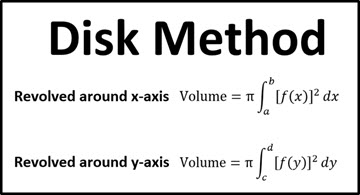
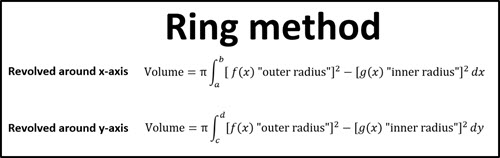
The Disk Method and Washer Method are used to find the volume of a solid formed by rotating a region around an axis. The Disk Method uses circular cross sections when there is no hole, while the Washer Method subtracts an inner radius from an outer radius when there is a hole. The main formulas are \(V=\pi\int_a^b R^2\,dx\) for disks and \(V=\pi\int_a^b \left(R^2-r^2\right)\,dx\) for washers.
Notes
Practice Problems
Region bounded by:
\(f(x)=-x^2+8x-12\)
and x-axis
\(\textbf{1)}\) Revolved around x-axis The answer is \(\pi\displaystyle\int_{2}^{6}(-x^2+8x-12)^2 dx \approx 107.23 \)
\(-x^2+8x-12=0\)
\(x^2-8x+12=0\)
\((x-2)(x-6)=0\)
\(x=2\text{ and }x=6\)
\(V=\pi\displaystyle\int_a^b R^2\,dx\)
\(R=-x^2+8x-12\)
\(V=\pi\displaystyle\int_{2}^{6}(-x^2+8x-12)^2\,dx\)
\(V\approx 107.23\)
\(\text{The answer is }\pi\displaystyle\int_{2}^{6}(-x^2+8x-12)^2 dx \approx 107.23\)
\(-x^2+8x-12=0\)
\(x^2-8x+12=0\)
\((x-2)(x-6)=0\)
\(x=2\text{ and }x=6\)
\(V=\pi\displaystyle\int_a^b R^2\,dx\)
\(R=-x^2+8x-12\)
\(V=\pi\displaystyle\int_{2}^{6}(-x^2+8x-12)^2\,dx\)
\(V\approx 107.23\)
\(\text{The answer is }\pi\displaystyle\int_{2}^{6}(-x^2+8x-12)^2 dx \approx 107.23\)
Region bounded by:
\(y=x^2\)
\(x=0\)
\(x=4\)
and x-axis
\(\textbf{2)}\) Revolved around x-axis The answer is \(\pi\displaystyle\int_{0}^{4}(x^2)^2 dx= \displaystyle\frac{1024\pi}{5} \approx 643.40 \)
\(V=\pi\displaystyle\int_a^b R^2\,dx\)
\(R=x^2\)
\(V=\pi\displaystyle\int_0^4 (x^2)^2\,dx\)
\(V=\pi\displaystyle\int_0^4 x^4\,dx\)
\(V=\pi\left[\frac{x^5}{5}\right]_0^4\)
\(V=\pi\left(\frac{4^5}{5}-0\right)\)
\(V=\frac{1024\pi}{5}\)
\(V\approx 643.40\)
\(\text{The answer is }\frac{1024\pi}{5}\approx 643.40\)
\(V=\pi\displaystyle\int_a^b R^2\,dx\)
\(R=x^2\)
\(V=\pi\displaystyle\int_0^4 (x^2)^2\,dx\)
\(V=\pi\displaystyle\int_0^4 x^4\,dx\)
\(V=\pi\left[\frac{x^5}{5}\right]_0^4\)
\(V=\pi\left(\frac{4^5}{5}-0\right)\)
\(V=\frac{1024\pi}{5}\)
\(V\approx 643.40\)
\(\text{The answer is }\frac{1024\pi}{5}\approx 643.40\)
\(\textbf{3)}\) Revolved around y-axis The answer is \(\pi\displaystyle\int_{0}^{16}(\sqrt{y})^2 dy=128\pi \approx 402.12 \)
\(y=x^2\)
\(x=\sqrt{y}\)
\(\text{When }x=4,\text{ }y=16\)
\(V=\pi\displaystyle\int_a^b R^2\,dy\)
\(R=\sqrt{y}\)
\(V=\pi\displaystyle\int_0^{16}(\sqrt{y})^2\,dy\)
\(V=\pi\displaystyle\int_0^{16}y\,dy\)
\(V=\pi\left[\frac{y^2}{2}\right]_0^{16}\)
\(V=\pi\left(\frac{256}{2}\right)\)
\(V=128\pi\)
\(V\approx 402.12\)
\(\text{The answer is }128\pi\approx 402.12\)
\(y=x^2\)
\(x=\sqrt{y}\)
\(\text{When }x=4,\text{ }y=16\)
\(V=\pi\displaystyle\int_a^b R^2\,dy\)
\(R=\sqrt{y}\)
\(V=\pi\displaystyle\int_0^{16}(\sqrt{y})^2\,dy\)
\(V=\pi\displaystyle\int_0^{16}y\,dy\)
\(V=\pi\left[\frac{y^2}{2}\right]_0^{16}\)
\(V=\pi\left(\frac{256}{2}\right)\)
\(V=128\pi\)
\(V\approx 402.12\)
\(\text{The answer is }128\pi\approx 402.12\)
Region bounded by:
\(f(x)=x^2-2x+8\)
\(x=1\)
\(x=3\)
and x-axis
\(\textbf{4)}\) Revolved around x-axis The answer is \(\pi\displaystyle\int_{1}^{3}(x^2-2x+8)^2 dx=\displaystyle\frac{2126\pi}{15} \approx 445.27 \)
\(V=\pi\displaystyle\int_a^b R^2\,dx\)
\(R=x^2-2x+8\)
\(V=\pi\displaystyle\int_1^3 (x^2-2x+8)^2\,dx\)
\((x^2-2x+8)^2=x^4-4x^3+20x^2-32x+64\)
\(V=\pi\displaystyle\int_1^3 \left(x^4-4x^3+20x^2-32x+64\right)\,dx\)
\(V=\pi\left[\frac{x^5}{5}-x^4+\frac{20x^3}{3}-16x^2+64x\right]_1^3\)
\(V=\frac{2126\pi}{15}\)
\(V\approx 445.27\)
\(\text{The answer is }\frac{2126\pi}{15}\approx 445.27\)
\(V=\pi\displaystyle\int_a^b R^2\,dx\)
\(R=x^2-2x+8\)
\(V=\pi\displaystyle\int_1^3 (x^2-2x+8)^2\,dx\)
\((x^2-2x+8)^2=x^4-4x^3+20x^2-32x+64\)
\(V=\pi\displaystyle\int_1^3 \left(x^4-4x^3+20x^2-32x+64\right)\,dx\)
\(V=\pi\left[\frac{x^5}{5}-x^4+\frac{20x^3}{3}-16x^2+64x\right]_1^3\)
\(V=\frac{2126\pi}{15}\)
\(V\approx 445.27\)
\(\text{The answer is }\frac{2126\pi}{15}\approx 445.27\)
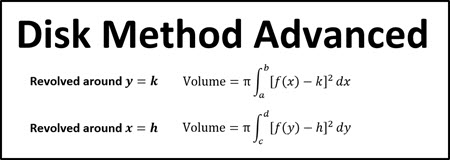
\(\textbf{5)}\) Revolved around \(y=3\) The answer is \(\pi\int_{1}^{3}(x^2-2x+5)^2 dx=\displaystyle\frac{896\pi}{15} \approx 187.66 \)
\(R=(x^2-2x+8)-3\)
\(R=x^2-2x+5\)
\(V=\pi\displaystyle\int_a^b R^2\,dx\)
\(V=\pi\displaystyle\int_1^3 (x^2-2x+5)^2\,dx\)
\((x^2-2x+5)^2=x^4-4x^3+14x^2-20x+25\)
\(V=\pi\displaystyle\int_1^3 \left(x^4-4x^3+14x^2-20x+25\right)\,dx\)
\(V=\pi\left[\frac{x^5}{5}-x^4+\frac{14x^3}{3}-10x^2+25x\right]_1^3\)
\(V=\frac{896\pi}{15}\)
\(V\approx 187.66\)
\(\text{The answer is }\frac{896\pi}{15}\approx 187.66\)
\(R=(x^2-2x+8)-3\)
\(R=x^2-2x+5\)
\(V=\pi\displaystyle\int_a^b R^2\,dx\)
\(V=\pi\displaystyle\int_1^3 (x^2-2x+5)^2\,dx\)
\((x^2-2x+5)^2=x^4-4x^3+14x^2-20x+25\)
\(V=\pi\displaystyle\int_1^3 \left(x^4-4x^3+14x^2-20x+25\right)\,dx\)
\(V=\pi\left[\frac{x^5}{5}-x^4+\frac{14x^3}{3}-10x^2+25x\right]_1^3\)
\(V=\frac{896\pi}{15}\)
\(V\approx 187.66\)
\(\text{The answer is }\frac{896\pi}{15}\approx 187.66\)
Region bounded by: y=x
\(y=x^3\)
in quadrant I
\(\textbf{6)}\) Revolved around x-axis The answer is \(\pi\displaystyle\int_{0}^{1}(x)^2-(x^3)^2 dx=\displaystyle\frac{4\pi}{21} \approx 0.59840 \)
\(x=x^3\)
\(x^3-x=0\)
\(x(x^2-1)=0\)
\(x=0\text{ and }x=1\text{ in quadrant I}\)
\(V=\pi\displaystyle\int_a^b \left(R^2-r^2\right)\,dx\)
\(R=x\)
\(r=x^3\)
\(V=\pi\displaystyle\int_0^1 \left(x^2-(x^3)^2\right)\,dx\)
\(V=\pi\displaystyle\int_0^1 \left(x^2-x^6\right)\,dx\)
\(V=\pi\left[\frac{x^3}{3}-\frac{x^7}{7}\right]_0^1\)
\(V=\pi\left(\frac{1}{3}-\frac{1}{7}\right)\)
\(V=\frac{4\pi}{21}\)
\(V\approx 0.59840\)
\(\text{The answer is }\frac{4\pi}{21}\approx 0.59840\)
\(x=x^3\)
\(x^3-x=0\)
\(x(x^2-1)=0\)
\(x=0\text{ and }x=1\text{ in quadrant I}\)
\(V=\pi\displaystyle\int_a^b \left(R^2-r^2\right)\,dx\)
\(R=x\)
\(r=x^3\)
\(V=\pi\displaystyle\int_0^1 \left(x^2-(x^3)^2\right)\,dx\)
\(V=\pi\displaystyle\int_0^1 \left(x^2-x^6\right)\,dx\)
\(V=\pi\left[\frac{x^3}{3}-\frac{x^7}{7}\right]_0^1\)
\(V=\pi\left(\frac{1}{3}-\frac{1}{7}\right)\)
\(V=\frac{4\pi}{21}\)
\(V\approx 0.59840\)
\(\text{The answer is }\frac{4\pi}{21}\approx 0.59840\)
\(\textbf{7)}\) Revolved around y-axis The answer is \(\pi\displaystyle\int_{0}^{1}(\sqrt[3]{y})^2-(y)^2 dy=\displaystyle\frac{4\pi}{15} \approx 0.83776 \)
\(y=x\)
\(x=y\)
\(y=x^3\)
\(x=\sqrt[3]{y}\)
\(V=\pi\displaystyle\int_a^b \left(R^2-r^2\right)\,dy\)
\(R=\sqrt[3]{y}\)
\(r=y\)
\(V=\pi\displaystyle\int_0^1 \left((\sqrt[3]{y})^2-y^2\right)\,dy\)
\(V=\pi\displaystyle\int_0^1 \left(y^{2/3}-y^2\right)\,dy\)
\(V=\pi\left[\frac{3y^{5/3}}{5}-\frac{y^3}{3}\right]_0^1\)
\(V=\pi\left(\frac{3}{5}-\frac{1}{3}\right)\)
\(V=\frac{4\pi}{15}\)
\(V\approx 0.83776\)
\(\text{The answer is }\frac{4\pi}{15}\approx 0.83776\)
\(y=x\)
\(x=y\)
\(y=x^3\)
\(x=\sqrt[3]{y}\)
\(V=\pi\displaystyle\int_a^b \left(R^2-r^2\right)\,dy\)
\(R=\sqrt[3]{y}\)
\(r=y\)
\(V=\pi\displaystyle\int_0^1 \left((\sqrt[3]{y})^2-y^2\right)\,dy\)
\(V=\pi\displaystyle\int_0^1 \left(y^{2/3}-y^2\right)\,dy\)
\(V=\pi\left[\frac{3y^{5/3}}{5}-\frac{y^3}{3}\right]_0^1\)
\(V=\pi\left(\frac{3}{5}-\frac{1}{3}\right)\)
\(V=\frac{4\pi}{15}\)
\(V\approx 0.83776\)
\(\text{The answer is }\frac{4\pi}{15}\approx 0.83776\)
\(\textbf{8)}\) Revolved around \(y=2\) The answer is \(\pi\displaystyle\int_{0}^{1}(x^3-2)^2-(x-2)^2 dx=\displaystyle\frac{17\pi}{21} \approx 2.5432 \)
\(x=x^3\)
\(x^3-x=0\)
\(x=0\text{ and }x=1\)
\(V=\pi\displaystyle\int_a^b \left(R^2-r^2\right)\,dx\)
\(R=2-x^3\)
\(r=2-x\)
\(V=\pi\displaystyle\int_0^1 \left((2-x^3)^2-(2-x)^2\right)\,dx\)
\(V=\pi\displaystyle\int_0^1 \left((x^3-2)^2-(x-2)^2\right)\,dx\)
\(V=\pi\displaystyle\int_0^1 \left(x^6-4x^3-x^2+4x\right)\,dx\)
\(V=\pi\left[\frac{x^7}{7}-x^4-\frac{x^3}{3}+2x^2\right]_0^1\)
\(V=\pi\left(\frac{1}{7}-1-\frac{1}{3}+2\right)\)
\(V=\frac{17\pi}{21}\)
\(V\approx 2.5432\)
\(\text{The answer is }\frac{17\pi}{21}\approx 2.5432\)
\(x=x^3\)
\(x^3-x=0\)
\(x=0\text{ and }x=1\)
\(V=\pi\displaystyle\int_a^b \left(R^2-r^2\right)\,dx\)
\(R=2-x^3\)
\(r=2-x\)
\(V=\pi\displaystyle\int_0^1 \left((2-x^3)^2-(2-x)^2\right)\,dx\)
\(V=\pi\displaystyle\int_0^1 \left((x^3-2)^2-(x-2)^2\right)\,dx\)
\(V=\pi\displaystyle\int_0^1 \left(x^6-4x^3-x^2+4x\right)\,dx\)
\(V=\pi\left[\frac{x^7}{7}-x^4-\frac{x^3}{3}+2x^2\right]_0^1\)
\(V=\pi\left(\frac{1}{7}-1-\frac{1}{3}+2\right)\)
\(V=\frac{17\pi}{21}\)
\(V\approx 2.5432\)
\(\text{The answer is }\frac{17\pi}{21}\approx 2.5432\)
\(\textbf{9)}\) Find the volume generated by rotating the region under \(y=x\) from \(x=0\) to \(x=4\) around the x-axis.
\(V=\pi\displaystyle\int_a^b R^2\,dx\)
\(R=x\)
\(V=\pi\displaystyle\int_0^4 x^2\,dx\)
\(V=\pi\left[\frac{x^3}{3}\right]_0^4\)
\(V=\frac{64\pi}{3}\)
\(\text{The answer is }\frac{64\pi}{3}\)
\(V=\pi\displaystyle\int_a^b R^2\,dx\)
\(R=x\)
\(V=\pi\displaystyle\int_0^4 x^2\,dx\)
\(V=\pi\left[\frac{x^3}{3}\right]_0^4\)
\(V=\frac{64\pi}{3}\)
\(\text{The answer is }\frac{64\pi}{3}\)
\(\textbf{10)}\) Find the volume generated by rotating the region under \(y=3\) from \(x=0\) to \(x=5\) around the x-axis.
\(V=\pi\displaystyle\int_a^b R^2\,dx\)
\(R=3\)
\(V=\pi\displaystyle\int_0^5 3^2\,dx\)
\(V=9\pi\displaystyle\int_0^5 1\,dx\)
\(V=9\pi[x]_0^5\)
\(V=45\pi\)
\(\text{The answer is }45\pi\)
\(V=\pi\displaystyle\int_a^b R^2\,dx\)
\(R=3\)
\(V=\pi\displaystyle\int_0^5 3^2\,dx\)
\(V=9\pi\displaystyle\int_0^5 1\,dx\)
\(V=9\pi[x]_0^5\)
\(V=45\pi\)
\(\text{The answer is }45\pi\)
\(\textbf{11)}\) Find the volume generated by rotating the region under \(y=\sqrt{x}\) from \(x=0\) to \(x=9\) around the x-axis.
\(V=\pi\displaystyle\int_a^b R^2\,dx\)
\(R=\sqrt{x}\)
\(V=\pi\displaystyle\int_0^9 (\sqrt{x})^2\,dx\)
\(V=\pi\displaystyle\int_0^9 x\,dx\)
\(V=\pi\left[\frac{x^2}{2}\right]_0^9\)
\(V=\frac{81\pi}{2}\)
\(\text{The answer is }\frac{81\pi}{2}\)
\(V=\pi\displaystyle\int_a^b R^2\,dx\)
\(R=\sqrt{x}\)
\(V=\pi\displaystyle\int_0^9 (\sqrt{x})^2\,dx\)
\(V=\pi\displaystyle\int_0^9 x\,dx\)
\(V=\pi\left[\frac{x^2}{2}\right]_0^9\)
\(V=\frac{81\pi}{2}\)
\(\text{The answer is }\frac{81\pi}{2}\)
\(\textbf{12)}\) Find the volume generated by rotating the region under \(y=5-x\) from \(x=0\) to \(x=5\) around the x-axis.
\(V=\pi\displaystyle\int_a^b R^2\,dx\)
\(R=5-x\)
\(V=\pi\displaystyle\int_0^5 (5-x)^2\,dx\)
\(V=\pi\displaystyle\int_0^5 (25-10x+x^2)\,dx\)
\(V=\pi\left[25x-5x^2+\frac{x^3}{3}\right]_0^5\)
\(V=\frac{125\pi}{3}\)
\(\text{The answer is }\frac{125\pi}{3}\)
\(V=\pi\displaystyle\int_a^b R^2\,dx\)
\(R=5-x\)
\(V=\pi\displaystyle\int_0^5 (5-x)^2\,dx\)
\(V=\pi\displaystyle\int_0^5 (25-10x+x^2)\,dx\)
\(V=\pi\left[25x-5x^2+\frac{x^3}{3}\right]_0^5\)
\(V=\frac{125\pi}{3}\)
\(\text{The answer is }\frac{125\pi}{3}\)
\(\textbf{13)}\) Find the volume generated by rotating the region under \(y=4-x^2\) from \(x=0\) to \(x=2\) around the x-axis.
\(V=\pi\displaystyle\int_a^b R^2\,dx\)
\(R=4-x^2\)
\(V=\pi\displaystyle\int_0^2 (4-x^2)^2\,dx\)
\(V=\pi\displaystyle\int_0^2 (16-8x^2+x^4)\,dx\)
\(V=\pi\left[16x-\frac{8x^3}{3}+\frac{x^5}{5}\right]_0^2\)
\(V=\frac{256\pi}{15}\)
\(\text{The answer is }\frac{256\pi}{15}\)
\(V=\pi\displaystyle\int_a^b R^2\,dx\)
\(R=4-x^2\)
\(V=\pi\displaystyle\int_0^2 (4-x^2)^2\,dx\)
\(V=\pi\displaystyle\int_0^2 (16-8x^2+x^4)\,dx\)
\(V=\pi\left[16x-\frac{8x^3}{3}+\frac{x^5}{5}\right]_0^2\)
\(V=\frac{256\pi}{15}\)
\(\text{The answer is }\frac{256\pi}{15}\)
\(\textbf{14)}\) Find the volume generated by rotating the region between \(y=4\) and \(y=x^2\) from \(x=0\) to \(x=2\) around the x-axis.
\(V=\pi\displaystyle\int_a^b\left(R^2-r^2\right)\,dx\)
\(R=4\)
\(r=x^2\)
\(V=\pi\displaystyle\int_0^2 \left(4^2-(x^2)^2\right)\,dx\)
\(V=\pi\displaystyle\int_0^2 \left(16-x^4\right)\,dx\)
\(V=\pi\left[16x-\frac{x^5}{5}\right]_0^2\)
\(V=\pi\left(32-\frac{32}{5}\right)\)
\(V=\frac{128\pi}{5}\)
\(\text{The answer is }\frac{128\pi}{5}\)
\(V=\pi\displaystyle\int_a^b\left(R^2-r^2\right)\,dx\)
\(R=4\)
\(r=x^2\)
\(V=\pi\displaystyle\int_0^2 \left(4^2-(x^2)^2\right)\,dx\)
\(V=\pi\displaystyle\int_0^2 \left(16-x^4\right)\,dx\)
\(V=\pi\left[16x-\frac{x^5}{5}\right]_0^2\)
\(V=\pi\left(32-\frac{32}{5}\right)\)
\(V=\frac{128\pi}{5}\)
\(\text{The answer is }\frac{128\pi}{5}\)
\(\textbf{15)}\) Find the volume generated by rotating the region between \(y=x\) and \(y=2x\) from \(x=0\) to \(x=3\) around the x-axis.
\(V=\pi\displaystyle\int_a^b\left(R^2-r^2\right)\,dx\)
\(R=2x\)
\(r=x\)
\(V=\pi\displaystyle\int_0^3 \left((2x)^2-x^2\right)\,dx\)
\(V=\pi\displaystyle\int_0^3 3x^2\,dx\)
\(V=3\pi\left[\frac{x^3}{3}\right]_0^3\)
\(V=27\pi\)
\(\text{The answer is }27\pi\)
\(V=\pi\displaystyle\int_a^b\left(R^2-r^2\right)\,dx\)
\(R=2x\)
\(r=x\)
\(V=\pi\displaystyle\int_0^3 \left((2x)^2-x^2\right)\,dx\)
\(V=\pi\displaystyle\int_0^3 3x^2\,dx\)
\(V=3\pi\left[\frac{x^3}{3}\right]_0^3\)
\(V=27\pi\)
\(\text{The answer is }27\pi\)
\(\textbf{16)}\) Find the volume generated by rotating the region between \(y=6\) and \(y=x+2\) from \(x=0\) to \(x=4\) around the x-axis.
\(V=\pi\displaystyle\int_a^b\left(R^2-r^2\right)\,dx\)
\(R=6\)
\(r=x+2\)
\(V=\pi\displaystyle\int_0^4 \left(36-(x+2)^2\right)\,dx\)
\(V=\pi\displaystyle\int_0^4 \left(36-x^2-4x-4\right)\,dx\)
\(V=\pi\displaystyle\int_0^4 \left(32-4x-x^2\right)\,dx\)
\(V=\pi\left[32x-2x^2-\frac{x^3}{3}\right]_0^4\)
\(V=\frac{224\pi}{3}\)
\(\text{The answer is }\frac{224\pi}{3}\)
\(V=\pi\displaystyle\int_a^b\left(R^2-r^2\right)\,dx\)
\(R=6\)
\(r=x+2\)
\(V=\pi\displaystyle\int_0^4 \left(36-(x+2)^2\right)\,dx\)
\(V=\pi\displaystyle\int_0^4 \left(36-x^2-4x-4\right)\,dx\)
\(V=\pi\displaystyle\int_0^4 \left(32-4x-x^2\right)\,dx\)
\(V=\pi\left[32x-2x^2-\frac{x^3}{3}\right]_0^4\)
\(V=\frac{224\pi}{3}\)
\(\text{The answer is }\frac{224\pi}{3}\)
\(\textbf{17)}\) Find the volume generated by rotating the region under \(x=y^2\) from \(y=0\) to \(y=3\) around the y-axis.
\(V=\pi\displaystyle\int_a^b R^2\,dy\)
\(R=y^2\)
\(V=\pi\displaystyle\int_0^3 (y^2)^2\,dy\)
\(V=\pi\displaystyle\int_0^3 y^4\,dy\)
\(V=\pi\left[\frac{y^5}{5}\right]_0^3\)
\(V=\frac{243\pi}{5}\)
\(\text{The answer is }\frac{243\pi}{5}\)
\(V=\pi\displaystyle\int_a^b R^2\,dy\)
\(R=y^2\)
\(V=\pi\displaystyle\int_0^3 (y^2)^2\,dy\)
\(V=\pi\displaystyle\int_0^3 y^4\,dy\)
\(V=\pi\left[\frac{y^5}{5}\right]_0^3\)
\(V=\frac{243\pi}{5}\)
\(\text{The answer is }\frac{243\pi}{5}\)
\(\textbf{18)}\) Find the volume generated by rotating the region between \(x=9\) and \(x=y^2\) from \(y=0\) to \(y=3\) around the y-axis.
\(V=\pi\displaystyle\int_a^b\left(R^2-r^2\right)\,dy\)
\(R=9\)
\(r=y^2\)
\(V=\pi\displaystyle\int_0^3 \left(9^2-(y^2)^2\right)\,dy\)
\(V=\pi\displaystyle\int_0^3 \left(81-y^4\right)\,dy\)
\(V=\pi\left[81y-\frac{y^5}{5}\right]_0^3\)
\(V=\frac{972\pi}{5}\)
\(\text{The answer is }\frac{972\pi}{5}\)
\(V=\pi\displaystyle\int_a^b\left(R^2-r^2\right)\,dy\)
\(R=9\)
\(r=y^2\)
\(V=\pi\displaystyle\int_0^3 \left(9^2-(y^2)^2\right)\,dy\)
\(V=\pi\displaystyle\int_0^3 \left(81-y^4\right)\,dy\)
\(V=\pi\left[81y-\frac{y^5}{5}\right]_0^3\)
\(V=\frac{972\pi}{5}\)
\(\text{The answer is }\frac{972\pi}{5}\)
\(\textbf{19)}\) Find the volume generated by rotating the region between \(x=4\) and \(x=y+1\) from \(y=0\) to \(y=3\) around the y-axis.
\(V=\pi\displaystyle\int_a^b\left(R^2-r^2\right)\,dy\)
\(R=4\)
\(r=y+1\)
\(V=\pi\displaystyle\int_0^3 \left(16-(y+1)^2\right)\,dy\)
\(V=\pi\displaystyle\int_0^3 \left(16-y^2-2y-1\right)\,dy\)
\(V=\pi\displaystyle\int_0^3 \left(15-2y-y^2\right)\,dy\)
\(V=\pi\left[15y-y^2-\frac{y^3}{3}\right]_0^3\)
\(V=27\pi\)
\(\text{The answer is }27\pi\)
\(V=\pi\displaystyle\int_a^b\left(R^2-r^2\right)\,dy\)
\(R=4\)
\(r=y+1\)
\(V=\pi\displaystyle\int_0^3 \left(16-(y+1)^2\right)\,dy\)
\(V=\pi\displaystyle\int_0^3 \left(16-y^2-2y-1\right)\,dy\)
\(V=\pi\displaystyle\int_0^3 \left(15-2y-y^2\right)\,dy\)
\(V=\pi\left[15y-y^2-\frac{y^3}{3}\right]_0^3\)
\(V=27\pi\)
\(\text{The answer is }27\pi\)
\(\textbf{20)}\) Find the volume generated by rotating the region between \(y=9-x^2\) and \(y=0\) around the x-axis.
\(9-x^2=0\)
\(x^2=9\)
\(x=-3\text{ and }x=3\)
\(V=\pi\displaystyle\int_a^b R^2\,dx\)
\(R=9-x^2\)
\(V=\pi\displaystyle\int_{-3}^{3}(9-x^2)^2\,dx\)
\(V=\pi\displaystyle\int_{-3}^{3}(81-18x^2+x^4)\,dx\)
\(V=\pi\left[81x-6x^3+\frac{x^5}{5}\right]_{-3}^{3}\)
\(V=\frac{1296\pi}{5}\)
\(\text{The answer is }\frac{1296\pi}{5}\)
\(9-x^2=0\)
\(x^2=9\)
\(x=-3\text{ and }x=3\)
\(V=\pi\displaystyle\int_a^b R^2\,dx\)
\(R=9-x^2\)
\(V=\pi\displaystyle\int_{-3}^{3}(9-x^2)^2\,dx\)
\(V=\pi\displaystyle\int_{-3}^{3}(81-18x^2+x^4)\,dx\)
\(V=\pi\left[81x-6x^3+\frac{x^5}{5}\right]_{-3}^{3}\)
\(V=\frac{1296\pi}{5}\)
\(\text{The answer is }\frac{1296\pi}{5}\)
See Related Pages\(\)
\(\bullet\text{ Calculus Homepage}\)
\(\,\,\,\,\,\,\,\,\text{All the Best Topics…}\)
\(\bullet\text{ Trapezoidal Rule}\)
\(\,\,\,\,\,\,\,\,\displaystyle\frac{b-a}{2n}\left[f(a)+2f(x_1)+2f(x_2)+…+2fx_{n-1}+f(b)\right]…\)
\(\bullet\text{ Properties of Integrals}\)
\(\,\,\,\,\,\,\,\,\displaystyle \int_{a}^{b}cf(x) \, dx=c\displaystyle \int_{a}^{b}f(x) \,dx…\)
\(\bullet\text{ Indefinite Integrals- Power Rule}\)
\(\,\,\,\,\,\,\,\,\displaystyle \int x^n \, dx = \displaystyle \frac{x^{n+1}}{n+1}+C…\)
\(\bullet\text{ Indefinite Integrals- Trig Functions}\)
\(\,\,\,\,\,\,\,\,\displaystyle \int \cos{x} \, dx=\sin{x}+C…\)
\(\bullet\text{ Definite Integrals}\)
\(\,\,\,\,\,\,\,\,\displaystyle \int_{5}^{7} x^3 \, dx…\)
\(\bullet\text{ Integration by Substitution}\)
\(\,\,\,\,\,\,\,\,\displaystyle \int (x^2+3)^3(2x) \,dx…\)
\(\bullet\text{ Area of Region Between Two Curves}\)
\(\,\,\,\,\,\,\,\,A=\displaystyle \int_{a}^{b}\left[f(x)-g(x)\right]\,dx…\)
\(\bullet\text{ Arc Length}\)
\(\,\,\,\,\,\,\,\,\displaystyle \int_{a}^{b}\sqrt{1+\left[f'(x)\right]^2} \,dx…\)
\(\bullet\text{ Average Function Value}\)
\(\,\,\,\,\,\,\,\,\displaystyle\frac{1}{b-a} \int_{a}^{b}f(x) \,dx\)
\(\bullet\text{ Volume by Cross Sections}\)
\(\,\,\,\,\,\,\,\,\)
\(\bullet\text{ Disk Method}\)
\(\,\,\,\,\,\,\,\,V=\displaystyle \int_{a}^{b}\left[f(x)\right]^2\,dx…\)
\(\bullet\text{ Cylindrical Shells}\)
\(\,\,\,\,\,\,\,\,V=2 \pi \displaystyle \int_{a}^{b} y f(y) \, dy…\)
In Summary
The Disk Method (also known as the Ring Method or Washer Method) is a mathematical technique used to find the volume of a solid of revolution. This method involves rotating a two-dimensional region around a fixed axis to create a three-dimensional object. The Disk Method is often taught in advanced calculus and physics courses, as it allows students to find the volume of objects with complex shapes.
The Disk Method uses a definite integral to calculate the volume of a solid of revolution. The Disk Method slices cross sections perpendicular to the axis of rotation with thickness Δx, then sums the volumes of those infinitely many cross sections. Washer Method is the same idea, but the cross sections are shaped like washers instead of circles.
The Disk Method is closely related to the Shell Method, another technique for finding the volume of a solid of revolution. While the Disk Method involves summing the volumes of thin disks, the Shell Method involves summing the volumes of thin cylindrical shells. Sometimes Cylindrical Shells method is preferable the Disk or Washer Methods because it integrates with respect to the other variable.