

Average rate of change measures how much a function changes over an interval compared to how much the input changes. It is found using the slope between two points on a function, which is also called the secant line slope. These problems include polynomial, radical, logarithmic, exponential, trigonometric, absolute value, and symbolic interval examples.
Notes
Average Rate of Change over \([a,b]\)
\(ARC=\displaystyle \frac{f(b)-f(a)}{b-a}\)
Questions & Solutions
\(\textbf{1)}\) Find the average rate of change of \(f(x)=x^2\) over the interval \([2,5]\).
The answer is \( 7 \)
\(\,\,\,\,\,\, \text{Average Rate of Change}=\displaystyle\frac{f(b)-f(a)}{b-a}\)
\(\,\,\,\,\,\,\displaystyle\frac{5^2-2^2}{5-2}\)
\(\,\,\,\,\,\,\displaystyle\frac{25-4}{5-2}\)
\(\,\,\,\,\,\,\displaystyle\frac{21}{3}\)
\(\,\,\,\,\,\,\)The answer is \( 7 \)

\(\,\,\,\,\,\, \text{Average Rate of Change}=\displaystyle\frac{f(b)-f(a)}{b-a}\)
\(\,\,\,\,\,\,\displaystyle\frac{5^2-2^2}{5-2}\)
\(\,\,\,\,\,\,\displaystyle\frac{25-4}{5-2}\)
\(\,\,\,\,\,\,\displaystyle\frac{21}{3}\)
\(\,\,\,\,\,\,\)The answer is \( 7 \)
\(\textbf{2)}\) Find the average rate of change of \(f(x)=2x^3\) over the interval \([0,4]\).
The answer is \( 32 \)
\(\,\,\,\,\,\, \text{Average Rate of Change}=\displaystyle\frac{f(b)-f(a)}{b-a}\)
\(\,\,\,\,\,\,\displaystyle\frac{2\cdot 4^3-2\cdot 0^3}{4-0}\)
\(\,\,\,\,\,\,\displaystyle\frac{2 \cdot 64 -2 \cdot 0}{4-0}\)
\(\,\,\,\,\,\,\displaystyle\frac{128}{4}\)
\(\,\,\,\,\,\,\)The answer is \( 32 \)
\(\,\,\,\,\,\, \text{Average Rate of Change}=\displaystyle\frac{f(b)-f(a)}{b-a}\)
\(\,\,\,\,\,\,\displaystyle\frac{2\cdot 4^3-2\cdot 0^3}{4-0}\)
\(\,\,\,\,\,\,\displaystyle\frac{2 \cdot 64 -2 \cdot 0}{4-0}\)
\(\,\,\,\,\,\,\displaystyle\frac{128}{4}\)
\(\,\,\,\,\,\,\)The answer is \( 32 \)
\(\textbf{3)}\) Find the average rate of change of \(f(x)=\cos{x}\) over the interval \([0,2\pi]\).
The answer is \( 0 \)
\(\,\,\,\,\,\, \text{Average Rate of Change}=\displaystyle\frac{f(b)-f(a)}{b-a}\)
\(\,\,\,\,\,\,\displaystyle\frac{\cos{(2\pi)}-\cos{(0)}}{2\pi-0}\)
\(\,\,\,\,\,\,\displaystyle\frac{1-1}{2\pi}\)
\(\,\,\,\,\,\,\displaystyle\frac{0}{2\pi}\)
\(\,\,\,\,\,\,\)The answer is \( 0 \)
\(\,\,\,\,\,\, \text{Average Rate of Change}=\displaystyle\frac{f(b)-f(a)}{b-a}\)
\(\,\,\,\,\,\,\displaystyle\frac{\cos{(2\pi)}-\cos{(0)}}{2\pi-0}\)
\(\,\,\,\,\,\,\displaystyle\frac{1-1}{2\pi}\)
\(\,\,\,\,\,\,\displaystyle\frac{0}{2\pi}\)
\(\,\,\,\,\,\,\)The answer is \( 0 \)
\(\textbf{4)}\) Find the average rate of change of \(f(x)=3x\) over the interval \([3,8]\).
The answer is \( 3 \)
\(\,\,\,\,\,\, \text{Average Rate of Change}=\displaystyle\frac{f(b)-f(a)}{b-a}\)
\(\,\,\,\,\,\,\displaystyle\frac{3(8)-3(3)}{8-3}\)
\(\,\,\,\,\,\,\displaystyle\frac{24-9}{8-3}\)
\(\,\,\,\,\,\,\displaystyle\frac{15}{5}\)
\(\,\,\,\,\,\,\)The answer is \( 3 \)
\(\,\,\,\,\,\, \text{Average Rate of Change}=\displaystyle\frac{f(b)-f(a)}{b-a}\)
\(\,\,\,\,\,\,\displaystyle\frac{3(8)-3(3)}{8-3}\)
\(\,\,\,\,\,\,\displaystyle\frac{24-9}{8-3}\)
\(\,\,\,\,\,\,\displaystyle\frac{15}{5}\)
\(\,\,\,\,\,\,\)The answer is \( 3 \)
\(\textbf{5)}\) Find the average rate of change of \(f(x)=|x|\) over the interval \([-3,2]\).
The answer is \( -\frac{1}{5} \)
\(\,\,\,\,\,\, \text{Average Rate of Change}=\displaystyle\frac{f(b)-f(a)}{b-a}\)
\(\,\,\,\,\,\,\displaystyle\frac{|2|-|-3|}{2-(-3)}\)
\(\,\,\,\,\,\,\displaystyle\frac{2-3}{2+3}\)
\(\,\,\,\,\,\,\displaystyle\frac{-1}{5}\)
\(\,\,\,\,\,\,\)The answer is \( -\frac{1}{5} \)
\(\,\,\,\,\,\, \text{Average Rate of Change}=\displaystyle\frac{f(b)-f(a)}{b-a}\)
\(\,\,\,\,\,\,\displaystyle\frac{|2|-|-3|}{2-(-3)}\)
\(\,\,\,\,\,\,\displaystyle\frac{2-3}{2+3}\)
\(\,\,\,\,\,\,\displaystyle\frac{-1}{5}\)
\(\,\,\,\,\,\,\)The answer is \( -\frac{1}{5} \)
\(\textbf{6)}\) Find the average rate of change of \(f(x)=x^3\) over the interval \([1,3]\). The answer is \( 13 \)
\(\,\,\,\,\,\, \text{Average Rate of Change}=\displaystyle\frac{f(b)-f(a)}{b-a}\)
\(\,\,\,\,\,\,\displaystyle\frac{3^3-1^3}{3-1}\)
\(\,\,\,\,\,\,\displaystyle\frac{27-1}{2}\)
\(\,\,\,\,\,\,\displaystyle\frac{26}{2}\)
\(\,\,\,\,\,\,\)The answer is \( 13 \)
\(\,\,\,\,\,\, \text{Average Rate of Change}=\displaystyle\frac{f(b)-f(a)}{b-a}\)
\(\,\,\,\,\,\,\displaystyle\frac{3^3-1^3}{3-1}\)
\(\,\,\,\,\,\,\displaystyle\frac{27-1}{2}\)
\(\,\,\,\,\,\,\displaystyle\frac{26}{2}\)
\(\,\,\,\,\,\,\)The answer is \( 13 \)
\(\textbf{7)}\) Find the average rate of change of \(f(x)=\sqrt{x}\) over the interval \([1,9]\). The answer is \( \frac{1}{4} \)
\(\,\,\,\,\,\, \text{Average Rate of Change}=\displaystyle\frac{f(b)-f(a)}{b-a}\)
\(\,\,\,\,\,\,\displaystyle\frac{\sqrt{9}-\sqrt{1}}{9-1}\)
\(\,\,\,\,\,\,\displaystyle\frac{3-1}{8}\)
\(\,\,\,\,\,\,\displaystyle\frac{2}{8}\)
\(\,\,\,\,\,\,\)The answer is \( \frac{1}{4} \)
\(\,\,\,\,\,\, \text{Average Rate of Change}=\displaystyle\frac{f(b)-f(a)}{b-a}\)
\(\,\,\,\,\,\,\displaystyle\frac{\sqrt{9}-\sqrt{1}}{9-1}\)
\(\,\,\,\,\,\,\displaystyle\frac{3-1}{8}\)
\(\,\,\,\,\,\,\displaystyle\frac{2}{8}\)
\(\,\,\,\,\,\,\)The answer is \( \frac{1}{4} \)
\(\textbf{8)}\) Find the average rate of change of \(f(x)=\ln{x}\) over the interval \([1,4]\). The answer is \( \frac{\ln{4}}{3} \)
\(\,\,\,\,\,\, \text{Average Rate of Change}=\displaystyle\frac{f(b)-f(a)}{b-a}\)
\(\,\,\,\,\,\,\displaystyle\frac{\ln{4}-\ln{1}}{4-1}\)
\(\,\,\,\,\,\,\displaystyle\frac{\ln{4}-0}{4-1}\)
\(\,\,\,\,\,\,\displaystyle\frac{\ln{4}}{3}\)
\(\,\,\,\,\,\,\)The answer is \( \frac{\ln{4}}{3} \)
\(\,\,\,\,\,\, \text{Average Rate of Change}=\displaystyle\frac{f(b)-f(a)}{b-a}\)
\(\,\,\,\,\,\,\displaystyle\frac{\ln{4}-\ln{1}}{4-1}\)
\(\,\,\,\,\,\,\displaystyle\frac{\ln{4}-0}{4-1}\)
\(\,\,\,\,\,\,\displaystyle\frac{\ln{4}}{3}\)
\(\,\,\,\,\,\,\)The answer is \( \frac{\ln{4}}{3} \)
\(\textbf{9)}\) Find the average rate of change of \(f(x)=e^x\) over the interval \([0,2]\). The answer is \( \displaystyle \frac{e^2-1}{2} \)
\(\,\,\,\,\,\, \text{Average Rate of Change}=\displaystyle\frac{f(b)-f(a)}{b-a}\)
\(\,\,\,\,\,\,\displaystyle\frac{e^2-e^0}{2-0}\)
\(\,\,\,\,\,\,\displaystyle\frac{e^2-1}{2}\)
\(\,\,\,\,\,\,\)The answer is \( \displaystyle \frac{e^2-1}{2} \)
\(\,\,\,\,\,\, \text{Average Rate of Change}=\displaystyle\frac{f(b)-f(a)}{b-a}\)
\(\,\,\,\,\,\,\displaystyle\frac{e^2-e^0}{2-0}\)
\(\,\,\,\,\,\,\displaystyle\frac{e^2-1}{2}\)
\(\,\,\,\,\,\,\)The answer is \( \displaystyle \frac{e^2-1}{2} \)
\(\textbf{10)}\) Find the average rate of change of \(f(x)=x^2 – 4x\) over the interval \([2,6]\). The answer is \( 4 \)
\(\,\,\,\,\,\, \text{Average Rate of Change}=\displaystyle\frac{f(b)-f(a)}{b-a}\)
\(\,\,\,\,\,\,\displaystyle\frac{(6^2 – 4 \cdot 6) – (2^2 – 4 \cdot 2)}{6-2}\)
\(\,\,\,\,\,\,\displaystyle\frac{(36 – 24) – (4 – 8)}{4}\)
\(\,\,\,\,\,\,\displaystyle\frac{12 + 4}{4}\)
\(\,\,\,\,\,\,\displaystyle\frac{16}{4}\)
\(\,\,\,\,\,\,\)The answer is \( 4 \)
\(\,\,\,\,\,\, \text{Average Rate of Change}=\displaystyle\frac{f(b)-f(a)}{b-a}\)
\(\,\,\,\,\,\,\displaystyle\frac{(6^2 – 4 \cdot 6) – (2^2 – 4 \cdot 2)}{6-2}\)
\(\,\,\,\,\,\,\displaystyle\frac{(36 – 24) – (4 – 8)}{4}\)
\(\,\,\,\,\,\,\displaystyle\frac{12 + 4}{4}\)
\(\,\,\,\,\,\,\displaystyle\frac{16}{4}\)
\(\,\,\,\,\,\,\)The answer is \( 4 \)
\(\textbf{11)}\) Find the average rate of change of \(f(x)=\sin{x}\) over the interval \([0,\pi]\). The answer is \( 0 \)
\(\,\,\,\,\,\, \text{Average Rate of Change}=\displaystyle\frac{f(b)-f(a)}{b-a}\)
\(\,\,\,\,\,\,\displaystyle\frac{\sin{(\pi)} – \sin{(0)}}{\pi – 0}\)
\(\,\,\,\,\,\,\displaystyle\frac{0 – 0}{\pi}\)
\(\,\,\,\,\,\,\)The answer is \( 0 \)
\(\,\,\,\,\,\, \text{Average Rate of Change}=\displaystyle\frac{f(b)-f(a)}{b-a}\)
\(\,\,\,\,\,\,\displaystyle\frac{\sin{(\pi)} – \sin{(0)}}{\pi – 0}\)
\(\,\,\,\,\,\,\displaystyle\frac{0 – 0}{\pi}\)
\(\,\,\,\,\,\,\)The answer is \( 0 \)
\(\textbf{12)}\) Find the average rate of change of \(f(x)=2x^2+3x\) over the interval \([1,4]\).
The answer is \( 13 \)
\(\,\,\,\,\,\, \text{Average Rate of Change}=\displaystyle\frac{f(b)-f(a)}{b-a}\)
\(\,\,\,\,\,\,\displaystyle\frac{f(4)-f(1)}{4-1}\)
\(\,\,\,\,\,\,\displaystyle\frac{\left(2(4)^2+3(4)\right)-\left(2(1)^2+3(1)\right)}{3}\)
\(\,\,\,\,\,\,\displaystyle\frac{44-5}{3}\)
\(\,\,\,\,\,\,\displaystyle\frac{39}{3}\)
\(\,\,\,\,\,\,\)The answer is \( 13 \)
\(\,\,\,\,\,\, \text{Average Rate of Change}=\displaystyle\frac{f(b)-f(a)}{b-a}\)
\(\,\,\,\,\,\,\displaystyle\frac{f(4)-f(1)}{4-1}\)
\(\,\,\,\,\,\,\displaystyle\frac{\left(2(4)^2+3(4)\right)-\left(2(1)^2+3(1)\right)}{3}\)
\(\,\,\,\,\,\,\displaystyle\frac{44-5}{3}\)
\(\,\,\,\,\,\,\displaystyle\frac{39}{3}\)
\(\,\,\,\,\,\,\)The answer is \( 13 \)
\(\textbf{13)}\) Find the average rate of change of \(f(x)=\frac{1}{x}\) over the interval \([2,5]\).
The answer is \( -\frac{1}{10} \)
\(\,\,\,\,\,\, \text{Average Rate of Change}=\displaystyle\frac{f(b)-f(a)}{b-a}\)
\(\,\,\,\,\,\,\displaystyle\frac{f(5)-f(2)}{5-2}\)
\(\,\,\,\,\,\,\displaystyle\frac{\frac{1}{5}-\frac{1}{2}}{3}\)
\(\,\,\,\,\,\,\displaystyle\frac{-\frac{3}{10}}{3}\)
\(\,\,\,\,\,\,\)The answer is \( -\frac{1}{10} \)
\(\,\,\,\,\,\, \text{Average Rate of Change}=\displaystyle\frac{f(b)-f(a)}{b-a}\)
\(\,\,\,\,\,\,\displaystyle\frac{f(5)-f(2)}{5-2}\)
\(\,\,\,\,\,\,\displaystyle\frac{\frac{1}{5}-\frac{1}{2}}{3}\)
\(\,\,\,\,\,\,\displaystyle\frac{-\frac{3}{10}}{3}\)
\(\,\,\,\,\,\,\)The answer is \( -\frac{1}{10} \)
\(\textbf{14)}\) Find the average rate of change of \(f(x)=x^2+1\) over the interval \([-2,3]\).
The answer is \( 1 \)
\(\,\,\,\,\,\, \text{Average Rate of Change}=\displaystyle\frac{f(b)-f(a)}{b-a}\)
\(\,\,\,\,\,\,\displaystyle\frac{f(3)-f(-2)}{3-(-2)}\)
\(\,\,\,\,\,\,\displaystyle\frac{\left(3^2+1\right)-\left((-2)^2+1\right)}{5}\)
\(\,\,\,\,\,\,\displaystyle\frac{10-5}{5}\)
\(\,\,\,\,\,\,\)The answer is \( 1 \)
\(\,\,\,\,\,\, \text{Average Rate of Change}=\displaystyle\frac{f(b)-f(a)}{b-a}\)
\(\,\,\,\,\,\,\displaystyle\frac{f(3)-f(-2)}{3-(-2)}\)
\(\,\,\,\,\,\,\displaystyle\frac{\left(3^2+1\right)-\left((-2)^2+1\right)}{5}\)
\(\,\,\,\,\,\,\displaystyle\frac{10-5}{5}\)
\(\,\,\,\,\,\,\)The answer is \( 1 \)
\(\textbf{15)}\) Find the average rate of change of \(f(x)=\sqrt{x+1}\) over the interval \([3,8]\).
The answer is \( \frac{1}{5} \)
\(\,\,\,\,\,\, \text{Average Rate of Change}=\displaystyle\frac{f(b)-f(a)}{b-a}\)
\(\,\,\,\,\,\,\displaystyle\frac{f(8)-f(3)}{8-3}\)
\(\,\,\,\,\,\,\displaystyle\frac{\sqrt{8+1}-\sqrt{3+1}}{5}\)
\(\,\,\,\,\,\,\displaystyle\frac{3-2}{5}\)
\(\,\,\,\,\,\,\)The answer is \( \frac{1}{5} \)
\(\,\,\,\,\,\, \text{Average Rate of Change}=\displaystyle\frac{f(b)-f(a)}{b-a}\)
\(\,\,\,\,\,\,\displaystyle\frac{f(8)-f(3)}{8-3}\)
\(\,\,\,\,\,\,\displaystyle\frac{\sqrt{8+1}-\sqrt{3+1}}{5}\)
\(\,\,\,\,\,\,\displaystyle\frac{3-2}{5}\)
\(\,\,\,\,\,\,\)The answer is \( \frac{1}{5} \)
\(\textbf{16)}\) Find the average rate of change of \(f(x)=x^3-3x\) over the interval \([-1,2]\).
The answer is \( 1 \)
\(\,\,\,\,\,\, \text{Average Rate of Change}=\displaystyle\frac{f(b)-f(a)}{b-a}\)
\(\,\,\,\,\,\,\displaystyle\frac{f(2)-f(-1)}{2-(-1)}\)
\(\,\,\,\,\,\,\displaystyle\frac{\left(2^3-3(2)\right)-\left((-1)^3-3(-1)\right)}{3}\)
\(\,\,\,\,\,\,\displaystyle\frac{2-2}{3}\)
\(\,\,\,\,\,\,\)The answer is \( 0 \)
\(\,\,\,\,\,\, \text{Average Rate of Change}=\displaystyle\frac{f(b)-f(a)}{b-a}\)
\(\,\,\,\,\,\,\displaystyle\frac{f(2)-f(-1)}{2-(-1)}\)
\(\,\,\,\,\,\,\displaystyle\frac{\left(2^3-3(2)\right)-\left((-1)^3-3(-1)\right)}{3}\)
\(\,\,\,\,\,\,\displaystyle\frac{2-2}{3}\)
\(\,\,\,\,\,\,\)The answer is \( 0 \)
\(\textbf{17)}\) Find the average rate of change of \(f(x)=2^x\) over the interval \([1,4]\).
The answer is \( 2 \)
\(\,\,\,\,\,\, \text{Average Rate of Change}=\displaystyle\frac{f(b)-f(a)}{b-a}\)
\(\,\,\,\,\,\,\displaystyle\frac{f(4)-f(1)}{4-1}\)
\(\,\,\,\,\,\,\displaystyle\frac{2^4-2^1}{3}\)
\(\,\,\,\,\,\,\displaystyle\frac{16-2}{3}\)
\(\,\,\,\,\,\,\)The answer is \( \frac{14}{3} \)
\(\,\,\,\,\,\, \text{Average Rate of Change}=\displaystyle\frac{f(b)-f(a)}{b-a}\)
\(\,\,\,\,\,\,\displaystyle\frac{f(4)-f(1)}{4-1}\)
\(\,\,\,\,\,\,\displaystyle\frac{2^4-2^1}{3}\)
\(\,\,\,\,\,\,\displaystyle\frac{16-2}{3}\)
\(\,\,\,\,\,\,\)The answer is \( \frac{14}{3} \)
\(\textbf{18)}\) Find the average rate of change of \(f(x)=\tan{x}\) over the interval \([0,\frac{\pi}{4}]\).
The answer is \( \frac{4}{\pi} \)
\(\,\,\,\,\,\, \text{Average Rate of Change}=\displaystyle\frac{f(b)-f(a)}{b-a}\)
\(\,\,\,\,\,\,\displaystyle\frac{\tan\left(\frac{\pi}{4}\right)-\tan(0)}{\frac{\pi}{4}-0}\)
\(\,\,\,\,\,\,\displaystyle\frac{1-0}{\frac{\pi}{4}}\)
\(\,\,\,\,\,\,\)The answer is \( \frac{4}{\pi} \)
\(\,\,\,\,\,\, \text{Average Rate of Change}=\displaystyle\frac{f(b)-f(a)}{b-a}\)
\(\,\,\,\,\,\,\displaystyle\frac{\tan\left(\frac{\pi}{4}\right)-\tan(0)}{\frac{\pi}{4}-0}\)
\(\,\,\,\,\,\,\displaystyle\frac{1-0}{\frac{\pi}{4}}\)
\(\,\,\,\,\,\,\)The answer is \( \frac{4}{\pi} \)
\(\textbf{19)}\) A car travels \(120\) miles in \(3\) hours. Find the average rate of change of distance with respect to time.
The answer is \(40\) miles per hour
\(\,\,\,\,\,\, \text{Average Rate of Change}=\displaystyle\frac{\text{change in distance}}{\text{change in time}}\)
\(\,\,\,\,\,\,\displaystyle\frac{120-0}{3-0}\)
\(\,\,\,\,\,\,\displaystyle\frac{120}{3}\)
\(\,\,\,\,\,\,\)The answer is \(40\) miles per hour
\(\,\,\,\,\,\, \text{Average Rate of Change}=\displaystyle\frac{\text{change in distance}}{\text{change in time}}\)
\(\,\,\,\,\,\,\displaystyle\frac{120-0}{3-0}\)
\(\,\,\,\,\,\,\displaystyle\frac{120}{3}\)
\(\,\,\,\,\,\,\)The answer is \(40\) miles per hour
\(\textbf{20)}\) The temperature of a cup of coffee changes from \(180^\circ\)F to \(120^\circ\)F over \(15\) minutes. Find the average rate of change of the temperature.
The answer is \(-4^\circ\)F per minute
\(\,\,\,\,\,\, \text{Average Rate of Change}=\displaystyle\frac{\text{change in temperature}}{\text{change in time}}\)
\(\,\,\,\,\,\,\displaystyle\frac{120-180}{15-0}\)
\(\,\,\,\,\,\,\displaystyle\frac{-60}{15}\)
\(\,\,\,\,\,\,\)The answer is \(-4^\circ\)F per minute
\(\,\,\,\,\,\, \text{Average Rate of Change}=\displaystyle\frac{\text{change in temperature}}{\text{change in time}}\)
\(\,\,\,\,\,\,\displaystyle\frac{120-180}{15-0}\)
\(\,\,\,\,\,\,\displaystyle\frac{-60}{15}\)
\(\,\,\,\,\,\,\)The answer is \(-4^\circ\)F per minute
Challenge Questions
\(\textbf{21)}\) Find the average rate of change of \(f(x)=x^2\) over the interval \([a,b]\).
The answer is \( b+a \)
\(\,\,\,\,\,\, \text{Average Rate of Change}=\displaystyle\frac{f(b)-f(a)}{b-a}\)
\(\,\,\,\,\,\,\displaystyle\frac{b^2-a^2}{b-a}\)
\(\,\,\,\,\,\,\displaystyle\frac{(b-a)(b+a)}{(b-a)}\)
\(\,\,\,\,\,\,\)The answer is \( b+a \)
\(\,\,\,\,\,\, \text{Average Rate of Change}=\displaystyle\frac{f(b)-f(a)}{b-a}\)
\(\,\,\,\,\,\,\displaystyle\frac{b^2-a^2}{b-a}\)
\(\,\,\,\,\,\,\displaystyle\frac{(b-a)(b+a)}{(b-a)}\)
\(\,\,\,\,\,\,\)The answer is \( b+a \)
See Related Pages\(\)
\(\bullet\text{ Calculus Homepage}\)
\(\,\,\,\,\,\,\,\,\text{All the Best Topics…}\)
\(\bullet\text{ Definition of Derivative}\)
\(\,\,\,\,\,\,\,\, \displaystyle \lim_{\Delta x\to 0} \frac{f(x+ \Delta x)-f(x)}{\Delta x} \)
\(\bullet\text{ Equation of the Tangent Line}\)
\(\,\,\,\,\,\,\,\,f(x)=x^3+3x^2−x \text{ at the point } (2,18)\)
\(\bullet\text{ Derivatives- Constant Rule}\)
\(\,\,\,\,\,\,\,\,\displaystyle\frac{d}{dx}(c)=0\)
\(\bullet\text{ Derivatives- Power Rule}\)
\(\,\,\,\,\,\,\,\,\displaystyle\frac{d}{dx}(x^n)=nx^{n-1}\)
\(\bullet\text{ Derivatives- Constant Multiple Rule}\)
\(\,\,\,\,\,\,\,\,\displaystyle\frac{d}{dx}(cf(x))=cf'(x)\)
\(\bullet\text{ Derivatives- Sum and Difference Rules}\)
\(\,\,\,\,\,\,\,\,\displaystyle\frac{d}{dx}[f(x) \pm g(x)]=f'(x) \pm g'(x)\)
\(\bullet\text{ Derivatives- Sin and Cos}\)
\(\,\,\,\,\,\,\,\,\displaystyle\frac{d}{dx}sin(x)=cos(x)\)
\(\bullet\text{ Derivatives- Product Rule}\)
\(\,\,\,\,\,\,\,\,\displaystyle\frac{d}{dx}[f(x) \cdot g(x)]=f(x) \cdot g'(x)+f'(x) \cdot g(x)\)
\(\bullet\text{ Derivatives- Quotient Rule}\)
\(\,\,\,\,\,\,\,\,\displaystyle\frac{d}{dx}\left[\displaystyle\frac{f(x)}{g(x)}\right]=\displaystyle\frac{g(x) \cdot f'(x)-f(x) \cdot g'(x)}{[g(x)]^2}\)
\(\bullet\text{ Derivatives- Chain Rule}\)
\(\,\,\,\,\,\,\,\,\displaystyle\frac{d}{dx}[f(g(x))]= f'(g(x)) \cdot g'(x)\)
\(\bullet\text{ Derivatives- ln(x)}\)
\(\,\,\,\,\,\,\,\,\displaystyle\frac{d}{dx}[ln(x)]= \displaystyle \frac{1}{x}\)
\(\bullet\text{ Implicit Differentiation}\)
\(\,\,\,\,\,\,\,\,\)
\(\bullet\text{ Horizontal Tangent Line}\)
\(\,\,\,\,\,\,\,\,\)
\(\bullet\text{ Mean Value Theorem}\)
\(\,\,\,\,\,\,\,\,\)
\(\bullet\text{ Related Rates}\)
\(\,\,\,\,\,\,\,\,\)
\(\bullet\text{ Increasing and Decreasing Intervals}\)
\(\,\,\,\,\,\,\,\,\)
\(\bullet\text{ Intervals of concave up and down}\)
\(\,\,\,\,\,\,\,\,\)
\(\bullet\text{ Inflection Points}\)
\(\,\,\,\,\,\,\,\,\)
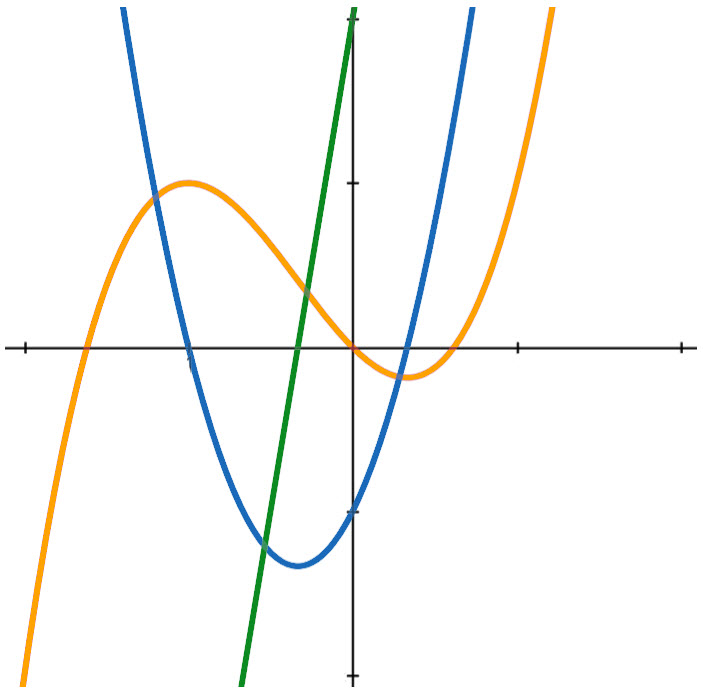
\(\bullet\text{ Graph of f(x), f'(x) and f”(x)}\)
\(\,\,\,\,\,\,\,\,\)
\(\bullet\text{ Newton’s Method}\)
\(\,\,\,\,\,\,\,\,x_{n+1}=x_n – \displaystyle \frac{f(x_n)}{f'(x_n)}\)