Lesson
Notes
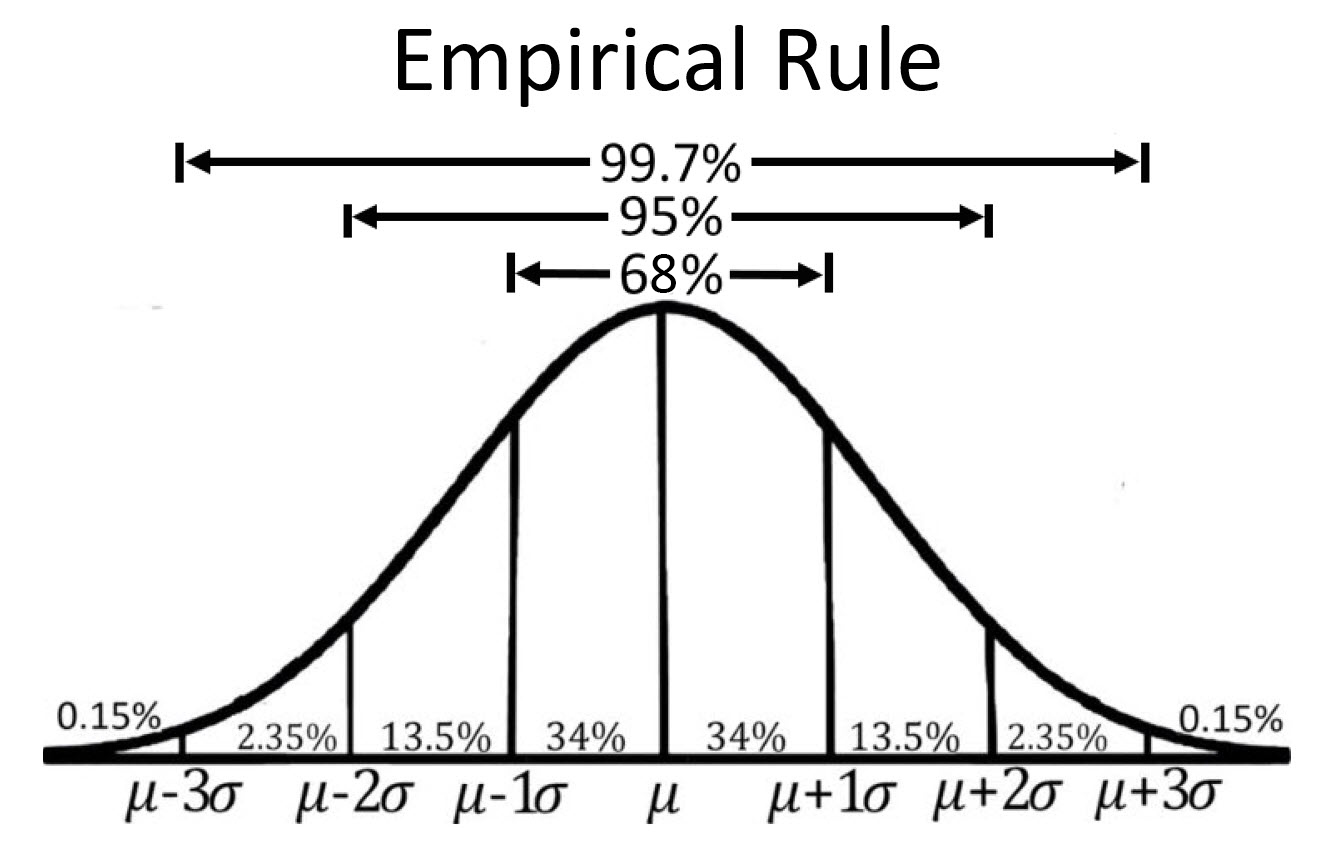
Note: For continuous distributions, \(\lt and \le\) are both treated the same
Questions
\(1)\) \(P ( x \lt \mu – \sigma)\)
The answer is \(16\%\)
\(2)\) \(P ( x \le \mu – \sigma)\)
The answer is \(16\%\)
\(3)\) \(P ( x \gt \mu – 2\sigma)\)
The answer is \(97.5\%\)
\(4)\) \(P ( \mu – \sigma \lt x \lt \mu + \sigma)\)
The answer is \(68\%\)
\(5)\) \(P ( \mu – 2\sigma \lt x \lt \mu – \sigma)\)
The answer is \(13.5\%\)
\(6)\) \(P ( \mu – 2\sigma \lt x \lt \mu + 2\sigma)\)
The answer is \(95\%\)
\(7)\) \(P ( \mu – 3\sigma \lt x \lt \mu + 3\sigma)\)
The answer is \(99.7\%\)
\(8)\) \(P ( \mu \lt x \lt \mu + 2\sigma)\)
The answer is \(47.5\%\)
\(9)\) \(P ( \mu \lt x \lt \mu + 3\sigma)\)
The answer is \(49.85\%\)
\(10)\) \(P ( \mu – 3\sigma \lt x \lt \mu )\)
The answer is \(49.85\%\)
Challenge Problem
\(11)\) For a normal distribution with mean=1 and standard deviation=1, what percent of the data is less than 0?
The answer is approximately \(.16 \text{ or } 16\%\)
See Related Pages\(\)