

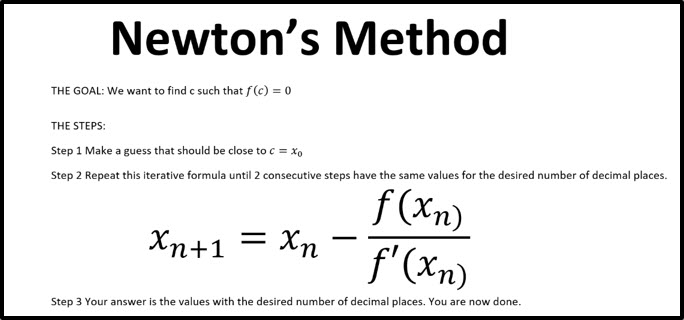
Newton’s Method is an iterative process for approximating the roots of a function. Starting with an initial guess, the formula uses the tangent line at that point to create a better estimate. Repeating the process often gives a very accurate approximation to a root, square root, cube root, or other solution.
Notes
Practice Problems
For #1-4, use Newton’s method to find \(x_1\) and \(x_2\) for the given initial guess
\(\textbf{1)}\) \(f(x)=x^3-4, \, x_0=1.8\) The answer is \(x_1\approx 1.6115, \, x_2\approx1.5878\)
\(\,\,\,x_{n+1}=x_n-\displaystyle \frac{f\left(x_n\right)}{f’\left(x_n\right)}\)
\(\,\,\,f'(x)=3x^2\)
\(\,\,\,x_1=1.8-\displaystyle \frac{(1.8)^3-4}{3(1.8)^2}\)
\(\,\,\,x_1=1.8-\displaystyle \frac{1.832}{9.72}\)
\(\,\,\,x_1\approx1.6115\)
\(\,\,\,x_2=1.6115-\displaystyle \frac{(1.6115)^3-4}{3(1.6115)^2}\)
\(\,\,\,x_2=1.6115-\displaystyle \frac{0.18496}{7.7908}\)
\(\,\,\,x_2\approx1.5878\)
\(\,\,\,\)The answer is \(x_1\approx 1.6115, \, x_2\approx1.5878\)
\(\,\,\,x_{n+1}=x_n-\displaystyle \frac{f\left(x_n\right)}{f’\left(x_n\right)}\)
\(\,\,\,f'(x)=3x^2\)
\(\,\,\,x_1=1.8-\displaystyle \frac{(1.8)^3-4}{3(1.8)^2}\)
\(\,\,\,x_1=1.8-\displaystyle \frac{1.832}{9.72}\)
\(\,\,\,x_1\approx1.6115\)
\(\,\,\,x_2=1.6115-\displaystyle \frac{(1.6115)^3-4}{3(1.6115)^2}\)
\(\,\,\,x_2=1.6115-\displaystyle \frac{0.18496}{7.7908}\)
\(\,\,\,x_2\approx1.5878\)
\(\,\,\,\)The answer is \(x_1\approx 1.6115, \, x_2\approx1.5878\)
\(\textbf{2)}\) \(f(x)=\sin x, \, x_0=1.8\) The answer is \(x_1\approx 6.0863, \, x_2\approx6.2858\)
\(\,\,\,x_{n+1}=x_n-\displaystyle \frac{f\left(x_n\right)}{f’\left(x_n\right)}\)
\(\,\,\,f'(x)=\cos x\)
\(\,\,\,x_1=1.8-\displaystyle \frac{\sin(1.8)}{\cos(1.8)}\)
\(\,\,\,x_1\approx6.0863\)
\(\,\,\,x_2=6.0863-\displaystyle \frac{\sin(6.0863)}{\cos(6.0863)}\)
\(\,\,\,x_2\approx6.2858\)
\(\,\,\,\)The answer is \(x_1\approx 6.0863, \, x_2\approx6.2858\)
\(\,\,\,x_{n+1}=x_n-\displaystyle \frac{f\left(x_n\right)}{f’\left(x_n\right)}\)
\(\,\,\,f'(x)=\cos x\)
\(\,\,\,x_1=1.8-\displaystyle \frac{\sin(1.8)}{\cos(1.8)}\)
\(\,\,\,x_1\approx6.0863\)
\(\,\,\,x_2=6.0863-\displaystyle \frac{\sin(6.0863)}{\cos(6.0863)}\)
\(\,\,\,x_2\approx6.2858\)
\(\,\,\,\)The answer is \(x_1\approx 6.0863, \, x_2\approx6.2858\)
\(\textbf{3)}\) \(f(x)=5-x^2, \, x_0=1.8\) The answer is \(x_1\approx 2.2889, \, x_2\approx2.2367\)
\(\,\,\,x_{n+1}=x_n-\displaystyle \frac{f\left(x_n\right)}{f’\left(x_n\right)}\)
\(\,\,\,f'(x)=-2x\)
\(\,\,\,x_1=1.8-\displaystyle \frac{5-(1.8)^2}{-2(1.8)}\)
\(\,\,\,x_1=1.8-\displaystyle \frac{1.76}{-3.6}\)
\(\,\,\,x_1\approx2.2889\)
\(\,\,\,x_2=2.2889-\displaystyle \frac{5-(2.2889)^2}{-2(2.2889)}\)
\(\,\,\,x_2\approx2.2367\)
\(\,\,\,\)The answer is \(x_1\approx 2.2889, \, x_2\approx2.2367\)
\(\,\,\,x_{n+1}=x_n-\displaystyle \frac{f\left(x_n\right)}{f’\left(x_n\right)}\)
\(\,\,\,f'(x)=-2x\)
\(\,\,\,x_1=1.8-\displaystyle \frac{5-(1.8)^2}{-2(1.8)}\)
\(\,\,\,x_1=1.8-\displaystyle \frac{1.76}{-3.6}\)
\(\,\,\,x_1\approx2.2889\)
\(\,\,\,x_2=2.2889-\displaystyle \frac{5-(2.2889)^2}{-2(2.2889)}\)
\(\,\,\,x_2\approx2.2367\)
\(\,\,\,\)The answer is \(x_1\approx 2.2889, \, x_2\approx2.2367\)
\(\textbf{4)}\) \(f(x)=x^2-4, \, x_0=10\) The answer is \(x_1=5.2, \, x_2\approx2.9846\)
\(\,\,\,x_{n+1}=x_n-\displaystyle \frac{f\left(x_n\right)}{f’\left(x_n\right)}\)
\(\,\,\,f'(x)=2x\)
\(\,\,\,x_1=10-\displaystyle \frac{10^2-4}{2(10)}\)
\(\,\,\,x_1=10-\displaystyle \frac{96}{20}\)
\(\,\,\,x_1=5.2\)
\(\,\,\,x_2=5.2-\displaystyle \frac{(5.2)^2-4}{2(5.2)}\)
\(\,\,\,x_2=5.2-\displaystyle \frac{23.04}{10.4}\)
\(\,\,\,x_2\approx2.9846\)
\(\,\,\,\)The answer is \(x_1=5.2, \, x_2\approx2.9846\)
\(\,\,\,x_{n+1}=x_n-\displaystyle \frac{f\left(x_n\right)}{f’\left(x_n\right)}\)
\(\,\,\,f'(x)=2x\)
\(\,\,\,x_1=10-\displaystyle \frac{10^2-4}{2(10)}\)
\(\,\,\,x_1=10-\displaystyle \frac{96}{20}\)
\(\,\,\,x_1=5.2\)
\(\,\,\,x_2=5.2-\displaystyle \frac{(5.2)^2-4}{2(5.2)}\)
\(\,\,\,x_2=5.2-\displaystyle \frac{23.04}{10.4}\)
\(\,\,\,x_2\approx2.9846\)
\(\,\,\,\)The answer is \(x_1=5.2, \, x_2\approx2.9846\)
\(\textbf{5)}\) Using Newton’s method, find the root in the given range accurate to 4 decimal points \(f(x)=x^4-3x^2+4x-6, \, [1,3]\) The answer is \(c\approx1.6627\)
\(\,\,\,x_{n+1}=x_n-\displaystyle \frac{f(x_n)}{f'(x_n)}\)
\(\,\,\,f'(x)=4x^3-6x+4\)
\(\,\,\,\text{Choose }x_0=2\text{ since }2\text{ is in }[1,3].\)
\(\,\,\,x_1=2-\displaystyle\frac{2^4-3(2)^2+4(2)-6}{4(2)^3-6(2)+4}\)
\(\,\,\,x_1=1.7500\)
\(\,\,\,x_2=1.75-\displaystyle\frac{(1.75)^4-3(1.75)^2+4(1.75)-6}{4(1.75)^3-6(1.75)+4}\)
\(\,\,\,x_2\approx1.6702\)
\(\,\,\,x_3\approx1.6628\)
\(\,\,\,x_4\approx1.6627\)
\(\,\,\,\)The answer is \(c\approx1.6627\)
\(\,\,\,x_{n+1}=x_n-\displaystyle \frac{f(x_n)}{f'(x_n)}\)
\(\,\,\,f'(x)=4x^3-6x+4\)
\(\,\,\,\text{Choose }x_0=2\text{ since }2\text{ is in }[1,3].\)
\(\,\,\,x_1=2-\displaystyle\frac{2^4-3(2)^2+4(2)-6}{4(2)^3-6(2)+4}\)
\(\,\,\,x_1=1.7500\)
\(\,\,\,x_2=1.75-\displaystyle\frac{(1.75)^4-3(1.75)^2+4(1.75)-6}{4(1.75)^3-6(1.75)+4}\)
\(\,\,\,x_2\approx1.6702\)
\(\,\,\,x_3\approx1.6628\)
\(\,\,\,x_4\approx1.6627\)
\(\,\,\,\)The answer is \(c\approx1.6627\)
\(\textbf{6)}\) Using Newton’s method, find all the roots accurate to 4 decimal points \(f(x)=x^2-5\) The answer is \(c\approx\pm2.2361\)
\(\,\,\,x_{n+1}=x_n-\displaystyle \frac{f(x_n)}{f'(x_n)}\)
\(\,\,\,f'(x)=2x\)
\(\,\,\,\text{For the positive root, choose }x_0=2.\)
\(\,\,\,x_1=2-\displaystyle\frac{2^2-5}{2(2)}=2.25\)
\(\,\,\,x_2=2.25-\displaystyle\frac{(2.25)^2-5}{2(2.25)}\approx2.2361\)
\(\,\,\,\text{Since }x^2-5\text{ is even, the other root is the opposite.}\)
\(\,\,\,\)The answer is \(c\approx\pm2.2361\)
\(\,\,\,x_{n+1}=x_n-\displaystyle \frac{f(x_n)}{f'(x_n)}\)
\(\,\,\,f'(x)=2x\)
\(\,\,\,\text{For the positive root, choose }x_0=2.\)
\(\,\,\,x_1=2-\displaystyle\frac{2^2-5}{2(2)}=2.25\)
\(\,\,\,x_2=2.25-\displaystyle\frac{(2.25)^2-5}{2(2.25)}\approx2.2361\)
\(\,\,\,\text{Since }x^2-5\text{ is even, the other root is the opposite.}\)
\(\,\,\,\)The answer is \(c\approx\pm2.2361\)
\(\textbf{7)}\) Find \(\sqrt[5]{58}\) to 4 decimal points using Newton’s method The answer is \(\sqrt[5]{58}\approx 2.2526\)
\(\,\,\,\sqrt[5]{58}\text{ means solve }x^5=58.\)
\(\,\,\,f(x)=x^5-58\)
\(\,\,\,f'(x)=5x^4\)
\(\,\,\,\text{Choose }x_0=2.3.\)
\(\,\,\,x_1=2.3-\displaystyle\frac{(2.3)^5-58}{5(2.3)^4}\approx2.2545\)
\(\,\,\,x_2=2.2545-\displaystyle\frac{(2.2545)^5-58}{5(2.2545)^4}\approx2.2526\)
\(\,\,\,\)The answer is \(\sqrt[5]{58}\approx 2.2526\)
\(\,\,\,\sqrt[5]{58}\text{ means solve }x^5=58.\)
\(\,\,\,f(x)=x^5-58\)
\(\,\,\,f'(x)=5x^4\)
\(\,\,\,\text{Choose }x_0=2.3.\)
\(\,\,\,x_1=2.3-\displaystyle\frac{(2.3)^5-58}{5(2.3)^4}\approx2.2545\)
\(\,\,\,x_2=2.2545-\displaystyle\frac{(2.2545)^5-58}{5(2.2545)^4}\approx2.2526\)
\(\,\,\,\)The answer is \(\sqrt[5]{58}\approx 2.2526\)
\(\textbf{8)}\) Use Newton’s method to approximate \(\sqrt{2}\) to 4 decimal points. The answer is \(\sqrt{2}\approx1.4142\)
\(\,\,\,\sqrt{2}\text{ means solve }x^2-2=0.\)
\(\,\,\,f(x)=x^2-2\)
\(\,\,\,f'(x)=2x\)
\(\,\,\,\text{Choose }x_0=1.5.\)
\(\,\,\,x_1=1.5-\displaystyle\frac{(1.5)^2-2}{2(1.5)}\approx1.4167\)
\(\,\,\,x_2=1.4167-\displaystyle\frac{(1.4167)^2-2}{2(1.4167)}\approx1.4142\)
\(\,\,\,\)The answer is \(\sqrt{2}\approx1.4142\)
\(\,\,\,\sqrt{2}\text{ means solve }x^2-2=0.\)
\(\,\,\,f(x)=x^2-2\)
\(\,\,\,f'(x)=2x\)
\(\,\,\,\text{Choose }x_0=1.5.\)
\(\,\,\,x_1=1.5-\displaystyle\frac{(1.5)^2-2}{2(1.5)}\approx1.4167\)
\(\,\,\,x_2=1.4167-\displaystyle\frac{(1.4167)^2-2}{2(1.4167)}\approx1.4142\)
\(\,\,\,\)The answer is \(\sqrt{2}\approx1.4142\)
\(\textbf{9)}\) Use Newton’s method to find the real root of \(f(x)=x^3-x-1\) accurate to 4 decimal points. The answer is \(x\approx1.3247\)
\(\,\,\,f(x)=x^3-x-1\)
\(\,\,\,f'(x)=3x^2-1\)
\(\,\,\,\text{Choose }x_0=1.3.\)
\(\,\,\,x_1=1.3-\displaystyle\frac{(1.3)^3-1.3-1}{3(1.3)^2-1}\approx1.3253\)
\(\,\,\,x_2=1.3253-\displaystyle\frac{(1.3253)^3-1.3253-1}{3(1.3253)^2-1}\approx1.3247\)
\(\,\,\,\)The answer is \(x\approx1.3247\)
\(\,\,\,f(x)=x^3-x-1\)
\(\,\,\,f'(x)=3x^2-1\)
\(\,\,\,\text{Choose }x_0=1.3.\)
\(\,\,\,x_1=1.3-\displaystyle\frac{(1.3)^3-1.3-1}{3(1.3)^2-1}\approx1.3253\)
\(\,\,\,x_2=1.3253-\displaystyle\frac{(1.3253)^3-1.3253-1}{3(1.3253)^2-1}\approx1.3247\)
\(\,\,\,\)The answer is \(x\approx1.3247\)
\(\textbf{10)}\) Use Newton’s method to solve \(\cos{x}=x\) accurate to 4 decimal points. The answer is \(x\approx0.7391\)
\(\,\,\,\cos{x}=x\text{ means solve }\cos{x}-x=0.\)
\(\,\,\,f(x)=\cos{x}-x\)
\(\,\,\,f'(x)=-\sin{x}-1\)
\(\,\,\,\text{Choose }x_0=0.7.\)
\(\,\,\,x_1=0.7-\displaystyle\frac{\cos(0.7)-0.7}{-\sin(0.7)-1}\approx0.7394\)
\(\,\,\,x_2=0.7394-\displaystyle\frac{\cos(0.7394)-0.7394}{-\sin(0.7394)-1}\approx0.7391\)
\(\,\,\,\)The answer is \(x\approx0.7391\)
\(\,\,\,\cos{x}=x\text{ means solve }\cos{x}-x=0.\)
\(\,\,\,f(x)=\cos{x}-x\)
\(\,\,\,f'(x)=-\sin{x}-1\)
\(\,\,\,\text{Choose }x_0=0.7.\)
\(\,\,\,x_1=0.7-\displaystyle\frac{\cos(0.7)-0.7}{-\sin(0.7)-1}\approx0.7394\)
\(\,\,\,x_2=0.7394-\displaystyle\frac{\cos(0.7394)-0.7394}{-\sin(0.7394)-1}\approx0.7391\)
\(\,\,\,\)The answer is \(x\approx0.7391\)
\(\textbf{11)}\) Use Newton’s method to solve \(e^x=3\) accurate to 4 decimal points. The answer is \(x\approx1.0986\)
\(\,\,\,e^x=3\text{ means solve }e^x-3=0.\)
\(\,\,\,f(x)=e^x-3\)
\(\,\,\,f'(x)=e^x\)
\(\,\,\,\text{Choose }x_0=1.\)
\(\,\,\,x_1=1-\displaystyle\frac{e^1-3}{e^1}\approx1.1036\)
\(\,\,\,x_2=1.1036-\displaystyle\frac{e^{1.1036}-3}{e^{1.1036}}\approx1.0986\)
\(\,\,\,\)The answer is \(x\approx1.0986\)
\(\,\,\,e^x=3\text{ means solve }e^x-3=0.\)
\(\,\,\,f(x)=e^x-3\)
\(\,\,\,f'(x)=e^x\)
\(\,\,\,\text{Choose }x_0=1.\)
\(\,\,\,x_1=1-\displaystyle\frac{e^1-3}{e^1}\approx1.1036\)
\(\,\,\,x_2=1.1036-\displaystyle\frac{e^{1.1036}-3}{e^{1.1036}}\approx1.0986\)
\(\,\,\,\)The answer is \(x\approx1.0986\)
\(\textbf{12)}\) Use Newton’s method to solve \(\ln{x}=1\) accurate to 4 decimal points. The answer is \(x\approx2.7183\)
\(\,\,\,\ln{x}=1\text{ means solve }\ln{x}-1=0.\)
\(\,\,\,f(x)=\ln{x}-1\)
\(\,\,\,f'(x)=\frac{1}{x}\)
\(\,\,\,\text{Choose }x_0=2.5.\)
\(\,\,\,x_1=2.5-\displaystyle\frac{\ln(2.5)-1}{1/2.5}\approx2.7093\)
\(\,\,\,x_2=2.7093-\displaystyle\frac{\ln(2.7093)-1}{1/2.7093}\approx2.7183\)
\(\,\,\,\)The answer is \(x\approx2.7183\)
\(\,\,\,\ln{x}=1\text{ means solve }\ln{x}-1=0.\)
\(\,\,\,f(x)=\ln{x}-1\)
\(\,\,\,f'(x)=\frac{1}{x}\)
\(\,\,\,\text{Choose }x_0=2.5.\)
\(\,\,\,x_1=2.5-\displaystyle\frac{\ln(2.5)-1}{1/2.5}\approx2.7093\)
\(\,\,\,x_2=2.7093-\displaystyle\frac{\ln(2.7093)-1}{1/2.7093}\approx2.7183\)
\(\,\,\,\)The answer is \(x\approx2.7183\)
\(\textbf{13)}\) Use Newton’s method to approximate \(\sqrt{10}\) to 4 decimal points. The answer is \(\sqrt{10}\approx3.1623\)
\(\,\,\,\sqrt{10}\text{ means solve }x^2-10=0.\)
\(\,\,\,f(x)=x^2-10\)
\(\,\,\,f'(x)=2x\)
\(\,\,\,\text{Choose }x_0=3.\)
\(\,\,\,x_1=3-\displaystyle\frac{3^2-10}{2(3)}\approx3.1667\)
\(\,\,\,x_2=3.1667-\displaystyle\frac{(3.1667)^2-10}{2(3.1667)}\approx3.1623\)
\(\,\,\,\)The answer is \(\sqrt{10}\approx3.1623\)
\(\,\,\,\sqrt{10}\text{ means solve }x^2-10=0.\)
\(\,\,\,f(x)=x^2-10\)
\(\,\,\,f'(x)=2x\)
\(\,\,\,\text{Choose }x_0=3.\)
\(\,\,\,x_1=3-\displaystyle\frac{3^2-10}{2(3)}\approx3.1667\)
\(\,\,\,x_2=3.1667-\displaystyle\frac{(3.1667)^2-10}{2(3.1667)}\approx3.1623\)
\(\,\,\,\)The answer is \(\sqrt{10}\approx3.1623\)
\(\textbf{14)}\) Use Newton’s method to approximate \(\sqrt[3]{30}\) to 4 decimal points. The answer is \(\sqrt[3]{30}\approx3.1072\)
\(\,\,\,\sqrt[3]{30}\text{ means solve }x^3-30=0.\)
\(\,\,\,f(x)=x^3-30\)
\(\,\,\,f'(x)=3x^2\)
\(\,\,\,\text{Choose }x_0=3.\)
\(\,\,\,x_1=3-\displaystyle\frac{3^3-30}{3(3)^2}\approx3.1111\)
\(\,\,\,x_2=3.1111-\displaystyle\frac{(3.1111)^3-30}{3(3.1111)^2}\approx3.1072\)
\(\,\,\,\)The answer is \(\sqrt[3]{30}\approx3.1072\)
\(\,\,\,\sqrt[3]{30}\text{ means solve }x^3-30=0.\)
\(\,\,\,f(x)=x^3-30\)
\(\,\,\,f'(x)=3x^2\)
\(\,\,\,\text{Choose }x_0=3.\)
\(\,\,\,x_1=3-\displaystyle\frac{3^3-30}{3(3)^2}\approx3.1111\)
\(\,\,\,x_2=3.1111-\displaystyle\frac{(3.1111)^3-30}{3(3.1111)^2}\approx3.1072\)
\(\,\,\,\)The answer is \(\sqrt[3]{30}\approx3.1072\)
\(\textbf{15)}\) Use Newton’s method to approximate \(\sqrt{7}\) to 4 decimal points. The answer is \(\sqrt{7}\approx2.6458\)
\(\,\,\,\sqrt{7}\text{ means solve }x^2-7=0.\)
\(\,\,\,f(x)=x^2-7\)
\(\,\,\,f'(x)=2x\)
\(\,\,\,\text{Choose }x_0=2.5.\)
\(\,\,\,x_1=2.5-\displaystyle\frac{(2.5)^2-7}{2(2.5)}=2.65\)
\(\,\,\,x_2=2.65-\displaystyle\frac{(2.65)^2-7}{2(2.65)}\approx2.6458\)
\(\,\,\,\)The answer is \(\sqrt{7}\approx2.6458\)
\(\,\,\,\sqrt{7}\text{ means solve }x^2-7=0.\)
\(\,\,\,f(x)=x^2-7\)
\(\,\,\,f'(x)=2x\)
\(\,\,\,\text{Choose }x_0=2.5.\)
\(\,\,\,x_1=2.5-\displaystyle\frac{(2.5)^2-7}{2(2.5)}=2.65\)
\(\,\,\,x_2=2.65-\displaystyle\frac{(2.65)^2-7}{2(2.65)}\approx2.6458\)
\(\,\,\,\)The answer is \(\sqrt{7}\approx2.6458\)
\(\textbf{16)}\) Use Newton’s method to solve \(x^4-16=0\) accurate to 4 decimal points, starting with \(x_0=1.5\). The answer is \(x\approx2.0000\)
\(\,\,\,f(x)=x^4-16\)
\(\,\,\,f'(x)=4x^3\)
\(\,\,\,x_1=1.5-\displaystyle\frac{(1.5)^4-16}{4(1.5)^3}\approx2.3102\)
\(\,\,\,x_2=2.3102-\displaystyle\frac{(2.3102)^4-16}{4(2.3102)^3}\approx2.0571\)
\(\,\,\,x_3\approx2.0023\)
\(\,\,\,x_4\approx2.0000\)
\(\,\,\,\)The answer is \(x\approx2.0000\)
\(\,\,\,f(x)=x^4-16\)
\(\,\,\,f'(x)=4x^3\)
\(\,\,\,x_1=1.5-\displaystyle\frac{(1.5)^4-16}{4(1.5)^3}\approx2.3102\)
\(\,\,\,x_2=2.3102-\displaystyle\frac{(2.3102)^4-16}{4(2.3102)^3}\approx2.0571\)
\(\,\,\,x_3\approx2.0023\)
\(\,\,\,x_4\approx2.0000\)
\(\,\,\,\)The answer is \(x\approx2.0000\)
\(\textbf{17)}\) Use Newton’s method to solve \(x^3+2x-5=0\) accurate to 4 decimal points. The answer is \(x\approx1.3283\)
\(\,\,\,f(x)=x^3+2x-5\)
\(\,\,\,f'(x)=3x^2+2\)
\(\,\,\,\text{Choose }x_0=1.5.\)
\(\,\,\,x_1=1.5-\displaystyle\frac{(1.5)^3+2(1.5)-5}{3(1.5)^2+2}\approx1.3429\)
\(\,\,\,x_2=1.3429-\displaystyle\frac{(1.3429)^3+2(1.3429)-5}{3(1.3429)^2+2}\approx1.3284\)
\(\,\,\,x_3\approx1.3283\)
\(\,\,\,\)The answer is \(x\approx1.3283\)
\(\,\,\,f(x)=x^3+2x-5\)
\(\,\,\,f'(x)=3x^2+2\)
\(\,\,\,\text{Choose }x_0=1.5.\)
\(\,\,\,x_1=1.5-\displaystyle\frac{(1.5)^3+2(1.5)-5}{3(1.5)^2+2}\approx1.3429\)
\(\,\,\,x_2=1.3429-\displaystyle\frac{(1.3429)^3+2(1.3429)-5}{3(1.3429)^2+2}\approx1.3284\)
\(\,\,\,x_3\approx1.3283\)
\(\,\,\,\)The answer is \(x\approx1.3283\)
\(\textbf{18)}\) Use Newton’s method to solve \(e^{-x}=x\) accurate to 4 decimal points. The answer is \(x\approx0.5671\)
\(\,\,\,e^{-x}=x\text{ means solve }e^{-x}-x=0.\)
\(\,\,\,f(x)=e^{-x}-x\)
\(\,\,\,f'(x)=-e^{-x}-1\)
\(\,\,\,\text{Choose }x_0=0.5.\)
\(\,\,\,x_1=0.5-\displaystyle\frac{e^{-0.5}-0.5}{-e^{-0.5}-1}\approx0.5663\)
\(\,\,\,x_2=0.5663-\displaystyle\frac{e^{-0.5663}-0.5663}{-e^{-0.5663}-1}\approx0.5671\)
\(\,\,\,\)The answer is \(x\approx0.5671\)
\(\,\,\,e^{-x}=x\text{ means solve }e^{-x}-x=0.\)
\(\,\,\,f(x)=e^{-x}-x\)
\(\,\,\,f'(x)=-e^{-x}-1\)
\(\,\,\,\text{Choose }x_0=0.5.\)
\(\,\,\,x_1=0.5-\displaystyle\frac{e^{-0.5}-0.5}{-e^{-0.5}-1}\approx0.5663\)
\(\,\,\,x_2=0.5663-\displaystyle\frac{e^{-0.5663}-0.5663}{-e^{-0.5663}-1}\approx0.5671\)
\(\,\,\,\)The answer is \(x\approx0.5671\)
\(\textbf{19)}\) Use Newton’s method to solve \(\sin{x}=\frac{1}{2}\) near \(x=0.5\) accurate to 4 decimal points. The answer is \(x\approx0.5236\)
\(\,\,\,\sin{x}=\frac{1}{2}\text{ means solve }\sin{x}-\frac{1}{2}=0.\)
\(\,\,\,f(x)=\sin{x}-\frac{1}{2}\)
\(\,\,\,f'(x)=\cos{x}\)
\(\,\,\,x_0=0.5\)
\(\,\,\,x_1=0.5-\displaystyle\frac{\sin(0.5)-\frac{1}{2}}{\cos(0.5)}\approx0.5234\)
\(\,\,\,x_2=0.5234-\displaystyle\frac{\sin(0.5234)-\frac{1}{2}}{\cos(0.5234)}\approx0.5236\)
\(\,\,\,\)The answer is \(x\approx0.5236\)
\(\,\,\,\sin{x}=\frac{1}{2}\text{ means solve }\sin{x}-\frac{1}{2}=0.\)
\(\,\,\,f(x)=\sin{x}-\frac{1}{2}\)
\(\,\,\,f'(x)=\cos{x}\)
\(\,\,\,x_0=0.5\)
\(\,\,\,x_1=0.5-\displaystyle\frac{\sin(0.5)-\frac{1}{2}}{\cos(0.5)}\approx0.5234\)
\(\,\,\,x_2=0.5234-\displaystyle\frac{\sin(0.5234)-\frac{1}{2}}{\cos(0.5234)}\approx0.5236\)
\(\,\,\,\)The answer is \(x\approx0.5236\)
\(\textbf{20)}\) Use Newton’s method to solve \(x^5-x-1=0\) accurate to 4 decimal points. The answer is \(x\approx1.1673\)
\(\,\,\,f(x)=x^5-x-1\)
\(\,\,\,f'(x)=5x^4-1\)
\(\,\,\,\text{Choose }x_0=1.2.\)
\(\,\,\,x_1=1.2-\displaystyle\frac{(1.2)^5-1.2-1}{5(1.2)^4-1}\approx1.1692\)
\(\,\,\,x_2=1.1692-\displaystyle\frac{(1.1692)^5-1.1692-1}{5(1.1692)^4-1}\approx1.1673\)
\(\,\,\,\)The answer is \(x\approx1.1673\)
\(\,\,\,f(x)=x^5-x-1\)
\(\,\,\,f'(x)=5x^4-1\)
\(\,\,\,\text{Choose }x_0=1.2.\)
\(\,\,\,x_1=1.2-\displaystyle\frac{(1.2)^5-1.2-1}{5(1.2)^4-1}\approx1.1692\)
\(\,\,\,x_2=1.1692-\displaystyle\frac{(1.1692)^5-1.1692-1}{5(1.1692)^4-1}\approx1.1673\)
\(\,\,\,\)The answer is \(x\approx1.1673\)
See Related Pages\(\)
\(\bullet\text{ Calculus Homepage}\)
\(\,\,\,\,\,\,\,\,\text{All the Best Topics…}\)
\(\bullet\text{ Definition of Derivative}\)
\(\,\,\,\,\,\,\,\, \displaystyle \lim_{\Delta x\to 0} \frac{f(x+ \Delta x)-f(x)}{\Delta x} \)
\(\bullet\text{ Equation of the Tangent Line}\)
\(\,\,\,\,\,\,\,\,f(x)=x^3+3x^2−x \text{ at the point } (2,18)\)
\(\bullet\text{ Derivatives- Constant Rule}\)
\(\,\,\,\,\,\,\,\,\displaystyle\frac{d}{dx}(c)=0\)
\(\bullet\text{ Derivatives- Power Rule}\)
\(\,\,\,\,\,\,\,\,\displaystyle\frac{d}{dx}(x^n)=nx^{n-1}\)
\(\bullet\text{ Derivatives- Constant Multiple Rule}\)
\(\,\,\,\,\,\,\,\,\displaystyle\frac{d}{dx}(cf(x))=cf'(x)\)
\(\bullet\text{ Derivatives- Sum and Difference Rules}\)
\(\,\,\,\,\,\,\,\,\displaystyle\frac{d}{dx}[f(x) \pm g(x)]=f'(x) \pm g'(x)\)
\(\bullet\text{ Derivatives- Sin and Cos}\)
\(\,\,\,\,\,\,\,\,\displaystyle\frac{d}{dx}sin(x)=cos(x)\)
\(\bullet\text{ Derivatives- Product Rule}\)
\(\,\,\,\,\,\,\,\,\displaystyle\frac{d}{dx}[f(x) \cdot g(x)]=f(x) \cdot g'(x)+f'(x) \cdot g(x)\)
\(\bullet\text{ Derivatives- Quotient Rule}\)
\(\,\,\,\,\,\,\,\,\displaystyle\frac{d}{dx}\left[\displaystyle\frac{f(x)}{g(x)}\right]=\displaystyle\frac{g(x) \cdot f'(x)-f(x) \cdot g'(x)}{[g(x)]^2}\)
\(\bullet\text{ Derivatives- Chain Rule}\)
\(\,\,\,\,\,\,\,\,\displaystyle\frac{d}{dx}[f(g(x))]= f'(g(x)) \cdot g'(x)\)
\(\bullet\text{ Derivatives- ln(x)}\)
\(\,\,\,\,\,\,\,\,\displaystyle\frac{d}{dx}[ln(x)]= \displaystyle \frac{1}{x}\)
\(\bullet\text{ Implicit Differentiation}\)
\(\,\,\,\,\,\,\,\,\)
\(\bullet\text{ Horizontal Tangent Line}\)
\(\,\,\,\,\,\,\,\,\)
\(\bullet\text{ Mean Value Theorem}\)
\(\,\,\,\,\,\,\,\,\)
\(\bullet\text{ Related Rates}\)
\(\,\,\,\,\,\,\,\,\)
\(\bullet\text{ Increasing and Decreasing Intervals}\)
\(\,\,\,\,\,\,\,\,\)
\(\bullet\text{ Intervals of concave up and down}\)
\(\,\,\,\,\,\,\,\,\)
\(\bullet\text{ Inflection Points}\)
\(\,\,\,\,\,\,\,\,\)
\(\bullet\text{ Graph of f(x), f'(x) and f”(x)}\)
\(\,\,\,\,\,\,\,\,\)
\(\bullet\text{ Newton’s Method}\)
\(\,\,\,\,\,\,\,\,x_{n+1}=x_n – \displaystyle \frac{f(x_n)}{f'(x_n)}\)