

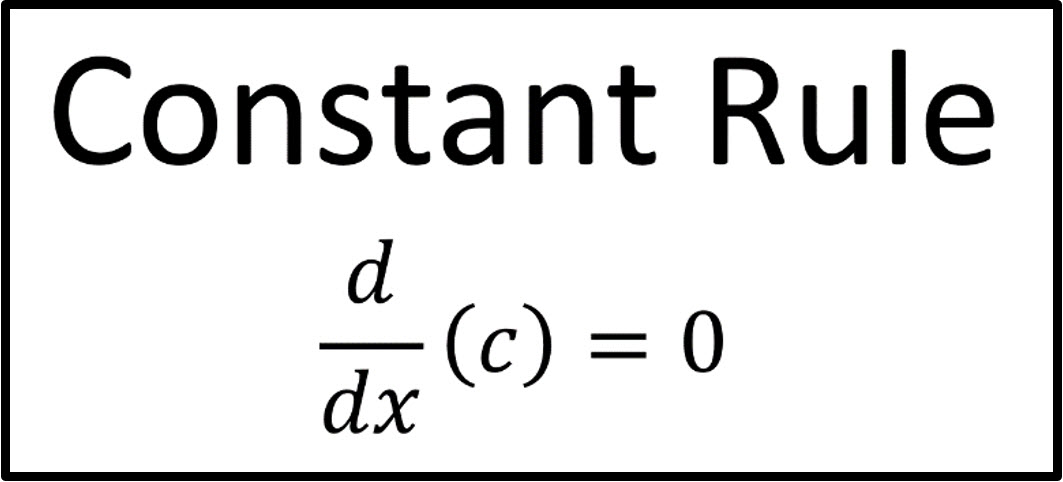
The constant rule says that the derivative of any constant is zero. This happens because a constant function does not change, so its rate of change is always zero. These problems include positive constants, negative constants, zero, special constants like \(\pi\) and \(e\), and expressions that look complicated but still represent constants.
Notes
Questions
Find the derivative
\(\textbf{1)}\) \(f(x)=4\) The answer is \(f'(x)=0\)
\(\,\,\,\,\,f(x)=4\)
\(\,\,\,\,\,4\text{ is a constant.}\)
\(\,\,\,\,\,\frac{d}{dx}(4)=0\)
\(\,\,\,\,\,f'(x)=0\)
\(\,\,\,\,\,\)The answer is \(f'(x)=0\)

\(\,\,\,\,\,f(x)=4\)
\(\,\,\,\,\,4\text{ is a constant.}\)
\(\,\,\,\,\,\frac{d}{dx}(4)=0\)
\(\,\,\,\,\,f'(x)=0\)
\(\,\,\,\,\,\)The answer is \(f'(x)=0\)
\(\textbf{2)}\) \(y=-3\) The answer is \(y’=0\)
\(\,\,\,\,\,y=-3\)
\(\,\,\,\,\,-3\text{ is a constant.}\)
\(\,\,\,\,\,\frac{d}{dx}(-3)=0\)
\(\,\,\,\,\,y’=0\)
\(\,\,\,\,\,\)The answer is \(y’=0\)
\(\,\,\,\,\,y=-3\)
\(\,\,\,\,\,-3\text{ is a constant.}\)
\(\,\,\,\,\,\frac{d}{dx}(-3)=0\)
\(\,\,\,\,\,y’=0\)
\(\,\,\,\,\,\)The answer is \(y’=0\)
\(\textbf{3)}\) \(f(x)=0\) The answer is \(f'(x)=0\)
\(\,\,\,\,\,f(x)=0\)
\(\,\,\,\,\,0\text{ is a constant.}\)
\(\,\,\,\,\,\frac{d}{dx}(0)=0\)
\(\,\,\,\,\,f'(x)=0\)
\(\,\,\,\,\,\)The answer is \(f'(x)=0\)
\(\,\,\,\,\,f(x)=0\)
\(\,\,\,\,\,0\text{ is a constant.}\)
\(\,\,\,\,\,\frac{d}{dx}(0)=0\)
\(\,\,\,\,\,f'(x)=0\)
\(\,\,\,\,\,\)The answer is \(f'(x)=0\)
\(\textbf{4)}\) \(y=\sqrt{3}\) The answer is \(y’=0\)
\(\,\,\,\,\,y=\sqrt{3}\)
\(\,\,\,\,\,\sqrt{3}\text{ is a constant.}\)
\(\,\,\,\,\,\frac{d}{dx}\left(\sqrt{3}\right)=0\)
\(\,\,\,\,\,y’=0\)
\(\,\,\,\,\,\)The answer is \(y’=0\)
\(\,\,\,\,\,y=\sqrt{3}\)
\(\,\,\,\,\,\sqrt{3}\text{ is a constant.}\)
\(\,\,\,\,\,\frac{d}{dx}\left(\sqrt{3}\right)=0\)
\(\,\,\,\,\,y’=0\)
\(\,\,\,\,\,\)The answer is \(y’=0\)
\(\textbf{5)}\) \(f(x)=e^2\) The answer is \(f'(x)=0\)
\(\,\,\,\,\,f(x)=e^2\)
\(\,\,\,\,\,e^2\text{ is a constant because the exponent is not }x.\)
\(\,\,\,\,\,\frac{d}{dx}\left(e^2\right)=0\)
\(\,\,\,\,\,f'(x)=0\)
\(\,\,\,\,\,\)The answer is \(f'(x)=0\)
\(\,\,\,\,\,f(x)=e^2\)
\(\,\,\,\,\,e^2\text{ is a constant because the exponent is not }x.\)
\(\,\,\,\,\,\frac{d}{dx}\left(e^2\right)=0\)
\(\,\,\,\,\,f'(x)=0\)
\(\,\,\,\,\,\)The answer is \(f'(x)=0\)
\(\textbf{6)}\) \(f(x)=\pi\) The answer is \(f'(x)=0\)
\(\,\,\,\,\,f(x)=\pi\)
\(\,\,\,\,\,\pi\text{ is a constant.}\)
\(\,\,\,\,\,\frac{d}{dx}(\pi)=0\)
\(\,\,\,\,\,f'(x)=0\)
\(\,\,\,\,\,\)The answer is \(f'(x)=0\)
\(\,\,\,\,\,f(x)=\pi\)
\(\,\,\,\,\,\pi\text{ is a constant.}\)
\(\,\,\,\,\,\frac{d}{dx}(\pi)=0\)
\(\,\,\,\,\,f'(x)=0\)
\(\,\,\,\,\,\)The answer is \(f'(x)=0\)
\(\textbf{7)}\) \(f(x)=2^{30}\) The answer is \(f'(x)=0\)
\(\,\,\,\,\,f(x)=2^{30}\)
\(\,\,\,\,\,2^{30}\text{ is a constant because there is no }x.\)
\(\,\,\,\,\,\frac{d}{dx}\left(2^{30}\right)=0\)
\(\,\,\,\,\,f'(x)=0\)
\(\,\,\,\,\,\)The answer is \(f'(x)=0\)
\(\,\,\,\,\,f(x)=2^{30}\)
\(\,\,\,\,\,2^{30}\text{ is a constant because there is no }x.\)
\(\,\,\,\,\,\frac{d}{dx}\left(2^{30}\right)=0\)
\(\,\,\,\,\,f'(x)=0\)
\(\,\,\,\,\,\)The answer is \(f'(x)=0\)
\(\textbf{8)}\) \(f(x)=9\) The answer is \(f'(x)=0\)
\(\,\,\,\,\,f(x)=9\)
\(\,\,\,\,\,9\text{ is a constant.}\)
\(\,\,\,\,\,\frac{d}{dx}(9)=0\)
\(\,\,\,\,\,f'(x)=0\)
\(\,\,\,\,\,\)The answer is \(f'(x)=0\)
\(\,\,\,\,\,f(x)=9\)
\(\,\,\,\,\,9\text{ is a constant.}\)
\(\,\,\,\,\,\frac{d}{dx}(9)=0\)
\(\,\,\,\,\,f'(x)=0\)
\(\,\,\,\,\,\)The answer is \(f'(x)=0\)
\(\textbf{9)}\) \(y=-4\) The answer is \(y’=0\)
\(\,\,\,\,\,y=-4\)
\(\,\,\,\,\,-4\text{ is a constant.}\)
\(\,\,\,\,\,\frac{d}{dx}(-4)=0\)
\(\,\,\,\,\,y’=0\)
\(\,\,\,\,\,\)The answer is \(y’=0\)
\(\,\,\,\,\,y=-4\)
\(\,\,\,\,\,-4\text{ is a constant.}\)
\(\,\,\,\,\,\frac{d}{dx}(-4)=0\)
\(\,\,\,\,\,y’=0\)
\(\,\,\,\,\,\)The answer is \(y’=0\)
\(\textbf{10)}\) \(f(x)=11\) The answer is \(f'(x)=0\)
\(\,\,\,\,\,f(x)=11\)
\(\,\,\,\,\,11\text{ is a constant.}\)
\(\,\,\,\,\,\frac{d}{dx}(11)=0\)
\(\,\,\,\,\,f'(x)=0\)
\(\,\,\,\,\,\)The answer is \(f'(x)=0\)
\(\,\,\,\,\,f(x)=11\)
\(\,\,\,\,\,11\text{ is a constant.}\)
\(\,\,\,\,\,\frac{d}{dx}(11)=0\)
\(\,\,\,\,\,f'(x)=0\)
\(\,\,\,\,\,\)The answer is \(f'(x)=0\)
\(\textbf{11)}\) \(f(x)=-12\) The answer is \(f'(x)=0\)
\(\,\,\,\,\,f(x)=-12\)
\(\,\,\,\,\,-12\text{ is a constant.}\)
\(\,\,\,\,\,\frac{d}{dx}(-12)=0\)
\(\,\,\,\,\,f'(x)=0\)
\(\,\,\,\,\,\)The answer is \(f'(x)=0\)
\(\,\,\,\,\,f(x)=-12\)
\(\,\,\,\,\,-12\text{ is a constant.}\)
\(\,\,\,\,\,\frac{d}{dx}(-12)=0\)
\(\,\,\,\,\,f'(x)=0\)
\(\,\,\,\,\,\)The answer is \(f'(x)=0\)
\(\textbf{12)}\) \(y=\frac{5}{8}\) The answer is \(y’=0\)
\(\,\,\,\,\,y=\frac{5}{8}\)
\(\,\,\,\,\,\frac{5}{8}\text{ is a constant.}\)
\(\,\,\,\,\,\frac{d}{dx}\left(\frac{5}{8}\right)=0\)
\(\,\,\,\,\,y’=0\)
\(\,\,\,\,\,\)The answer is \(y’=0\)
\(\,\,\,\,\,y=\frac{5}{8}\)
\(\,\,\,\,\,\frac{5}{8}\text{ is a constant.}\)
\(\,\,\,\,\,\frac{d}{dx}\left(\frac{5}{8}\right)=0\)
\(\,\,\,\,\,y’=0\)
\(\,\,\,\,\,\)The answer is \(y’=0\)
\(\textbf{13)}\) \(f(x)=\sqrt{25}\) The answer is \(f'(x)=0\)
\(\,\,\,\,\,f(x)=\sqrt{25}\)
\(\,\,\,\,\,\sqrt{25}=5\)
\(\,\,\,\,\,5\text{ is a constant.}\)
\(\,\,\,\,\,f'(x)=0\)
\(\,\,\,\,\,\)The answer is \(f'(x)=0\)
\(\,\,\,\,\,f(x)=\sqrt{25}\)
\(\,\,\,\,\,\sqrt{25}=5\)
\(\,\,\,\,\,5\text{ is a constant.}\)
\(\,\,\,\,\,f'(x)=0\)
\(\,\,\,\,\,\)The answer is \(f'(x)=0\)
\(\textbf{14)}\) \(f(x)=\ln(7)\) The answer is \(f'(x)=0\)
\(\,\,\,\,\,f(x)=\ln(7)\)
\(\,\,\,\,\,\ln(7)\text{ is a constant because the input is not }x.\)
\(\,\,\,\,\,\frac{d}{dx}\left(\ln(7)\right)=0\)
\(\,\,\,\,\,f'(x)=0\)
\(\,\,\,\,\,\)The answer is \(f'(x)=0\)
\(\,\,\,\,\,f(x)=\ln(7)\)
\(\,\,\,\,\,\ln(7)\text{ is a constant because the input is not }x.\)
\(\,\,\,\,\,\frac{d}{dx}\left(\ln(7)\right)=0\)
\(\,\,\,\,\,f'(x)=0\)
\(\,\,\,\,\,\)The answer is \(f'(x)=0\)
\(\textbf{15)}\) \(y=\cos(\pi)\) The answer is \(y’=0\)
\(\,\,\,\,\,y=\cos(\pi)\)
\(\,\,\,\,\,\cos(\pi)=-1\)
\(\,\,\,\,\,-1\text{ is a constant.}\)
\(\,\,\,\,\,y’=0\)
\(\,\,\,\,\,\)The answer is \(y’=0\)
\(\,\,\,\,\,y=\cos(\pi)\)
\(\,\,\,\,\,\cos(\pi)=-1\)
\(\,\,\,\,\,-1\text{ is a constant.}\)
\(\,\,\,\,\,y’=0\)
\(\,\,\,\,\,\)The answer is \(y’=0\)
\(\textbf{16)}\) \(f(x)=\frac{3^4}{2}\) The answer is \(f'(x)=0\)
\(\,\,\,\,\,f(x)=\frac{3^4}{2}\)
\(\,\,\,\,\,\frac{3^4}{2}\text{ is a constant because there is no }x.\)
\(\,\,\,\,\,\frac{d}{dx}\left(\frac{3^4}{2}\right)=0\)
\(\,\,\,\,\,f'(x)=0\)
\(\,\,\,\,\,\)The answer is \(f'(x)=0\)
\(\,\,\,\,\,f(x)=\frac{3^4}{2}\)
\(\,\,\,\,\,\frac{3^4}{2}\text{ is a constant because there is no }x.\)
\(\,\,\,\,\,\frac{d}{dx}\left(\frac{3^4}{2}\right)=0\)
\(\,\,\,\,\,f'(x)=0\)
\(\,\,\,\,\,\)The answer is \(f'(x)=0\)
\(\textbf{17)}\) \(f(x)=\sin\left(\frac{\pi}{2}\right)\) The answer is \(f'(x)=0\)
\(\,\,\,\,\,f(x)=\sin\left(\frac{\pi}{2}\right)\)
\(\,\,\,\,\,\sin\left(\frac{\pi}{2}\right)=1\)
\(\,\,\,\,\,1\text{ is a constant.}\)
\(\,\,\,\,\,f'(x)=0\)
\(\,\,\,\,\,\)The answer is \(f'(x)=0\)
\(\,\,\,\,\,f(x)=\sin\left(\frac{\pi}{2}\right)\)
\(\,\,\,\,\,\sin\left(\frac{\pi}{2}\right)=1\)
\(\,\,\,\,\,1\text{ is a constant.}\)
\(\,\,\,\,\,f'(x)=0\)
\(\,\,\,\,\,\)The answer is \(f'(x)=0\)
\(\textbf{18)}\) \(y=1000\) The answer is \(y’=0\)
\(\,\,\,\,\,y=1000\)
\(\,\,\,\,\,1000\text{ is a constant.}\)
\(\,\,\,\,\,\frac{d}{dx}(1000)=0\)
\(\,\,\,\,\,y’=0\)
\(\,\,\,\,\,\)The answer is \(y’=0\)
\(\,\,\,\,\,y=1000\)
\(\,\,\,\,\,1000\text{ is a constant.}\)
\(\,\,\,\,\,\frac{d}{dx}(1000)=0\)
\(\,\,\,\,\,y’=0\)
\(\,\,\,\,\,\)The answer is \(y’=0\)
\(\textbf{19)}\) \(f(x)=-\sqrt{11}\) The answer is \(f'(x)=0\)
\(\,\,\,\,\,f(x)=-\sqrt{11}\)
\(\,\,\,\,\,-\sqrt{11}\text{ is a constant.}\)
\(\,\,\,\,\,\frac{d}{dx}\left(-\sqrt{11}\right)=0\)
\(\,\,\,\,\,f'(x)=0\)
\(\,\,\,\,\,\)The answer is \(f'(x)=0\)
\(\,\,\,\,\,f(x)=-\sqrt{11}\)
\(\,\,\,\,\,-\sqrt{11}\text{ is a constant.}\)
\(\,\,\,\,\,\frac{d}{dx}\left(-\sqrt{11}\right)=0\)
\(\,\,\,\,\,f'(x)=0\)
\(\,\,\,\,\,\)The answer is \(f'(x)=0\)
\(\textbf{20)}\) \(f(x)=\frac{\pi^2+1}{4}\) The answer is \(f'(x)=0\)
\(\,\,\,\,\,f(x)=\frac{\pi^2+1}{4}\)
\(\,\,\,\,\,\frac{\pi^2+1}{4}\text{ is a constant because there is no }x.\)
\(\,\,\,\,\,\frac{d}{dx}\left(\frac{\pi^2+1}{4}\right)=0\)
\(\,\,\,\,\,f'(x)=0\)
\(\,\,\,\,\,\)The answer is \(f'(x)=0\)
\(\,\,\,\,\,f(x)=\frac{\pi^2+1}{4}\)
\(\,\,\,\,\,\frac{\pi^2+1}{4}\text{ is a constant because there is no }x.\)
\(\,\,\,\,\,\frac{d}{dx}\left(\frac{\pi^2+1}{4}\right)=0\)
\(\,\,\,\,\,f'(x)=0\)
\(\,\,\,\,\,\)The answer is \(f'(x)=0\)
See Related Pages\(\)
\(\bullet\text{Derivative Calculator }\)
\(\,\,\,\,\,\,\,\,\text{(Symbolab.com)}\)
\(\bullet\text{ Calculus Homepage}\)
\(\,\,\,\,\,\,\,\,\text{All the Best Topics…}\)
\(\bullet\text{ Definition of Derivative}\)
\(\,\,\,\,\,\,\,\, \displaystyle \lim_{\Delta x\to 0} \frac{f(x+ \Delta x)-f(x)}{\Delta x} \)
\(\bullet\text{ Equation of the Tangent Line}\)
\(\,\,\,\,\,\,\,\,f(x)=x^3+3x^2−x \text{ at the point } (2,18)\)
\(\bullet\text{ Derivatives- Constant Rule}\)
\(\,\,\,\,\,\,\,\,\displaystyle\frac{d}{dx}(c)=0\)
\(\bullet\text{ Derivatives- Power Rule}\)
\(\,\,\,\,\,\,\,\,\displaystyle\frac{d}{dx}(x^n)=nx^{n-1}\)
\(\bullet\text{ Derivatives- Constant Multiple Rule}\)
\(\,\,\,\,\,\,\,\,\displaystyle\frac{d}{dx}(cf(x))=cf'(x)\)
\(\bullet\text{ Derivatives- Sum and Difference Rules}\)
\(\,\,\,\,\,\,\,\,\displaystyle\frac{d}{dx}[f(x) \pm g(x)]=f'(x) \pm g'(x)\)
\(\bullet\text{ Derivatives- Sin and Cos}\)
\(\,\,\,\,\,\,\,\,\displaystyle\frac{d}{dx}sin(x)=cos(x)\)
\(\bullet\text{ Derivatives- Product Rule}\)
\(\,\,\,\,\,\,\,\,\displaystyle\frac{d}{dx}[f(x) \cdot g(x)]=f(x) \cdot g'(x)+f'(x) \cdot g(x)\)
\(\bullet\text{ Derivatives- Quotient Rule}\)
\(\,\,\,\,\,\,\,\,\displaystyle\frac{d}{dx}\left[\displaystyle\frac{f(x)}{g(x)}\right]=\displaystyle\frac{g(x) \cdot f'(x)-f(x) \cdot g'(x)}{[g(x)]^2}\)
\(\bullet\text{ Derivatives- Chain Rule}\)
\(\,\,\,\,\,\,\,\,\displaystyle\frac{d}{dx}[f(g(x))]= f'(g(x)) \cdot g'(x)\)
\(\bullet\text{ Derivatives- ln(x)}\)
\(\,\,\,\,\,\,\,\,\displaystyle\frac{d}{dx}[ln(x)]= \displaystyle \frac{1}{x}\)
\(\bullet\text{ Implicit Differentiation}\)
\(\,\,\,\,\,\,\,\,\)
\(\bullet\text{ Horizontal Tangent Line}\)
\(\,\,\,\,\,\,\,\,\)
\(\bullet\text{ Mean Value Theorem}\)
\(\,\,\,\,\,\,\,\,\)
\(\bullet\text{ Related Rates}\)
\(\,\,\,\,\,\,\,\,\)
\(\bullet\text{ Increasing and Decreasing Intervals}\)
\(\,\,\,\,\,\,\,\,\)
\(\bullet\text{ Intervals of concave up and down}\)
\(\,\,\,\,\,\,\,\,\)
\(\bullet\text{ Inflection Points}\)
\(\,\,\,\,\,\,\,\,\)
\(\bullet\text{ Graph of f(x), f'(x) and f”(x)}\)
\(\,\,\,\,\,\,\,\,\)
\(\bullet\text{ Newton’s Method}\)
\(\,\,\,\,\,\,\,\,x_{n+1}=x_n – \displaystyle \frac{f(x_n)}{f'(x_n)}\)