
Magnitude, direction, and unit vectors help describe both the size and direction of a vector. The magnitude tells how long the vector is, the direction angle tells where it points, and a unit vector keeps the same direction but has length \(1\). These problems include finding magnitudes, unit vectors, direction angles, component form, and adding vectors using magnitude and direction.
Notes
Questions
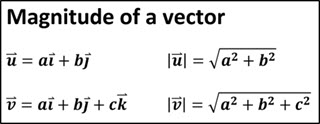
\(1)\) Find \(|\vec{a}|\) where \(\vec{a}=3\vec{i}-4\vec{j}\) The answer is \(|\vec{a}|=5 \)
\(|\vec{a}|=\sqrt{3^2+(-4)^2}\)
\(|\vec{a}|=\sqrt{9+16}\)
\(|\vec{a}|=\sqrt{25}\)
\(|\vec{a}|=5\)

\(|\vec{a}|=\sqrt{3^2+(-4)^2}\)
\(|\vec{a}|=\sqrt{9+16}\)
\(|\vec{a}|=\sqrt{25}\)
\(|\vec{a}|=5\)
\(2)\) Find the unit vector in the same direction as \(\vec{a}=3\vec{i}-4\vec{j}\). The answer is \(\frac{3}{5}\vec{i}- \frac{4}{5}\vec{j} \)
\(|\vec{a}|=\sqrt{3^2+(-4)^2}=5\)
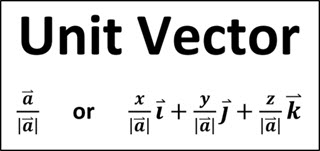
\(\text{Unit Vector}=\frac{\vec{a}}{|\vec{a}|}\)
\(\text{Unit Vector}=\frac{3\vec{i}-4\vec{j}}{5}\)
\(\text{Unit Vector}=\frac{3}{5}\vec{i}-\frac{4}{5}\vec{j}\)
\(|\vec{a}|=\sqrt{3^2+(-4)^2}=5\)
\(\text{Unit Vector}=\frac{\vec{a}}{|\vec{a}|}\)
\(\text{Unit Vector}=\frac{3\vec{i}-4\vec{j}}{5}\)
\(\text{Unit Vector}=\frac{3}{5}\vec{i}-\frac{4}{5}\vec{j}\)
\(3)\) Find \(|\vec{b}|\) where \(\vec{b}=3\vec{i}-4\vec{j}+6\vec{k}\) The answer is \(|\vec{b}|=\sqrt{61} \)
\(|\vec{b}|=\sqrt{3^2+(-4)^2+6^2}\)
\(|\vec{b}|=\sqrt{9+16+36}\)
\(|\vec{b}|=\sqrt{61}\)
\(|\vec{b}|=\sqrt{3^2+(-4)^2+6^2}\)
\(|\vec{b}|=\sqrt{9+16+36}\)
\(|\vec{b}|=\sqrt{61}\)
\(4)\) Find the unit vector in the same direction as \(\vec{b}=3\vec{i}-4\vec{j}+6\vec{k}\). The answer is \(\frac{3}{\sqrt{61}} \vec{i}-\frac{4}{\sqrt{61}}\vec{j}+\frac{6}{\sqrt{61}}\vec{k}\) or \(\frac{3\sqrt{61}}{61}\vec{i}-\frac{4\sqrt{61}}{61}\vec{j}+\frac{6\sqrt{61}}{61}\vec{k}\)
\(|\vec{b}|=\sqrt{3^2+(-4)^2+6^2}=\sqrt{61}\)
\(\text{Unit Vector}=\frac{\vec{b}}{|\vec{b}|}\)
\(\text{Unit Vector}=\frac{3\vec{i}-4\vec{j}+6\vec{k}}{\sqrt{61}}\)
\(\text{Unit Vector}=\frac{3}{\sqrt{61}}\vec{i}-\frac{4}{\sqrt{61}}\vec{j}+\frac{6}{\sqrt{61}}\vec{k}\)
\(\text{Unit Vector}=\frac{3\sqrt{61}}{61}\vec{i}-\frac{4\sqrt{61}}{61}\vec{j}+\frac{6\sqrt{61}}{61}\vec{k}\)
\(|\vec{b}|=\sqrt{3^2+(-4)^2+6^2}=\sqrt{61}\)
\(\text{Unit Vector}=\frac{\vec{b}}{|\vec{b}|}\)
\(\text{Unit Vector}=\frac{3\vec{i}-4\vec{j}+6\vec{k}}{\sqrt{61}}\)
\(\text{Unit Vector}=\frac{3}{\sqrt{61}}\vec{i}-\frac{4}{\sqrt{61}}\vec{j}+\frac{6}{\sqrt{61}}\vec{k}\)
\(\text{Unit Vector}=\frac{3\sqrt{61}}{61}\vec{i}-\frac{4\sqrt{61}}{61}\vec{j}+\frac{6\sqrt{61}}{61}\vec{k}\)
\(5)\) Find the direction and magnitude of the vector.
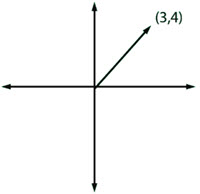 The answer is \(|\vec{v}|=5, \theta=53.1^{\circ}\)
\(\vec{v}=\langle3,4\rangle\)
\(|\vec{v}|=\sqrt{3^2+4^2}\)
\(|\vec{v}|=\sqrt{25}=5\)
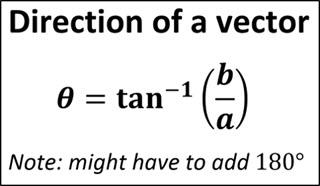
\(\theta=\tan^{-1}\left(\frac{4}{3}\right)\)
\(\theta\approx53.1^{\circ}\)
\(\vec{v}=\langle3,4\rangle\)
\(|\vec{v}|=\sqrt{3^2+4^2}\)
\(|\vec{v}|=\sqrt{25}=5\)
\(\theta=\tan^{-1}\left(\frac{4}{3}\right)\)
\(\theta\approx53.1^{\circ}\)
\(6)\) Find the direction and magnitude of the vector.
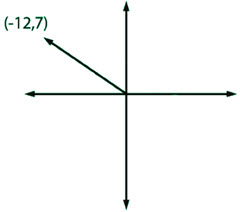 The answer is \(|\vec{v}|=13.9, \theta=149.7^{\circ}\)
\(\vec{v}=\langle-12,7\rangle\)
\(|\vec{v}|=\sqrt{(-12)^2+7^2}\)
\(|\vec{v}|=\sqrt{144+49}\)
\(|\vec{v}|=\sqrt{193}\approx13.9\)
\(\theta=180^{\circ}-\tan^{-1}\left(\frac{7}{12}\right)\)
\(\theta\approx149.7^{\circ}\)
\(\vec{v}=\langle-12,7\rangle\)
\(|\vec{v}|=\sqrt{(-12)^2+7^2}\)
\(|\vec{v}|=\sqrt{144+49}\)
\(|\vec{v}|=\sqrt{193}\approx13.9\)
\(\theta=180^{\circ}-\tan^{-1}\left(\frac{7}{12}\right)\)
\(\theta\approx149.7^{\circ}\)
\(7)\) \(|\vec{a}|=3, 70^{\circ}\), \( |\vec{b}|=4, 110^{\circ} \)
Find \(\vec{a}+\vec{b}\) as a magnitude and direction
The answer is \(|\vec{a}+\vec{b}|=6.59, \theta=93^{\circ}\)
\(\vec{a}=\langle3\cos70^{\circ},3\sin70^{\circ}\rangle\)
\(\vec{a}\approx\langle1.03,2.82\rangle\)
\(\vec{b}=\langle4\cos110^{\circ},4\sin110^{\circ}\rangle\)
\(\vec{b}\approx\langle-1.37,3.76\rangle\)
\(\vec{a}+\vec{b}\approx\langle-0.34,6.58\rangle\)
\(|\vec{a}+\vec{b}|=\sqrt{(-0.34)^2+(6.58)^2}\approx6.59\)
\(\theta\approx93^{\circ}\)
\(\vec{a}=\langle3\cos70^{\circ},3\sin70^{\circ}\rangle\)
\(\vec{a}\approx\langle1.03,2.82\rangle\)
\(\vec{b}=\langle4\cos110^{\circ},4\sin110^{\circ}\rangle\)
\(\vec{b}\approx\langle-1.37,3.76\rangle\)
\(\vec{a}+\vec{b}\approx\langle-0.34,6.58\rangle\)
\(|\vec{a}+\vec{b}|=\sqrt{(-0.34)^2+(6.58)^2}\approx6.59\)
\(\theta\approx93^{\circ}\)
\(8)\) Find \(|\vec{u}|\) where \(\vec{u}=5\vec{i}+12\vec{j}\). The answer is \(|\vec{u}|=13\)
\(|\vec{u}|=\sqrt{5^2+12^2}\)
\(|\vec{u}|=\sqrt{25+144}\)
\(|\vec{u}|=\sqrt{169}\)
\(|\vec{u}|=13\)
\(|\vec{u}|=\sqrt{5^2+12^2}\)
\(|\vec{u}|=\sqrt{25+144}\)
\(|\vec{u}|=\sqrt{169}\)
\(|\vec{u}|=13\)
\(9)\) Find the unit vector in the same direction as \(\vec{u}=5\vec{i}+12\vec{j}\). The answer is \(\frac{5}{13}\vec{i}+\frac{12}{13}\vec{j}\)
\(|\vec{u}|=\sqrt{5^2+12^2}=13\)
\(\text{Unit Vector}=\frac{\vec{u}}{|\vec{u}|}\)
\(\text{Unit Vector}=\frac{5\vec{i}+12\vec{j}}{13}\)
\(\text{Unit Vector}=\frac{5}{13}\vec{i}+\frac{12}{13}\vec{j}\)
\(|\vec{u}|=\sqrt{5^2+12^2}=13\)
\(\text{Unit Vector}=\frac{\vec{u}}{|\vec{u}|}\)
\(\text{Unit Vector}=\frac{5\vec{i}+12\vec{j}}{13}\)
\(\text{Unit Vector}=\frac{5}{13}\vec{i}+\frac{12}{13}\vec{j}\)
\(10)\) Find \(|\vec{w}|\) where \(\vec{w}=-6\vec{i}+8\vec{j}\). The answer is \(|\vec{w}|=10\)
\(|\vec{w}|=\sqrt{(-6)^2+8^2}\)
\(|\vec{w}|=\sqrt{36+64}\)
\(|\vec{w}|=\sqrt{100}\)
\(|\vec{w}|=10\)
\(|\vec{w}|=\sqrt{(-6)^2+8^2}\)
\(|\vec{w}|=\sqrt{36+64}\)
\(|\vec{w}|=\sqrt{100}\)
\(|\vec{w}|=10\)
\(11)\) Find the unit vector in the same direction as \(\vec{w}=-6\vec{i}+8\vec{j}\). The answer is \(-\frac{3}{5}\vec{i}+\frac{4}{5}\vec{j}\)
\(|\vec{w}|=\sqrt{(-6)^2+8^2}=10\)
\(\text{Unit Vector}=\frac{\vec{w}}{|\vec{w}|}\)
\(\text{Unit Vector}=\frac{-6\vec{i}+8\vec{j}}{10}\)
\(\text{Unit Vector}=-\frac{3}{5}\vec{i}+\frac{4}{5}\vec{j}\)
\(|\vec{w}|=\sqrt{(-6)^2+8^2}=10\)
\(\text{Unit Vector}=\frac{\vec{w}}{|\vec{w}|}\)
\(\text{Unit Vector}=\frac{-6\vec{i}+8\vec{j}}{10}\)
\(\text{Unit Vector}=-\frac{3}{5}\vec{i}+\frac{4}{5}\vec{j}\)
\(12)\) Find \(|\vec{p}|\) where \(\vec{p}=2\vec{i}-3\vec{j}+6\vec{k}\). The answer is \(|\vec{p}|=7\)
\(|\vec{p}|=\sqrt{2^2+(-3)^2+6^2}\)
\(|\vec{p}|=\sqrt{4+9+36}\)
\(|\vec{p}|=\sqrt{49}\)
\(|\vec{p}|=7\)
\(|\vec{p}|=\sqrt{2^2+(-3)^2+6^2}\)
\(|\vec{p}|=\sqrt{4+9+36}\)
\(|\vec{p}|=\sqrt{49}\)
\(|\vec{p}|=7\)
\(13)\) Find the unit vector in the same direction as \(\vec{p}=2\vec{i}-3\vec{j}+6\vec{k}\). The answer is \(\frac{2}{7}\vec{i}-\frac{3}{7}\vec{j}+\frac{6}{7}\vec{k}\)
\(|\vec{p}|=\sqrt{2^2+(-3)^2+6^2}=7\)
\(\text{Unit Vector}=\frac{\vec{p}}{|\vec{p}|}\)
\(\text{Unit Vector}=\frac{2\vec{i}-3\vec{j}+6\vec{k}}{7}\)
\(\text{Unit Vector}=\frac{2}{7}\vec{i}-\frac{3}{7}\vec{j}+\frac{6}{7}\vec{k}\)
\(|\vec{p}|=\sqrt{2^2+(-3)^2+6^2}=7\)
\(\text{Unit Vector}=\frac{\vec{p}}{|\vec{p}|}\)
\(\text{Unit Vector}=\frac{2\vec{i}-3\vec{j}+6\vec{k}}{7}\)
\(\text{Unit Vector}=\frac{2}{7}\vec{i}-\frac{3}{7}\vec{j}+\frac{6}{7}\vec{k}\)
\(14)\) Find the direction angle of \(\vec{v}=4\vec{i}+4\vec{j}\). The answer is \(\theta=45^{\circ}\)
\(\theta=\tan^{-1}\left(\frac{4}{4}\right)\)
\(\theta=\tan^{-1}(1)\)
\(\theta=45^{\circ}\)
\(\theta=\tan^{-1}\left(\frac{4}{4}\right)\)
\(\theta=\tan^{-1}(1)\)
\(\theta=45^{\circ}\)
\(15)\) Find the direction angle of \(\vec{v}=-3\vec{i}+3\sqrt{3}\vec{j}\). The answer is \(\theta=120^{\circ}\)
\(\vec{v}=\langle-3,3\sqrt{3}\rangle\)
\(\text{The vector is in Quadrant II.}\)
\(\theta=180^{\circ}-\tan^{-1}\left(\frac{3\sqrt{3}}{3}\right)\)
\(\theta=180^{\circ}-60^{\circ}\)
\(\theta=120^{\circ}\)
\(\vec{v}=\langle-3,3\sqrt{3}\rangle\)
\(\text{The vector is in Quadrant II.}\)
\(\theta=180^{\circ}-\tan^{-1}\left(\frac{3\sqrt{3}}{3}\right)\)
\(\theta=180^{\circ}-60^{\circ}\)
\(\theta=120^{\circ}\)
Challenge Problems
\(16)\) Write a vector with magnitude \(10\) and direction angle \(30^{\circ}\) in component form. The answer is \(5\sqrt{3}\vec{i}+5\vec{j}\)
\(\vec{v}=\langle r\cos\theta,r\sin\theta\rangle\)
\(\vec{v}=\langle10\cos30^{\circ},10\sin30^{\circ}\rangle\)
\(\vec{v}=\left\langle10\cdot\frac{\sqrt{3}}{2},10\cdot\frac{1}{2}\right\rangle\)
\(\vec{v}=\langle5\sqrt{3},5\rangle\)
\(\text{The answer is }5\sqrt{3}\vec{i}+5\vec{j}\)
\(\vec{v}=\langle r\cos\theta,r\sin\theta\rangle\)
\(\vec{v}=\langle10\cos30^{\circ},10\sin30^{\circ}\rangle\)
\(\vec{v}=\left\langle10\cdot\frac{\sqrt{3}}{2},10\cdot\frac{1}{2}\right\rangle\)
\(\vec{v}=\langle5\sqrt{3},5\rangle\)
\(\text{The answer is }5\sqrt{3}\vec{i}+5\vec{j}\)
\(17)\) Write a vector with magnitude \(6\) and direction angle \(150^{\circ}\) in component form. The answer is \(-3\sqrt{3}\vec{i}+3\vec{j}\)
\(\vec{v}=\langle r\cos\theta,r\sin\theta\rangle\)
\(\vec{v}=\langle6\cos150^{\circ},6\sin150^{\circ}\rangle\)
\(\vec{v}=\left\langle6\left(-\frac{\sqrt{3}}{2}\right),6\left(\frac{1}{2}\right)\right\rangle\)
\(\vec{v}=\langle-3\sqrt{3},3\rangle\)
\(\text{The answer is }-3\sqrt{3}\vec{i}+3\vec{j}\)
\(\vec{v}=\langle r\cos\theta,r\sin\theta\rangle\)
\(\vec{v}=\langle6\cos150^{\circ},6\sin150^{\circ}\rangle\)
\(\vec{v}=\left\langle6\left(-\frac{\sqrt{3}}{2}\right),6\left(\frac{1}{2}\right)\right\rangle\)
\(\vec{v}=\langle-3\sqrt{3},3\rangle\)
\(\text{The answer is }-3\sqrt{3}\vec{i}+3\vec{j}\)
\(18)\) Find the magnitude and direction of \(\vec{v}=\langle-5,-5\rangle\). The answer is \(|\vec{v}|=5\sqrt{2}, \theta=225^{\circ}\)
\(|\vec{v}|=\sqrt{(-5)^2+(-5)^2}\)
\(|\vec{v}|=\sqrt{25+25}\)
\(|\vec{v}|=5\sqrt{2}\)
\(\text{The vector is in Quadrant III.}\)
\(\theta=180^{\circ}+45^{\circ}\)
\(\theta=225^{\circ}\)
\(|\vec{v}|=\sqrt{(-5)^2+(-5)^2}\)
\(|\vec{v}|=\sqrt{25+25}\)
\(|\vec{v}|=5\sqrt{2}\)
\(\text{The vector is in Quadrant III.}\)
\(\theta=180^{\circ}+45^{\circ}\)
\(\theta=225^{\circ}\)
\(19)\) Find the magnitude and direction of \(\vec{v}=\langle0,-8\rangle\). The answer is \(|\vec{v}|=8, \theta=270^{\circ}\)
\(|\vec{v}|=\sqrt{0^2+(-8)^2}\)
\(|\vec{v}|=8\)
\(\text{The vector points straight down on the negative }y\text{-axis.}\)
\(\theta=270^{\circ}\)
\(|\vec{v}|=\sqrt{0^2+(-8)^2}\)
\(|\vec{v}|=8\)
\(\text{The vector points straight down on the negative }y\text{-axis.}\)
\(\theta=270^{\circ}\)
\(20)\) \(|\vec{a}|=5, 20^{\circ}\), \(|\vec{b}|=7, 140^{\circ}\). Find \(\vec{a}+\vec{b}\) as a magnitude and direction. The answer is \(|\vec{a}+\vec{b}|\approx6.25, \theta\approx103.9^{\circ}\)
\(\vec{a}=\langle5\cos20^{\circ},5\sin20^{\circ}\rangle\)
\(\vec{a}\approx\langle4.70,1.71\rangle\)
\(\vec{b}=\langle7\cos140^{\circ},7\sin140^{\circ}\rangle\)
\(\vec{b}\approx\langle-5.36,4.50\rangle\)
\(\vec{a}+\vec{b}\approx\langle-0.66,6.21\rangle\)
\(|\vec{a}+\vec{b}|\approx\sqrt{(-0.66)^2+(6.21)^2}\)
\(|\vec{a}+\vec{b}|\approx6.25\)
\(\theta\approx103.9^{\circ}\)
\(\vec{a}=\langle5\cos20^{\circ},5\sin20^{\circ}\rangle\)
\(\vec{a}\approx\langle4.70,1.71\rangle\)
\(\vec{b}=\langle7\cos140^{\circ},7\sin140^{\circ}\rangle\)
\(\vec{b}\approx\langle-5.36,4.50\rangle\)
\(\vec{a}+\vec{b}\approx\langle-0.66,6.21\rangle\)
\(|\vec{a}+\vec{b}|\approx\sqrt{(-0.66)^2+(6.21)^2}\)
\(|\vec{a}+\vec{b}|\approx6.25\)
\(\theta\approx103.9^{\circ}\)
See Related Pages\(\)
\(\bullet\text{ Displacement Vectors}\)
\(\,\,\,\,\,\,\,\,(x_2-x_1)\vec{i}+(y_2-y_1)\vec{j}…\)
\(\bullet\text{ Magnitude, Direction, and Unit Vectors}\)
\(\,\,\,\,\,\,\,\,|\vec{u}|=\sqrt{a^2+b^2}…\)
\(\bullet\text{ Dot Product}\)
\(\,\,\,\,\,\,\,\,a \cdot b=x_1 x_2+ y_1 y_2…\)
\(\bullet\text{ Parallel and Perpendicular Vectors}\)
\(\,\,\,\,\,\,\,\,⟨8,2⟩ \text{ and } ⟨−4,−1⟩…\)
\(\bullet\text{ Scalar and Vector Projections}\)
\(\,\,\,\,\,\,\,\,\displaystyle\frac{a \cdot b}{|b|^2} \, \vec{b}…\)
\(\bullet\text{ Cross Product}\)
\(\,\,\,\,\,\,\,\,\)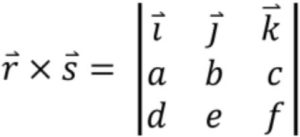 \(…\)
\(…\)
\(\bullet\text{ Equation of a Plane}\)
\(\,\,\,\,\,\,\,\,Ax+By+Cz=D…\)