
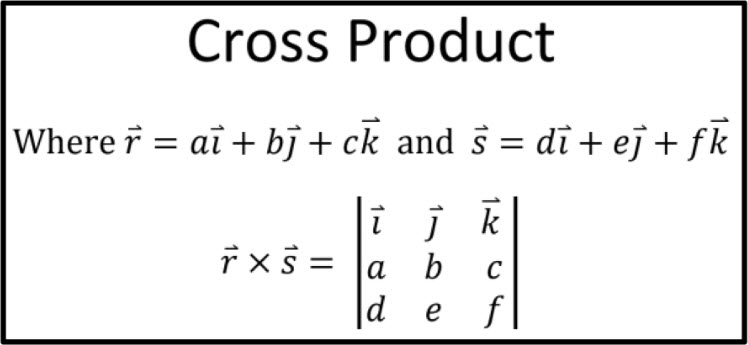
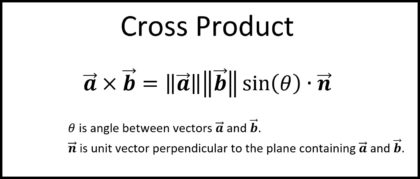
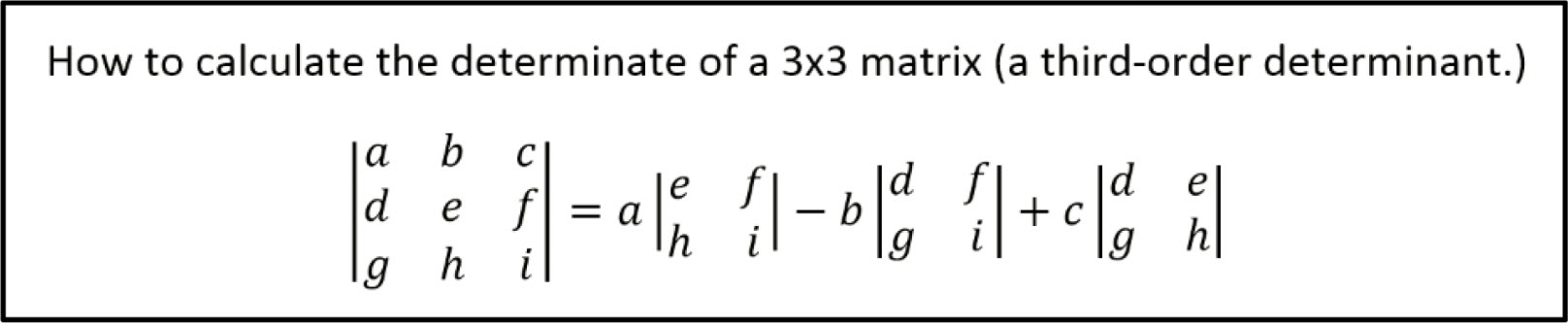
The cross product is an operation that takes two three-dimensional vectors and produces a new vector perpendicular to both original vectors. It is often found using a determinant with \(\vec{i}\), \(\vec{j}\), and \(\vec{k}\) in the first row. These problems include computing cross products, interpreting cross product properties, identifying parallel vectors, and using the magnitude of a cross product for area.
Notes
Practice Problems
\(\textbf{1)}\) Find \(\,\,\vec{r}\times\vec{s}\,\,\) where \(\,\,\vec{r}=2\vec{i}+5\vec{j}-1\vec{k}\,\,\) and \(\,\,\vec{s}=3\vec{i}-4\vec{j}+6\vec{k}\) The answer is \(\vec{r}\times\vec{s}=26\vec{i}-15\vec{j}-23\vec{k}\)
\(\,\,\,\,\,\, \left| {\begin{array}{ccc}\vec{i} & \vec{j} & \vec{k} \\ 2 & 5 & -1 \\ 3 & -4 & 6 \\\end{array} } \right|\)
\(\,\,\,\,\,\,\vec{i} \left| {\begin{array}{cc} 5 & -1 \\ -4 & 6 \\\end{array} } \right| -\vec{j} \left| {\begin{array}{cc} 2 & -1 \\ 3 & 6 \\\end{array} } \right| +\vec{k} \left| {\begin{array}{cc} 2 & 5 \\ 3 & -4 \\\end{array} } \right| \)
\(\,\,\,\,\,\,\vec{i} \left( (5)(6)-(-1)(-4) \right) -\vec{j} \left( (2)(6)-(-1)(3) \right) +\vec{k} \left( (2)(-4)-(3)(5) \right) \)
\(\,\,\,\,\,\,\vec{i} \left( 26 \right) -\vec{j} \left( 15 \right) +\vec{k} \left( -23 \right) \)
\(\,\,\,\,\,\,\)The answer is \(\vec{r}\times\vec{s}=26\vec{i}-15\vec{j}-23\vec{k}\)

\(\,\,\,\,\,\, \left| {\begin{array}{ccc}\vec{i} & \vec{j} & \vec{k} \\ 2 & 5 & -1 \\ 3 & -4 & 6 \\\end{array} } \right|\)
\(\,\,\,\,\,\,\vec{i} \left| {\begin{array}{cc} 5 & -1 \\ -4 & 6 \\\end{array} } \right| -\vec{j} \left| {\begin{array}{cc} 2 & -1 \\ 3 & 6 \\\end{array} } \right| +\vec{k} \left| {\begin{array}{cc} 2 & 5 \\ 3 & -4 \\\end{array} } \right| \)
\(\,\,\,\,\,\,\vec{i} \left( (5)(6)-(-1)(-4) \right) -\vec{j} \left( (2)(6)-(-1)(3) \right) +\vec{k} \left( (2)(-4)-(3)(5) \right) \)
\(\,\,\,\,\,\,\vec{i} \left( 26 \right) -\vec{j} \left( 15 \right) +\vec{k} \left( -23 \right) \)
\(\,\,\,\,\,\,\)The answer is \(\vec{r}\times\vec{s}=26\vec{i}-15\vec{j}-23\vec{k}\)
\(\textbf{2)}\) Find \(\,\,\vec{u}\times\vec{v}\,\,\) where \(\,\,\vec{u}=\langle2,5,3\rangle\,\,\) and \(\,\,\vec{v}=\langle6,-2,1\rangle\) The answer is \(\vec{u}\times\vec{v}=\langle11,16,-34\rangle\)
\(\,\,\,\,\,\, \left| {\begin{array}{ccc}\vec{i} & \vec{j} & \vec{k} \\ 2 & 5 & 3 \\ 6 & -2 & 1 \\\end{array} } \right|\)
\(\,\,\,\,\,\,\vec{i} \left| {\begin{array}{cc} 5 & 3 \\ -2 & 1 \\\end{array} } \right| -\vec{j} \left| {\begin{array}{cc} 2 & 3 \\ 6 & 1 \\\end{array} } \right| +\vec{k} \left| {\begin{array}{cc} 2 & 5 \\ 6 & -2 \\\end{array} } \right| \)
\(\,\,\,\,\,\,\vec{i} \left( (5)(1)-(3)(-2) \right) -\vec{j} \left( (2)(1)-(3)(6) \right) +\vec{k} \left( (2)(-2)-(5)(6) \right) \)
\(\,\,\,\,\,\,\vec{i} \left( 11 \right) -\vec{j} \left( -16 \right) +\vec{k} \left( -34 \right) \)
\(\,\,\,\,\,\,\)The answer is \(\vec{u}\times\vec{v}=\langle11,16,-34\rangle\)
\(\,\,\,\,\,\, \left| {\begin{array}{ccc}\vec{i} & \vec{j} & \vec{k} \\ 2 & 5 & 3 \\ 6 & -2 & 1 \\\end{array} } \right|\)
\(\,\,\,\,\,\,\vec{i} \left| {\begin{array}{cc} 5 & 3 \\ -2 & 1 \\\end{array} } \right| -\vec{j} \left| {\begin{array}{cc} 2 & 3 \\ 6 & 1 \\\end{array} } \right| +\vec{k} \left| {\begin{array}{cc} 2 & 5 \\ 6 & -2 \\\end{array} } \right| \)
\(\,\,\,\,\,\,\vec{i} \left( (5)(1)-(3)(-2) \right) -\vec{j} \left( (2)(1)-(3)(6) \right) +\vec{k} \left( (2)(-2)-(5)(6) \right) \)
\(\,\,\,\,\,\,\vec{i} \left( 11 \right) -\vec{j} \left( -16 \right) +\vec{k} \left( -34 \right) \)
\(\,\,\,\,\,\,\)The answer is \(\vec{u}\times\vec{v}=\langle11,16,-34\rangle\)
\(\textbf{3)}\) Find \(\,\,\vec{a}\times\vec{b}\,\,\) where \(\,\,\vec{a}=\langle1,3,4\rangle\,\,\) and \(\,\,\vec{b}=\langle-5,1,1\rangle\) The answer is \(\vec{a}\times\vec{b}=\langle-1,-21,16\rangle\)
\(\,\,\,\,\,\, \left| {\begin{array}{ccc}\vec{i} & \vec{j} & \vec{k} \\ 1 & 3 & 4 \\ -5 & 1 & 1 \\\end{array} } \right|\)
\(\,\,\,\,\,\,\vec{i} \left| {\begin{array}{cc} 3 & 4 \\ 1 & 1 \\\end{array} } \right| -\vec{j} \left| {\begin{array}{cc} 1 & 4 \\ -5 & 1 \\\end{array} } \right| +\vec{k} \left| {\begin{array}{cc} 1 & 3 \\ -5 & 1 \\\end{array} } \right| \)
\(\,\,\,\,\,\,\vec{i} \left( (3)(1)-(4)(1) \right) -\vec{j} \left( (1)(1)-(4)(-5) \right) +\vec{k} \left( (1)(1)-(3)(-5) \right) \)
\(\,\,\,\,\,\,\vec{i} \left( -1 \right) -\vec{j} \left( 21 \right) +\vec{k} \left( 16 \right) \)
\(\,\,\,\,\,\,\)The answer is \(\vec{a}\times\vec{b}=\langle-1,-21,16\rangle\)
\(\,\,\,\,\,\, \left| {\begin{array}{ccc}\vec{i} & \vec{j} & \vec{k} \\ 1 & 3 & 4 \\ -5 & 1 & 1 \\\end{array} } \right|\)
\(\,\,\,\,\,\,\vec{i} \left| {\begin{array}{cc} 3 & 4 \\ 1 & 1 \\\end{array} } \right| -\vec{j} \left| {\begin{array}{cc} 1 & 4 \\ -5 & 1 \\\end{array} } \right| +\vec{k} \left| {\begin{array}{cc} 1 & 3 \\ -5 & 1 \\\end{array} } \right| \)
\(\,\,\,\,\,\,\vec{i} \left( (3)(1)-(4)(1) \right) -\vec{j} \left( (1)(1)-(4)(-5) \right) +\vec{k} \left( (1)(1)-(3)(-5) \right) \)
\(\,\,\,\,\,\,\vec{i} \left( -1 \right) -\vec{j} \left( 21 \right) +\vec{k} \left( 16 \right) \)
\(\,\,\,\,\,\,\)The answer is \(\vec{a}\times\vec{b}=\langle-1,-21,16\rangle\)
\(\textbf{4)}\) Find \(\,\,\vec{m}\times\vec{n}\,\,\) where \(\,\,\vec{m}=\langle1,2,3\rangle\,\,\) and \(\,\,\vec{n}=\langle1,0,0\rangle\) The answer is \(\vec{m}\times\vec{n}=\langle0,3,-2\rangle\)
\(\,\,\,\,\,\, \left| {\begin{array}{ccc}\vec{i} & \vec{j} & \vec{k} \\ 1 & 2 & 3 \\ 1 & 0 & 0 \\\end{array} } \right|\)
\(\,\,\,\,\,\,\vec{i}\left((2)(0)-(3)(0)\right)-\vec{j}\left((1)(0)-(3)(1)\right)+\vec{k}\left((1)(0)-(2)(1)\right)\)
\(\,\,\,\,\,\,\vec{i}(0)-\vec{j}(-3)+\vec{k}(-2)\)
\(\,\,\,\,\,\,\)The answer is \(\vec{m}\times\vec{n}=\langle0,3,-2\rangle\)
\(\,\,\,\,\,\, \left| {\begin{array}{ccc}\vec{i} & \vec{j} & \vec{k} \\ 1 & 2 & 3 \\ 1 & 0 & 0 \\\end{array} } \right|\)
\(\,\,\,\,\,\,\vec{i}\left((2)(0)-(3)(0)\right)-\vec{j}\left((1)(0)-(3)(1)\right)+\vec{k}\left((1)(0)-(2)(1)\right)\)
\(\,\,\,\,\,\,\vec{i}(0)-\vec{j}(-3)+\vec{k}(-2)\)
\(\,\,\,\,\,\,\)The answer is \(\vec{m}\times\vec{n}=\langle0,3,-2\rangle\)
\(\textbf{5)}\) Find \(\,\,\vec{u}\times\vec{v}\,\,\) where \(\,\,\vec{u}=\langle1,2,3\rangle\,\,\) and \(\,\,\vec{v}=\langle3,2,1\rangle\) The answer is \(\vec{u}\times\vec{v}=\langle-4,8,-4\rangle\)
\(\,\,\,\,\,\, \left| {\begin{array}{ccc}\vec{i} & \vec{j} & \vec{k} \\ 1 & 2 & 3 \\ 3 & 2 & 1 \\\end{array} } \right|\)
\(\,\,\,\,\,\,\vec{i}\left((2)(1)-(3)(2)\right)-\vec{j}\left((1)(1)-(3)(3)\right)+\vec{k}\left((1)(2)-(2)(3)\right)\)
\(\,\,\,\,\,\,\vec{i}(-4)-\vec{j}(-8)+\vec{k}(-4)\)
\(\,\,\,\,\,\,\)The answer is \(\vec{u}\times\vec{v}=\langle-4,8,-4\rangle\)
\(\,\,\,\,\,\, \left| {\begin{array}{ccc}\vec{i} & \vec{j} & \vec{k} \\ 1 & 2 & 3 \\ 3 & 2 & 1 \\\end{array} } \right|\)
\(\,\,\,\,\,\,\vec{i}\left((2)(1)-(3)(2)\right)-\vec{j}\left((1)(1)-(3)(3)\right)+\vec{k}\left((1)(2)-(2)(3)\right)\)
\(\,\,\,\,\,\,\vec{i}(-4)-\vec{j}(-8)+\vec{k}(-4)\)
\(\,\,\,\,\,\,\)The answer is \(\vec{u}\times\vec{v}=\langle-4,8,-4\rangle\)
\(\textbf{6)}\) Find \(\,\,\vec{p}\times\vec{q}\,\,\) where \(\vec{p}=\langle4,-1,2\rangle\) and \(\vec{q}=\langle0,3,5\rangle\) The answer is \(\vec{p}\times\vec{q}=\langle-11,-20,12\rangle\)
\(\,\,\,\,\,\, \left| {\begin{array}{ccc}\vec{i} & \vec{j} & \vec{k} \\ 4 & -1 & 2 \\ 0 & 3 & 5 \\\end{array} } \right|\)
\(\,\,\,\,\,\,\vec{i}\left((-1)(5)-(2)(3)\right)-\vec{j}\left((4)(5)-(2)(0)\right)+\vec{k}\left((4)(3)-(-1)(0)\right)\)
\(\,\,\,\,\,\,\vec{i}(-11)-\vec{j}(20)+\vec{k}(12)\)
\(\,\,\,\,\,\,\)The answer is \(\vec{p}\times\vec{q}=\langle-11,-20,12\rangle\)
\(\,\,\,\,\,\, \left| {\begin{array}{ccc}\vec{i} & \vec{j} & \vec{k} \\ 4 & -1 & 2 \\ 0 & 3 & 5 \\\end{array} } \right|\)
\(\,\,\,\,\,\,\vec{i}\left((-1)(5)-(2)(3)\right)-\vec{j}\left((4)(5)-(2)(0)\right)+\vec{k}\left((4)(3)-(-1)(0)\right)\)
\(\,\,\,\,\,\,\vec{i}(-11)-\vec{j}(20)+\vec{k}(12)\)
\(\,\,\,\,\,\,\)The answer is \(\vec{p}\times\vec{q}=\langle-11,-20,12\rangle\)
\(\textbf{7)}\) Find \(\,\,\vec{a}\times\vec{b}\,\,\) where \(\vec{a}=\langle-2,4,1\rangle\) and \(\vec{b}=\langle3,0,-5\rangle\) The answer is \(\vec{a}\times\vec{b}=\langle-20,-7,-12\rangle\)
\(\,\,\,\,\,\, \left| {\begin{array}{ccc}\vec{i} & \vec{j} & \vec{k} \\ -2 & 4 & 1 \\ 3 & 0 & -5 \\\end{array} } \right|\)
\(\,\,\,\,\,\,\vec{i}\left((4)(-5)-(1)(0)\right)-\vec{j}\left((-2)(-5)-(1)(3)\right)+\vec{k}\left((-2)(0)-(4)(3)\right)\)
\(\,\,\,\,\,\,\vec{i}(-20)-\vec{j}(7)+\vec{k}(-12)\)
\(\,\,\,\,\,\,\)The answer is \(\vec{a}\times\vec{b}=\langle-20,-7,-12\rangle\)
\(\,\,\,\,\,\, \left| {\begin{array}{ccc}\vec{i} & \vec{j} & \vec{k} \\ -2 & 4 & 1 \\ 3 & 0 & -5 \\\end{array} } \right|\)
\(\,\,\,\,\,\,\vec{i}\left((4)(-5)-(1)(0)\right)-\vec{j}\left((-2)(-5)-(1)(3)\right)+\vec{k}\left((-2)(0)-(4)(3)\right)\)
\(\,\,\,\,\,\,\vec{i}(-20)-\vec{j}(7)+\vec{k}(-12)\)
\(\,\,\,\,\,\,\)The answer is \(\vec{a}\times\vec{b}=\langle-20,-7,-12\rangle\)
\(\textbf{8)}\) Find \(\,\,\vec{x}\times\vec{y}\,\,\) where \(\vec{x}=\langle0,2,-3\rangle\) and \(\vec{y}=\langle7,1,4\rangle\) The answer is \(\vec{x}\times\vec{y}=\langle11,-21,-14\rangle\)
\(\,\,\,\,\,\, \left| {\begin{array}{ccc}\vec{i} & \vec{j} & \vec{k} \\ 0 & 2 & -3 \\ 7 & 1 & 4 \\\end{array} } \right|\)
\(\,\,\,\,\,\,\vec{i}\left((2)(4)-(-3)(1)\right)-\vec{j}\left((0)(4)-(-3)(7)\right)+\vec{k}\left((0)(1)-(2)(7)\right)\)
\(\,\,\,\,\,\,\vec{i}(11)-\vec{j}(21)+\vec{k}(-14)\)
\(\,\,\,\,\,\,\)The answer is \(\vec{x}\times\vec{y}=\langle11,-21,-14\rangle\)
\(\,\,\,\,\,\, \left| {\begin{array}{ccc}\vec{i} & \vec{j} & \vec{k} \\ 0 & 2 & -3 \\ 7 & 1 & 4 \\\end{array} } \right|\)
\(\,\,\,\,\,\,\vec{i}\left((2)(4)-(-3)(1)\right)-\vec{j}\left((0)(4)-(-3)(7)\right)+\vec{k}\left((0)(1)-(2)(7)\right)\)
\(\,\,\,\,\,\,\vec{i}(11)-\vec{j}(21)+\vec{k}(-14)\)
\(\,\,\,\,\,\,\)The answer is \(\vec{x}\times\vec{y}=\langle11,-21,-14\rangle\)
\(\textbf{9)}\) Find \(\,\,\vec{c}\times\vec{d}\,\,\) where \(\vec{c}=\langle1,0,0\rangle\) and \(\vec{d}=\langle0,1,0\rangle\) The answer is \(\vec{c}\times\vec{d}=\langle0,0,1\rangle\)
\(\,\,\,\,\,\,\vec{i}\times\vec{j}=\vec{k}\)
\(\,\,\,\,\,\,\langle1,0,0\rangle\times\langle0,1,0\rangle=\langle0,0,1\rangle\)
\(\,\,\,\,\,\,\)The answer is \(\vec{c}\times\vec{d}=\langle0,0,1\rangle\)
\(\,\,\,\,\,\,\vec{i}\times\vec{j}=\vec{k}\)
\(\,\,\,\,\,\,\langle1,0,0\rangle\times\langle0,1,0\rangle=\langle0,0,1\rangle\)
\(\,\,\,\,\,\,\)The answer is \(\vec{c}\times\vec{d}=\langle0,0,1\rangle\)
\(\textbf{10)}\) Find \(\,\,\vec{d}\times\vec{c}\,\,\) where \(\vec{c}=\langle1,0,0\rangle\) and \(\vec{d}=\langle0,1,0\rangle\) The answer is \(\vec{d}\times\vec{c}=\langle0,0,-1\rangle\)
\(\,\,\,\,\,\,\vec{j}\times\vec{i}=-\vec{k}\)
\(\,\,\,\,\,\,\langle0,1,0\rangle\times\langle1,0,0\rangle=\langle0,0,-1\rangle\)
\(\,\,\,\,\,\,\)The answer is \(\vec{d}\times\vec{c}=\langle0,0,-1\rangle\)
\(\,\,\,\,\,\,\vec{j}\times\vec{i}=-\vec{k}\)
\(\,\,\,\,\,\,\langle0,1,0\rangle\times\langle1,0,0\rangle=\langle0,0,-1\rangle\)
\(\,\,\,\,\,\,\)The answer is \(\vec{d}\times\vec{c}=\langle0,0,-1\rangle\)
\(\textbf{11)}\) Find \(\,\,\vec{u}\times\vec{v}\,\,\) where \(\vec{u}=\langle2,4,6\rangle\) and \(\vec{v}=\langle1,2,3\rangle\) The answer is \(\vec{u}\times\vec{v}=\langle0,0,0\rangle\)
\(\,\,\,\,\,\,\vec{u}=\langle2,4,6\rangle=2\langle1,2,3\rangle\)
\(\,\,\,\,\,\,\vec{v}=\langle1,2,3\rangle\)
\(\,\,\,\,\,\,\text{The vectors are parallel.}\)
\(\,\,\,\,\,\,\text{The cross product of parallel vectors is the zero vector.}\)
\(\,\,\,\,\,\,\)The answer is \(\vec{u}\times\vec{v}=\langle0,0,0\rangle\)
\(\,\,\,\,\,\,\vec{u}=\langle2,4,6\rangle=2\langle1,2,3\rangle\)
\(\,\,\,\,\,\,\vec{v}=\langle1,2,3\rangle\)
\(\,\,\,\,\,\,\text{The vectors are parallel.}\)
\(\,\,\,\,\,\,\text{The cross product of parallel vectors is the zero vector.}\)
\(\,\,\,\,\,\,\)The answer is \(\vec{u}\times\vec{v}=\langle0,0,0\rangle\)
\(\textbf{12)}\) Find \(\,\,\vec{u}\times\vec{v}\,\,\) where \(\vec{u}=\langle3,-2,1\rangle\) and \(\vec{v}=\langle-6,4,-2\rangle\) The answer is \(\vec{u}\times\vec{v}=\langle0,0,0\rangle\)
\(\,\,\,\,\,\,\vec{v}=-2\vec{u}\)
\(\,\,\,\,\,\,\text{Since one vector is a scalar multiple of the other, the vectors are parallel.}\)
\(\,\,\,\,\,\,\vec{u}\times\vec{v}=\vec{0}\)
\(\,\,\,\,\,\,\)The answer is \(\vec{u}\times\vec{v}=\langle0,0,0\rangle\)
\(\,\,\,\,\,\,\vec{v}=-2\vec{u}\)
\(\,\,\,\,\,\,\text{Since one vector is a scalar multiple of the other, the vectors are parallel.}\)
\(\,\,\,\,\,\,\vec{u}\times\vec{v}=\vec{0}\)
\(\,\,\,\,\,\,\)The answer is \(\vec{u}\times\vec{v}=\langle0,0,0\rangle\)
\(\textbf{13)}\) Find \(\,\,\vec{v}\times\vec{u}\,\,\) if \(\vec{u}\times\vec{v}=\langle4,-6,9\rangle\). The answer is \(\vec{v}\times\vec{u}=\langle-4,6,-9\rangle\)
\(\,\,\,\,\,\,\vec{v}\times\vec{u}=-(\vec{u}\times\vec{v})\)
\(\,\,\,\,\,\,\vec{v}\times\vec{u}=-\langle4,-6,9\rangle\)
\(\,\,\,\,\,\,\vec{v}\times\vec{u}=\langle-4,6,-9\rangle\)
\(\,\,\,\,\,\,\)The answer is \(\vec{v}\times\vec{u}=\langle-4,6,-9\rangle\)
\(\,\,\,\,\,\,\vec{v}\times\vec{u}=-(\vec{u}\times\vec{v})\)
\(\,\,\,\,\,\,\vec{v}\times\vec{u}=-\langle4,-6,9\rangle\)
\(\,\,\,\,\,\,\vec{v}\times\vec{u}=\langle-4,6,-9\rangle\)
\(\,\,\,\,\,\,\)The answer is \(\vec{v}\times\vec{u}=\langle-4,6,-9\rangle\)
\(\textbf{14)}\) Find the area of the parallelogram formed by \(\vec{u}=\langle1,2,2\rangle\) and \(\vec{v}=\langle3,0,1\rangle\). The answer is \(3\sqrt{5}\)
\(\,\,\,\,\,\,\text{Area}=||\vec{u}\times\vec{v}||\)
\(\,\,\,\,\,\,\vec{u}\times\vec{v}=\langle(2)(1)-(2)(0),-\left((1)(1)-(2)(3)\right),(1)(0)-(2)(3)\rangle\)
\(\,\,\,\,\,\,\vec{u}\times\vec{v}=\langle2,5,-6\rangle\)
\(\,\,\,\,\,\,||\vec{u}\times\vec{v}||=\sqrt{2^2+5^2+(-6)^2}\)
\(\,\,\,\,\,\,||\vec{u}\times\vec{v}||=\sqrt{65}\)
\(\,\,\,\,\,\,\)The answer is \(\sqrt{65}\)
\(\,\,\,\,\,\,\text{Area}=||\vec{u}\times\vec{v}||\)
\(\,\,\,\,\,\,\vec{u}\times\vec{v}=\langle(2)(1)-(2)(0),-\left((1)(1)-(2)(3)\right),(1)(0)-(2)(3)\rangle\)
\(\,\,\,\,\,\,\vec{u}\times\vec{v}=\langle2,5,-6\rangle\)
\(\,\,\,\,\,\,||\vec{u}\times\vec{v}||=\sqrt{2^2+5^2+(-6)^2}\)
\(\,\,\,\,\,\,||\vec{u}\times\vec{v}||=\sqrt{65}\)
\(\,\,\,\,\,\,\)The answer is \(\sqrt{65}\)
\(\textbf{15)}\) Find the area of the triangle formed by \(\vec{u}=\langle1,0,2\rangle\) and \(\vec{v}=\langle0,3,1\rangle\). The answer is \(\frac{\sqrt{46}}{2}\)
\(\,\,\,\,\,\,\text{Triangle Area}=\displaystyle\frac{1}{2}||\vec{u}\times\vec{v}||\)
\(\,\,\,\,\,\,\vec{u}\times\vec{v}=\langle(0)(1)-(2)(3),-\left((1)(1)-(2)(0)\right),(1)(3)-(0)(0)\rangle\)
\(\,\,\,\,\,\,\vec{u}\times\vec{v}=\langle-6,-1,3\rangle\)
\(\,\,\,\,\,\,||\vec{u}\times\vec{v}||=\sqrt{(-6)^2+(-1)^2+3^2}\)
\(\,\,\,\,\,\,||\vec{u}\times\vec{v}||=\sqrt{46}\)
\(\,\,\,\,\,\,\)The answer is \(\frac{\sqrt{46}}{2}\)
\(\,\,\,\,\,\,\text{Triangle Area}=\displaystyle\frac{1}{2}||\vec{u}\times\vec{v}||\)
\(\,\,\,\,\,\,\vec{u}\times\vec{v}=\langle(0)(1)-(2)(3),-\left((1)(1)-(2)(0)\right),(1)(3)-(0)(0)\rangle\)
\(\,\,\,\,\,\,\vec{u}\times\vec{v}=\langle-6,-1,3\rangle\)
\(\,\,\,\,\,\,||\vec{u}\times\vec{v}||=\sqrt{(-6)^2+(-1)^2+3^2}\)
\(\,\,\,\,\,\,||\vec{u}\times\vec{v}||=\sqrt{46}\)
\(\,\,\,\,\,\,\)The answer is \(\frac{\sqrt{46}}{2}\)
True or False
\(\textbf{16)}\) \(\,\,\vec{u}\times\vec{v}\,\,=\,\,\vec{v}\times\vec{u}\) The answer is False
\(\,\,\,\,\,\,\vec{u}\times\vec{v}=-(\vec{v}\times\vec{u})\)
\(\,\,\,\,\,\,\text{Changing the order changes the sign of the cross product.}\)
\(\,\,\,\,\,\,\)The answer is False
\(\,\,\,\,\,\,\vec{u}\times\vec{v}=-(\vec{v}\times\vec{u})\)
\(\,\,\,\,\,\,\text{Changing the order changes the sign of the cross product.}\)
\(\,\,\,\,\,\,\)The answer is False
\(\textbf{17)}\) \(\,\,||\vec{u}\times\vec{v}||\,\,=\,\,||\vec{v}\times\vec{u}||\) The answer is True
\(\,\,\,\,\,\,\vec{v}\times\vec{u}=-(\vec{u}\times\vec{v})\)
\(\,\,\,\,\,\,\text{Opposite vectors have the same magnitude.}\)
\(\,\,\,\,\,\,||\vec{u}\times\vec{v}||=||\vec{v}\times\vec{u}||\)
\(\,\,\,\,\,\,\)The answer is True
\(\,\,\,\,\,\,\vec{v}\times\vec{u}=-(\vec{u}\times\vec{v})\)
\(\,\,\,\,\,\,\text{Opposite vectors have the same magnitude.}\)
\(\,\,\,\,\,\,||\vec{u}\times\vec{v}||=||\vec{v}\times\vec{u}||\)
\(\,\,\,\,\,\,\)The answer is True
\(\textbf{18)}\) The cross product of two parallel vectors is zero. The answer is True
\(\,\,\,\,\,\,||\vec{u}\times\vec{v}||=||\vec{u}||||\vec{v}||\sin{\theta}\)
\(\,\,\,\,\,\,\text{Parallel vectors have }\theta=0\text{ or }\theta=\pi.\)
\(\,\,\,\,\,\,\sin{0}=0\text{ and }\sin{\pi}=0\)
\(\,\,\,\,\,\,\)The answer is True
\(\,\,\,\,\,\,||\vec{u}\times\vec{v}||=||\vec{u}||||\vec{v}||\sin{\theta}\)
\(\,\,\,\,\,\,\text{Parallel vectors have }\theta=0\text{ or }\theta=\pi.\)
\(\,\,\,\,\,\,\sin{0}=0\text{ and }\sin{\pi}=0\)
\(\,\,\,\,\,\,\)The answer is True
\(\textbf{19)}\) The cross product of two vectors in the \(xy\)-plane points in a direction perpendicular to the \(xy\)-plane. The answer is True
\(\,\,\,\,\,\,\text{A vector in the }xy\text{-plane has the form }\langle a,b,0\rangle.\)
\(\,\,\,\,\,\,\langle a,b,0\rangle\times\langle c,d,0\rangle=\langle0,0,ad-bc\rangle\)
\(\,\,\,\,\,\,\text{This points in the positive or negative }z\text{-direction.}\)
\(\,\,\,\,\,\,\)The answer is True
\(\,\,\,\,\,\,\text{A vector in the }xy\text{-plane has the form }\langle a,b,0\rangle.\)
\(\,\,\,\,\,\,\langle a,b,0\rangle\times\langle c,d,0\rangle=\langle0,0,ad-bc\rangle\)
\(\,\,\,\,\,\,\text{This points in the positive or negative }z\text{-direction.}\)
\(\,\,\,\,\,\,\)The answer is True
\(\textbf{20)}\) If \(\vec{u}\times\vec{v}=\vec{0}\), then \(\vec{u}\) and \(\vec{v}\) must be perpendicular. The answer is False
\(\,\,\,\,\,\,||\vec{u}\times\vec{v}||=||\vec{u}||||\vec{v}||\sin{\theta}\)
\(\,\,\,\,\,\,\vec{u}\times\vec{v}=\vec{0}\text{ when the vectors are parallel or one vector is the zero vector.}\)
\(\,\,\,\,\,\,\text{Perpendicular vectors usually have the largest cross product magnitude, not zero.}\)
\(\,\,\,\,\,\,\)The answer is False
\(\,\,\,\,\,\,||\vec{u}\times\vec{v}||=||\vec{u}||||\vec{v}||\sin{\theta}\)
\(\,\,\,\,\,\,\vec{u}\times\vec{v}=\vec{0}\text{ when the vectors are parallel or one vector is the zero vector.}\)
\(\,\,\,\,\,\,\text{Perpendicular vectors usually have the largest cross product magnitude, not zero.}\)
\(\,\,\,\,\,\,\)The answer is False
See Related Pages\(\)
\(\bullet\text{ Displacement Vectors}\)
\(\,\,\,\,\,\,\,\,(x_2-x_1)\vec{i}+(y_2-y_1)\vec{j}…\)
\(\bullet\text{ Magnitude, Direction, and Unit Vectors}\)
\(\,\,\,\,\,\,\,\,|\vec{u}|=\sqrt{a^2+b^2}…\)
\(\bullet\text{ Dot Product}\)
\(\,\,\,\,\,\,\,\,a \cdot b=x_1 x_2+ y_1 y_2…\)
\(\bullet\text{ Parallel and Perpendicular Vectors}\)
\(\,\,\,\,\,\,\,\,⟨8,2⟩ \text{ and } ⟨−4,−1⟩…\)
\(\bullet\text{ Scalar and Vector Projections}\)
\(\,\,\,\,\,\,\,\,\displaystyle\frac{a \cdot b}{|b|^2} \, \vec{b}…\)
\(\bullet\text{ Cross Product}\)
\(\,\,\,\,\,\,\,\,\)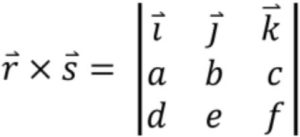 \(…\)
\(…\)
\(\bullet\text{ Equation of a Plane}\)
\(\,\,\,\,\,\,\,\,Ax+By+Cz=D…\)