

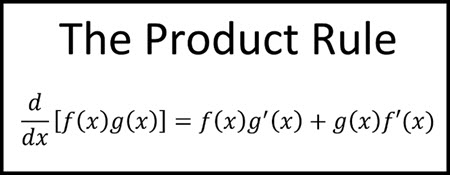
The product rule is used to find derivatives when two functions are multiplied together. The key idea is to take the first function times the derivative of the second, then add the derivative of the first times the second. These problems include polynomial, radical, trigonometric, exponential, logarithmic, and table-based product rule examples.
Notes
Practice Problems & Videos
Use the product rule to find the derivative of the following functions.
\(\textbf{1)}\) \(f(x)=5x^{3} \cos x\) The derivative is \(f'(x)=-5x^{3} \sin x+15x^{2} \cos x\)
\(\,\,\,\,\,\,f(x)=5x^{3} \cos x\)
\(\,\,\,\,\,\,\frac{d}{dx}[f(x)⋅g(x)]=f(x) \cdot g′(x)+f′(x) \cdot g(x)\)
\(\,\,\,\,\,\,f'(x)=5\left[\left(x^{3}\right) \cdot \left(\cos x\right)’+\left(x^{3}\right)’ \cdot \left(\cos x\right)\right]\)
\(\,\,\,\,\,\,f'(x)=5\left[\left(x^{3}\right) \cdot \left(-\sin x\right)+\left(3x^{2}\right) \cdot \left(\cos x\right)\right]\)
\(\,\,\,\,\,\,\)The derivative is \(f'(x)=-5x^{3} \sin x+15x^{2} \cos x\)

\(\,\,\,\,\,\,f(x)=5x^{3} \cos x\)
\(\,\,\,\,\,\,\frac{d}{dx}[f(x)⋅g(x)]=f(x) \cdot g′(x)+f′(x) \cdot g(x)\)
\(\,\,\,\,\,\,f'(x)=5\left[\left(x^{3}\right) \cdot \left(\cos x\right)’+\left(x^{3}\right)’ \cdot \left(\cos x\right)\right]\)
\(\,\,\,\,\,\,f'(x)=5\left[\left(x^{3}\right) \cdot \left(-\sin x\right)+\left(3x^{2}\right) \cdot \left(\cos x\right)\right]\)
\(\,\,\,\,\,\,\)The derivative is \(f'(x)=-5x^{3} \sin x+15x^{2} \cos x\)
\(\textbf{2)}\) \(f(x)=\sqrt{x} (x^{2}+5)\) The derivative is \(f'(x)=\displaystyle\frac{5x^{2}+5}{2\sqrt{x}}\)
\(\,\,\,\,\,\,f(x)=\sqrt{x} (x^{2}+5)\)
\(\,\,\,\,\,\,\frac{d}{dx}[f(x)⋅g(x)]=f(x) \cdot g′(x)+f′(x) \cdot g(x)\)
\(\,\,\,\,\,\,f'(x)=\left(\sqrt{x}\right)\left(x^{2}+5\right)’+\left(\sqrt{x}\right)’\left(x^{2}+5\right)\)
\(\,\,\,\,\,\,f'(x)=\left(\sqrt{x}\right)\left(2x\right)+\left(\displaystyle\frac{1}{2\sqrt{x}}\right)\left(x^{2}+5\right)\)
\(\,\,\,\,\,\,\displaystyle f'(x)=\frac{2x\sqrt{x}}{1}+\frac{x^{2}+5}{2\sqrt{x}}\)
\(\,\,\,\,\,\,\displaystyle f'(x)=\frac{4x^2}{2\sqrt{x}}+\frac{x^{2}+5}{2\sqrt{x}}\)
\(\,\,\,\,\,\,\displaystyle f'(x)=\frac{4x^2 + x^{2}+5}{2\sqrt{x}}\)
\(\,\,\,\,\,\,\displaystyle f'(x)=\frac{5x^{2}+5}{2\sqrt{x}}\)
\(\,\,\,\,\,\,\)The derivative is \(f'(x)=\displaystyle\frac{5x^{2}+5}{2\sqrt{x}}\)
\(\,\,\,\,\,\,f(x)=\sqrt{x} (x^{2}+5)\)
\(\,\,\,\,\,\,\frac{d}{dx}[f(x)⋅g(x)]=f(x) \cdot g′(x)+f′(x) \cdot g(x)\)
\(\,\,\,\,\,\,f'(x)=\left(\sqrt{x}\right)\left(x^{2}+5\right)’+\left(\sqrt{x}\right)’\left(x^{2}+5\right)\)
\(\,\,\,\,\,\,f'(x)=\left(\sqrt{x}\right)\left(2x\right)+\left(\displaystyle\frac{1}{2\sqrt{x}}\right)\left(x^{2}+5\right)\)
\(\,\,\,\,\,\,\displaystyle f'(x)=\frac{2x\sqrt{x}}{1}+\frac{x^{2}+5}{2\sqrt{x}}\)
\(\,\,\,\,\,\,\displaystyle f'(x)=\frac{4x^2}{2\sqrt{x}}+\frac{x^{2}+5}{2\sqrt{x}}\)
\(\,\,\,\,\,\,\displaystyle f'(x)=\frac{4x^2 + x^{2}+5}{2\sqrt{x}}\)
\(\,\,\,\,\,\,\displaystyle f'(x)=\frac{5x^{2}+5}{2\sqrt{x}}\)
\(\,\,\,\,\,\,\)The derivative is \(f'(x)=\displaystyle\frac{5x^{2}+5}{2\sqrt{x}}\)
\(\textbf{3)}\) \(f(x)=(x^{3}+2)(x^{2}-1)\) The derivative is \(f'(x)=5x^{4}-3x^{2}+4x\)
\(\,\,\,\,\,\,\text{Let’s find the derivative using the product rule:}\)
\(\,\,\,\,\,\,\frac{d}{dx}[f(x)⋅g(x)]=f(x) \cdot g′(x)+f′(x) \cdot g(x)\)
\(\,\,\,\,\,\,f'(x)=(x^{3}+2)(x^{2}-1)’+(x^{3}+2)'(x^{2}-1)\)
\(\,\,\,\,\,\,f'(x)=(x^{3}+2)(2x)+(3x^{2})(x^{2}-1)\)
\(\,\,\,\,\,\,f'(x)=2x^{4}+4x+3x^{4}-3x^{2}\)
\(\,\,\,\,\,\,f'(x)=5x^{4}-3x^{2}+4x\)
\(\,\,\,\,\,\,\)The derivative is \(f'(x)=5x^{4}-3x^{2}+4x\)
\(\,\,\,\,\,\,\text{Let’s find the derivative using the product rule:}\)
\(\,\,\,\,\,\,\frac{d}{dx}[f(x)⋅g(x)]=f(x) \cdot g′(x)+f′(x) \cdot g(x)\)
\(\,\,\,\,\,\,f'(x)=(x^{3}+2)(x^{2}-1)’+(x^{3}+2)'(x^{2}-1)\)
\(\,\,\,\,\,\,f'(x)=(x^{3}+2)(2x)+(3x^{2})(x^{2}-1)\)
\(\,\,\,\,\,\,f'(x)=2x^{4}+4x+3x^{4}-3x^{2}\)
\(\,\,\,\,\,\,f'(x)=5x^{4}-3x^{2}+4x\)
\(\,\,\,\,\,\,\)The derivative is \(f'(x)=5x^{4}-3x^{2}+4x\)
\(\textbf{4)}\) \(f(x)=(x^{4}+4x)(x^{2}-2)\) The derivative is \(f'(x)=6x^{5}-8x^{3}+12x^{2}-8\)
\(\,\,\,\,\,\,\frac{d}{dx}[f(x)⋅g(x)]=f(x) \cdot g′(x)+f′(x) \cdot g(x)\)
\(\,\,\,\,\,\,f'(x)=(x^{4}+4x)(x^{2}-2)’+(x^{4}+4x)'(x^{2}-2)\)
\(\,\,\,\,\,\,f'(x)=(x^{4}+4x)(2x)+(4x^{3}+4)(x^{2}-2)\)
\(\,\,\,\,\,\,f'(x)=2x^{5}+8x^{2}+4x^{5}-8x^{3}+4x^{2}-8\)
\(\,\,\,\,\,\,f'(x)=6x^{5}-8x^{3}+12x^{2}-8\)
\(\,\,\,\,\,\,\)The derivative is \(f'(x)=6x^{5}-8x^{3}+12x^{2}-8\)
\(\,\,\,\,\,\,\frac{d}{dx}[f(x)⋅g(x)]=f(x) \cdot g′(x)+f′(x) \cdot g(x)\)
\(\,\,\,\,\,\,f'(x)=(x^{4}+4x)(x^{2}-2)’+(x^{4}+4x)'(x^{2}-2)\)
\(\,\,\,\,\,\,f'(x)=(x^{4}+4x)(2x)+(4x^{3}+4)(x^{2}-2)\)
\(\,\,\,\,\,\,f'(x)=2x^{5}+8x^{2}+4x^{5}-8x^{3}+4x^{2}-8\)
\(\,\,\,\,\,\,f'(x)=6x^{5}-8x^{3}+12x^{2}-8\)
\(\,\,\,\,\,\,\)The derivative is \(f'(x)=6x^{5}-8x^{3}+12x^{2}-8\)
\(\textbf{5)}\) \(f(x)=3e^{x}\sqrt{x}\) The derivative is \(f'(x)=\displaystyle\frac{3e^{x}}{2\sqrt{x}}+3e^{x}\sqrt{x}\)
\(\,\,\,\,\,\,f(x)=3e^{x}\sqrt{x}\)
\(\,\,\,\,\,\,\frac{d}{dx}\left[f(x)⋅g(x)\right]=f(x) \cdot g′(x)+f′(x) \cdot g(x)\)
\(\,\,\,\,\,\,f'(x)=\left(3e^{x}\right)\left(\sqrt{x}\right)’+\left(3e^{x}\right)’\left(\sqrt{x}\right)\)
\(\,\,\,\,\,\,f'(x)=\left(3e^{x}\right)\left(\frac{1}{2\sqrt{x}}\right)+\left(3e^{x}\right)\left(\sqrt{x}\right)\)
\(\,\,\,\,\,\,f'(x)=\frac{3e^{x}}{2\sqrt{x}}+3e^{x}\sqrt{x}\)
\(\,\,\,\,\,\,\)The derivative is \(f'(x)=\displaystyle\frac{3e^{x}}{2\sqrt{x}}+3e^{x}\sqrt{x}\)
\(\,\,\,\,\,\,f(x)=3e^{x}\sqrt{x}\)
\(\,\,\,\,\,\,\frac{d}{dx}\left[f(x)⋅g(x)\right]=f(x) \cdot g′(x)+f′(x) \cdot g(x)\)
\(\,\,\,\,\,\,f'(x)=\left(3e^{x}\right)\left(\sqrt{x}\right)’+\left(3e^{x}\right)’\left(\sqrt{x}\right)\)
\(\,\,\,\,\,\,f'(x)=\left(3e^{x}\right)\left(\frac{1}{2\sqrt{x}}\right)+\left(3e^{x}\right)\left(\sqrt{x}\right)\)
\(\,\,\,\,\,\,f'(x)=\frac{3e^{x}}{2\sqrt{x}}+3e^{x}\sqrt{x}\)
\(\,\,\,\,\,\,\)The derivative is \(f'(x)=\displaystyle\frac{3e^{x}}{2\sqrt{x}}+3e^{x}\sqrt{x}\)
\(\textbf{6)}\) Find \(f'(3)\) where \(f(x)=e^{x} g(x),\) \(\,g(3)=6\) and \(\,g'(3)=2\) The answer is \(f'(3)=8e^{3}\)
\(\,\,\,\,\,\,f(x)=e^{x} \cdot g(x)\)
\(\,\,\,\text{Step 1: Take the derivative using Product Rule}\)
\(\,\,\,\,\,\,\frac{d}{dx}[f(x)⋅g(x)]=f(x) \cdot g′(x)+f′(x) \cdot g(x)\)
\(\,\,\,\,\,\,f'(x)=e^{x} \cdot g′(x)+\left(e^{x}\right)’ \cdot g(x)\)
\(\,\,\,\,\,\,f'(x)=e^{x} \cdot g′(x)+e^{x} \cdot g(x)\)
\(\,\,\,\text{Step 2: Plug in }x=3\)
\(\,\,\,\,\,\,f'(3)=e^{3} \cdot g′(3)+e^{3} \cdot g(3)\)
\(\,\,\,\,\,\,f'(3)=e^{3} \cdot (2) + e^{3} \cdot (6)\)
\(\,\,\,\,\,\,f'(3)=2e^{3} + 6e^{3}\)
\(\,\,\,\,\,\,f'(3)=8e^{3}\)
\(\,\,\,\,\,\,\)The answer is \(f'(3)=8e^{3}\)
\(\,\,\,\,\,\,f(x)=e^{x} \cdot g(x)\)
\(\,\,\,\text{Step 1: Take the derivative using Product Rule}\)
\(\,\,\,\,\,\,\frac{d}{dx}[f(x)⋅g(x)]=f(x) \cdot g′(x)+f′(x) \cdot g(x)\)
\(\,\,\,\,\,\,f'(x)=e^{x} \cdot g′(x)+\left(e^{x}\right)’ \cdot g(x)\)
\(\,\,\,\,\,\,f'(x)=e^{x} \cdot g′(x)+e^{x} \cdot g(x)\)
\(\,\,\,\text{Step 2: Plug in }x=3\)
\(\,\,\,\,\,\,f'(3)=e^{3} \cdot g′(3)+e^{3} \cdot g(3)\)
\(\,\,\,\,\,\,f'(3)=e^{3} \cdot (2) + e^{3} \cdot (6)\)
\(\,\,\,\,\,\,f'(3)=2e^{3} + 6e^{3}\)
\(\,\,\,\,\,\,f'(3)=8e^{3}\)
\(\,\,\,\,\,\,\)The answer is \(f'(3)=8e^{3}\)
\(\textbf{7)}\) \(f(x)=x \lnx\) The answer is \(f'(x)=\lnx+1\)
\(\,\,\,\,\,\,\text{Let’s find the derivative using the product rule:}\)
\(\,\,\,\,\,\,\frac{d}{dx}[f(x)⋅g(x)]=f(x) \cdot g′(x)+f′(x) \cdot g(x)\)
\(\,\,\,\,\,\,f'(x)=x \cdot (\lnx)’+x’\cdot \lnx\)
\(\,\,\,\,\,\,f'(x)=x \cdot \left(\frac{1}{x}\right)+1 \cdot \lnx\)
\(\,\,\,\,\,\,f'(x)=\lnx+1\)
\(\,\,\,\,\,\,\)The answer is \(f'(x)=\lnx+1\)
\(\,\,\,\,\,\,\text{Let’s find the derivative using the product rule:}\)
\(\,\,\,\,\,\,\frac{d}{dx}[f(x)⋅g(x)]=f(x) \cdot g′(x)+f′(x) \cdot g(x)\)
\(\,\,\,\,\,\,f'(x)=x \cdot (\lnx)’+x’\cdot \lnx\)
\(\,\,\,\,\,\,f'(x)=x \cdot \left(\frac{1}{x}\right)+1 \cdot \lnx\)
\(\,\,\,\,\,\,f'(x)=\lnx+1\)
\(\,\,\,\,\,\,\)The answer is \(f'(x)=\lnx+1\)
\(\textbf{8)}\) \(f(x)=(2x^{3}+3)(x^{2}-2x+1)\) The derivative is \(f'(x)=10x^{4}-16x^{3}+6x^{2}+6x-6\)
\(\,\,\,\,\,\,\text{Let’s find the derivative using the product rule:}\)
\(\,\,\,\,\,\,\frac{d}{dx}[f(x)⋅g(x)]=f(x) \cdot g′(x)+f′(x) \cdot g(x)\)
\(\,\,\,\,\,\,f'(x)=(2x^{3}+3)(x^{2}-2x+1)’+(2x^{3}+3)'(x^{2}-2x+1)\)
\(\,\,\,\,\,\,f'(x)=(2x^{3}+3)(2x-2)+(6x^{2})(x^{2}-2x+1)\)
\(\,\,\,\,\,\,f'(x)=4x^{4}-4x^{3}+6x-6+6x^{4}-12x^{3}+6x^{2}\)
\(\,\,\,\,\,\,f'(x)=10x^{4}-16x^{3}+6x^{2}+6x-6\)
\(\,\,\,\,\,\,\)The derivative is \(f'(x)=10x^{4}-16x^{3}+6x^{2}+6x-6\)
\(\,\,\,\,\,\,\text{Let’s find the derivative using the product rule:}\)
\(\,\,\,\,\,\,\frac{d}{dx}[f(x)⋅g(x)]=f(x) \cdot g′(x)+f′(x) \cdot g(x)\)
\(\,\,\,\,\,\,f'(x)=(2x^{3}+3)(x^{2}-2x+1)’+(2x^{3}+3)'(x^{2}-2x+1)\)
\(\,\,\,\,\,\,f'(x)=(2x^{3}+3)(2x-2)+(6x^{2})(x^{2}-2x+1)\)
\(\,\,\,\,\,\,f'(x)=4x^{4}-4x^{3}+6x-6+6x^{4}-12x^{3}+6x^{2}\)
\(\,\,\,\,\,\,f'(x)=10x^{4}-16x^{3}+6x^{2}+6x-6\)
\(\,\,\,\,\,\,\)The derivative is \(f'(x)=10x^{4}-16x^{3}+6x^{2}+6x-6\)
\(\textbf{9)}\) \(f(x)=x^{2}\sin x\) The derivative is \(f'(x)=x^{2}\cos x+2x\sin x\)
\(\,\,\,\,\,\,f(x)=x^{2}\sin x\)
\(\,\,\,\,\,\,\frac{d}{dx}[f(x)⋅g(x)]=f(x) \cdot g′(x)+f′(x) \cdot g(x)\)
\(\,\,\,\,\,\,f'(x)=x^2(\sin x)’+(x^2)’\sin x\)
\(\,\,\,\,\,\,f'(x)=x^2\cos x+2x\sin x\)
\(\,\,\,\,\,\,\)The derivative is \(f'(x)=x^{2}\cos x+2x\sin x\)
\(\,\,\,\,\,\,f(x)=x^{2}\sin x\)
\(\,\,\,\,\,\,\frac{d}{dx}[f(x)⋅g(x)]=f(x) \cdot g′(x)+f′(x) \cdot g(x)\)
\(\,\,\,\,\,\,f'(x)=x^2(\sin x)’+(x^2)’\sin x\)
\(\,\,\,\,\,\,f'(x)=x^2\cos x+2x\sin x\)
\(\,\,\,\,\,\,\)The derivative is \(f'(x)=x^{2}\cos x+2x\sin x\)
\(\textbf{10)}\) \(f(x)=x^{4}e^x\) The derivative is \(f'(x)=x^4e^x+4x^3e^x\)
\(\,\,\,\,\,\,f(x)=x^{4}e^x\)
\(\,\,\,\,\,\,\frac{d}{dx}[f(x)⋅g(x)]=f(x) \cdot g′(x)+f′(x) \cdot g(x)\)
\(\,\,\,\,\,\,f'(x)=x^4(e^x)’+(x^4)’e^x\)
\(\,\,\,\,\,\,f'(x)=x^4e^x+4x^3e^x\)
\(\,\,\,\,\,\,\)The derivative is \(f'(x)=x^4e^x+4x^3e^x\)
\(\,\,\,\,\,\,f(x)=x^{4}e^x\)
\(\,\,\,\,\,\,\frac{d}{dx}[f(x)⋅g(x)]=f(x) \cdot g′(x)+f′(x) \cdot g(x)\)
\(\,\,\,\,\,\,f'(x)=x^4(e^x)’+(x^4)’e^x\)
\(\,\,\,\,\,\,f'(x)=x^4e^x+4x^3e^x\)
\(\,\,\,\,\,\,\)The derivative is \(f'(x)=x^4e^x+4x^3e^x\)
\(\textbf{11)}\) \(f(x)=\left(x^2+1\right)\ln x\) The derivative is \(f'(x)=\displaystyle\frac{x^2+1}{x}+2x\ln x\)
\(\,\,\,\,\,\,f(x)=\left(x^2+1\right)\ln x\)
\(\,\,\,\,\,\,\frac{d}{dx}[f(x)⋅g(x)]=f(x) \cdot g′(x)+f′(x) \cdot g(x)\)
\(\,\,\,\,\,\,f'(x)=\left(x^2+1\right)(\ln x)’+\left(x^2+1\right)’\ln x\)
\(\,\,\,\,\,\,f'(x)=\left(x^2+1\right)\left(\frac{1}{x}\right)+2x\ln x\)
\(\,\,\,\,\,\,\)The derivative is \(f'(x)=\displaystyle\frac{x^2+1}{x}+2x\ln x\)
\(\,\,\,\,\,\,f(x)=\left(x^2+1\right)\ln x\)
\(\,\,\,\,\,\,\frac{d}{dx}[f(x)⋅g(x)]=f(x) \cdot g′(x)+f′(x) \cdot g(x)\)
\(\,\,\,\,\,\,f'(x)=\left(x^2+1\right)(\ln x)’+\left(x^2+1\right)’\ln x\)
\(\,\,\,\,\,\,f'(x)=\left(x^2+1\right)\left(\frac{1}{x}\right)+2x\ln x\)
\(\,\,\,\,\,\,\)The derivative is \(f'(x)=\displaystyle\frac{x^2+1}{x}+2x\ln x\)
\(\textbf{12)}\) \(f(x)=\left(3x-1\right)\cos x\) The derivative is \(f'(x)=3\cos x-(3x-1)\sin x\)
\(\,\,\,\,\,\,f(x)=\left(3x-1\right)\cos x\)
\(\,\,\,\,\,\,\frac{d}{dx}[f(x)⋅g(x)]=f(x) \cdot g′(x)+f′(x) \cdot g(x)\)
\(\,\,\,\,\,\,f'(x)=\left(3x-1\right)(\cos x)’+\left(3x-1\right)’\cos x\)
\(\,\,\,\,\,\,f'(x)=\left(3x-1\right)(-\sin x)+3\cos x\)
\(\,\,\,\,\,\,\)The derivative is \(f'(x)=3\cos x-(3x-1)\sin x\)
\(\,\,\,\,\,\,f(x)=\left(3x-1\right)\cos x\)
\(\,\,\,\,\,\,\frac{d}{dx}[f(x)⋅g(x)]=f(x) \cdot g′(x)+f′(x) \cdot g(x)\)
\(\,\,\,\,\,\,f'(x)=\left(3x-1\right)(\cos x)’+\left(3x-1\right)’\cos x\)
\(\,\,\,\,\,\,f'(x)=\left(3x-1\right)(-\sin x)+3\cos x\)
\(\,\,\,\,\,\,\)The derivative is \(f'(x)=3\cos x-(3x-1)\sin x\)
\(\textbf{13)}\) \(f(x)=\left(x^2+4\right)\left(2x^3-1\right)\) The derivative is \(f'(x)=10x^4+24x^2-2x\)
\(\,\,\,\,\,\,f(x)=\left(x^2+4\right)\left(2x^3-1\right)\)
\(\,\,\,\,\,\,\frac{d}{dx}[f(x)⋅g(x)]=f(x) \cdot g′(x)+f′(x) \cdot g(x)\)
\(\,\,\,\,\,\,f'(x)=\left(x^2+4\right)\left(2x^3-1\right)’+\left(x^2+4\right)’\left(2x^3-1\right)\)
\(\,\,\,\,\,\,f'(x)=\left(x^2+4\right)\left(6x^2\right)+\left(2x\right)\left(2x^3-1\right)\)
\(\,\,\,\,\,\,f'(x)=6x^4+24x^2+4x^4-2x\)
\(\,\,\,\,\,\,f'(x)=10x^4+24x^2-2x\)
\(\,\,\,\,\,\,\)The derivative is \(f'(x)=10x^4+24x^2-2x\)
\(\,\,\,\,\,\,f(x)=\left(x^2+4\right)\left(2x^3-1\right)\)
\(\,\,\,\,\,\,\frac{d}{dx}[f(x)⋅g(x)]=f(x) \cdot g′(x)+f′(x) \cdot g(x)\)
\(\,\,\,\,\,\,f'(x)=\left(x^2+4\right)\left(2x^3-1\right)’+\left(x^2+4\right)’\left(2x^3-1\right)\)
\(\,\,\,\,\,\,f'(x)=\left(x^2+4\right)\left(6x^2\right)+\left(2x\right)\left(2x^3-1\right)\)
\(\,\,\,\,\,\,f'(x)=6x^4+24x^2+4x^4-2x\)
\(\,\,\,\,\,\,f'(x)=10x^4+24x^2-2x\)
\(\,\,\,\,\,\,\)The derivative is \(f'(x)=10x^4+24x^2-2x\)
\(\textbf{14)}\) \(f(x)=\left(x^2+3x\right)e^{2x}\) The derivative is \(f'(x)=\left(2x+3\right)e^{2x}+2\left(x^2+3x\right)e^{2x}\)
\(\,\,\,\,\,\,f(x)=\left(x^2+3x\right)e^{2x}\)
\(\,\,\,\,\,\,\frac{d}{dx}[f(x)⋅g(x)]=f(x) \cdot g′(x)+f′(x) \cdot g(x)\)
\(\,\,\,\,\,\,f'(x)=\left(x^2+3x\right)\left(e^{2x}\right)’+\left(x^2+3x\right)’e^{2x}\)
\(\,\,\,\,\,\,f'(x)=\left(x^2+3x\right)\left(2e^{2x}\right)+\left(2x+3\right)e^{2x}\)
\(\,\,\,\,\,\,\)The derivative is \(f'(x)=\left(2x+3\right)e^{2x}+2\left(x^2+3x\right)e^{2x}\)
\(\,\,\,\,\,\,f(x)=\left(x^2+3x\right)e^{2x}\)
\(\,\,\,\,\,\,\frac{d}{dx}[f(x)⋅g(x)]=f(x) \cdot g′(x)+f′(x) \cdot g(x)\)
\(\,\,\,\,\,\,f'(x)=\left(x^2+3x\right)\left(e^{2x}\right)’+\left(x^2+3x\right)’e^{2x}\)
\(\,\,\,\,\,\,f'(x)=\left(x^2+3x\right)\left(2e^{2x}\right)+\left(2x+3\right)e^{2x}\)
\(\,\,\,\,\,\,\)The derivative is \(f'(x)=\left(2x+3\right)e^{2x}+2\left(x^2+3x\right)e^{2x}\)
\(\textbf{15)}\) \(f(x)=\sqrt{x}\ln x\) The derivative is \(f'(x)=\displaystyle\frac{\ln x}{2\sqrt{x}}+\frac{1}{\sqrt{x}}\)
\(\,\,\,\,\,\,f(x)=\sqrt{x}\ln x\)
\(\,\,\,\,\,\,\frac{d}{dx}[f(x)⋅g(x)]=f(x) \cdot g′(x)+f′(x) \cdot g(x)\)
\(\,\,\,\,\,\,f'(x)=\sqrt{x}(\ln x)’+(\sqrt{x})’\ln x\)
\(\,\,\,\,\,\,f'(x)=\sqrt{x}\left(\frac{1}{x}\right)+\left(\frac{1}{2\sqrt{x}}\right)\ln x\)
\(\,\,\,\,\,\,f'(x)=\frac{1}{\sqrt{x}}+\frac{\ln x}{2\sqrt{x}}\)
\(\,\,\,\,\,\,\)The derivative is \(f'(x)=\displaystyle\frac{\ln x}{2\sqrt{x}}+\frac{1}{\sqrt{x}}\)
\(\,\,\,\,\,\,f(x)=\sqrt{x}\ln x\)
\(\,\,\,\,\,\,\frac{d}{dx}[f(x)⋅g(x)]=f(x) \cdot g′(x)+f′(x) \cdot g(x)\)
\(\,\,\,\,\,\,f'(x)=\sqrt{x}(\ln x)’+(\sqrt{x})’\ln x\)
\(\,\,\,\,\,\,f'(x)=\sqrt{x}\left(\frac{1}{x}\right)+\left(\frac{1}{2\sqrt{x}}\right)\ln x\)
\(\,\,\,\,\,\,f'(x)=\frac{1}{\sqrt{x}}+\frac{\ln x}{2\sqrt{x}}\)
\(\,\,\,\,\,\,\)The derivative is \(f'(x)=\displaystyle\frac{\ln x}{2\sqrt{x}}+\frac{1}{\sqrt{x}}\)
\(\textbf{16)}\) \(f(x)=\left(x^2-5\right)\sin x\) The derivative is \(f'(x)=\left(x^2-5\right)\cos x+2x\sin x\)
\(\,\,\,\,\,\,f(x)=\left(x^2-5\right)\sin x\)
\(\,\,\,\,\,\,\frac{d}{dx}[f(x)⋅g(x)]=f(x) \cdot g′(x)+f′(x) \cdot g(x)\)
\(\,\,\,\,\,\,f'(x)=\left(x^2-5\right)(\sin x)’+\left(x^2-5\right)’\sin x\)
\(\,\,\,\,\,\,f'(x)=\left(x^2-5\right)\cos x+2x\sin x\)
\(\,\,\,\,\,\,\)The derivative is \(f'(x)=\left(x^2-5\right)\cos x+2x\sin x\)
\(\,\,\,\,\,\,f(x)=\left(x^2-5\right)\sin x\)
\(\,\,\,\,\,\,\frac{d}{dx}[f(x)⋅g(x)]=f(x) \cdot g′(x)+f′(x) \cdot g(x)\)
\(\,\,\,\,\,\,f'(x)=\left(x^2-5\right)(\sin x)’+\left(x^2-5\right)’\sin x\)
\(\,\,\,\,\,\,f'(x)=\left(x^2-5\right)\cos x+2x\sin x\)
\(\,\,\,\,\,\,\)The derivative is \(f'(x)=\left(x^2-5\right)\cos x+2x\sin x\)
\(\textbf{17)}\) Find \(h'(2)\) where \(h(x)=f(x)g(x)\), \(f(2)=4\), \(f'(2)=7\), \(g(2)=3\), and \(g'(2)=-1\) The answer is \(h'(2)=17\)
\(\,\,\,\,\,\,h(x)=f(x)g(x)\)
\(\,\,\,\,\,\,h'(x)=f(x)g'(x)+f'(x)g(x)\)
\(\,\,\,\,\,\,h'(2)=f(2)g'(2)+f'(2)g(2)\)
\(\,\,\,\,\,\,h'(2)=4(-1)+7(3)\)
\(\,\,\,\,\,\,h'(2)=-4+21\)
\(\,\,\,\,\,\,\)The answer is \(h'(2)=17\)
\(\,\,\,\,\,\,h(x)=f(x)g(x)\)
\(\,\,\,\,\,\,h'(x)=f(x)g'(x)+f'(x)g(x)\)
\(\,\,\,\,\,\,h'(2)=f(2)g'(2)+f'(2)g(2)\)
\(\,\,\,\,\,\,h'(2)=4(-1)+7(3)\)
\(\,\,\,\,\,\,h'(2)=-4+21\)
\(\,\,\,\,\,\,\)The answer is \(h'(2)=17\)
\(\textbf{18)}\) \(f(x)=\left(4x^3-2x\right)\left(x^2+6\right)\) The derivative is \(f'(x)=20x^4+68x^2-12\)
\(\,\,\,\,\,\,f(x)=\left(4x^3-2x\right)\left(x^2+6\right)\)
\(\,\,\,\,\,\,\frac{d}{dx}[f(x)⋅g(x)]=f(x) \cdot g′(x)+f′(x) \cdot g(x)\)
\(\,\,\,\,\,\,f'(x)=\left(4x^3-2x\right)(2x)+\left(12x^2-2\right)\left(x^2+6\right)\)
\(\,\,\,\,\,\,f'(x)=8x^4-4x^2+12x^4+72x^2-2x^2-12\)
\(\,\,\,\,\,\,f'(x)=20x^4+66x^2-12\)
\(\,\,\,\,\,\,\)The derivative is \(f'(x)=20x^4+66x^2-12\)
\(\,\,\,\,\,\,f(x)=\left(4x^3-2x\right)\left(x^2+6\right)\)
\(\,\,\,\,\,\,\frac{d}{dx}[f(x)⋅g(x)]=f(x) \cdot g′(x)+f′(x) \cdot g(x)\)
\(\,\,\,\,\,\,f'(x)=\left(4x^3-2x\right)(2x)+\left(12x^2-2\right)\left(x^2+6\right)\)
\(\,\,\,\,\,\,f'(x)=8x^4-4x^2+12x^4+72x^2-2x^2-12\)
\(\,\,\,\,\,\,f'(x)=20x^4+66x^2-12\)
\(\,\,\,\,\,\,\)The derivative is \(f'(x)=20x^4+66x^2-12\)
\(\textbf{19)}\) \(f(x)=x^2\arctan x\) The derivative is \(f'(x)=\displaystyle\frac{x^2}{1+x^2}+2x\arctan x\)
\(\,\,\,\,\,\,f(x)=x^2\arctan x\)
\(\,\,\,\,\,\,\frac{d}{dx}[f(x)⋅g(x)]=f(x) \cdot g′(x)+f′(x) \cdot g(x)\)
\(\,\,\,\,\,\,f'(x)=x^2(\arctan x)’+(x^2)’\arctan x\)
\(\,\,\,\,\,\,f'(x)=x^2\left(\frac{1}{1+x^2}\right)+2x\arctan x\)
\(\,\,\,\,\,\,\)The derivative is \(f'(x)=\displaystyle\frac{x^2}{1+x^2}+2x\arctan x\)
\(\,\,\,\,\,\,f(x)=x^2\arctan x\)
\(\,\,\,\,\,\,\frac{d}{dx}[f(x)⋅g(x)]=f(x) \cdot g′(x)+f′(x) \cdot g(x)\)
\(\,\,\,\,\,\,f'(x)=x^2(\arctan x)’+(x^2)’\arctan x\)
\(\,\,\,\,\,\,f'(x)=x^2\left(\frac{1}{1+x^2}\right)+2x\arctan x\)
\(\,\,\,\,\,\,\)The derivative is \(f'(x)=\displaystyle\frac{x^2}{1+x^2}+2x\arctan x\)
\(\textbf{20)}\) \(f(x)=\left(x^3+1\right)\left(e^x+\ln x\right)\) The derivative is \(f'(x)=\left(x^3+1\right)\left(e^x+\frac{1}{x}\right)+3x^2\left(e^x+\ln x\right)\)
\(\,\,\,\,\,\,f(x)=\left(x^3+1\right)\left(e^x+\ln x\right)\)
\(\,\,\,\,\,\,\frac{d}{dx}[f(x)⋅g(x)]=f(x) \cdot g′(x)+f′(x) \cdot g(x)\)
\(\,\,\,\,\,\,f'(x)=\left(x^3+1\right)\left(e^x+\ln x\right)’+\left(x^3+1\right)’\left(e^x+\ln x\right)\)
\(\,\,\,\,\,\,f'(x)=\left(x^3+1\right)\left(e^x+\frac{1}{x}\right)+3x^2\left(e^x+\ln x\right)\)
\(\,\,\,\,\,\,\)The derivative is \(f'(x)=\left(x^3+1\right)\left(e^x+\frac{1}{x}\right)+3x^2\left(e^x+\ln x\right)\)
\(\,\,\,\,\,\,f(x)=\left(x^3+1\right)\left(e^x+\ln x\right)\)
\(\,\,\,\,\,\,\frac{d}{dx}[f(x)⋅g(x)]=f(x) \cdot g′(x)+f′(x) \cdot g(x)\)
\(\,\,\,\,\,\,f'(x)=\left(x^3+1\right)\left(e^x+\ln x\right)’+\left(x^3+1\right)’\left(e^x+\ln x\right)\)
\(\,\,\,\,\,\,f'(x)=\left(x^3+1\right)\left(e^x+\frac{1}{x}\right)+3x^2\left(e^x+\ln x\right)\)
\(\,\,\,\,\,\,\)The derivative is \(f'(x)=\left(x^3+1\right)\left(e^x+\frac{1}{x}\right)+3x^2\left(e^x+\ln x\right)\)
See Related Pages\(\)
\(\bullet\text{ Calculus Homepage}\)
\(\,\,\,\,\,\,\,\,\text{All the Best Topics…}\)
\(\bullet\text{ Definition of Derivative}\)
\(\,\,\,\,\,\,\,\, \displaystyle \lim_{\Delta x\to 0} \frac{f(x+ \Delta x)-f(x)}{\Delta x} \)
\(\bullet\text{ Equation of the Tangent Line}\)
\(\,\,\,\,\,\,\,\,f(x)=x^3+3x^2−x \text{ at the point } (2,18)\)
\(\bullet\text{ Derivatives- Constant Rule}\)
\(\,\,\,\,\,\,\,\,\displaystyle\frac{d}{dx}(c)=0\)
\(\bullet\text{ Derivatives- Power Rule}\)
\(\,\,\,\,\,\,\,\,\displaystyle\frac{d}{dx}(x^n)=nx^{n-1}\)
\(\bullet\text{ Derivatives- Constant Multiple Rule}\)
\(\,\,\,\,\,\,\,\,\displaystyle\frac{d}{dx}(cf(x))=cf'(x)\)
\(\bullet\text{ Derivatives- Sum and Difference Rules}\)
\(\,\,\,\,\,\,\,\,\displaystyle\frac{d}{dx}[f(x) \pm g(x)]=f'(x) \pm g'(x)\)
\(\bullet\text{ Derivatives- Sin and Cos}\)
\(\,\,\,\,\,\,\,\,\displaystyle\frac{d}{dx}sin(x)=cos(x)\)
\(\bullet\text{ Derivatives- Product Rule}\)
\(\,\,\,\,\,\,\,\,\displaystyle\frac{d}{dx}[f(x) \cdot g(x)]=f(x) \cdot g'(x)+f'(x) \cdot g(x)\)
\(\bullet\text{ Derivatives- Quotient Rule}\)
\(\,\,\,\,\,\,\,\,\displaystyle\frac{d}{dx}\left[\displaystyle\frac{f(x)}{g(x)}\right]=\displaystyle\frac{g(x) \cdot f'(x)-f(x) \cdot g'(x)}{[g(x)]^2}\)
\(\bullet\text{ Derivatives- Chain Rule}\)
\(\,\,\,\,\,\,\,\,\displaystyle\frac{d}{dx}[f(g(x))]= f'(g(x)) \cdot g'(x)\)
\(\bullet\text{ Derivatives- ln(x)}\)
\(\,\,\,\,\,\,\,\,\displaystyle\frac{d}{dx}[ln(x)]= \displaystyle \frac{1}{x}\)
\(\bullet\text{ Implicit Differentiation}\)
\(\,\,\,\,\,\,\,\,\)
\(\bullet\text{ Horizontal Tangent Line}\)
\(\,\,\,\,\,\,\,\,\)
\(\bullet\text{ Mean Value Theorem}\)
\(\,\,\,\,\,\,\,\,\)
\(\bullet\text{ Related Rates}\)
\(\,\,\,\,\,\,\,\,\)
\(\bullet\text{ Increasing and Decreasing Intervals}\)
\(\,\,\,\,\,\,\,\,\)
\(\bullet\text{ Intervals of concave up and down}\)
\(\,\,\,\,\,\,\,\,\)
\(\bullet\text{ Inflection Points}\)
\(\,\,\,\,\,\,\,\,\)
\(\bullet\text{ Graph of f(x), f'(x) and f”(x)}\)
\(\,\,\,\,\,\,\,\,\)
\(\bullet\text{ Newton’s Method}\)
\(\,\,\,\,\,\,\,\,x_{n+1}=x_n – \displaystyle \frac{f(x_n)}{f'(x_n)}\)