
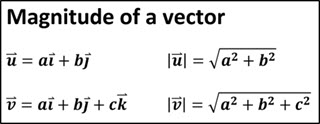
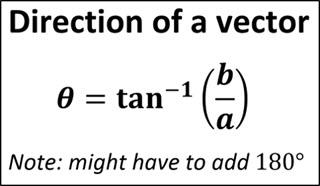
The direction of a vector is usually measured as an angle starting from the positive x-axis, or due East, and rotating counterclockwise. This is the same angle convention used on the unit circle in trigonometry. These problems include finding magnitude and direction from graphs, adding vectors using components, and writing vectors from a given magnitude and direction.
Notes
Practice Problems
\(\textbf{1)}\) Find the direction and magnitude of the vector.
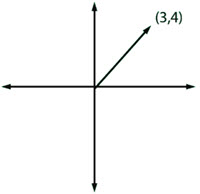 The answer is \(|\vec{v}|=5, \theta=53.1^{\circ}\)
\(\vec{v}=\langle3,4\rangle\)
\(|\vec{v}|=\sqrt{3^2+4^2}\)
\(|\vec{v}|=\sqrt{9+16}\)
\(|\vec{v}|=5\)
\(\theta=\tan^{-1}\left(\frac{4}{3}\right)\)
\(\theta\approx53.1^{\circ}\)

\(\vec{v}=\langle3,4\rangle\)
\(|\vec{v}|=\sqrt{3^2+4^2}\)
\(|\vec{v}|=\sqrt{9+16}\)
\(|\vec{v}|=5\)
\(\theta=\tan^{-1}\left(\frac{4}{3}\right)\)
\(\theta\approx53.1^{\circ}\)
\(\textbf{2)}\) Find the direction and magnitude of the vector.
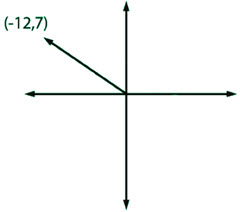 The answer is \(|\vec{v}|=13.9, \theta=149.7^{\circ}\)
\(\vec{v}=\langle-12,7\rangle\)
\(|\vec{v}|=\sqrt{(-12)^2+7^2}\)
\(|\vec{v}|=\sqrt{144+49}\)
\(|\vec{v}|=\sqrt{193}\approx13.9\)
\(\text{The vector is in Quadrant II.}\)
\(\theta=180^{\circ}-\tan^{-1}\left(\frac{7}{12}\right)\)
\(\theta\approx149.7^{\circ}\)
\(\vec{v}=\langle-12,7\rangle\)
\(|\vec{v}|=\sqrt{(-12)^2+7^2}\)
\(|\vec{v}|=\sqrt{144+49}\)
\(|\vec{v}|=\sqrt{193}\approx13.9\)
\(\text{The vector is in Quadrant II.}\)
\(\theta=180^{\circ}-\tan^{-1}\left(\frac{7}{12}\right)\)
\(\theta\approx149.7^{\circ}\)
\(\textbf{3)}\) \(|\vec{a}|=3, 70^{\circ}\), \( |\vec{b}|=4, 110^{\circ} \)
Find \(\vec{a}+\vec{b}\) as a magnitude and direction
The answer is \(|\vec{a}+\vec{b}|=6.59, \theta=93^{\circ}\)
\(\vec{a}=\langle3\cos70^{\circ},3\sin70^{\circ}\rangle\)
\(\vec{a}\approx\langle1.03,2.82\rangle\)
\(\vec{b}=\langle4\cos110^{\circ},4\sin110^{\circ}\rangle\)
\(\vec{b}\approx\langle-1.37,3.76\rangle\)
\(\vec{a}+\vec{b}\approx\langle-0.34,6.58\rangle\)
\(|\vec{a}+\vec{b}|=\sqrt{(-0.34)^2+(6.58)^2}\)
\(|\vec{a}+\vec{b}|\approx6.59\)
\(\theta\approx93^{\circ}\)
\(\vec{a}=\langle3\cos70^{\circ},3\sin70^{\circ}\rangle\)
\(\vec{a}\approx\langle1.03,2.82\rangle\)
\(\vec{b}=\langle4\cos110^{\circ},4\sin110^{\circ}\rangle\)
\(\vec{b}\approx\langle-1.37,3.76\rangle\)
\(\vec{a}+\vec{b}\approx\langle-0.34,6.58\rangle\)
\(|\vec{a}+\vec{b}|=\sqrt{(-0.34)^2+(6.58)^2}\)
\(|\vec{a}+\vec{b}|\approx6.59\)
\(\theta\approx93^{\circ}\)
\(\textbf{4)}\) Find the magnitude and direction of \(\vec{v}=\langle5,12\rangle\). The answer is \(|\vec{v}|=13, \theta\approx67.4^{\circ}\)
\(|\vec{v}|=\sqrt{5^2+12^2}\)
\(|\vec{v}|=\sqrt{25+144}\)
\(|\vec{v}|=13\)
\(\theta=\tan^{-1}\left(\frac{12}{5}\right)\)
\(\theta\approx67.4^{\circ}\)
\(|\vec{v}|=\sqrt{5^2+12^2}\)
\(|\vec{v}|=\sqrt{25+144}\)
\(|\vec{v}|=13\)
\(\theta=\tan^{-1}\left(\frac{12}{5}\right)\)
\(\theta\approx67.4^{\circ}\)
\(\textbf{5)}\) Find the magnitude and direction of \(\vec{v}=\langle-6,8\rangle\). The answer is \(|\vec{v}|=10, \theta\approx126.9^{\circ}\)
\(|\vec{v}|=\sqrt{(-6)^2+8^2}\)
\(|\vec{v}|=\sqrt{36+64}\)
\(|\vec{v}|=10\)
\(\text{The vector is in Quadrant II.}\)
\(\theta=180^{\circ}-\tan^{-1}\left(\frac{8}{6}\right)\)
\(\theta\approx126.9^{\circ}\)
\(|\vec{v}|=\sqrt{(-6)^2+8^2}\)
\(|\vec{v}|=\sqrt{36+64}\)
\(|\vec{v}|=10\)
\(\text{The vector is in Quadrant II.}\)
\(\theta=180^{\circ}-\tan^{-1}\left(\frac{8}{6}\right)\)
\(\theta\approx126.9^{\circ}\)
\(\textbf{6)}\) Find the magnitude and direction of \(\vec{v}=\langle-4,-4\rangle\). The answer is \(|\vec{v}|=4\sqrt{2}, \theta=225^{\circ}\)
\(|\vec{v}|=\sqrt{(-4)^2+(-4)^2}\)
\(|\vec{v}|=\sqrt{16+16}\)
\(|\vec{v}|=4\sqrt{2}\)
\(\text{The vector is in Quadrant III.}\)
\(\theta=180^{\circ}+45^{\circ}\)
\(\theta=225^{\circ}\)
\(|\vec{v}|=\sqrt{(-4)^2+(-4)^2}\)
\(|\vec{v}|=\sqrt{16+16}\)
\(|\vec{v}|=4\sqrt{2}\)
\(\text{The vector is in Quadrant III.}\)
\(\theta=180^{\circ}+45^{\circ}\)
\(\theta=225^{\circ}\)
\(\textbf{7)}\) Find the magnitude and direction of \(\vec{v}=\langle9,-12\rangle\). The answer is \(|\vec{v}|=15, \theta\approx306.9^{\circ}\)
\(|\vec{v}|=\sqrt{9^2+(-12)^2}\)
\(|\vec{v}|=\sqrt{81+144}\)
\(|\vec{v}|=15\)
\(\text{The vector is in Quadrant IV.}\)
\(\theta=360^{\circ}-\tan^{-1}\left(\frac{12}{9}\right)\)
\(\theta\approx306.9^{\circ}\)
\(|\vec{v}|=\sqrt{9^2+(-12)^2}\)
\(|\vec{v}|=\sqrt{81+144}\)
\(|\vec{v}|=15\)
\(\text{The vector is in Quadrant IV.}\)
\(\theta=360^{\circ}-\tan^{-1}\left(\frac{12}{9}\right)\)
\(\theta\approx306.9^{\circ}\)
\(\textbf{8)}\) Find the magnitude and direction of \(\vec{v}=\langle0,7\rangle\). The answer is \(|\vec{v}|=7, \theta=90^{\circ}\)
\(|\vec{v}|=\sqrt{0^2+7^2}\)
\(|\vec{v}|=7\)
\(\text{The vector points straight up on the positive }y\text{-axis.}\)
\(\theta=90^{\circ}\)
\(|\vec{v}|=\sqrt{0^2+7^2}\)
\(|\vec{v}|=7\)
\(\text{The vector points straight up on the positive }y\text{-axis.}\)
\(\theta=90^{\circ}\)
\(\textbf{9)}\) Find the magnitude and direction of \(\vec{v}=\langle-8,0\rangle\). The answer is \(|\vec{v}|=8, \theta=180^{\circ}\)
\(|\vec{v}|=\sqrt{(-8)^2+0^2}\)
\(|\vec{v}|=8\)
\(\text{The vector points left on the negative }x\text{-axis.}\)
\(\theta=180^{\circ}\)
\(|\vec{v}|=\sqrt{(-8)^2+0^2}\)
\(|\vec{v}|=8\)
\(\text{The vector points left on the negative }x\text{-axis.}\)
\(\theta=180^{\circ}\)
\(\textbf{10)}\) Find the magnitude and direction of \(\vec{v}=\langle0,-10\rangle\). The answer is \(|\vec{v}|=10, \theta=270^{\circ}\)
\(|\vec{v}|=\sqrt{0^2+(-10)^2}\)
\(|\vec{v}|=10\)
\(\text{The vector points straight down on the negative }y\text{-axis.}\)
\(\theta=270^{\circ}\)
\(|\vec{v}|=\sqrt{0^2+(-10)^2}\)
\(|\vec{v}|=10\)
\(\text{The vector points straight down on the negative }y\text{-axis.}\)
\(\theta=270^{\circ}\)
\(\textbf{11)}\) Write a vector with magnitude \(10\) and direction angle \(30^{\circ}\) in component form. The answer is \(\langle5\sqrt{3},5\rangle\)
\(\vec{v}=\langle r\cos\theta,r\sin\theta\rangle\)
\(\vec{v}=\langle10\cos30^{\circ},10\sin30^{\circ}\rangle\)
\(\vec{v}=\left\langle10\cdot\frac{\sqrt{3}}{2},10\cdot\frac{1}{2}\right\rangle\)
\(\vec{v}=\langle5\sqrt{3},5\rangle\)
\(\vec{v}=\langle r\cos\theta,r\sin\theta\rangle\)
\(\vec{v}=\langle10\cos30^{\circ},10\sin30^{\circ}\rangle\)
\(\vec{v}=\left\langle10\cdot\frac{\sqrt{3}}{2},10\cdot\frac{1}{2}\right\rangle\)
\(\vec{v}=\langle5\sqrt{3},5\rangle\)
\(\textbf{12)}\) Write a vector with magnitude \(6\) and direction angle \(150^{\circ}\) in component form. The answer is \(\langle-3\sqrt{3},3\rangle\)
\(\vec{v}=\langle r\cos\theta,r\sin\theta\rangle\)
\(\vec{v}=\langle6\cos150^{\circ},6\sin150^{\circ}\rangle\)
\(\vec{v}=\left\langle6\left(-\frac{\sqrt{3}}{2}\right),6\left(\frac{1}{2}\right)\right\rangle\)
\(\vec{v}=\langle-3\sqrt{3},3\rangle\)
\(\vec{v}=\langle r\cos\theta,r\sin\theta\rangle\)
\(\vec{v}=\langle6\cos150^{\circ},6\sin150^{\circ}\rangle\)
\(\vec{v}=\left\langle6\left(-\frac{\sqrt{3}}{2}\right),6\left(\frac{1}{2}\right)\right\rangle\)
\(\vec{v}=\langle-3\sqrt{3},3\rangle\)
\(\textbf{13)}\) Write a vector with magnitude \(8\) and direction angle \(225^{\circ}\) in component form. The answer is \(\langle-4\sqrt{2},-4\sqrt{2}\rangle\)
\(\vec{v}=\langle r\cos\theta,r\sin\theta\rangle\)
\(\vec{v}=\langle8\cos225^{\circ},8\sin225^{\circ}\rangle\)
\(\vec{v}=\left\langle8\left(-\frac{\sqrt{2}}{2}\right),8\left(-\frac{\sqrt{2}}{2}\right)\right\rangle\)
\(\vec{v}=\langle-4\sqrt{2},-4\sqrt{2}\rangle\)
\(\vec{v}=\langle r\cos\theta,r\sin\theta\rangle\)
\(\vec{v}=\langle8\cos225^{\circ},8\sin225^{\circ}\rangle\)
\(\vec{v}=\left\langle8\left(-\frac{\sqrt{2}}{2}\right),8\left(-\frac{\sqrt{2}}{2}\right)\right\rangle\)
\(\vec{v}=\langle-4\sqrt{2},-4\sqrt{2}\rangle\)
\(\textbf{14)}\) Write a vector with magnitude \(12\) and direction angle \(270^{\circ}\) in component form. The answer is \(\langle0,-12\rangle\)
\(\vec{v}=\langle r\cos\theta,r\sin\theta\rangle\)
\(\vec{v}=\langle12\cos270^{\circ},12\sin270^{\circ}\rangle\)
\(\vec{v}=\langle12(0),12(-1)\rangle\)
\(\vec{v}=\langle0,-12\rangle\)
\(\vec{v}=\langle r\cos\theta,r\sin\theta\rangle\)
\(\vec{v}=\langle12\cos270^{\circ},12\sin270^{\circ}\rangle\)
\(\vec{v}=\langle12(0),12(-1)\rangle\)
\(\vec{v}=\langle0,-12\rangle\)
\(\textbf{15)}\) Write a vector with magnitude \(5\) and direction angle \(180^{\circ}\) in component form. The answer is \(\langle-5,0\rangle\)
\(\vec{v}=\langle r\cos\theta,r\sin\theta\rangle\)
\(\vec{v}=\langle5\cos180^{\circ},5\sin180^{\circ}\rangle\)
\(\vec{v}=\langle5(-1),5(0)\rangle\)
\(\vec{v}=\langle-5,0\rangle\)
\(\vec{v}=\langle r\cos\theta,r\sin\theta\rangle\)
\(\vec{v}=\langle5\cos180^{\circ},5\sin180^{\circ}\rangle\)
\(\vec{v}=\langle5(-1),5(0)\rangle\)
\(\vec{v}=\langle-5,0\rangle\)
Challenge Problems
\(\textbf{16)}\) \(|\vec{a}|=5, 20^{\circ}\), \(|\vec{b}|=7, 140^{\circ}\). Find \(\vec{a}+\vec{b}\) as a magnitude and direction. The answer is \(|\vec{a}+\vec{b}|\approx6.25, \theta\approx103.9^{\circ}\)
\(\vec{a}=\langle5\cos20^{\circ},5\sin20^{\circ}\rangle\)
\(\vec{a}\approx\langle4.70,1.71\rangle\)
\(\vec{b}=\langle7\cos140^{\circ},7\sin140^{\circ}\rangle\)
\(\vec{b}\approx\langle-5.36,4.50\rangle\)
\(\vec{a}+\vec{b}\approx\langle-0.66,6.21\rangle\)
\(|\vec{a}+\vec{b}|\approx\sqrt{(-0.66)^2+(6.21)^2}\)
\(|\vec{a}+\vec{b}|\approx6.25\)
\(\theta\approx103.9^{\circ}\)
\(\vec{a}=\langle5\cos20^{\circ},5\sin20^{\circ}\rangle\)
\(\vec{a}\approx\langle4.70,1.71\rangle\)
\(\vec{b}=\langle7\cos140^{\circ},7\sin140^{\circ}\rangle\)
\(\vec{b}\approx\langle-5.36,4.50\rangle\)
\(\vec{a}+\vec{b}\approx\langle-0.66,6.21\rangle\)
\(|\vec{a}+\vec{b}|\approx\sqrt{(-0.66)^2+(6.21)^2}\)
\(|\vec{a}+\vec{b}|\approx6.25\)
\(\theta\approx103.9^{\circ}\)
\(\textbf{17)}\) \(|\vec{a}|=8, 35^{\circ}\), \(|\vec{b}|=6, 210^{\circ}\). Find \(\vec{a}+\vec{b}\) as a magnitude and direction. The answer is \(|\vec{a}+\vec{b}|\approx2.09, \theta\approx22.6^{\circ}\)
\(\vec{a}=\langle8\cos35^{\circ},8\sin35^{\circ}\rangle\)
\(\vec{a}\approx\langle6.55,4.59\rangle\)
\(\vec{b}=\langle6\cos210^{\circ},6\sin210^{\circ}\rangle\)
\(\vec{b}\approx\langle-5.20,-3.00\rangle\)
\(\vec{a}+\vec{b}\approx\langle1.35,1.59\rangle\)
\(|\vec{a}+\vec{b}|\approx\sqrt{1.35^2+1.59^2}\)
\(|\vec{a}+\vec{b}|\approx2.09\)
\(\theta=\tan^{-1}\left(\frac{1.59}{1.35}\right)\)
\(\theta\approx49.7^{\circ}\)
\(\vec{a}=\langle8\cos35^{\circ},8\sin35^{\circ}\rangle\)
\(\vec{a}\approx\langle6.55,4.59\rangle\)
\(\vec{b}=\langle6\cos210^{\circ},6\sin210^{\circ}\rangle\)
\(\vec{b}\approx\langle-5.20,-3.00\rangle\)
\(\vec{a}+\vec{b}\approx\langle1.35,1.59\rangle\)
\(|\vec{a}+\vec{b}|\approx\sqrt{1.35^2+1.59^2}\)
\(|\vec{a}+\vec{b}|\approx2.09\)
\(\theta=\tan^{-1}\left(\frac{1.59}{1.35}\right)\)
\(\theta\approx49.7^{\circ}\)
\(\textbf{18)}\) \(|\vec{a}|=10, 300^{\circ}\), \(|\vec{b}|=4, 60^{\circ}\). Find \(\vec{a}+\vec{b}\) as a magnitude and direction. The answer is \(|\vec{a}+\vec{b}|\approx8.72, \theta\approx321.4^{\circ}\)
\(\vec{a}=\langle10\cos300^{\circ},10\sin300^{\circ}\rangle\)
\(\vec{a}\approx\langle5.00,-8.66\rangle\)
\(\vec{b}=\langle4\cos60^{\circ},4\sin60^{\circ}\rangle\)
\(\vec{b}\approx\langle2.00,3.46\rangle\)
\(\vec{a}+\vec{b}\approx\langle7.00,-5.20\rangle\)
\(|\vec{a}+\vec{b}|\approx\sqrt{7.00^2+(-5.20)^2}\)
\(|\vec{a}+\vec{b}|\approx8.72\)
\(\theta=360^{\circ}-\tan^{-1}\left(\frac{5.20}{7.00}\right)\)
\(\theta\approx323.4^{\circ}\)
\(\vec{a}=\langle10\cos300^{\circ},10\sin300^{\circ}\rangle\)
\(\vec{a}\approx\langle5.00,-8.66\rangle\)
\(\vec{b}=\langle4\cos60^{\circ},4\sin60^{\circ}\rangle\)
\(\vec{b}\approx\langle2.00,3.46\rangle\)
\(\vec{a}+\vec{b}\approx\langle7.00,-5.20\rangle\)
\(|\vec{a}+\vec{b}|\approx\sqrt{7.00^2+(-5.20)^2}\)
\(|\vec{a}+\vec{b}|\approx8.72\)
\(\theta=360^{\circ}-\tan^{-1}\left(\frac{5.20}{7.00}\right)\)
\(\theta\approx323.4^{\circ}\)
\(\textbf{19)}\) Find the magnitude and direction of \(\vec{v}=\langle-7,24\rangle\). The answer is \(|\vec{v}|=25, \theta\approx106.3^{\circ}\)
\(|\vec{v}|=\sqrt{(-7)^2+24^2}\)
\(|\vec{v}|=\sqrt{49+576}\)
\(|\vec{v}|=25\)
\(\text{The vector is in Quadrant II.}\)
\(\theta=180^{\circ}-\tan^{-1}\left(\frac{24}{7}\right)\)
\(\theta\approx106.3^{\circ}\)
\(|\vec{v}|=\sqrt{(-7)^2+24^2}\)
\(|\vec{v}|=\sqrt{49+576}\)
\(|\vec{v}|=25\)
\(\text{The vector is in Quadrant II.}\)
\(\theta=180^{\circ}-\tan^{-1}\left(\frac{24}{7}\right)\)
\(\theta\approx106.3^{\circ}\)
\(\textbf{20)}\) Find the magnitude and direction of \(\vec{v}=\langle-9,-40\rangle\). The answer is \(|\vec{v}|=41, \theta\approx257.3^{\circ}\)
\(|\vec{v}|=\sqrt{(-9)^2+(-40)^2}\)
\(|\vec{v}|=\sqrt{81+1600}\)
\(|\vec{v}|=41\)
\(\text{The vector is in Quadrant III.}\)
\(\theta=180^{\circ}+\tan^{-1}\left(\frac{40}{9}\right)\)
\(\theta\approx257.3^{\circ}\)
\(|\vec{v}|=\sqrt{(-9)^2+(-40)^2}\)
\(|\vec{v}|=\sqrt{81+1600}\)
\(|\vec{v}|=41\)
\(\text{The vector is in Quadrant III.}\)
\(\theta=180^{\circ}+\tan^{-1}\left(\frac{40}{9}\right)\)
\(\theta\approx257.3^{\circ}\)
See Related Pages\(\)
\(\bullet\text{ Displacement Vectors}\)
\(\,\,\,\,\,\,\,\,(x_2-x_1)\vec{i}+(y_2-y_1)\vec{j}…\)
\(\bullet\text{ Magnitude, Direction, and Unit Vectors}\)
\(\,\,\,\,\,\,\,\,|\vec{u}|=\sqrt{a^2+b^2}…\)
\(\bullet\text{ Dot Product}\)
\(\,\,\,\,\,\,\,\,a \cdot b=x_1 x_2+ y_1 y_2…\)
\(\bullet\text{ Parallel and Perpendicular Vectors}\)
\(\,\,\,\,\,\,\,\,⟨8,2⟩ \text{ and } ⟨−4,−1⟩…\)
\(\bullet\text{ Scalar and Vector Projections}\)
\(\,\,\,\,\,\,\,\,\displaystyle\frac{a \cdot b}{|b|^2} \, \vec{b}…\)
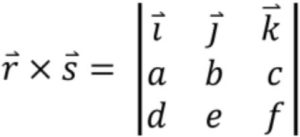
\(\bullet\text{ Cross Product}\)
\(\,\,\,\,\,\,\,\,\) \(…\)
\(…\)
\(\bullet\text{ Equation of a Plane}\)
\(\,\,\,\,\,\,\,\,Ax+By+Cz=D…\)
\(\bullet\text{ Andymath Homepage}\)