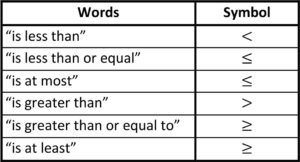
Notes


Questions
Solve for x.
\(\textbf{1)}\) \( 3x\gt18 \)
The answer is \( x>6 \)
\(\textbf{2)}\) \( 5x\lt-45 \)
The answer is \( x\lt-9 \)
\(\textbf{3)}\) \( 6x\ge21 \)
The answer is \( x\ge3.5 \)
\(\textbf{4)}\) \( -5x\le20 \)
The answer is \( x\ge-4 \)
\(\textbf{5)}\) \( \displaystyle\frac{x}{5}\lt-10 \)
The answer is \( x\lt-50 \)
\(\textbf{6)}\) \( -\displaystyle\frac{x}{6}\ge 12 \)
The answer is \( x\le -72 \)
\(\textbf{7)}\) \( \displaystyle\frac{x}{3}\le9 \)
The answer is \( x \le 27 \)
\(\textbf{8)}\) \( -\displaystyle\frac{x}{7}\le-7 \)
The answer is \( x\ge49 \)
\(\textbf{9)}\) Express as an inequalitiy. The product of a number n and 4 is less than 10.
The answer is \( 4n\lt10 \)
\(\textbf{10)}\) Express as an inequalitiy. A number n divided by 3 is at least 8.
The answer is \( \frac{n}{3}\ge8 \)
See Related Pages\(\)
In Summary
Inequalities describe the range of values that a variable can take on. When solving for inequalities you want to get the variable alone on one side. Most of the inverse operations behave as they would with equations. There are some differences, specifically multiplication or division by a negative number. When dividing or multiplying both sides of an inequality by a negative number, the inequality sign changes directions. A less than would become a greater than and so on.