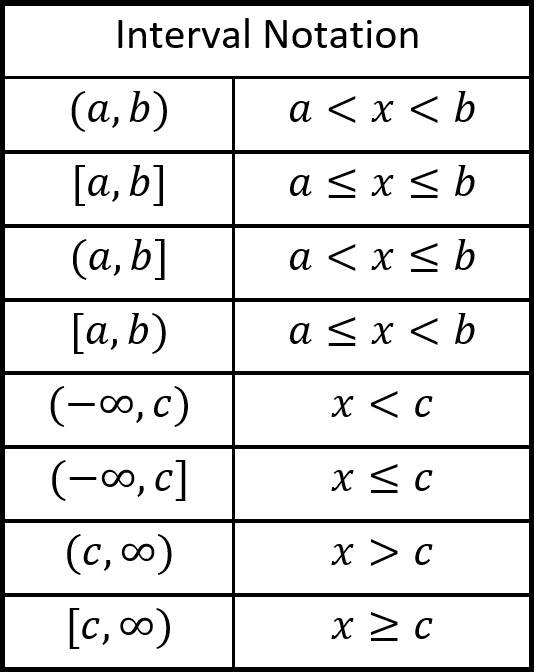
Interval notation is a way to express an interval on a number line. Brackets [] include the endpoints. Parenthesis () do not include the endpoints. See the helpful notes and practice problems below!
Notes
Practice Questions
Express each inequality in interval notation.
\(\textbf{1)}\) \( x\lt3 \)
The interval notation is \( (-\infty,3) \)
\(\textbf{2)}\) \(-8\le x\lt5\)
The interval notation is \( [-8,5) \)
\(\textbf{3)}\) \(x\ge-4\)
The interval notation is \([-4,\infty)\)
\(\textbf{4)}\) \(-8\le x\le 10\)
The interval notation is \([-8,10]\)
\(\textbf{5)}\) \(x\le2\)
The interval notation is \((-\infty,2]\)
\(\textbf{6)}\) \(5\lt x\le20\)
The interval notation is \((5,20]\)
\(\textbf{7)}\) \(x\gt15\)
The interval notation is \((15,\infty)\)
\(\textbf{8)}\) \(4\lt x\lt5\)
The interval notation is \((4,5)\)
\(\textbf{9)}\) \(x\lt4 \) or \( x\ge8\)
The interval notation is \((-\infty,4)\) U \([8,\infty)\)