

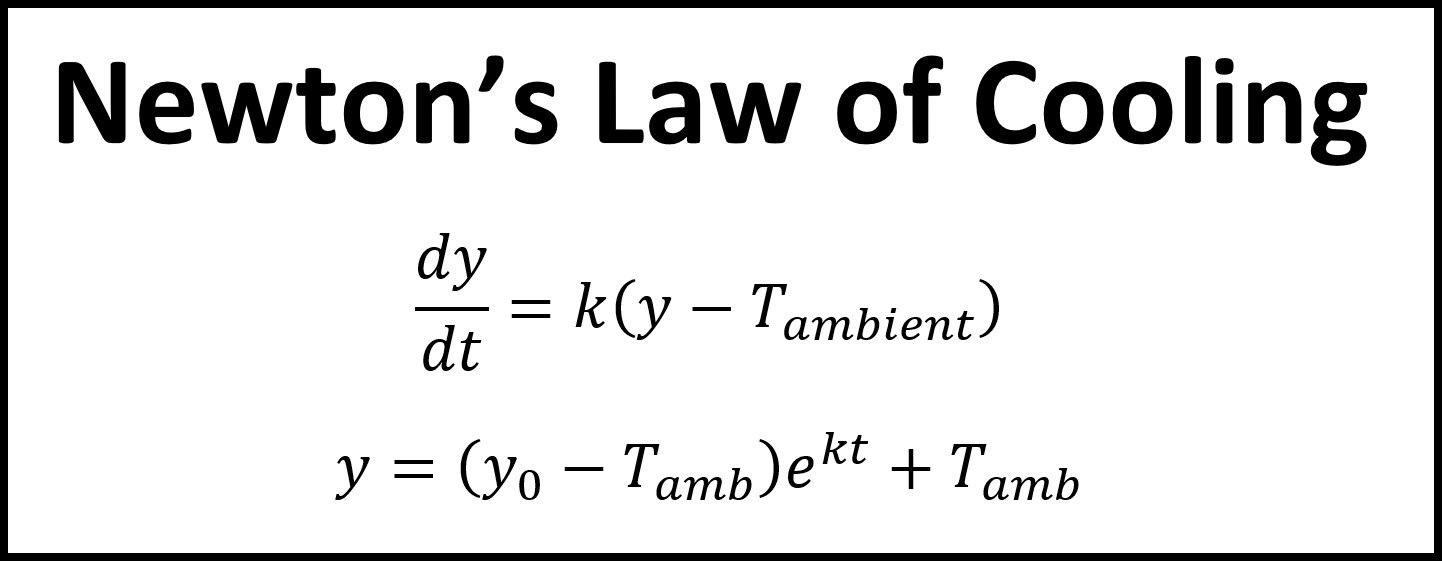
Newton’s Law of Cooling is used to model how the temperature of an object changes over time as it moves toward the temperature of its surroundings. The formula is often written as \(T(t)=(T_0-T_s)e^{kt}+T_s\), where \(T_0\) is the starting temperature, \(T_s\) is the surrounding temperature, and \(k\) is a constant. These problems focus on solving for \(k\), using the model to predict future temperatures, and finding when an object reaches a certain temperature.
Notes
Practice Problems
\(\textbf{1)}\) A cup of tea at \(180^{\circ}\) F, and the room temperature is \(70^{\circ}\) F. After 5 minutes, the temperature of the tea is \(152^{\circ}\) F. Solve for k in Newtons law of cooling formula.
\(152= \left( 180-70 \right) e^{k(5)}+70\)
\(152= \left( 110 \right) e^{k(5)}+70\)
\(82= \left( 110 \right) e^{k(5)}\)
\(\frac{82}{110}= e^{k(5)}\)
\(\ln{\frac{82}{110}}=5k\)
\(\displaystyle\frac{\ln{\frac{82}{110}}}{5}=k\)
\(k \approx -0.0587522237\)
\(152= \left( 180-70 \right) e^{k(5)}+70\)
\(152= \left( 110 \right) e^{k(5)}+70\)
\(82= \left( 110 \right) e^{k(5)}\)
\(\frac{82}{110}= e^{k(5)}\)
\(\ln{\frac{82}{110}}=5k\)
\(\displaystyle\frac{\ln{\frac{82}{110}}}{5}=k\)
\(k \approx -0.0587522237\)
\(\textbf{2)}\) A cup of tea at \(180^{\circ}\) F, and the room temperature is \(70^{\circ}\) F. After 5 minutes, the temperature of the tea is \(152^{\circ}\) F. What is the temperature of the tea after 10 minutes?
\(T(t)=\left(T_0-T_s\right)e^{kt}+T_s\)
\(T(10)= \left( 180-70 \right) e^{-0.0587522237(10)}+70\)
\(T(10)=110e^{-0.587522237}+70\)
\(T(10)\approx 131.14\)
\(\text{The answer is }131.14^{\circ}\text{ F}\)
\(T(t)=\left(T_0-T_s\right)e^{kt}+T_s\)
\(T(10)= \left( 180-70 \right) e^{-0.0587522237(10)}+70\)
\(T(10)=110e^{-0.587522237}+70\)
\(T(10)\approx 131.14\)
\(\text{The answer is }131.14^{\circ}\text{ F}\)
\(\textbf{3)}\) A cup of tea at \(180^{\circ}\) F, and the room temperature is \(70^{\circ}\) F. After 5 minutes, the temperature of the tea is \(152^{\circ}\) F. What is the temperature of the tea after 20 minutes?
\(T(t)=\left(T_0-T_s\right)e^{kt}+T_s\)
\(T(20)= \left( 180-70 \right) e^{-0.0587522237(20)}+70\)
\(T(20)=110e^{-1.175044474}+70\)
\(T(20)\approx 103.97\)
\(\text{The answer is }103.97^{\circ}\text{ F}\)
\(T(t)=\left(T_0-T_s\right)e^{kt}+T_s\)
\(T(20)= \left( 180-70 \right) e^{-0.0587522237(20)}+70\)
\(T(20)=110e^{-1.175044474}+70\)
\(T(20)\approx 103.97\)
\(\text{The answer is }103.97^{\circ}\text{ F}\)
\(\textbf{4)}\) A cup of coffee is \(200^{\circ}\) F and the room temperature is \(72^{\circ}\) F. After 6 minutes, the coffee is \(170^{\circ}\) F. Solve for \(k\).
\(170=(200-72)e^{6k}+72\)
\(170=128e^{6k}+72\)
\(98=128e^{6k}\)
\(\frac{98}{128}=e^{6k}\)
\(\ln\left(\frac{98}{128}\right)=6k\)
\(k=\frac{\ln\left(\frac{98}{128}\right)}{6}\)
\(k\approx -0.04450\)
\(170=(200-72)e^{6k}+72\)
\(170=128e^{6k}+72\)
\(98=128e^{6k}\)
\(\frac{98}{128}=e^{6k}\)
\(\ln\left(\frac{98}{128}\right)=6k\)
\(k=\frac{\ln\left(\frac{98}{128}\right)}{6}\)
\(k\approx -0.04450\)
\(\textbf{5)}\) A cup of coffee is \(200^{\circ}\) F and the room temperature is \(72^{\circ}\) F. Use \(k=-0.04450\). What is the temperature after 15 minutes?
\(T(t)=(T_0-T_s)e^{kt}+T_s\)
\(T(15)=(200-72)e^{-0.04450(15)}+72\)
\(T(15)=128e^{-0.6675}+72\)
\(T(15)\approx 137.70\)
\(\text{The answer is }137.70^{\circ}\text{ F}\)
\(T(t)=(T_0-T_s)e^{kt}+T_s\)
\(T(15)=(200-72)e^{-0.04450(15)}+72\)
\(T(15)=128e^{-0.6675}+72\)
\(T(15)\approx 137.70\)
\(\text{The answer is }137.70^{\circ}\text{ F}\)
\(\textbf{6)}\) A bowl of soup is \(160^{\circ}\) F and the room temperature is \(68^{\circ}\) F. After 10 minutes, the soup is \(120^{\circ}\) F. Solve for \(k\).
\(120=(160-68)e^{10k}+68\)
\(120=92e^{10k}+68\)
\(52=92e^{10k}\)
\(\frac{52}{92}=e^{10k}\)
\(\ln\left(\frac{52}{92}\right)=10k\)
\(k=\frac{\ln\left(\frac{52}{92}\right)}{10}\)
\(k\approx -0.05705\)
\(120=(160-68)e^{10k}+68\)
\(120=92e^{10k}+68\)
\(52=92e^{10k}\)
\(\frac{52}{92}=e^{10k}\)
\(\ln\left(\frac{52}{92}\right)=10k\)
\(k=\frac{\ln\left(\frac{52}{92}\right)}{10}\)
\(k\approx -0.05705\)
\(\textbf{7)}\) A bowl of soup is \(160^{\circ}\) F and the room temperature is \(68^{\circ}\) F. Use \(k=-0.05705\). What is the temperature after 25 minutes?
\(T(t)=(T_0-T_s)e^{kt}+T_s\)
\(T(25)=(160-68)e^{-0.05705(25)}+68\)
\(T(25)=92e^{-1.42625}+68\)
\(T(25)\approx 90.08\)
\(\text{The answer is }90.08^{\circ}\text{ F}\)
\(T(t)=(T_0-T_s)e^{kt}+T_s\)
\(T(25)=(160-68)e^{-0.05705(25)}+68\)
\(T(25)=92e^{-1.42625}+68\)
\(T(25)\approx 90.08\)
\(\text{The answer is }90.08^{\circ}\text{ F}\)
\(\textbf{8)}\) A hot pizza is \(190^{\circ}\) F and the room temperature is \(70^{\circ}\) F. If \(k=-0.035\), what is the temperature after 12 minutes?
\(T(t)=(T_0-T_s)e^{kt}+T_s\)
\(T(12)=(190-70)e^{-0.035(12)}+70\)
\(T(12)=120e^{-0.42}+70\)
\(T(12)\approx 148.85\)
\(\text{The answer is }148.85^{\circ}\text{ F}\)
\(T(t)=(T_0-T_s)e^{kt}+T_s\)
\(T(12)=(190-70)e^{-0.035(12)}+70\)
\(T(12)=120e^{-0.42}+70\)
\(T(12)\approx 148.85\)
\(\text{The answer is }148.85^{\circ}\text{ F}\)
\(\textbf{9)}\) A metal object is \(300^{\circ}\) F and the room temperature is \(75^{\circ}\) F. If \(k=-0.025\), what is the temperature after 20 minutes?
\(T(t)=(T_0-T_s)e^{kt}+T_s\)
\(T(20)=(300-75)e^{-0.025(20)}+75\)
\(T(20)=225e^{-0.5}+75\)
\(T(20)\approx 211.47\)
\(\text{The answer is }211.47^{\circ}\text{ F}\)
\(T(t)=(T_0-T_s)e^{kt}+T_s\)
\(T(20)=(300-75)e^{-0.025(20)}+75\)
\(T(20)=225e^{-0.5}+75\)
\(T(20)\approx 211.47\)
\(\text{The answer is }211.47^{\circ}\text{ F}\)
\(\textbf{10)}\) A drink is \(40^{\circ}\) F in a room that is \(70^{\circ}\) F. After 8 minutes, the drink is \(52^{\circ}\) F. Solve for \(k\).
\(52=(40-70)e^{8k}+70\)
\(52=-30e^{8k}+70\)
\(-18=-30e^{8k}\)
\(\frac{18}{30}=e^{8k}\)
\(\ln\left(\frac{18}{30}\right)=8k\)
\(k=\frac{\ln\left(\frac{18}{30}\right)}{8}\)
\(k\approx -0.06385\)
\(52=(40-70)e^{8k}+70\)
\(52=-30e^{8k}+70\)
\(-18=-30e^{8k}\)
\(\frac{18}{30}=e^{8k}\)
\(\ln\left(\frac{18}{30}\right)=8k\)
\(k=\frac{\ln\left(\frac{18}{30}\right)}{8}\)
\(k\approx -0.06385\)
\(\textbf{11)}\) A drink is \(40^{\circ}\) F in a room that is \(70^{\circ}\) F. Use \(k=-0.06385\). What is the temperature after 20 minutes?
\(T(t)=(T_0-T_s)e^{kt}+T_s\)
\(T(20)=(40-70)e^{-0.06385(20)}+70\)
\(T(20)=-30e^{-1.277}+70\)
\(T(20)\approx 61.62\)
\(\text{The answer is }61.62^{\circ}\text{ F}\)
\(T(t)=(T_0-T_s)e^{kt}+T_s\)
\(T(20)=(40-70)e^{-0.06385(20)}+70\)
\(T(20)=-30e^{-1.277}+70\)
\(T(20)\approx 61.62\)
\(\text{The answer is }61.62^{\circ}\text{ F}\)
\(\textbf{12)}\) A cup of tea is \(180^{\circ}\) F in a \(70^{\circ}\) F room. Use \(k=-0.0587522237\). How long until the tea reaches \(100^{\circ}\) F?
\(100=(180-70)e^{-0.0587522237t}+70\)
\(100=110e^{-0.0587522237t}+70\)
\(30=110e^{-0.0587522237t}\)
\(\frac{30}{110}=e^{-0.0587522237t}\)
\(\ln\left(\frac{30}{110}\right)=-0.0587522237t\)
\(t=\frac{\ln\left(\frac{30}{110}\right)}{-0.0587522237}\)
\(t\approx 22.11\)
\(\text{The answer is about }22.11\text{ minutes}\)
\(100=(180-70)e^{-0.0587522237t}+70\)
\(100=110e^{-0.0587522237t}+70\)
\(30=110e^{-0.0587522237t}\)
\(\frac{30}{110}=e^{-0.0587522237t}\)
\(\ln\left(\frac{30}{110}\right)=-0.0587522237t\)
\(t=\frac{\ln\left(\frac{30}{110}\right)}{-0.0587522237}\)
\(t\approx 22.11\)
\(\text{The answer is about }22.11\text{ minutes}\)
\(\textbf{13)}\) A pizza is \(190^{\circ}\) F in a \(70^{\circ}\) F room. Use \(k=-0.035\). How long until the pizza reaches \(120^{\circ}\) F?
\(120=(190-70)e^{-0.035t}+70\)
\(120=120e^{-0.035t}+70\)
\(50=120e^{-0.035t}\)
\(\frac{50}{120}=e^{-0.035t}\)
\(\ln\left(\frac{50}{120}\right)=-0.035t\)
\(t=\frac{\ln\left(\frac{50}{120}\right)}{-0.035}\)
\(t\approx 25.02\)
\(\text{The answer is about }25.02\text{ minutes}\)
\(120=(190-70)e^{-0.035t}+70\)
\(120=120e^{-0.035t}+70\)
\(50=120e^{-0.035t}\)
\(\frac{50}{120}=e^{-0.035t}\)
\(\ln\left(\frac{50}{120}\right)=-0.035t\)
\(t=\frac{\ln\left(\frac{50}{120}\right)}{-0.035}\)
\(t\approx 25.02\)
\(\text{The answer is about }25.02\text{ minutes}\)
\(\textbf{14)}\) A drink is in a room that is \(70^{\circ}\) F. If \(k=-0.04\) and the drink is \(120^{\circ}\) F after 15 minutes, what was the temperature of the drink at time \(0\)?
\(T(t)=(T_0-T_s)e^{kt}+T_s\)
\(120=(T_0-70)e^{-0.04(15)}+70\)
\(120=(T_0-70)e^{-0.6}+70\)
\(50=(T_0-70)e^{-0.6}\)
\(\frac{50}{e^{-0.6}}=T_0-70\)
\(T_0=\frac{50}{e^{-0.6}}+70\)
\(T_0\approx 161.11\)
\(\text{The answer is }161.11^{\circ}\text{ F}\)
\(T(t)=(T_0-T_s)e^{kt}+T_s\)
\(120=(T_0-70)e^{-0.04(15)}+70\)
\(120=(T_0-70)e^{-0.6}+70\)
\(50=(T_0-70)e^{-0.6}\)
\(\frac{50}{e^{-0.6}}=T_0-70\)
\(T_0=\frac{50}{e^{-0.6}}+70\)
\(T_0\approx 161.11\)
\(\text{The answer is }161.11^{\circ}\text{ F}\)
\(\textbf{15)}\) A hot chocolate is in a room that is \(68^{\circ}\) F. If \(k=-0.05\) and the hot chocolate is \(95^{\circ}\) F after 20 minutes, what was the temperature of the hot chocolate at time \(0\)?
\(T(t)=(T_0-T_s)e^{kt}+T_s\)
\(95=(T_0-68)e^{-0.05(20)}+68\)
\(95=(T_0-68)e^{-1} +68\)
\(27=(T_0-68)e^{-1}\)
\(\frac{27}{e^{-1}}=T_0-68\)
\(T_0=\frac{27}{e^{-1}}+68\)
\(T_0\approx 141.39\)
\(\text{The answer is }141.39^{\circ}\text{ F}\)
\(T(t)=(T_0-T_s)e^{kt}+T_s\)
\(95=(T_0-68)e^{-0.05(20)}+68\)
\(95=(T_0-68)e^{-1} +68\)
\(27=(T_0-68)e^{-1}\)
\(\frac{27}{e^{-1}}=T_0-68\)
\(T_0=\frac{27}{e^{-1}}+68\)
\(T_0\approx 141.39\)
\(\text{The answer is }141.39^{\circ}\text{ F}\)
\(\textbf{16)}\) A baked potato is in a room that is \(72^{\circ}\) F. If \(k=-0.03\) and the baked potato is \(150^{\circ}\) F after 10 minutes, what was the temperature of the baked potato at time \(0\)?
\(T(t)=(T_0-T_s)e^{kt}+T_s\)
\(150=(T_0-72)e^{-0.03(10)}+72\)
\(150=(T_0-72)e^{-0.3}+72\)
\(78=(T_0-72)e^{-0.3}\)
\(\frac{78}{e^{-0.3}}=T_0-72\)
\(T_0=\frac{78}{e^{-0.3}}+72\)
\(T_0\approx 177.29\)
\(\text{The answer is }177.29^{\circ}\text{ F}\)
\(T(t)=(T_0-T_s)e^{kt}+T_s\)
\(150=(T_0-72)e^{-0.03(10)}+72\)
\(150=(T_0-72)e^{-0.3}+72\)
\(78=(T_0-72)e^{-0.3}\)
\(\frac{78}{e^{-0.3}}=T_0-72\)
\(T_0=\frac{78}{e^{-0.3}}+72\)
\(T_0\approx 177.29\)
\(\text{The answer is }177.29^{\circ}\text{ F}\)
\(\textbf{17)}\) A cup of coffee starts at \(200^{\circ}\) F. If \(k=-0.04\) and the coffee is \(140^{\circ}\) F after 20 minutes, what is the temperature of the room?
\(T(t)=(T_0-T_s)e^{kt}+T_s\)
\(140=(200-T_s)e^{-0.04(20)}+T_s\)
\(140=(200-T_s)e^{-0.8}+T_s\)
\(140=200e^{-0.8}-T_se^{-0.8}+T_s\)
\(140=200e^{-0.8}+T_s(1-e^{-0.8})\)
\(140-200e^{-0.8}=T_s(1-e^{-0.8})\)
\(T_s=\frac{140-200e^{-0.8}}{1-e^{-0.8}}\)
\(T_s\approx 91.04\)
\(\text{The room temperature is }91.04^{\circ}\text{ F}\)
\(T(t)=(T_0-T_s)e^{kt}+T_s\)
\(140=(200-T_s)e^{-0.04(20)}+T_s\)
\(140=(200-T_s)e^{-0.8}+T_s\)
\(140=200e^{-0.8}-T_se^{-0.8}+T_s\)
\(140=200e^{-0.8}+T_s(1-e^{-0.8})\)
\(140-200e^{-0.8}=T_s(1-e^{-0.8})\)
\(T_s=\frac{140-200e^{-0.8}}{1-e^{-0.8}}\)
\(T_s\approx 91.04\)
\(\text{The room temperature is }91.04^{\circ}\text{ F}\)
\(\textbf{18)}\) A bowl of soup starts at \(160^{\circ}\) F. If \(k=-0.06\) and the soup is \(90^{\circ}\) F after 25 minutes, what is the temperature of the room?
\(T(t)=(T_0-T_s)e^{kt}+T_s\)
\(90=(160-T_s)e^{-0.06(25)}+T_s\)
\(90=(160-T_s)e^{-1.5}+T_s\)
\(90=160e^{-1.5}-T_se^{-1.5}+T_s\)
\(90=160e^{-1.5}+T_s(1-e^{-1.5})\)
\(90-160e^{-1.5}=T_s(1-e^{-1.5})\)
\(T_s=\frac{90-160e^{-1.5}}{1-e^{-1.5}}\)
\(T_s\approx 69.89\)
\(\text{The room temperature is }69.89^{\circ}\text{ F}\)
\(T(t)=(T_0-T_s)e^{kt}+T_s\)
\(90=(160-T_s)e^{-0.06(25)}+T_s\)
\(90=(160-T_s)e^{-1.5}+T_s\)
\(90=160e^{-1.5}-T_se^{-1.5}+T_s\)
\(90=160e^{-1.5}+T_s(1-e^{-1.5})\)
\(90-160e^{-1.5}=T_s(1-e^{-1.5})\)
\(T_s=\frac{90-160e^{-1.5}}{1-e^{-1.5}}\)
\(T_s\approx 69.89\)
\(\text{The room temperature is }69.89^{\circ}\text{ F}\)
\(\textbf{19)}\) A cold bottle of water starts at \(35^{\circ}\) F. If \(k=-0.05\) and the water is \(60^{\circ}\) F after 15 minutes, what is the temperature of the room?
\(T(t)=(T_0-T_s)e^{kt}+T_s\)
\(60=(35-T_s)e^{-0.05(15)}+T_s\)
\(60=(35-T_s)e^{-0.75}+T_s\)
\(60=35e^{-0.75}-T_se^{-0.75}+T_s\)
\(60=35e^{-0.75}+T_s(1-e^{-0.75})\)
\(60-35e^{-0.75}=T_s(1-e^{-0.75})\)
\(T_s=\frac{60-35e^{-0.75}}{1-e^{-0.75}}\)
\(T_s\approx 82.38\)
\(\text{The room temperature is }82.38^{\circ}\text{ F}\)
\(T(t)=(T_0-T_s)e^{kt}+T_s\)
\(60=(35-T_s)e^{-0.05(15)}+T_s\)
\(60=(35-T_s)e^{-0.75}+T_s\)
\(60=35e^{-0.75}-T_se^{-0.75}+T_s\)
\(60=35e^{-0.75}+T_s(1-e^{-0.75})\)
\(60-35e^{-0.75}=T_s(1-e^{-0.75})\)
\(T_s=\frac{60-35e^{-0.75}}{1-e^{-0.75}}\)
\(T_s\approx 82.38\)
\(\text{The room temperature is }82.38^{\circ}\text{ F}\)
\(\textbf{20)}\) A pan starts at \(180^{\circ}\) F. If \(k=-0.03\) and the pan is \(100^{\circ}\) F after 30 minutes, what is the temperature of the room?
\(T(t)=(T_0-T_s)e^{kt}+T_s\)
\(100=(180-T_s)e^{-0.03(30)}+T_s\)
\(100=(180-T_s)e^{-0.9}+T_s\)
\(100=180e^{-0.9}-T_se^{-0.9}+T_s\)
\(100=180e^{-0.9}+T_s(1-e^{-0.9})\)
\(100-180e^{-0.9}=T_s(1-e^{-0.9})\)
\(T_s=\frac{100-180e^{-0.9}}{1-e^{-0.9}}\)
\(T_s\approx 45.19\)
\(\text{The room temperature is }45.19^{\circ}\text{ F}\)
\(T(t)=(T_0-T_s)e^{kt}+T_s\)
\(100=(180-T_s)e^{-0.03(30)}+T_s\)
\(100=(180-T_s)e^{-0.9}+T_s\)
\(100=180e^{-0.9}-T_se^{-0.9}+T_s\)
\(100=180e^{-0.9}+T_s(1-e^{-0.9})\)
\(100-180e^{-0.9}=T_s(1-e^{-0.9})\)
\(T_s=\frac{100-180e^{-0.9}}{1-e^{-0.9}}\)
\(T_s\approx 45.19\)
\(\text{The room temperature is }45.19^{\circ}\text{ F}\)
See Related Pages\(\)
\(\bullet\text{ Calculus Homepage}\)
\(\,\,\,\,\,\,\,\,\text{All the Best Topics…}\)
\(\bullet\text{ Expanding Logarithms}\)
\(\,\,\,\,\,\,\,\,2\log_{b}(x)+\log_{b}(z)-5\log_{b}(y)…\)
\(\bullet\text{ Decibel Problems}\)
\(\,\,\,\,\,\,\,\,N_{dB}=10\log \left(\frac{P}{10^{-12}}\right)…\)
\(\bullet\text{ Earthquake Problems}\)
\(\,\,\,\,\,\,\,\,M=\log\frac{I}{10^{-4}}…\)
\(\bullet\text{ Domain and Range Logarithmic Functions}\)
\(\,\,\,\,\,\,\,\,f(x)=log(x) \rightarrow \text{Domain:} x\gt0… \)
\(\bullet\text{ Graphing Logarithmic Functions}\)
\(\,\,\,\,\,\,\,\,f(x)=log_{2}(x)\) 
\(\bullet\text{ Solving Logarithmic Equations}\)
\(\,\,\,\,\,\,\,\,\log_{2}(5x)=\log_{2}(2x+12)…\)
\(\bullet\text{ Inverse of Logarithmic Functions}\)
\(\,\,\,\,\,\,\,\,f(x)=log_{2}(x) \rightarrow f^{-1}(x)=2^x\)