
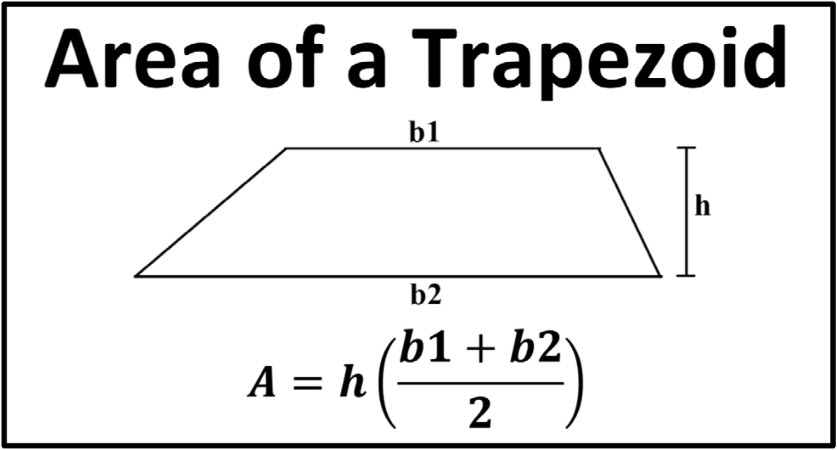
You can find the area of a trapezoid by using the formula
\(\displaystyle \text{Area} = h\cdot \frac{b_1+b_2}{2} \)
where \(b_1\) and \(b_2\) are the two parallel sides (or “bases”) and \(h\) is the height of the trapezoid.
Notes
Practice Problems
Find the area of the following trapezoids.
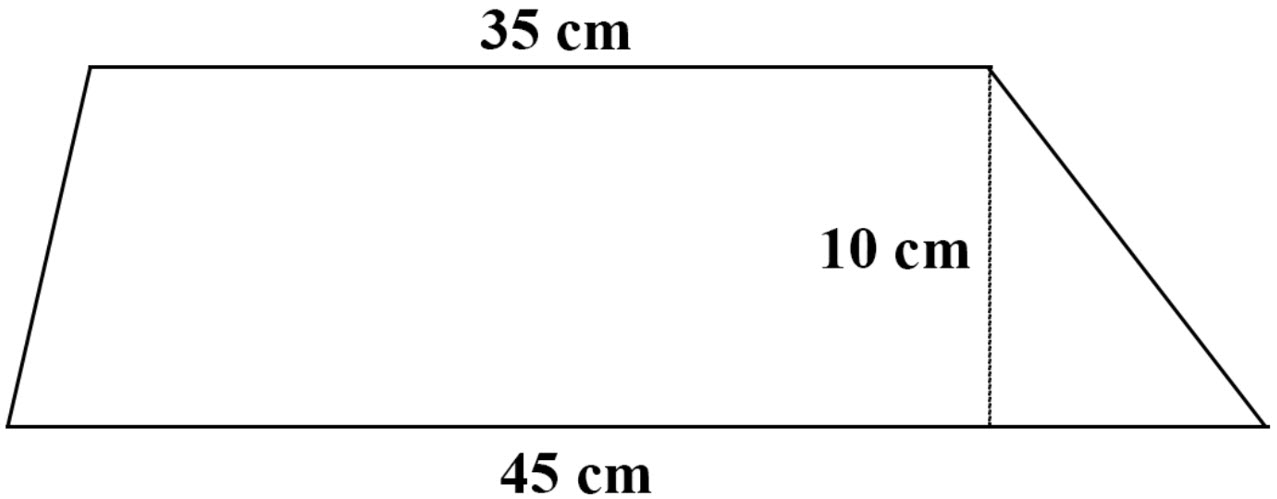
\(\textbf{1)}\)
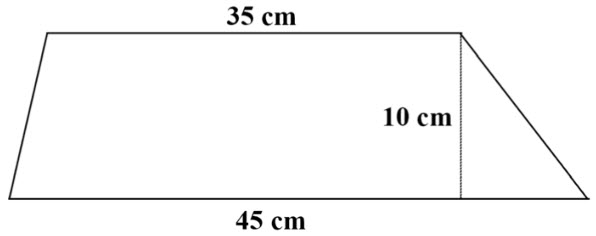
The answer is \( 400 \) cm\(^2 \)
\(\,\,\,\,\,\,\text{Area}=\displaystyle h \cdot \left(\frac{b_1+b_2}{2}\right)\)
\(\,\,\,\,\,\,\text{Area}=\displaystyle 10 \cdot \left(\frac{35+45}{2}\right)\)
\(\,\,\,\,\,\,\text{Area}=\displaystyle 10 \cdot \left(\frac{80}{2}\right)\)
\(\,\,\,\,\,\,\text{Area}=\displaystyle 10 \cdot \left(40\right)\)
\(\,\,\,\,\,\,\text{Area}=\displaystyle 400\)
\(\,\,\,\,\,\,\)The answer is \( 400 \) cm\(^2 \)
\(\,\,\,\,\,\,\text{Area}=\displaystyle h \cdot \left(\frac{b_1+b_2}{2}\right)\)
\(\,\,\,\,\,\,\text{Area}=\displaystyle 10 \cdot \left(\frac{35+45}{2}\right)\)
\(\,\,\,\,\,\,\text{Area}=\displaystyle 10 \cdot \left(\frac{80}{2}\right)\)
\(\,\,\,\,\,\,\text{Area}=\displaystyle 10 \cdot \left(40\right)\)
\(\,\,\,\,\,\,\text{Area}=\displaystyle 400\)
\(\,\,\,\,\,\,\)The answer is \( 400 \) cm\(^2 \)
\(\textbf{2)}\)
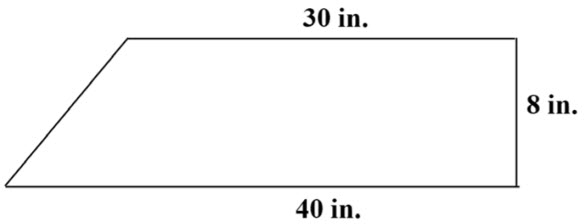
The answer is \( 280 \) in\(^2 \)
\(\,\,\,\,\,\,\text{Area}=\displaystyle h \cdot \left(\frac{b_1+b_2}{2}\right)\)
\(\,\,\,\,\,\,\text{Area}=\displaystyle 8 \cdot \left(\frac{30+40}{2}\right)\)
\(\,\,\,\,\,\,\text{Area}=\displaystyle 8 \cdot \left(\frac{70}{2}\right)\)
\(\,\,\,\,\,\,\text{Area}=\displaystyle 8 \cdot \left(35\right)\)
\(\,\,\,\,\,\,\)The answer is \( 280 \) in\(^2 \)
\(\,\,\,\,\,\,\text{Area}=\displaystyle h \cdot \left(\frac{b_1+b_2}{2}\right)\)
\(\,\,\,\,\,\,\text{Area}=\displaystyle 8 \cdot \left(\frac{30+40}{2}\right)\)
\(\,\,\,\,\,\,\text{Area}=\displaystyle 8 \cdot \left(\frac{70}{2}\right)\)
\(\,\,\,\,\,\,\text{Area}=\displaystyle 8 \cdot \left(35\right)\)
\(\,\,\,\,\,\,\)The answer is \( 280 \) in\(^2 \)
\(\textbf{3)}\)
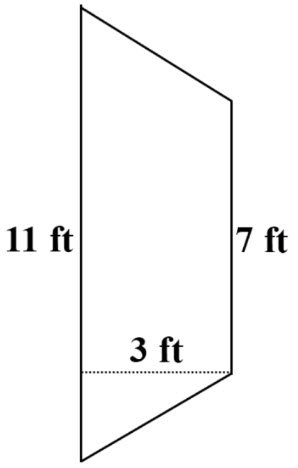
The answer is \( 27 \) ft\(^2 \)
\(\,\,\,\,\,\,\text{Area}=\displaystyle h \cdot \left(\frac{b_1+b_2}{2}\right)\)
\(\,\,\,\,\,\,\text{Area}=\displaystyle 3 \cdot \left(\frac{7+11}{2}\right)\)
\(\,\,\,\,\,\,\text{Area}=\displaystyle 3 \cdot \left(\frac{18}{2}\right)\)
\(\,\,\,\,\,\,\text{Area}=\displaystyle 3 \cdot \left(9\right)\)
The answer is \( 27 \) ft\(^2 \)
\(\,\,\,\,\,\,\text{Area}=\displaystyle h \cdot \left(\frac{b_1+b_2}{2}\right)\)
\(\,\,\,\,\,\,\text{Area}=\displaystyle 3 \cdot \left(\frac{7+11}{2}\right)\)
\(\,\,\,\,\,\,\text{Area}=\displaystyle 3 \cdot \left(\frac{18}{2}\right)\)
\(\,\,\,\,\,\,\text{Area}=\displaystyle 3 \cdot \left(9\right)\)
The answer is \( 27 \) ft\(^2 \)
\(\textbf{4)}\) Find the area of the trapezoid with the following vertices. \((0,0), (2,8), (6,8), (8,0)\) The answer is \( 48 \) units\(^2 \)
\(\textbf{5)}\) Find the area of the following trapezoid.
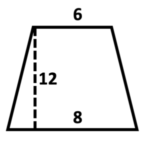 The answer is \( 84 \) units\(^2 \)
Challenge Problems
\(\textbf{6)}\) Solve for x if the area = \( 200 \) units\(^2 \).
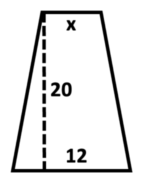 The answer is \( x=8 \)
\(\textbf{7)}\) Solve for y if the area = \( 196 \) units\(^2 \).
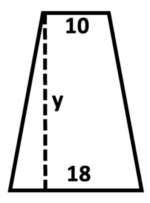 The answer is \( y=14 \)
\(\textbf{8)}\) Solve for x if the area = \( 90 \) units\(^2 \).
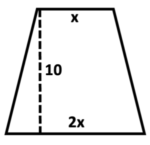 The answer is \( x=6 \)
See Related Pages\(\)
\(\bullet\text{ Geometry Homepage}\)
\(\,\,\,\,\,\,\,\,\text{All the Best Topics…}\)
\(\bullet\text{ Trapezoid Area Calculator (Omnicalculator.com)}\)
\(\,\,\,\,\,\,\,\,\) \(\)
\(\)
\(\bullet\text{ Area and Perimeter of Rectangles}\)
\(\,\,\,\,\,\,\,\,\)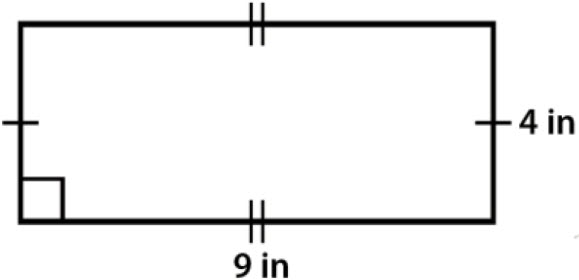 \(\,\, A=bh, \,\, P=2b+2h…\)
\(\bullet\text{ Area and Perimeter of Triangles}\)
\(\,\,\,\,\,\,\,\,\)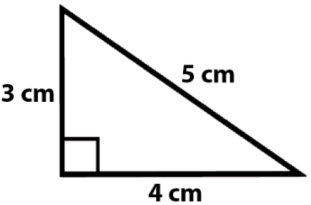 \(\,\, A=\frac{1}{2}bh, \,\, P=s_1+s_2+s_3…\)
\(\bullet\text{ Area and Circumference of Circles}\)
\(\,\,\,\,\,\,\,\,\) \(\,\, A= \pi r^2, \,\,C=2 \pi r…\)
\(\bullet\text{ Area of Trapezoids}\)
\(\,\,\,\,\,\,\,\,\)\(A=\frac{1}{2}(b_1+b_2)\cdot h…\)
\(\bullet\text{ Area of Compound Figures}\)
\(\,\,\,\,\,\,\,\,\) \(\)
\(\)
\(\bullet\text{ Andymath Homepage}\)