

The quotient rule is used to find derivatives when one function is divided by another function. The main idea is “low d high minus high d low, all over low squared,” which helps keep the order of the numerator straight. This page gives practice finding derivatives of rational, radical, exponential, trigonometric, and table-based quotient expressions.
Notes
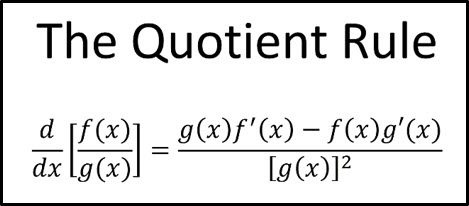
Quotient Rule (Formal)
\(\displaystyle\frac{d}{dx}\left[\frac{f(x)}{g(x)}\right]=\frac{g(x)f'(x)-f(x)g'(x)}{\left[g(x)\right]^2}\)
Quotient Rule (Easy to Remember)
\(\displaystyle\frac{d}{dx}\left[\frac{hi}{lo}\right]=\frac{lo \cdot d hi\,-\,hi \cdot d lo}{lo^2}\)
Problems
Use the quotient rule to find the derivative of the following.
\(\textbf{1)}\) \(f(x)=\displaystyle\frac{x}{x^3+1}\) The answer is \(f'(x)=\displaystyle\frac{1-2x^3}{(x^3+1)^2}\)
\(\,\,\,\,\,\,\displaystyle\frac{d}{dx}\left[\frac{hi}{lo}\right]=\frac{lo \cdot d hi\,-\,hi \cdot d lo}{lo^2}\)
\(\,\,\,\,\,\,\displaystyle\frac{d}{dx}\left[\frac{x}{x^3+1}\right]=\frac{\left(x^3+1\right) \cdot \frac{d}{dx} (x)\,-\,(x) \cdot \frac{d}{dx} \left(x^3+1\right)}{\left(x^3+1\right)^2}\)
\(\,\,\,\,\,\,\displaystyle\frac{d}{dx}\left[\frac{x}{x^3+1}\right]=\frac{\left(x^3+1\right) \cdot (1)\,-\,(x) \cdot \left(3x^2\right)}{\left(x^3+1\right)^2}\)
\(\,\,\,\,\,\,\displaystyle\frac{d}{dx}\left[\frac{x}{x^3+1}\right]=\frac{x^3+1-3x^3}{\left(x^3+1\right)^2}\)
\(\,\,\,\,\,\,\displaystyle\frac{d}{dx}\left[\frac{x}{x^3+1}\right]=\frac{-2x^3+1}{\left(x^3+1\right)^2}\)
\(\,\,\,\,\,\,\)The answer is \(f'(x)=\displaystyle\frac{1-2x^3}{(x^3+1)^2}\)

\(\,\,\,\,\,\,\displaystyle\frac{d}{dx}\left[\frac{hi}{lo}\right]=\frac{lo \cdot d hi\,-\,hi \cdot d lo}{lo^2}\)
\(\,\,\,\,\,\,\displaystyle\frac{d}{dx}\left[\frac{x}{x^3+1}\right]=\frac{\left(x^3+1\right) \cdot \frac{d}{dx} (x)\,-\,(x) \cdot \frac{d}{dx} \left(x^3+1\right)}{\left(x^3+1\right)^2}\)
\(\,\,\,\,\,\,\displaystyle\frac{d}{dx}\left[\frac{x}{x^3+1}\right]=\frac{\left(x^3+1\right) \cdot (1)\,-\,(x) \cdot \left(3x^2\right)}{\left(x^3+1\right)^2}\)
\(\,\,\,\,\,\,\displaystyle\frac{d}{dx}\left[\frac{x}{x^3+1}\right]=\frac{x^3+1-3x^3}{\left(x^3+1\right)^2}\)
\(\,\,\,\,\,\,\displaystyle\frac{d}{dx}\left[\frac{x}{x^3+1}\right]=\frac{-2x^3+1}{\left(x^3+1\right)^2}\)
\(\,\,\,\,\,\,\)The answer is \(f'(x)=\displaystyle\frac{1-2x^3}{(x^3+1)^2}\)
\(\textbf{2)}\) \(f(x)=\displaystyle\frac{\sqrt{x}}{x^2-2}\) The answer is \(f'(x)=-\displaystyle\frac{3x^2+2}{2\sqrt{x}(x^2-2)^2}\)
\(\,\,\,\,\,\,\displaystyle\frac{d}{dx}\left[\frac{hi}{lo}\right]=\frac{lo \cdot d hi\,-\,hi \cdot d lo}{lo^2}\)
\(\,\,\,\,\,\,\displaystyle\frac{d}{dx}\left[\frac{\sqrt{x}}{x^2-2}\right]=\frac{\left(x^2-2\right) \cdot \frac{d}{dx} (\sqrt{x})\,-\,(\sqrt{x}) \cdot \frac{d}{dx} \left(x^2-2\right)}{\left(x^2-2\right)^2}\)
\(\,\,\,\,\,\,\displaystyle\frac{d}{dx}\left[\frac{\sqrt{x}}{x^2-2}\right]=\frac{\left(x^2-2\right) \cdot \frac{1}{2\sqrt{x}} \,-\,(\sqrt{x}) \cdot \left(2x\right)}{\left(x^2-2\right)^2}\)
\(\,\,\,\,\,\,\displaystyle\frac{d}{dx}\left[\frac{\sqrt{x}}{x^2-2}\right]=\frac{\frac{x^2-2}{2\sqrt{x}} \,-\,(2x\sqrt{x})}{\left(x^2-2\right)^2}\)
\(\,\,\,\,\,\,\displaystyle\frac{d}{dx}\left[\frac{\sqrt{x}}{x^2-2}\right]=\frac{\frac{x^2-2}{2\sqrt{x}} \,-\,(2x\sqrt{x}) \cdot \frac{2\sqrt{x}}{2\sqrt{x}}}{\left(x^2-2\right)^2}\)
\(\,\,\,\,\,\,\displaystyle\frac{d}{dx}\left[\frac{\sqrt{x}}{x^2-2}\right]=\frac{\frac{x^2-2}{2\sqrt{x}} \,-\, \frac{4x^2}{2\sqrt{x}}}{\left(x^2-2\right)^2}\)
\(\,\,\,\,\,\,\displaystyle\frac{d}{dx}\left[\frac{\sqrt{x}}{x^2-2}\right]=\frac{\frac{x^2-2-4x^2}{2\sqrt{x}}}{\left(x^2-2\right)^2}\)
\(\,\,\,\,\,\,\displaystyle\frac{d}{dx}\left[\frac{\sqrt{x}}{x^2-2}\right]=\frac{\frac{-3x^2-2}{2\sqrt{x}}}{\left(x^2-2\right)^2}\)
\(\,\,\,\,\,\,\displaystyle\frac{d}{dx}\left[\frac{\sqrt{x}}{x^2-2}\right]=-\frac{3x^2+2}{2\sqrt{x}} \cdot \frac{1}{\left(x^2-2\right)^2}\)
\(\,\,\,\,\,\,\)The answer is \(f'(x)=-\displaystyle\frac{3x^2+2}{2\sqrt{x}(x^2-2)^2}\)
\(\,\,\,\,\,\,\displaystyle\frac{d}{dx}\left[\frac{hi}{lo}\right]=\frac{lo \cdot d hi\,-\,hi \cdot d lo}{lo^2}\)
\(\,\,\,\,\,\,\displaystyle\frac{d}{dx}\left[\frac{\sqrt{x}}{x^2-2}\right]=\frac{\left(x^2-2\right) \cdot \frac{d}{dx} (\sqrt{x})\,-\,(\sqrt{x}) \cdot \frac{d}{dx} \left(x^2-2\right)}{\left(x^2-2\right)^2}\)
\(\,\,\,\,\,\,\displaystyle\frac{d}{dx}\left[\frac{\sqrt{x}}{x^2-2}\right]=\frac{\left(x^2-2\right) \cdot \frac{1}{2\sqrt{x}} \,-\,(\sqrt{x}) \cdot \left(2x\right)}{\left(x^2-2\right)^2}\)
\(\,\,\,\,\,\,\displaystyle\frac{d}{dx}\left[\frac{\sqrt{x}}{x^2-2}\right]=\frac{\frac{x^2-2}{2\sqrt{x}} \,-\,(2x\sqrt{x})}{\left(x^2-2\right)^2}\)
\(\,\,\,\,\,\,\displaystyle\frac{d}{dx}\left[\frac{\sqrt{x}}{x^2-2}\right]=\frac{\frac{x^2-2}{2\sqrt{x}} \,-\,(2x\sqrt{x}) \cdot \frac{2\sqrt{x}}{2\sqrt{x}}}{\left(x^2-2\right)^2}\)
\(\,\,\,\,\,\,\displaystyle\frac{d}{dx}\left[\frac{\sqrt{x}}{x^2-2}\right]=\frac{\frac{x^2-2}{2\sqrt{x}} \,-\, \frac{4x^2}{2\sqrt{x}}}{\left(x^2-2\right)^2}\)
\(\,\,\,\,\,\,\displaystyle\frac{d}{dx}\left[\frac{\sqrt{x}}{x^2-2}\right]=\frac{\frac{x^2-2-4x^2}{2\sqrt{x}}}{\left(x^2-2\right)^2}\)
\(\,\,\,\,\,\,\displaystyle\frac{d}{dx}\left[\frac{\sqrt{x}}{x^2-2}\right]=\frac{\frac{-3x^2-2}{2\sqrt{x}}}{\left(x^2-2\right)^2}\)
\(\,\,\,\,\,\,\displaystyle\frac{d}{dx}\left[\frac{\sqrt{x}}{x^2-2}\right]=-\frac{3x^2+2}{2\sqrt{x}} \cdot \frac{1}{\left(x^2-2\right)^2}\)
\(\,\,\,\,\,\,\)The answer is \(f'(x)=-\displaystyle\frac{3x^2+2}{2\sqrt{x}(x^2-2)^2}\)
\(\textbf{3)}\) \(f(x)=\displaystyle\frac{\cos x}{x^2}\) The answer is \(f'(x)=-\displaystyle\frac{x \sin x + 2 \cos x}{x^3}\)
\(\,\,\,\,\,\,\displaystyle\frac{d}{dx}\left[\frac{hi}{lo}\right]=\frac{lo \cdot d hi\,-\,hi \cdot d lo}{lo^2}\)
\(\,\,\,\,\,\,\displaystyle\frac{d}{dx}\left[\frac{\cos x}{x^2}\right]=\frac{\left(x^2\right) \cdot \frac{d}{dx} (\cos x)\,-\,(\cos x) \cdot \frac{d}{dx} \left(x^2\right)}{\left(x^2\right)^2}\)
\(\,\,\,\,\,\,\displaystyle\frac{d}{dx}\left[\frac{\cos x}{x^2}\right]=\frac{\left(x^2\right) \cdot (-\sin x)\,-\,(\cos x) \cdot \left(2x\right)}{\left(x^2\right)^2}\)
\(\,\,\,\,\,\,\displaystyle\frac{d}{dx}\left[\frac{\cos x}{x^2}\right]=\frac{-x^2 \sin (x)\,-\,2x \cos (x) }{x^4}\)
\(\,\,\,\,\,\,\displaystyle\frac{d}{dx}\left[\frac{\cos x}{x^2}\right]=\frac{-x \left(x \sin (x)\,+\,2 \cos (x)\right) }{x \left(x^3\right)}\)
\(\,\,\,\,\,\,\)The answer is \(f'(x)=-\displaystyle\frac{x \sin x + 2 \cos x}{x^3}\)
\(\,\,\,\,\,\,\displaystyle\frac{d}{dx}\left[\frac{hi}{lo}\right]=\frac{lo \cdot d hi\,-\,hi \cdot d lo}{lo^2}\)
\(\,\,\,\,\,\,\displaystyle\frac{d}{dx}\left[\frac{\cos x}{x^2}\right]=\frac{\left(x^2\right) \cdot \frac{d}{dx} (\cos x)\,-\,(\cos x) \cdot \frac{d}{dx} \left(x^2\right)}{\left(x^2\right)^2}\)
\(\,\,\,\,\,\,\displaystyle\frac{d}{dx}\left[\frac{\cos x}{x^2}\right]=\frac{\left(x^2\right) \cdot (-\sin x)\,-\,(\cos x) \cdot \left(2x\right)}{\left(x^2\right)^2}\)
\(\,\,\,\,\,\,\displaystyle\frac{d}{dx}\left[\frac{\cos x}{x^2}\right]=\frac{-x^2 \sin (x)\,-\,2x \cos (x) }{x^4}\)
\(\,\,\,\,\,\,\displaystyle\frac{d}{dx}\left[\frac{\cos x}{x^2}\right]=\frac{-x \left(x \sin (x)\,+\,2 \cos (x)\right) }{x \left(x^3\right)}\)
\(\,\,\,\,\,\,\)The answer is \(f'(x)=-\displaystyle\frac{x \sin x + 2 \cos x}{x^3}\)
\(\textbf{4)}\) \(f(x)=\displaystyle\frac{x+4}{x-2}\) The answer is \(f'(x)=-\displaystyle\frac{6}{(x-2)^2}\)
\(\,\,\,\,\,\,\displaystyle\frac{d}{dx}\left[\frac{hi}{lo}\right]=\frac{lo \cdot d hi\,-\,hi \cdot d lo}{lo^2}\)
\(\,\,\,\,\,\,\displaystyle\frac{d}{dx}\left[\frac{x+4}{x-2}\right]=\frac{\left(x-2\right) \cdot \frac{d}{dx} (x+4)\,-\,(x+4) \cdot \frac{d}{dx} \left(x-2\right)}{\left(x-2\right)^2}\)
\(\,\,\,\,\,\,\displaystyle\frac{d}{dx}\left[\frac{x+4}{x-2}\right]=\frac{\left(x-2\right) \cdot (1)\,-\,(x+4) \cdot \left(1\right)}{\left(x-2\right)^2}\)
\(\,\,\,\,\,\,\displaystyle\frac{d}{dx}\left[\frac{x+4}{x-2}\right]=\frac{\left(x-2\right) \,-\,(x+4)}{\left(x-2\right)^2}\)
\(\,\,\,\,\,\,\displaystyle\frac{d}{dx}\left[\frac{x+4}{x-2}\right]=\frac{x-2-x-4}{\left(x-2\right)^2}\)
\(\,\,\,\,\,\,\)The answer is \(f'(x)=-\displaystyle\frac{6}{(x-2)^2}\)
\(\,\,\,\,\,\,\displaystyle\frac{d}{dx}\left[\frac{hi}{lo}\right]=\frac{lo \cdot d hi\,-\,hi \cdot d lo}{lo^2}\)
\(\,\,\,\,\,\,\displaystyle\frac{d}{dx}\left[\frac{x+4}{x-2}\right]=\frac{\left(x-2\right) \cdot \frac{d}{dx} (x+4)\,-\,(x+4) \cdot \frac{d}{dx} \left(x-2\right)}{\left(x-2\right)^2}\)
\(\,\,\,\,\,\,\displaystyle\frac{d}{dx}\left[\frac{x+4}{x-2}\right]=\frac{\left(x-2\right) \cdot (1)\,-\,(x+4) \cdot \left(1\right)}{\left(x-2\right)^2}\)
\(\,\,\,\,\,\,\displaystyle\frac{d}{dx}\left[\frac{x+4}{x-2}\right]=\frac{\left(x-2\right) \,-\,(x+4)}{\left(x-2\right)^2}\)
\(\,\,\,\,\,\,\displaystyle\frac{d}{dx}\left[\frac{x+4}{x-2}\right]=\frac{x-2-x-4}{\left(x-2\right)^2}\)
\(\,\,\,\,\,\,\)The answer is \(f'(x)=-\displaystyle\frac{6}{(x-2)^2}\)
\(\textbf{5)}\) \(f(x)=\displaystyle\frac{3x-4}{x^2+3}\) The answer is \(f'(x)=-\displaystyle\frac{3x^2-8x-9}{(x^2+3)^2}\)
\(\,\,\,\,\,\,\displaystyle\frac{d}{dx}\left[\frac{hi}{lo}\right]=\frac{lo \cdot d hi\,-\,hi \cdot d lo}{lo^2}\)
\(\,\,\,\,\,\,\displaystyle\frac{d}{dx}\left[\frac{3x-4}{x^2+3}\right]=\frac{\left(x^2+3\right) \cdot \frac{d}{dx} (3x-4)\,-\,(3x-4) \cdot \frac{d}{dx} \left(x^2+3\right)}{\left(x^2+3\right)^2}\)
\(\,\,\,\,\,\,\displaystyle\frac{d}{dx}\left[\frac{3x-4}{x^2+3}\right]=\frac{\left(x^2+3\right) \cdot (3)\,-\,(3x-4) \cdot \left(2x\right)}{\left(x^2+3\right)^2}\)
\(\,\,\,\,\,\,\displaystyle\frac{d}{dx}\left[\frac{3x-4}{x^2+3}\right]=\frac{\left(3x^2+9\right) \,-\,(6x^2-8x)}{\left(x^2+3\right)^2}\)
\(\,\,\,\,\,\,\displaystyle\frac{d}{dx}\left[\frac{3x-4}{x^2+3}\right]=\frac{3x^2+9-6x^2+8x}{\left(x^2+3\right)^2}\)
\(\,\,\,\,\,\,\displaystyle\frac{d}{dx}\left[\frac{3x-4}{x^2+3}\right]=\frac{-3x^2+8x+9}{\left(x^2+3\right)^2}\)
\(\,\,\,\,\,\,\)The answer is \(f'(x)=-\displaystyle\frac{3x^2-8x-9}{(x^2+3)^2}\)
\(\,\,\,\,\,\,\displaystyle\frac{d}{dx}\left[\frac{hi}{lo}\right]=\frac{lo \cdot d hi\,-\,hi \cdot d lo}{lo^2}\)
\(\,\,\,\,\,\,\displaystyle\frac{d}{dx}\left[\frac{3x-4}{x^2+3}\right]=\frac{\left(x^2+3\right) \cdot \frac{d}{dx} (3x-4)\,-\,(3x-4) \cdot \frac{d}{dx} \left(x^2+3\right)}{\left(x^2+3\right)^2}\)
\(\,\,\,\,\,\,\displaystyle\frac{d}{dx}\left[\frac{3x-4}{x^2+3}\right]=\frac{\left(x^2+3\right) \cdot (3)\,-\,(3x-4) \cdot \left(2x\right)}{\left(x^2+3\right)^2}\)
\(\,\,\,\,\,\,\displaystyle\frac{d}{dx}\left[\frac{3x-4}{x^2+3}\right]=\frac{\left(3x^2+9\right) \,-\,(6x^2-8x)}{\left(x^2+3\right)^2}\)
\(\,\,\,\,\,\,\displaystyle\frac{d}{dx}\left[\frac{3x-4}{x^2+3}\right]=\frac{3x^2+9-6x^2+8x}{\left(x^2+3\right)^2}\)
\(\,\,\,\,\,\,\displaystyle\frac{d}{dx}\left[\frac{3x-4}{x^2+3}\right]=\frac{-3x^2+8x+9}{\left(x^2+3\right)^2}\)
\(\,\,\,\,\,\,\)The answer is \(f'(x)=-\displaystyle\frac{3x^2-8x-9}{(x^2+3)^2}\)
\(\textbf{6)}\) \(f(x)=\displaystyle\frac{e^x}{x}\) The answer is \(f'(x)=\displaystyle\frac{e^x(x-1)}{x^2}\)
\(\,\,\,\,\,\,\displaystyle\frac{d}{dx}\left[\frac{hi}{lo}\right]=\frac{lo \cdot d hi\,-\,hi \cdot d lo}{lo^2}\)
\(\,\,\,\,\,\,\displaystyle\frac{d}{dx}\left[\frac{e^x}{x}\right]=\frac{\left(x\right) \cdot \frac{d}{dx} (e^x)\,-\,(e^x) \cdot \frac{d}{dx} \left(x\right)}{\left(x\right)^2}\)
\(\,\,\,\,\,\,\displaystyle\frac{d}{dx}\left[\frac{e^x}{x}\right]=\frac{\left(x\right) \cdot (e^x)\,-\,(e^x) \cdot \left(1\right)}{\left(x\right)^2}\)
\(\,\,\,\,\,\,\displaystyle\frac{d}{dx}\left[\frac{e^x}{x}\right]=\frac{x e^x-e^x }{x^2}\)
\(\,\,\,\,\,\,\)The answer is \(f'(x)=\displaystyle\frac{e^x(x-1)}{x^2}\)
\(\,\,\,\,\,\,\displaystyle\frac{d}{dx}\left[\frac{hi}{lo}\right]=\frac{lo \cdot d hi\,-\,hi \cdot d lo}{lo^2}\)
\(\,\,\,\,\,\,\displaystyle\frac{d}{dx}\left[\frac{e^x}{x}\right]=\frac{\left(x\right) \cdot \frac{d}{dx} (e^x)\,-\,(e^x) \cdot \frac{d}{dx} \left(x\right)}{\left(x\right)^2}\)
\(\,\,\,\,\,\,\displaystyle\frac{d}{dx}\left[\frac{e^x}{x}\right]=\frac{\left(x\right) \cdot (e^x)\,-\,(e^x) \cdot \left(1\right)}{\left(x\right)^2}\)
\(\,\,\,\,\,\,\displaystyle\frac{d}{dx}\left[\frac{e^x}{x}\right]=\frac{x e^x-e^x }{x^2}\)
\(\,\,\,\,\,\,\)The answer is \(f'(x)=\displaystyle\frac{e^x(x-1)}{x^2}\)
\(\textbf{7)}\) \(f(x)=\displaystyle\frac{x^2}{x+1}\) The answer is \(f'(x)=\displaystyle\frac{x(x+2)}{(x+1)^2}\)
\(\,\,\,\,\,\,\displaystyle\frac{d}{dx}\left[\frac{hi}{lo}\right]=\frac{lo \cdot d hi\,-\,hi \cdot d lo}{lo^2}\)
\(\,\,\,\,\,\,\displaystyle\frac{d}{dx}\left[\frac{x^2}{x+1}\right]=\frac{\left(x+1\right) \cdot \frac{d}{dx} (x^2)\,-\,(x^2) \cdot \frac{d}{dx} \left(x+1\right)}{\left(x+1\right)^2}\)
\(\,\,\,\,\,\,\displaystyle\frac{d}{dx}\left[\frac{x^2}{x+1}\right]=\frac{\left(x+1\right) \cdot (2x)\,-\,(x^2) \cdot \left(1\right)}{\left(x+1\right)^2}\)
\(\,\,\,\,\,\,\displaystyle\frac{d}{dx}\left[\frac{x^2}{x+1}\right]=\frac{2x^2+2x-x^2}{\left(x+1\right)^2}\)
\(\,\,\,\,\,\,\displaystyle\frac{d}{dx}\left[\frac{x^2}{x+1}\right]=\frac{x^2+2x}{\left(x+1\right)^2}\)
\(\,\,\,\,\,\,\)The answer is \(f'(x)=\displaystyle\frac{x(x+2)}{(x+1)^2}\)
\(\,\,\,\,\,\,\displaystyle\frac{d}{dx}\left[\frac{hi}{lo}\right]=\frac{lo \cdot d hi\,-\,hi \cdot d lo}{lo^2}\)
\(\,\,\,\,\,\,\displaystyle\frac{d}{dx}\left[\frac{x^2}{x+1}\right]=\frac{\left(x+1\right) \cdot \frac{d}{dx} (x^2)\,-\,(x^2) \cdot \frac{d}{dx} \left(x+1\right)}{\left(x+1\right)^2}\)
\(\,\,\,\,\,\,\displaystyle\frac{d}{dx}\left[\frac{x^2}{x+1}\right]=\frac{\left(x+1\right) \cdot (2x)\,-\,(x^2) \cdot \left(1\right)}{\left(x+1\right)^2}\)
\(\,\,\,\,\,\,\displaystyle\frac{d}{dx}\left[\frac{x^2}{x+1}\right]=\frac{2x^2+2x-x^2}{\left(x+1\right)^2}\)
\(\,\,\,\,\,\,\displaystyle\frac{d}{dx}\left[\frac{x^2}{x+1}\right]=\frac{x^2+2x}{\left(x+1\right)^2}\)
\(\,\,\,\,\,\,\)The answer is \(f'(x)=\displaystyle\frac{x(x+2)}{(x+1)^2}\)
\(\textbf{8)}\) \(f(x)=\displaystyle\frac{e^x}{x+2}\) The answer is \(f'(x)=\displaystyle\frac{e^x(x+1)}{(x+2)^2}\)
\(\,\,\,\,\,\,\displaystyle\frac{d}{dx}\left[\frac{hi}{lo}\right]=\frac{lo \cdot d hi\,-\,hi \cdot d lo}{lo^2}\)
\(\,\,\,\,\,\,\displaystyle\frac{d}{dx}\left[\frac{e^x}{x+2}\right]=\frac{\left(x+2\right) \cdot \frac{d}{dx} (e^x)\,-\,(e^x) \cdot \frac{d}{dx} \left(x+2\right)}{\left(x+2\right)^2}\)
\(\,\,\,\,\,\,\displaystyle\frac{d}{dx}\left[\frac{e^x}{x+2}\right]=\frac{\left(x+2\right) \cdot (e^x)\,-\,(e^x) \cdot \left(1\right)}{\left(x+2\right)^2}\)
\(\,\,\,\,\,\,\displaystyle\frac{d}{dx}\left[\frac{e^x}{x+2}\right]=\frac{xe^x + 2e^x \,-\,e^x}{\left(x+2\right)^2}\)
\(\,\,\,\,\,\,\displaystyle\frac{d}{dx}\left[\frac{e^x}{x+2}\right]=\frac{xe^x + e^x}{\left(x+2\right)^2}\)
\(\,\,\,\,\,\,\)The answer is \(f'(x)=\displaystyle\frac{e^x(x+1)}{(x+2)^2}\)
\(\,\,\,\,\,\,\displaystyle\frac{d}{dx}\left[\frac{hi}{lo}\right]=\frac{lo \cdot d hi\,-\,hi \cdot d lo}{lo^2}\)
\(\,\,\,\,\,\,\displaystyle\frac{d}{dx}\left[\frac{e^x}{x+2}\right]=\frac{\left(x+2\right) \cdot \frac{d}{dx} (e^x)\,-\,(e^x) \cdot \frac{d}{dx} \left(x+2\right)}{\left(x+2\right)^2}\)
\(\,\,\,\,\,\,\displaystyle\frac{d}{dx}\left[\frac{e^x}{x+2}\right]=\frac{\left(x+2\right) \cdot (e^x)\,-\,(e^x) \cdot \left(1\right)}{\left(x+2\right)^2}\)
\(\,\,\,\,\,\,\displaystyle\frac{d}{dx}\left[\frac{e^x}{x+2}\right]=\frac{xe^x + 2e^x \,-\,e^x}{\left(x+2\right)^2}\)
\(\,\,\,\,\,\,\displaystyle\frac{d}{dx}\left[\frac{e^x}{x+2}\right]=\frac{xe^x + e^x}{\left(x+2\right)^2}\)
\(\,\,\,\,\,\,\)The answer is \(f'(x)=\displaystyle\frac{e^x(x+1)}{(x+2)^2}\)
\(\textbf{9)}\) \(f(x)=\displaystyle\frac{3x^3-2x}{1+3x}\) The answer is \(f'(x)=\displaystyle\frac{18x^3+9x^2-2}{\left(1+3x\right)^2}\)
\(\,\,\,\,\,\,\displaystyle\frac{d}{dx}\left[\frac{hi}{lo}\right]=\frac{lo \cdot d hi\,-\,hi \cdot d lo}{lo^2}\)
\(\,\,\,\,\,\,\displaystyle\frac{d}{dx}\left[\frac{3x^3-2x}{1+3x}\right]=\frac{\left(1+3x\right) \cdot \frac{d}{dx} (3x^3-2x)\,-\,(3x^3-2x) \cdot \frac{d}{dx} \left(1+3x\right)}{\left(1+3x\right)^2}\)
\(\,\,\,\,\,\,\displaystyle\frac{d}{dx}\left[\frac{3x^3-2x}{1+3x}\right]=\frac{\left(1+3x\right) \cdot \left(9x^2-2\right)\,-\,\left(3x^3-2x\right) \cdot \left(3\right)}{\left(1+3x\right)^2}\)
\(\,\,\,\,\,\,\displaystyle\frac{d}{dx}\left[\frac{3x^3-2x}{1+3x}\right]=\frac{\left(1+3x\right)\left(9x^2-2\right)\,-\,\left(3x^3-2x\right)\left(3\right)}{\left(1+3x\right)^2}\)
\(\,\,\,\,\,\,\displaystyle\frac{d}{dx}\left[\frac{3x^3-2x}{1+3x}\right]=\frac{9x^2-2+27x^3-6x-9x^3+6x}{\left(1+3x\right)^2}\)
\(\,\,\,\,\,\,\displaystyle\frac{d}{dx}\left[\frac{3x^3-2x}{1+3x}\right]=\frac{18x^3+9x^2-2}{\left(1+3x\right)^2}\)
\(\,\,\,\,\,\,\displaystyle\frac{d}{dx}\left[\frac{hi}{lo}\right]=\frac{lo \cdot d hi\,-\,hi \cdot d lo}{lo^2}\)
\(\,\,\,\,\,\,\displaystyle\frac{d}{dx}\left[\frac{3x^3-2x}{1+3x}\right]=\frac{\left(1+3x\right) \cdot \frac{d}{dx} (3x^3-2x)\,-\,(3x^3-2x) \cdot \frac{d}{dx} \left(1+3x\right)}{\left(1+3x\right)^2}\)
\(\,\,\,\,\,\,\displaystyle\frac{d}{dx}\left[\frac{3x^3-2x}{1+3x}\right]=\frac{\left(1+3x\right) \cdot \left(9x^2-2\right)\,-\,\left(3x^3-2x\right) \cdot \left(3\right)}{\left(1+3x\right)^2}\)
\(\,\,\,\,\,\,\displaystyle\frac{d}{dx}\left[\frac{3x^3-2x}{1+3x}\right]=\frac{\left(1+3x\right)\left(9x^2-2\right)\,-\,\left(3x^3-2x\right)\left(3\right)}{\left(1+3x\right)^2}\)
\(\,\,\,\,\,\,\displaystyle\frac{d}{dx}\left[\frac{3x^3-2x}{1+3x}\right]=\frac{9x^2-2+27x^3-6x-9x^3+6x}{\left(1+3x\right)^2}\)
\(\,\,\,\,\,\,\displaystyle\frac{d}{dx}\left[\frac{3x^3-2x}{1+3x}\right]=\frac{18x^3+9x^2-2}{\left(1+3x\right)^2}\)
\(\textbf{10)}\) Find \((f/g)'(4)\) where \(f(4)=3\), \(f'(4)=6\), \(g(4)=2\), \(g'(4)=0\) The answer is \((f/g)'(4)=3\)
\(\,\,\,\,\,\,\displaystyle (f/g)'(4)=\frac{lo \cdot d hi\,-\,hi \cdot d lo}{lo^2}\)
\(\,\,\,\,\,\,\displaystyle (f/g)'(4)=\frac{g(4) \cdot f'(4)\,-\,f(4) \cdot g'(4)}{\left(g(4)\right)^2}\)
\(\,\,\,\,\,\,\displaystyle (f/g)'(4)=\frac{2 \cdot 6\,-\,3 \cdot 0}{\left(2\right)^2}\)
\(\,\,\,\,\,\,\displaystyle (f/g)'(4)=\frac{12\,-\,0}{4}\)
\(\,\,\,\,\,\,\)The answer is \((f/g)'(4)=3\)
\(\,\,\,\,\,\,\displaystyle (f/g)'(4)=\frac{lo \cdot d hi\,-\,hi \cdot d lo}{lo^2}\)
\(\,\,\,\,\,\,\displaystyle (f/g)'(4)=\frac{g(4) \cdot f'(4)\,-\,f(4) \cdot g'(4)}{\left(g(4)\right)^2}\)
\(\,\,\,\,\,\,\displaystyle (f/g)'(4)=\frac{2 \cdot 6\,-\,3 \cdot 0}{\left(2\right)^2}\)
\(\,\,\,\,\,\,\displaystyle (f/g)'(4)=\frac{12\,-\,0}{4}\)
\(\,\,\,\,\,\,\)The answer is \((f/g)'(4)=3\)
\(\textbf{11)}\) \(f(x) = \displaystyle \frac{\sin x}{x^2}\)The derivative is \(f'(x) = \frac{x \cos x – 2 \sin x}{x^3}\)
\(\,\,\,\,\,\text{This will use quotient rule}\)
\(\,\,\,\,\,f(x) = \frac{\sin x}{x^2}\)
\(\,\,\,\,\,f'(x) = \frac{(\sin x)’ \cdot x^2 – \sin x \cdot (x^2)’}{(x^2)^2}\)
\(\,\,\,\,\,f'(x) = \frac{x^2 \cos x – 2 x \sin x}{x^4}\)
\(\,\,\,\,\,f'(x) = \frac{x\left(x \cos x – 2 \sin x\right)}{x^4}\)
\(\,\,\,\,\,f'(x) = \frac{x \cos x – 2 \sin x}{x^3}\)
\(\,\,\,\,\,\text{This will use quotient rule}\)
\(\,\,\,\,\,f(x) = \frac{\sin x}{x^2}\)
\(\,\,\,\,\,f'(x) = \frac{(\sin x)’ \cdot x^2 – \sin x \cdot (x^2)’}{(x^2)^2}\)
\(\,\,\,\,\,f'(x) = \frac{x^2 \cos x – 2 x \sin x}{x^4}\)
\(\,\,\,\,\,f'(x) = \frac{x\left(x \cos x – 2 \sin x\right)}{x^4}\)
\(\,\,\,\,\,f'(x) = \frac{x \cos x – 2 \sin x}{x^3}\)
\(\textbf{12)}\) \(f(x) = \displaystyle \frac{\cos x}{x}\)The derivative is \(f'(x) = \frac{-x \sin x – \cos x}{x^2}\)
\(\,\,\,\,\,\text{This will use quotient rule}\)
\(\,\,\,\,\,f(x) = \frac{\cos x}{x}\)
\(\,\,\,\,\,f'(x) = \frac{(\cos x)’ \cdot x – \cos x \cdot (x)’}{x^2}\)
\(\,\,\,\,\,f'(x) = \frac{ \left(-\sin x \right) \cdot x – \cos x \cdot (1)}{(x)^2}\)
\(\,\,\,\,\,f'(x) = \frac{-x \sin x – \cos x}{x^2}\)
\(\,\,\,\,\,\text{This will use quotient rule}\)
\(\,\,\,\,\,f(x) = \frac{\cos x}{x}\)
\(\,\,\,\,\,f'(x) = \frac{(\cos x)’ \cdot x – \cos x \cdot (x)’}{x^2}\)
\(\,\,\,\,\,f'(x) = \frac{ \left(-\sin x \right) \cdot x – \cos x \cdot (1)}{(x)^2}\)
\(\,\,\,\,\,f'(x) = \frac{-x \sin x – \cos x}{x^2}\)
\(\textbf{13)}\) \(f(x) = \displaystyle \frac{x^3}{\sin x}\)
The derivative is \(f'(x) = \frac{3x^2 \sin x – x^3 \cos x}{\sin^2 x}\)
\(\,\,\,\,\,\text{This will use quotient rule}\)
\(\,\,\,\,\,f(x) = \frac{x^3}{\sin x}\)
\(\,\,\,\,\,f'(x) = \frac{(x^3)’ \cdot \sin x – x^3 \cdot (\sin x)’}{(\sin x)^2}\)
\(\,\,\,\,\,f'(x) = \frac{3x^2 \sin x – x^3 \cos x}{\sin^2 x}\)
\(\,\,\,\,\,\text{This will use quotient rule}\)
\(\,\,\,\,\,f(x) = \frac{x^3}{\sin x}\)
\(\,\,\,\,\,f'(x) = \frac{(x^3)’ \cdot \sin x – x^3 \cdot (\sin x)’}{(\sin x)^2}\)
\(\,\,\,\,\,f'(x) = \frac{3x^2 \sin x – x^3 \cos x}{\sin^2 x}\)
\(\textbf{14)}\) \(f(x)=\displaystyle\frac{x^2+1}{x-3}\) The answer is \(f'(x)=\displaystyle\frac{x^2-6x-1}{(x-3)^2}\)
\(\,\,\,\,\,\,\displaystyle\frac{d}{dx}\left[\frac{hi}{lo}\right]=\frac{lo \cdot d hi\,-\,hi \cdot d lo}{lo^2}\)
\(\,\,\,\,\,\,\displaystyle\frac{d}{dx}\left[\frac{x^2+1}{x-3}\right]=\frac{(x-3)\cdot\frac{d}{dx}(x^2+1)-(x^2+1)\cdot\frac{d}{dx}(x-3)}{(x-3)^2}\)
\(\,\,\,\,\,\,\displaystyle f'(x)=\frac{(x-3)(2x)-(x^2+1)(1)}{(x-3)^2}\)
\(\,\,\,\,\,\,\displaystyle f'(x)=\frac{2x^2-6x-x^2-1}{(x-3)^2}\)
\(\,\,\,\,\,\,\displaystyle f'(x)=\frac{x^2-6x-1}{(x-3)^2}\)
\(\,\,\,\,\,\,\)The answer is \(f'(x)=\displaystyle\frac{x^2-6x-1}{(x-3)^2}\)
\(\,\,\,\,\,\,\displaystyle\frac{d}{dx}\left[\frac{hi}{lo}\right]=\frac{lo \cdot d hi\,-\,hi \cdot d lo}{lo^2}\)
\(\,\,\,\,\,\,\displaystyle\frac{d}{dx}\left[\frac{x^2+1}{x-3}\right]=\frac{(x-3)\cdot\frac{d}{dx}(x^2+1)-(x^2+1)\cdot\frac{d}{dx}(x-3)}{(x-3)^2}\)
\(\,\,\,\,\,\,\displaystyle f'(x)=\frac{(x-3)(2x)-(x^2+1)(1)}{(x-3)^2}\)
\(\,\,\,\,\,\,\displaystyle f'(x)=\frac{2x^2-6x-x^2-1}{(x-3)^2}\)
\(\,\,\,\,\,\,\displaystyle f'(x)=\frac{x^2-6x-1}{(x-3)^2}\)
\(\,\,\,\,\,\,\)The answer is \(f'(x)=\displaystyle\frac{x^2-6x-1}{(x-3)^2}\)
\(\textbf{15)}\) \(f(x)=\displaystyle\frac{\ln x}{x+5}\) The answer is \(f'(x)=\displaystyle\frac{\frac{x+5}{x}-\ln x}{(x+5)^2}\)
\(\,\,\,\,\,\,\displaystyle\frac{d}{dx}\left[\frac{hi}{lo}\right]=\frac{lo \cdot d hi\,-\,hi \cdot d lo}{lo^2}\)
\(\,\,\,\,\,\,\displaystyle\frac{d}{dx}\left[\frac{\ln x}{x+5}\right]=\frac{(x+5)\cdot\frac{d}{dx}(\ln x)-(\ln x)\cdot\frac{d}{dx}(x+5)}{(x+5)^2}\)
\(\,\,\,\,\,\,\displaystyle f'(x)=\frac{(x+5)\cdot\frac{1}{x}-(\ln x)(1)}{(x+5)^2}\)
\(\,\,\,\,\,\,\displaystyle f'(x)=\frac{\frac{x+5}{x}-\ln x}{(x+5)^2}\)
\(\,\,\,\,\,\,\)The answer is \(f'(x)=\displaystyle\frac{\frac{x+5}{x}-\ln x}{(x+5)^2}\)
\(\,\,\,\,\,\,\displaystyle\frac{d}{dx}\left[\frac{hi}{lo}\right]=\frac{lo \cdot d hi\,-\,hi \cdot d lo}{lo^2}\)
\(\,\,\,\,\,\,\displaystyle\frac{d}{dx}\left[\frac{\ln x}{x+5}\right]=\frac{(x+5)\cdot\frac{d}{dx}(\ln x)-(\ln x)\cdot\frac{d}{dx}(x+5)}{(x+5)^2}\)
\(\,\,\,\,\,\,\displaystyle f'(x)=\frac{(x+5)\cdot\frac{1}{x}-(\ln x)(1)}{(x+5)^2}\)
\(\,\,\,\,\,\,\displaystyle f'(x)=\frac{\frac{x+5}{x}-\ln x}{(x+5)^2}\)
\(\,\,\,\,\,\,\)The answer is \(f'(x)=\displaystyle\frac{\frac{x+5}{x}-\ln x}{(x+5)^2}\)
\(\textbf{16)}\) \(f(x)=\displaystyle\frac{2x+1}{e^x}\) The answer is \(f'(x)=\displaystyle\frac{1-2x}{e^x}\)
\(\,\,\,\,\,\,\displaystyle\frac{d}{dx}\left[\frac{hi}{lo}\right]=\frac{lo \cdot d hi\,-\,hi \cdot d lo}{lo^2}\)
\(\,\,\,\,\,\,\displaystyle\frac{d}{dx}\left[\frac{2x+1}{e^x}\right]=\frac{e^x\cdot\frac{d}{dx}(2x+1)-(2x+1)\cdot\frac{d}{dx}(e^x)}{(e^x)^2}\)
\(\,\,\,\,\,\,\displaystyle f'(x)=\frac{e^x(2)-(2x+1)e^x}{e^{2x}}\)
\(\,\,\,\,\,\,\displaystyle f'(x)=\frac{e^x(2-2x-1)}{e^{2x}}\)
\(\,\,\,\,\,\,\displaystyle f'(x)=\frac{1-2x}{e^x}\)
\(\,\,\,\,\,\,\)The answer is \(f'(x)=\displaystyle\frac{1-2x}{e^x}\)
\(\,\,\,\,\,\,\displaystyle\frac{d}{dx}\left[\frac{hi}{lo}\right]=\frac{lo \cdot d hi\,-\,hi \cdot d lo}{lo^2}\)
\(\,\,\,\,\,\,\displaystyle\frac{d}{dx}\left[\frac{2x+1}{e^x}\right]=\frac{e^x\cdot\frac{d}{dx}(2x+1)-(2x+1)\cdot\frac{d}{dx}(e^x)}{(e^x)^2}\)
\(\,\,\,\,\,\,\displaystyle f'(x)=\frac{e^x(2)-(2x+1)e^x}{e^{2x}}\)
\(\,\,\,\,\,\,\displaystyle f'(x)=\frac{e^x(2-2x-1)}{e^{2x}}\)
\(\,\,\,\,\,\,\displaystyle f'(x)=\frac{1-2x}{e^x}\)
\(\,\,\,\,\,\,\)The answer is \(f'(x)=\displaystyle\frac{1-2x}{e^x}\)
\(\textbf{17)}\) \(f(x)=\displaystyle\frac{\tan x}{x}\) The answer is \(f'(x)=\displaystyle\frac{x\sec^2 x-\tan x}{x^2}\)
\(\,\,\,\,\,\,\displaystyle\frac{d}{dx}\left[\frac{hi}{lo}\right]=\frac{lo \cdot d hi\,-\,hi \cdot d lo}{lo^2}\)
\(\,\,\,\,\,\,\displaystyle\frac{d}{dx}\left[\frac{\tan x}{x}\right]=\frac{x\cdot\frac{d}{dx}(\tan x)-(\tan x)\cdot\frac{d}{dx}(x)}{x^2}\)
\(\,\,\,\,\,\,\displaystyle f'(x)=\frac{x\sec^2 x-\tan x}{x^2}\)
\(\,\,\,\,\,\,\)The answer is \(f'(x)=\displaystyle\frac{x\sec^2 x-\tan x}{x^2}\)
\(\,\,\,\,\,\,\displaystyle\frac{d}{dx}\left[\frac{hi}{lo}\right]=\frac{lo \cdot d hi\,-\,hi \cdot d lo}{lo^2}\)
\(\,\,\,\,\,\,\displaystyle\frac{d}{dx}\left[\frac{\tan x}{x}\right]=\frac{x\cdot\frac{d}{dx}(\tan x)-(\tan x)\cdot\frac{d}{dx}(x)}{x^2}\)
\(\,\,\,\,\,\,\displaystyle f'(x)=\frac{x\sec^2 x-\tan x}{x^2}\)
\(\,\,\,\,\,\,\)The answer is \(f'(x)=\displaystyle\frac{x\sec^2 x-\tan x}{x^2}\)
\(\textbf{18)}\) \(f(x)=\displaystyle\frac{x^2+4x}{\sqrt{x}}\) The answer is \(f'(x)=\displaystyle\frac{3x+4}{2\sqrt{x}}\)
\(\,\,\,\,\,\,\displaystyle\frac{d}{dx}\left[\frac{hi}{lo}\right]=\frac{lo \cdot d hi\,-\,hi \cdot d lo}{lo^2}\)
\(\,\,\,\,\,\,\displaystyle\frac{d}{dx}\left[\frac{x^2+4x}{\sqrt{x}}\right]=\frac{\sqrt{x}\cdot(2x+4)-(x^2+4x)\cdot\frac{1}{2\sqrt{x}}}{(\sqrt{x})^2}\)
\(\,\,\,\,\,\,\displaystyle f'(x)=\frac{\sqrt{x}(2x+4)-\frac{x^2+4x}{2\sqrt{x}}}{x}\)
\(\,\,\,\,\,\,\displaystyle f'(x)=\frac{\frac{2x(2x+4)-(x^2+4x)}{2\sqrt{x}}}{x}\)
\(\,\,\,\,\,\,\displaystyle f'(x)=\frac{3x^2+4x}{2x\sqrt{x}}\)
\(\,\,\,\,\,\,\displaystyle f'(x)=\frac{3x+4}{2\sqrt{x}}\)
\(\,\,\,\,\,\,\)The answer is \(f'(x)=\displaystyle\frac{3x+4}{2\sqrt{x}}\)
\(\,\,\,\,\,\,\displaystyle\frac{d}{dx}\left[\frac{hi}{lo}\right]=\frac{lo \cdot d hi\,-\,hi \cdot d lo}{lo^2}\)
\(\,\,\,\,\,\,\displaystyle\frac{d}{dx}\left[\frac{x^2+4x}{\sqrt{x}}\right]=\frac{\sqrt{x}\cdot(2x+4)-(x^2+4x)\cdot\frac{1}{2\sqrt{x}}}{(\sqrt{x})^2}\)
\(\,\,\,\,\,\,\displaystyle f'(x)=\frac{\sqrt{x}(2x+4)-\frac{x^2+4x}{2\sqrt{x}}}{x}\)
\(\,\,\,\,\,\,\displaystyle f'(x)=\frac{\frac{2x(2x+4)-(x^2+4x)}{2\sqrt{x}}}{x}\)
\(\,\,\,\,\,\,\displaystyle f'(x)=\frac{3x^2+4x}{2x\sqrt{x}}\)
\(\,\,\,\,\,\,\displaystyle f'(x)=\frac{3x+4}{2\sqrt{x}}\)
\(\,\,\,\,\,\,\)The answer is \(f'(x)=\displaystyle\frac{3x+4}{2\sqrt{x}}\)
\(\textbf{19)}\) Find \((f/g)'(2)\) where \(f(2)=5\), \(f'(2)=-1\), \(g(2)=4\), \(g'(2)=3\) The answer is \((f/g)'(2)=-\displaystyle\frac{19}{16}\)
\(\,\,\,\,\,\,\displaystyle (f/g)'(2)=\frac{g(2)f'(2)-f(2)g'(2)}{\left(g(2)\right)^2}\)
\(\,\,\,\,\,\,\displaystyle (f/g)'(2)=\frac{4(-1)-5(3)}{4^2}\)
\(\,\,\,\,\,\,\displaystyle (f/g)'(2)=\frac{-4-15}{16}\)
\(\,\,\,\,\,\,\)The answer is \((f/g)'(2)=-\displaystyle\frac{19}{16}\)
\(\,\,\,\,\,\,\displaystyle (f/g)'(2)=\frac{g(2)f'(2)-f(2)g'(2)}{\left(g(2)\right)^2}\)
\(\,\,\,\,\,\,\displaystyle (f/g)'(2)=\frac{4(-1)-5(3)}{4^2}\)
\(\,\,\,\,\,\,\displaystyle (f/g)'(2)=\frac{-4-15}{16}\)
\(\,\,\,\,\,\,\)The answer is \((f/g)'(2)=-\displaystyle\frac{19}{16}\)
\(\textbf{20)}\) \(f(x)=\displaystyle\frac{x^2-1}{x^2+1}\) The answer is \(f'(x)=\displaystyle\frac{4x}{(x^2+1)^2}\)
\(\,\,\,\,\,\,\displaystyle\frac{d}{dx}\left[\frac{hi}{lo}\right]=\frac{lo \cdot d hi\,-\,hi \cdot d lo}{lo^2}\)
\(\,\,\,\,\,\,\displaystyle\frac{d}{dx}\left[\frac{x^2-1}{x^2+1}\right]=\frac{(x^2+1)(2x)-(x^2-1)(2x)}{(x^2+1)^2}\)
\(\,\,\,\,\,\,\displaystyle f'(x)=\frac{2x\left[(x^2+1)-(x^2-1)\right]}{(x^2+1)^2}\)
\(\,\,\,\,\,\,\displaystyle f'(x)=\frac{2x(2)}{(x^2+1)^2}\)
\(\,\,\,\,\,\,\displaystyle f'(x)=\frac{4x}{(x^2+1)^2}\)
\(\,\,\,\,\,\,\)The answer is \(f'(x)=\displaystyle\frac{4x}{(x^2+1)^2}\)
\(\,\,\,\,\,\,\displaystyle\frac{d}{dx}\left[\frac{hi}{lo}\right]=\frac{lo \cdot d hi\,-\,hi \cdot d lo}{lo^2}\)
\(\,\,\,\,\,\,\displaystyle\frac{d}{dx}\left[\frac{x^2-1}{x^2+1}\right]=\frac{(x^2+1)(2x)-(x^2-1)(2x)}{(x^2+1)^2}\)
\(\,\,\,\,\,\,\displaystyle f'(x)=\frac{2x\left[(x^2+1)-(x^2-1)\right]}{(x^2+1)^2}\)
\(\,\,\,\,\,\,\displaystyle f'(x)=\frac{2x(2)}{(x^2+1)^2}\)
\(\,\,\,\,\,\,\displaystyle f'(x)=\frac{4x}{(x^2+1)^2}\)
\(\,\,\,\,\,\,\)The answer is \(f'(x)=\displaystyle\frac{4x}{(x^2+1)^2}\)
See Related Pages\(\)
\(\bullet\text{ Calculus Homepage}\)
\(\,\,\,\,\,\,\,\,\text{All the Best Topics…}\)
\(\bullet\text{ Definition of Derivative}\)
\(\,\,\,\,\,\,\,\, \displaystyle \lim_{\Delta x\to 0} \frac{f(x+ \Delta x)-f(x)}{\Delta x} \)
\(\bullet\text{ Equation of the Tangent Line}\)
\(\,\,\,\,\,\,\,\,f(x)=x^3+3x^2−x \text{ at the point } (2,18)\)
\(\bullet\text{ Derivatives- Constant Rule}\)
\(\,\,\,\,\,\,\,\,\displaystyle\frac{d}{dx}(c)=0\)
\(\bullet\text{ Derivatives- Power Rule}\)
\(\,\,\,\,\,\,\,\,\displaystyle\frac{d}{dx}(x^n)=nx^{n-1}\)
\(\bullet\text{ Derivatives- Constant Multiple Rule}\)
\(\,\,\,\,\,\,\,\,\displaystyle\frac{d}{dx}(cf(x))=cf'(x)\)
\(\bullet\text{ Derivatives- Sum and Difference Rules}\)
\(\,\,\,\,\,\,\,\,\displaystyle\frac{d}{dx}[f(x) \pm g(x)]=f'(x) \pm g'(x)\)
\(\bullet\text{ Derivatives- Sin and Cos}\)
\(\,\,\,\,\,\,\,\,\displaystyle\frac{d}{dx}sin(x)=cos(x)\)
\(\bullet\text{ Derivatives- Product Rule}\)
\(\,\,\,\,\,\,\,\,\displaystyle\frac{d}{dx}[f(x) \cdot g(x)]=f(x) \cdot g'(x)+f'(x) \cdot g(x)\)
\(\bullet\text{ Derivatives- Quotient Rule}\)
\(\,\,\,\,\,\,\,\,\displaystyle\frac{d}{dx}\left[\displaystyle\frac{f(x)}{g(x)}\right]=\displaystyle\frac{g(x) \cdot f'(x)-f(x) \cdot g'(x)}{[g(x)]^2}\)
\(\bullet\text{ Derivatives- Chain Rule}\)
\(\,\,\,\,\,\,\,\,\displaystyle\frac{d}{dx}[f(g(x))]= f'(g(x)) \cdot g'(x)\)
\(\bullet\text{ Derivatives- ln(x)}\)
\(\,\,\,\,\,\,\,\,\displaystyle\frac{d}{dx}[ln(x)]= \displaystyle \frac{1}{x}\)
\(\bullet\text{ Implicit Differentiation}\)
\(\,\,\,\,\,\,\,\,\)
\(\bullet\text{ Horizontal Tangent Line}\)
\(\,\,\,\,\,\,\,\,\)
\(\bullet\text{ Mean Value Theorem}\)
\(\,\,\,\,\,\,\,\,\)
\(\bullet\text{ Related Rates}\)
\(\,\,\,\,\,\,\,\,\)
\(\bullet\text{ Increasing and Decreasing Intervals}\)
\(\,\,\,\,\,\,\,\,\)
\(\bullet\text{ Intervals of concave up and down}\)
\(\,\,\,\,\,\,\,\,\)
\(\bullet\text{ Inflection Points}\)
\(\,\,\,\,\,\,\,\,\)
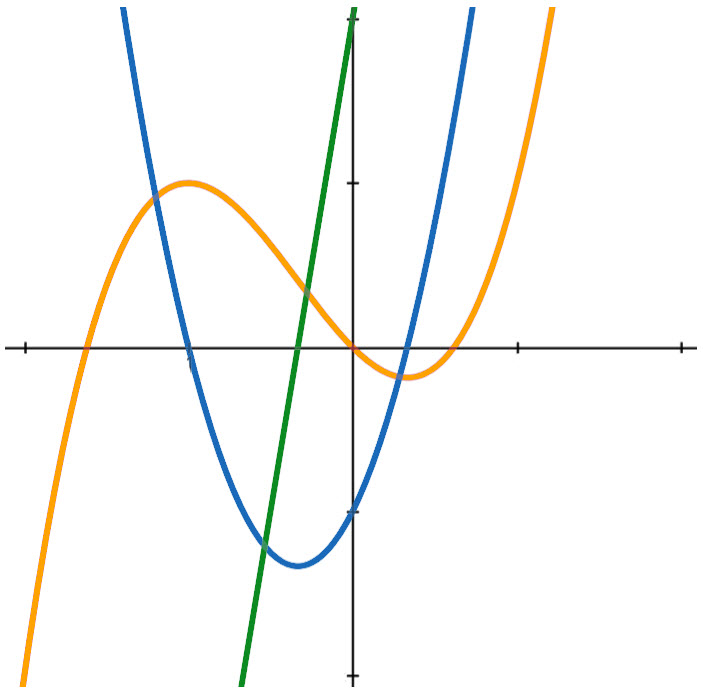
\(\bullet\text{ Graph of f(x), f'(x) and f”(x)}\)
\(\,\,\,\,\,\,\,\,\)
\(\bullet\text{ Newton’s Method}\)
\(\,\,\,\,\,\,\,\,x_{n+1}=x_n – \displaystyle \frac{f(x_n)}{f'(x_n)}\)