

Completing the square rewrites a quadratic equation using a perfect square trinomial. After making the coefficient of \(x^2\) equal to \(1\), add \(\left(\frac{b}{2}\right)^2\) to both sides of the equation. The resulting squared expression can then be solved by taking the square root of both sides.
Problems
Solve by completing the square
\(\textbf{1)}\) \(x^2+10x-24=0\)
The answer is \(x=-12,2\).\(\text{Move the constant to the other side.}\)
\(\,\,\,\,\,x^2+10x=24\)
\(\text{Find }\left(\frac{b}{2}\right)^2.\)
\(\,\,\,\,\,\left(\frac{10}{2}\right)^2=25\)
\(\text{Add }25\text{ to both sides.}\)
\(\,\,\,\,\,x^2+10x+25=24+25\)
\(\,\,\,\,\,(x+5)^2=49\)
\(\text{Take the square root of both sides.}\)
\(\,\,\,\,\,\sqrt{(x+5)^2}=\pm\sqrt{49}\)
\(\,\,\,\,\,x+5=\pm7\)
\(\,\,\,\,\,x=-5\pm7\)
\(\,\,\,\,\,x=-5-7\text{ or }x=-5+7\)
\(\,\,\,\,\,x=-12\text{ or }x=2\)
\(\text{The answer is }x=-12,2.\)

\(\,\,\,\,\,x^2+10x=24\)
\(\text{Find }\left(\frac{b}{2}\right)^2.\)
\(\,\,\,\,\,\left(\frac{10}{2}\right)^2=25\)
\(\text{Add }25\text{ to both sides.}\)
\(\,\,\,\,\,x^2+10x+25=24+25\)
\(\,\,\,\,\,(x+5)^2=49\)
\(\text{Take the square root of both sides.}\)
\(\,\,\,\,\,\sqrt{(x+5)^2}=\pm\sqrt{49}\)
\(\,\,\,\,\,x+5=\pm7\)
\(\,\,\,\,\,x=-5\pm7\)
\(\,\,\,\,\,x=-5-7\text{ or }x=-5+7\)
\(\,\,\,\,\,x=-12\text{ or }x=2\)
\(\text{The answer is }x=-12,2.\)
\(\textbf{2)}\) \(2x^2+7x=4\)
The answer is \(x=-4,\frac{1}{2}\).\(\text{Divide both sides by }2.\)
\(\,\,\,\,\,x^2+\frac{7}{2}x=2\)
\(\text{Find }\left(\frac{b}{2}\right)^2.\)
\(\,\,\,\,\,\left(\frac{\frac{7}{2}}{2}\right)^2=\left(\frac{7}{4}\right)^2=\frac{49}{16}\)
\(\text{Add }\frac{49}{16}\text{ to both sides.}\)
\(\,\,\,\,\,x^2+\frac{7}{2}x+\frac{49}{16}=2+\frac{49}{16}\)
\(\,\,\,\,\,\left(x+\frac{7}{4}\right)^2=\frac{81}{16}\)
\(\text{Take the square root of both sides.}\)
\(\,\,\,\,\,\sqrt{\left(x+\frac{7}{4}\right)^2}=\pm\sqrt{\frac{81}{16}}\)
\(\,\,\,\,\,x+\frac{7}{4}=\pm\frac{9}{4}\)
\(\,\,\,\,\,x=-\frac{7}{4}\pm\frac{9}{4}\)
\(\,\,\,\,\,x=-4\text{ or }x=\frac{1}{2}\)
\(\text{The answer is }x=-4,\frac{1}{2}.\)
\(\,\,\,\,\,x^2+\frac{7}{2}x=2\)
\(\text{Find }\left(\frac{b}{2}\right)^2.\)
\(\,\,\,\,\,\left(\frac{\frac{7}{2}}{2}\right)^2=\left(\frac{7}{4}\right)^2=\frac{49}{16}\)
\(\text{Add }\frac{49}{16}\text{ to both sides.}\)
\(\,\,\,\,\,x^2+\frac{7}{2}x+\frac{49}{16}=2+\frac{49}{16}\)
\(\,\,\,\,\,\left(x+\frac{7}{4}\right)^2=\frac{81}{16}\)
\(\text{Take the square root of both sides.}\)
\(\,\,\,\,\,\sqrt{\left(x+\frac{7}{4}\right)^2}=\pm\sqrt{\frac{81}{16}}\)
\(\,\,\,\,\,x+\frac{7}{4}=\pm\frac{9}{4}\)
\(\,\,\,\,\,x=-\frac{7}{4}\pm\frac{9}{4}\)
\(\,\,\,\,\,x=-4\text{ or }x=\frac{1}{2}\)
\(\text{The answer is }x=-4,\frac{1}{2}.\)
\(\textbf{3)}\) \(x^2-6x+8=0\)
The answer is \(x=2,4\).\(\text{Move the constant to the other side.}\)
\(\,\,\,\,\,x^2-6x=-8\)
\(\text{Find }\left(\frac{b}{2}\right)^2.\)
\(\,\,\,\,\,\left(\frac{-6}{2}\right)^2=(-3)^2=9\)
\(\text{Add }9\text{ to both sides.}\)
\(\,\,\,\,\,x^2-6x+9=-8+9\)
\(\,\,\,\,\,(x-3)^2=1\)
\(\text{Take the square root of both sides.}\)
\(\,\,\,\,\,\sqrt{(x-3)^2}=\pm\sqrt{1}\)
\(\,\,\,\,\,x-3=\pm1\)
\(\,\,\,\,\,x=3\pm1\)
\(\,\,\,\,\,x=2\text{ or }x=4\)
\(\text{The answer is }x=2,4.\)
\(\,\,\,\,\,x^2-6x=-8\)
\(\text{Find }\left(\frac{b}{2}\right)^2.\)
\(\,\,\,\,\,\left(\frac{-6}{2}\right)^2=(-3)^2=9\)
\(\text{Add }9\text{ to both sides.}\)
\(\,\,\,\,\,x^2-6x+9=-8+9\)
\(\,\,\,\,\,(x-3)^2=1\)
\(\text{Take the square root of both sides.}\)
\(\,\,\,\,\,\sqrt{(x-3)^2}=\pm\sqrt{1}\)
\(\,\,\,\,\,x-3=\pm1\)
\(\,\,\,\,\,x=3\pm1\)
\(\,\,\,\,\,x=2\text{ or }x=4\)
\(\text{The answer is }x=2,4.\)
\(\textbf{4)}\) \(x^2+5x+6=0\)
The answer is \(x=-3,-2\).\(\text{Move the constant to the other side.}\)
\(\,\,\,\,\,x^2+5x=-6\)
\(\text{Find }\left(\frac{b}{2}\right)^2.\)
\(\,\,\,\,\,\left(\frac{5}{2}\right)^2=\frac{25}{4}\)
\(\text{Add }\frac{25}{4}\text{ to both sides.}\)
\(\,\,\,\,\,x^2+5x+\frac{25}{4}=-6+\frac{25}{4}\)
\(\,\,\,\,\,\left(x+\frac{5}{2}\right)^2=\frac{1}{4}\)
\(\text{Take the square root of both sides.}\)
\(\,\,\,\,\,\sqrt{\left(x+\frac{5}{2}\right)^2}=\pm\sqrt{\frac{1}{4}}\)
\(\,\,\,\,\,x+\frac{5}{2}=\pm\frac{1}{2}\)
\(\,\,\,\,\,x=-\frac{5}{2}\pm\frac{1}{2}\)
\(\,\,\,\,\,x=-3\text{ or }x=-2\)
\(\text{The answer is }x=-3,-2.\)
\(\,\,\,\,\,x^2+5x=-6\)
\(\text{Find }\left(\frac{b}{2}\right)^2.\)
\(\,\,\,\,\,\left(\frac{5}{2}\right)^2=\frac{25}{4}\)
\(\text{Add }\frac{25}{4}\text{ to both sides.}\)
\(\,\,\,\,\,x^2+5x+\frac{25}{4}=-6+\frac{25}{4}\)
\(\,\,\,\,\,\left(x+\frac{5}{2}\right)^2=\frac{1}{4}\)
\(\text{Take the square root of both sides.}\)
\(\,\,\,\,\,\sqrt{\left(x+\frac{5}{2}\right)^2}=\pm\sqrt{\frac{1}{4}}\)
\(\,\,\,\,\,x+\frac{5}{2}=\pm\frac{1}{2}\)
\(\,\,\,\,\,x=-\frac{5}{2}\pm\frac{1}{2}\)
\(\,\,\,\,\,x=-3\text{ or }x=-2\)
\(\text{The answer is }x=-3,-2.\)
\(\textbf{5)}\) \(x^2-6x+8=0\)
The answer is \(x=2,4\).\(\text{Move the constant to the other side.}\)
\(\,\,\,\,\,x^2-6x=-8\)
\(\text{Find }\left(\frac{b}{2}\right)^2.\)
\(\,\,\,\,\,\left(\frac{-6}{2}\right)^2=9\)
\(\text{Add }9\text{ to both sides.}\)
\(\,\,\,\,\,x^2-6x+9=-8+9\)
\(\,\,\,\,\,(x-3)^2=1\)
\(\text{Take the square root of both sides.}\)
\(\,\,\,\,\,\sqrt{(x-3)^2}=\pm\sqrt{1}\)
\(\,\,\,\,\,x-3=\pm1\)
\(\,\,\,\,\,x=3\pm1\)
\(\,\,\,\,\,x=2\text{ or }x=4\)
\(\text{The answer is }x=2,4.\)
\(\,\,\,\,\,x^2-6x=-8\)
\(\text{Find }\left(\frac{b}{2}\right)^2.\)
\(\,\,\,\,\,\left(\frac{-6}{2}\right)^2=9\)
\(\text{Add }9\text{ to both sides.}\)
\(\,\,\,\,\,x^2-6x+9=-8+9\)
\(\,\,\,\,\,(x-3)^2=1\)
\(\text{Take the square root of both sides.}\)
\(\,\,\,\,\,\sqrt{(x-3)^2}=\pm\sqrt{1}\)
\(\,\,\,\,\,x-3=\pm1\)
\(\,\,\,\,\,x=3\pm1\)
\(\,\,\,\,\,x=2\text{ or }x=4\)
\(\text{The answer is }x=2,4.\)
\(\textbf{6)}\) \(x^2-8x=20\)
The answer is \(x=-2,10\).\(\text{Find }\left(\frac{b}{2}\right)^2.\)
\(\,\,\,\,\,\left(\frac{-8}{2}\right)^2=(-4)^2=16\)
\(\text{Add }16\text{ to both sides.}\)
\(\,\,\,\,\,x^2-8x+16=20+16\)
\(\,\,\,\,\,(x-4)^2=36\)
\(\text{Take the square root of both sides.}\)
\(\,\,\,\,\,\sqrt{(x-4)^2}=\pm\sqrt{36}\)
\(\,\,\,\,\,x-4=\pm6\)
\(\,\,\,\,\,x=4\pm6\)
\(\,\,\,\,\,x=-2\text{ or }x=10\)
\(\text{The answer is }x=-2,10.\)
\(\,\,\,\,\,\left(\frac{-8}{2}\right)^2=(-4)^2=16\)
\(\text{Add }16\text{ to both sides.}\)
\(\,\,\,\,\,x^2-8x+16=20+16\)
\(\,\,\,\,\,(x-4)^2=36\)
\(\text{Take the square root of both sides.}\)
\(\,\,\,\,\,\sqrt{(x-4)^2}=\pm\sqrt{36}\)
\(\,\,\,\,\,x-4=\pm6\)
\(\,\,\,\,\,x=4\pm6\)
\(\,\,\,\,\,x=-2\text{ or }x=10\)
\(\text{The answer is }x=-2,10.\)
\(\textbf{7)}\) \(x^2-4x-1=0\)
The answer is \(x=2+\sqrt{5},2-\sqrt{5}\).\(\text{Move the constant to the other side.}\)
\(\,\,\,\,\,x^2-4x=1\)
\(\text{Find }\left(\frac{b}{2}\right)^2.\)
\(\,\,\,\,\,\left(\frac{-4}{2}\right)^2=(-2)^2=4\)
\(\text{Add }4\text{ to both sides.}\)
\(\,\,\,\,\,x^2-4x+4=1+4\)
\(\,\,\,\,\,(x-2)^2=5\)
\(\text{Take the square root of both sides.}\)
\(\,\,\,\,\,\sqrt{(x-2)^2}=\pm\sqrt{5}\)
\(\,\,\,\,\,x-2=\pm\sqrt{5}\)
\(\,\,\,\,\,x=2\pm\sqrt{5}\)
\(\text{The answer is }x=2+\sqrt{5},2-\sqrt{5}.\)
\(\,\,\,\,\,x^2-4x=1\)
\(\text{Find }\left(\frac{b}{2}\right)^2.\)
\(\,\,\,\,\,\left(\frac{-4}{2}\right)^2=(-2)^2=4\)
\(\text{Add }4\text{ to both sides.}\)
\(\,\,\,\,\,x^2-4x+4=1+4\)
\(\,\,\,\,\,(x-2)^2=5\)
\(\text{Take the square root of both sides.}\)
\(\,\,\,\,\,\sqrt{(x-2)^2}=\pm\sqrt{5}\)
\(\,\,\,\,\,x-2=\pm\sqrt{5}\)
\(\,\,\,\,\,x=2\pm\sqrt{5}\)
\(\text{The answer is }x=2+\sqrt{5},2-\sqrt{5}.\)
\(\textbf{8)}\) \(x^2+6x+2=0\)
The answer is \(x=-3+\sqrt{7},-3-\sqrt{7}\).\(\text{Move the constant to the other side.}\)
\(\,\,\,\,\,x^2+6x=-2\)
\(\text{Find }\left(\frac{b}{2}\right)^2.\)
\(\,\,\,\,\,\left(\frac{6}{2}\right)^2=3^2=9\)
\(\text{Add }9\text{ to both sides.}\)
\(\,\,\,\,\,x^2+6x+9=-2+9\)
\(\,\,\,\,\,(x+3)^2=7\)
\(\text{Take the square root of both sides.}\)
\(\,\,\,\,\,\sqrt{(x+3)^2}=\pm\sqrt{7}\)
\(\,\,\,\,\,x+3=\pm\sqrt{7}\)
\(\,\,\,\,\,x=-3\pm\sqrt{7}\)
\(\text{The answer is }x=-3+\sqrt{7},-3-\sqrt{7}.\)
\(\,\,\,\,\,x^2+6x=-2\)
\(\text{Find }\left(\frac{b}{2}\right)^2.\)
\(\,\,\,\,\,\left(\frac{6}{2}\right)^2=3^2=9\)
\(\text{Add }9\text{ to both sides.}\)
\(\,\,\,\,\,x^2+6x+9=-2+9\)
\(\,\,\,\,\,(x+3)^2=7\)
\(\text{Take the square root of both sides.}\)
\(\,\,\,\,\,\sqrt{(x+3)^2}=\pm\sqrt{7}\)
\(\,\,\,\,\,x+3=\pm\sqrt{7}\)
\(\,\,\,\,\,x=-3\pm\sqrt{7}\)
\(\text{The answer is }x=-3+\sqrt{7},-3-\sqrt{7}.\)
\(\textbf{9)}\) \(x^2-2x-3=0\)
The answer is \(x=3,-1\).\(\text{Move the constant to the other side.}\)
\(\,\,\,\,\,x^2-2x=3\)
\(\text{Find }\left(\frac{b}{2}\right)^2.\)
\(\,\,\,\,\,\left(\frac{-2}{2}\right)^2=(-1)^2=1\)
\(\text{Add }1\text{ to both sides.}\)
\(\,\,\,\,\,x^2-2x+1=3+1\)
\(\,\,\,\,\,(x-1)^2=4\)
\(\text{Take the square root of both sides.}\)
\(\,\,\,\,\,\sqrt{(x-1)^2}=\pm\sqrt{4}\)
\(\,\,\,\,\,x-1=\pm2\)
\(\,\,\,\,\,x=1\pm2\)
\(\,\,\,\,\,x=3\text{ or }x=-1\)
\(\text{The answer is }x=3,-1.\)
\(\,\,\,\,\,x^2-2x=3\)
\(\text{Find }\left(\frac{b}{2}\right)^2.\)
\(\,\,\,\,\,\left(\frac{-2}{2}\right)^2=(-1)^2=1\)
\(\text{Add }1\text{ to both sides.}\)
\(\,\,\,\,\,x^2-2x+1=3+1\)
\(\,\,\,\,\,(x-1)^2=4\)
\(\text{Take the square root of both sides.}\)
\(\,\,\,\,\,\sqrt{(x-1)^2}=\pm\sqrt{4}\)
\(\,\,\,\,\,x-1=\pm2\)
\(\,\,\,\,\,x=1\pm2\)
\(\,\,\,\,\,x=3\text{ or }x=-1\)
\(\text{The answer is }x=3,-1.\)
\(\textbf{10)}\) \(x^2+4x-12=0\)
The answer is \(x=2,-6\).\(\text{Move the constant to the other side.}\)
\(\,\,\,\,\,x^2+4x=12\)
\(\text{Find }\left(\frac{b}{2}\right)^2.\)
\(\,\,\,\,\,\left(\frac{4}{2}\right)^2=2^2=4\)
\(\text{Add }4\text{ to both sides.}\)
\(\,\,\,\,\,x^2+4x+4=12+4\)
\(\,\,\,\,\,(x+2)^2=16\)
\(\text{Take the square root of both sides.}\)
\(\,\,\,\,\,\sqrt{(x+2)^2}=\pm\sqrt{16}\)
\(\,\,\,\,\,x+2=\pm4\)
\(\,\,\,\,\,x=-2\pm4\)
\(\,\,\,\,\,x=2\text{ or }x=-6\)
\(\text{The answer is }x=2,-6.\)
\(\,\,\,\,\,x^2+4x=12\)
\(\text{Find }\left(\frac{b}{2}\right)^2.\)
\(\,\,\,\,\,\left(\frac{4}{2}\right)^2=2^2=4\)
\(\text{Add }4\text{ to both sides.}\)
\(\,\,\,\,\,x^2+4x+4=12+4\)
\(\,\,\,\,\,(x+2)^2=16\)
\(\text{Take the square root of both sides.}\)
\(\,\,\,\,\,\sqrt{(x+2)^2}=\pm\sqrt{16}\)
\(\,\,\,\,\,x+2=\pm4\)
\(\,\,\,\,\,x=-2\pm4\)
\(\,\,\,\,\,x=2\text{ or }x=-6\)
\(\text{The answer is }x=2,-6.\)
\(\textbf{11)}\) \(x^2+8x+1=0\)
The answer is \(x=-4+\sqrt{15},-4-\sqrt{15}\).\(\text{Move the constant to the other side.}\)
\(\,\,\,\,\,x^2+8x=-1\)
\(\text{Find }\left(\frac{b}{2}\right)^2.\)
\(\,\,\,\,\,\left(\frac{8}{2}\right)^2=4^2=16\)
\(\text{Add }16\text{ to both sides.}\)
\(\,\,\,\,\,x^2+8x+16=-1+16\)
\(\,\,\,\,\,(x+4)^2=15\)
\(\text{Take the square root of both sides.}\)
\(\,\,\,\,\,\sqrt{(x+4)^2}=\pm\sqrt{15}\)
\(\,\,\,\,\,x+4=\pm\sqrt{15}\)
\(\,\,\,\,\,x=-4\pm\sqrt{15}\)
\(\text{The answer is }x=-4+\sqrt{15},-4-\sqrt{15}.\)
\(\,\,\,\,\,x^2+8x=-1\)
\(\text{Find }\left(\frac{b}{2}\right)^2.\)
\(\,\,\,\,\,\left(\frac{8}{2}\right)^2=4^2=16\)
\(\text{Add }16\text{ to both sides.}\)
\(\,\,\,\,\,x^2+8x+16=-1+16\)
\(\,\,\,\,\,(x+4)^2=15\)
\(\text{Take the square root of both sides.}\)
\(\,\,\,\,\,\sqrt{(x+4)^2}=\pm\sqrt{15}\)
\(\,\,\,\,\,x+4=\pm\sqrt{15}\)
\(\,\,\,\,\,x=-4\pm\sqrt{15}\)
\(\text{The answer is }x=-4+\sqrt{15},-4-\sqrt{15}.\)
\(\textbf{12)}\) \(x^2-10x+7=0\)
The answer is \(x=5+3\sqrt{2},5-3\sqrt{2}\).\(\text{Move the constant to the other side.}\)
\(\,\,\,\,\,x^2-10x=-7\)
\(\text{Find }\left(\frac{b}{2}\right)^2.\)
\(\,\,\,\,\,\left(\frac{-10}{2}\right)^2=(-5)^2=25\)
\(\text{Add }25\text{ to both sides.}\)
\(\,\,\,\,\,x^2-10x+25=-7+25\)
\(\,\,\,\,\,(x-5)^2=18\)
\(\text{Take the square root of both sides.}\)
\(\,\,\,\,\,\sqrt{(x-5)^2}=\pm\sqrt{18}\)
\(\,\,\,\,\,x-5=\pm3\sqrt{2}\)
\(\,\,\,\,\,x=5\pm3\sqrt{2}\)
\(\text{The answer is }x=5+3\sqrt{2},5-3\sqrt{2}.\)
\(\,\,\,\,\,x^2-10x=-7\)
\(\text{Find }\left(\frac{b}{2}\right)^2.\)
\(\,\,\,\,\,\left(\frac{-10}{2}\right)^2=(-5)^2=25\)
\(\text{Add }25\text{ to both sides.}\)
\(\,\,\,\,\,x^2-10x+25=-7+25\)
\(\,\,\,\,\,(x-5)^2=18\)
\(\text{Take the square root of both sides.}\)
\(\,\,\,\,\,\sqrt{(x-5)^2}=\pm\sqrt{18}\)
\(\,\,\,\,\,x-5=\pm3\sqrt{2}\)
\(\,\,\,\,\,x=5\pm3\sqrt{2}\)
\(\text{The answer is }x=5+3\sqrt{2},5-3\sqrt{2}.\)
\(\textbf{13)}\) \(3x^2+12x-15=0\)
The answer is \(x=1,-5\).\(\text{Divide every term by }3.\)
\(\,\,\,\,\,x^2+4x-5=0\)
\(\text{Move the constant to the other side.}\)
\(\,\,\,\,\,x^2+4x=5\)
\(\text{Find }\left(\frac{b}{2}\right)^2.\)
\(\,\,\,\,\,\left(\frac{4}{2}\right)^2=4\)
\(\text{Add }4\text{ to both sides.}\)
\(\,\,\,\,\,x^2+4x+4=5+4\)
\(\,\,\,\,\,(x+2)^2=9\)
\(\text{Take the square root of both sides.}\)
\(\,\,\,\,\,\sqrt{(x+2)^2}=\pm\sqrt{9}\)
\(\,\,\,\,\,x+2=\pm3\)
\(\,\,\,\,\,x=-2\pm3\)
\(\,\,\,\,\,x=1\text{ or }x=-5\)
\(\text{The answer is }x=1,-5.\)
\(\,\,\,\,\,x^2+4x-5=0\)
\(\text{Move the constant to the other side.}\)
\(\,\,\,\,\,x^2+4x=5\)
\(\text{Find }\left(\frac{b}{2}\right)^2.\)
\(\,\,\,\,\,\left(\frac{4}{2}\right)^2=4\)
\(\text{Add }4\text{ to both sides.}\)
\(\,\,\,\,\,x^2+4x+4=5+4\)
\(\,\,\,\,\,(x+2)^2=9\)
\(\text{Take the square root of both sides.}\)
\(\,\,\,\,\,\sqrt{(x+2)^2}=\pm\sqrt{9}\)
\(\,\,\,\,\,x+2=\pm3\)
\(\,\,\,\,\,x=-2\pm3\)
\(\,\,\,\,\,x=1\text{ or }x=-5\)
\(\text{The answer is }x=1,-5.\)
\(\textbf{14)}\) \(4x^2-8x-3=0\)
The answer is \(x=1+\frac{\sqrt{7}}{2},1-\frac{\sqrt{7}}{2}\).\(\text{Move the constant to the other side.}\)
\(\,\,\,\,\,4x^2-8x=3\)
\(\text{Divide both sides by }4.\)
\(\,\,\,\,\,x^2-2x=\frac{3}{4}\)
\(\text{Find }\left(\frac{b}{2}\right)^2.\)
\(\,\,\,\,\,\left(\frac{-2}{2}\right)^2=1\)
\(\text{Add }1\text{ to both sides.}\)
\(\,\,\,\,\,x^2-2x+1=\frac{3}{4}+1\)
\(\,\,\,\,\,(x-1)^2=\frac{7}{4}\)
\(\text{Take the square root of both sides.}\)
\(\,\,\,\,\,\sqrt{(x-1)^2}=\pm\sqrt{\frac{7}{4}}\)
\(\,\,\,\,\,x-1=\pm\frac{\sqrt{7}}{2}\)
\(\,\,\,\,\,x=1\pm\frac{\sqrt{7}}{2}\)
\(\text{The answer is }x=1+\frac{\sqrt{7}}{2},1-\frac{\sqrt{7}}{2}.\)
\(\,\,\,\,\,4x^2-8x=3\)
\(\text{Divide both sides by }4.\)
\(\,\,\,\,\,x^2-2x=\frac{3}{4}\)
\(\text{Find }\left(\frac{b}{2}\right)^2.\)
\(\,\,\,\,\,\left(\frac{-2}{2}\right)^2=1\)
\(\text{Add }1\text{ to both sides.}\)
\(\,\,\,\,\,x^2-2x+1=\frac{3}{4}+1\)
\(\,\,\,\,\,(x-1)^2=\frac{7}{4}\)
\(\text{Take the square root of both sides.}\)
\(\,\,\,\,\,\sqrt{(x-1)^2}=\pm\sqrt{\frac{7}{4}}\)
\(\,\,\,\,\,x-1=\pm\frac{\sqrt{7}}{2}\)
\(\,\,\,\,\,x=1\pm\frac{\sqrt{7}}{2}\)
\(\text{The answer is }x=1+\frac{\sqrt{7}}{2},1-\frac{\sqrt{7}}{2}.\)
\(\textbf{15)}\) \(2x^2-5x-3=0\)
The answer is \(x=3,-\frac{1}{2}\).\(\text{Move the constant to the other side.}\)
\(\,\,\,\,\,2x^2-5x=3\)
\(\text{Divide both sides by }2.\)
\(\,\,\,\,\,x^2-\frac{5}{2}x=\frac{3}{2}\)
\(\text{Find }\left(\frac{b}{2}\right)^2.\)
\(\,\,\,\,\,\left(\frac{-\frac{5}{2}}{2}\right)^2=\left(-\frac{5}{4}\right)^2=\frac{25}{16}\)
\(\text{Add }\frac{25}{16}\text{ to both sides.}\)
\(\,\,\,\,\,x^2-\frac{5}{2}x+\frac{25}{16}=\frac{3}{2}+\frac{25}{16}\)
\(\,\,\,\,\,\left(x-\frac{5}{4}\right)^2=\frac{49}{16}\)
\(\text{Take the square root of both sides.}\)
\(\,\,\,\,\,\sqrt{\left(x-\frac{5}{4}\right)^2}=\pm\sqrt{\frac{49}{16}}\)
\(\,\,\,\,\,x-\frac{5}{4}=\pm\frac{7}{4}\)
\(\,\,\,\,\,x=\frac{5}{4}\pm\frac{7}{4}\)
\(\,\,\,\,\,x=3\text{ or }x=-\frac{1}{2}\)
\(\text{The answer is }x=3,-\frac{1}{2}.\)
\(\,\,\,\,\,2x^2-5x=3\)
\(\text{Divide both sides by }2.\)
\(\,\,\,\,\,x^2-\frac{5}{2}x=\frac{3}{2}\)
\(\text{Find }\left(\frac{b}{2}\right)^2.\)
\(\,\,\,\,\,\left(\frac{-\frac{5}{2}}{2}\right)^2=\left(-\frac{5}{4}\right)^2=\frac{25}{16}\)
\(\text{Add }\frac{25}{16}\text{ to both sides.}\)
\(\,\,\,\,\,x^2-\frac{5}{2}x+\frac{25}{16}=\frac{3}{2}+\frac{25}{16}\)
\(\,\,\,\,\,\left(x-\frac{5}{4}\right)^2=\frac{49}{16}\)
\(\text{Take the square root of both sides.}\)
\(\,\,\,\,\,\sqrt{\left(x-\frac{5}{4}\right)^2}=\pm\sqrt{\frac{49}{16}}\)
\(\,\,\,\,\,x-\frac{5}{4}=\pm\frac{7}{4}\)
\(\,\,\,\,\,x=\frac{5}{4}\pm\frac{7}{4}\)
\(\,\,\,\,\,x=3\text{ or }x=-\frac{1}{2}\)
\(\text{The answer is }x=3,-\frac{1}{2}.\)
\(\textbf{16)}\) \(x^2+12x+36=0\)
The answer is \(x=-6\).\(\text{Move the constant to the other side.}\)
\(\,\,\,\,\,x^2+12x=-36\)
\(\text{Find }\left(\frac{b}{2}\right)^2.\)
\(\,\,\,\,\,\left(\frac{12}{2}\right)^2=6^2=36\)
\(\text{Add }36\text{ to both sides.}\)
\(\,\,\,\,\,x^2+12x+36=-36+36\)
\(\,\,\,\,\,(x+6)^2=0\)
\(\text{Take the square root of both sides.}\)
\(\,\,\,\,\,\sqrt{(x+6)^2}=\pm\sqrt{0}\)
\(\,\,\,\,\,x+6=0\)
\(\,\,\,\,\,x=-6\)
\(\text{The equation has one repeated solution: }x=-6.\)
\(\,\,\,\,\,x^2+12x=-36\)
\(\text{Find }\left(\frac{b}{2}\right)^2.\)
\(\,\,\,\,\,\left(\frac{12}{2}\right)^2=6^2=36\)
\(\text{Add }36\text{ to both sides.}\)
\(\,\,\,\,\,x^2+12x+36=-36+36\)
\(\,\,\,\,\,(x+6)^2=0\)
\(\text{Take the square root of both sides.}\)
\(\,\,\,\,\,\sqrt{(x+6)^2}=\pm\sqrt{0}\)
\(\,\,\,\,\,x+6=0\)
\(\,\,\,\,\,x=-6\)
\(\text{The equation has one repeated solution: }x=-6.\)
\(\textbf{17)}\) \(x^2+2x+10=0\)
The answer is \(x=-1+3i,-1-3i\).\(\text{Move the constant to the other side.}\)
\(\,\,\,\,\,x^2+2x=-10\)
\(\text{Find }\left(\frac{b}{2}\right)^2.\)
\(\,\,\,\,\,\left(\frac{2}{2}\right)^2=1\)
\(\text{Add }1\text{ to both sides.}\)
\(\,\,\,\,\,x^2+2x+1=-10+1\)
\(\,\,\,\,\,(x+1)^2=-9\)
\(\text{Take the square root of both sides.}\)
\(\,\,\,\,\,\sqrt{(x+1)^2}=\pm\sqrt{-9}\)
\(\,\,\,\,\,x+1=\pm3i\)
\(\,\,\,\,\,x=-1\pm3i\)
\(\text{The answer is }x=-1+3i,-1-3i.\)
\(\,\,\,\,\,x^2+2x=-10\)
\(\text{Find }\left(\frac{b}{2}\right)^2.\)
\(\,\,\,\,\,\left(\frac{2}{2}\right)^2=1\)
\(\text{Add }1\text{ to both sides.}\)
\(\,\,\,\,\,x^2+2x+1=-10+1\)
\(\,\,\,\,\,(x+1)^2=-9\)
\(\text{Take the square root of both sides.}\)
\(\,\,\,\,\,\sqrt{(x+1)^2}=\pm\sqrt{-9}\)
\(\,\,\,\,\,x+1=\pm3i\)
\(\,\,\,\,\,x=-1\pm3i\)
\(\text{The answer is }x=-1+3i,-1-3i.\)
\(\textbf{18)}\) \(5x^2+10x+1=0\)
The answer is \(x=-1+\frac{2\sqrt{5}}{5},-1-\frac{2\sqrt{5}}{5}\).\(\text{Move the constant to the other side.}\)
\(\,\,\,\,\,5x^2+10x=-1\)
\(\text{Divide both sides by }5.\)
\(\,\,\,\,\,x^2+2x=-\frac{1}{5}\)
\(\text{Find }\left(\frac{b}{2}\right)^2.\)
\(\,\,\,\,\,\left(\frac{2}{2}\right)^2=1\)
\(\text{Add }1\text{ to both sides.}\)
\(\,\,\,\,\,x^2+2x+1=-\frac{1}{5}+1\)
\(\,\,\,\,\,(x+1)^2=\frac{4}{5}\)
\(\text{Take the square root of both sides.}\)
\(\,\,\,\,\,\sqrt{(x+1)^2}=\pm\sqrt{\frac{4}{5}}\)
\(\,\,\,\,\,x+1=\pm\frac{2\sqrt{5}}{5}\)
\(\,\,\,\,\,x=-1\pm\frac{2\sqrt{5}}{5}\)
\(\text{The answer is }x=-1+\frac{2\sqrt{5}}{5},-1-\frac{2\sqrt{5}}{5}.\)
\(\,\,\,\,\,5x^2+10x=-1\)
\(\text{Divide both sides by }5.\)
\(\,\,\,\,\,x^2+2x=-\frac{1}{5}\)
\(\text{Find }\left(\frac{b}{2}\right)^2.\)
\(\,\,\,\,\,\left(\frac{2}{2}\right)^2=1\)
\(\text{Add }1\text{ to both sides.}\)
\(\,\,\,\,\,x^2+2x+1=-\frac{1}{5}+1\)
\(\,\,\,\,\,(x+1)^2=\frac{4}{5}\)
\(\text{Take the square root of both sides.}\)
\(\,\,\,\,\,\sqrt{(x+1)^2}=\pm\sqrt{\frac{4}{5}}\)
\(\,\,\,\,\,x+1=\pm\frac{2\sqrt{5}}{5}\)
\(\,\,\,\,\,x=-1\pm\frac{2\sqrt{5}}{5}\)
\(\text{The answer is }x=-1+\frac{2\sqrt{5}}{5},-1-\frac{2\sqrt{5}}{5}.\)
\(\textbf{19)}\) \(x^2-\frac{3}{2}x-\frac{5}{2}=0\)
The answer is \(x=\frac{5}{2},-1\).\(\text{Move the constant to the other side.}\)
\(\,\,\,\,\,x^2-\frac{3}{2}x=\frac{5}{2}\)
\(\text{Find }\left(\frac{b}{2}\right)^2.\)
\(\,\,\,\,\,\left(\frac{-\frac{3}{2}}{2}\right)^2=\left(-\frac{3}{4}\right)^2=\frac{9}{16}\)
\(\text{Add }\frac{9}{16}\text{ to both sides.}\)
\(\,\,\,\,\,x^2-\frac{3}{2}x+\frac{9}{16}=\frac{5}{2}+\frac{9}{16}\)
\(\,\,\,\,\,\left(x-\frac{3}{4}\right)^2=\frac{49}{16}\)
\(\text{Take the square root of both sides.}\)
\(\,\,\,\,\,\sqrt{\left(x-\frac{3}{4}\right)^2}=\pm\sqrt{\frac{49}{16}}\)
\(\,\,\,\,\,x-\frac{3}{4}=\pm\frac{7}{4}\)
\(\,\,\,\,\,x=\frac{3}{4}\pm\frac{7}{4}\)
\(\,\,\,\,\,x=\frac{5}{2}\text{ or }x=-1\)
\(\text{The answer is }x=\frac{5}{2},-1.\)
\(\,\,\,\,\,x^2-\frac{3}{2}x=\frac{5}{2}\)
\(\text{Find }\left(\frac{b}{2}\right)^2.\)
\(\,\,\,\,\,\left(\frac{-\frac{3}{2}}{2}\right)^2=\left(-\frac{3}{4}\right)^2=\frac{9}{16}\)
\(\text{Add }\frac{9}{16}\text{ to both sides.}\)
\(\,\,\,\,\,x^2-\frac{3}{2}x+\frac{9}{16}=\frac{5}{2}+\frac{9}{16}\)
\(\,\,\,\,\,\left(x-\frac{3}{4}\right)^2=\frac{49}{16}\)
\(\text{Take the square root of both sides.}\)
\(\,\,\,\,\,\sqrt{\left(x-\frac{3}{4}\right)^2}=\pm\sqrt{\frac{49}{16}}\)
\(\,\,\,\,\,x-\frac{3}{4}=\pm\frac{7}{4}\)
\(\,\,\,\,\,x=\frac{3}{4}\pm\frac{7}{4}\)
\(\,\,\,\,\,x=\frac{5}{2}\text{ or }x=-1\)
\(\text{The answer is }x=\frac{5}{2},-1.\)
\(\textbf{20)}\) \(2x^2+8x+5=0\)
The answer is \(x=-2+\frac{\sqrt{6}}{2},-2-\frac{\sqrt{6}}{2}\).\(\text{Move the constant to the other side.}\)
\(\,\,\,\,\,2x^2+8x=-5\)
\(\text{Divide both sides by }2.\)
\(\,\,\,\,\,x^2+4x=-\frac{5}{2}\)
\(\text{Find }\left(\frac{b}{2}\right)^2.\)
\(\,\,\,\,\,\left(\frac{4}{2}\right)^2=4\)
\(\text{Add }4\text{ to both sides.}\)
\(\,\,\,\,\,x^2+4x+4=-\frac{5}{2}+4\)
\(\,\,\,\,\,(x+2)^2=\frac{3}{2}\)
\(\text{Take the square root of both sides.}\)
\(\,\,\,\,\,\sqrt{(x+2)^2}=\pm\sqrt{\frac{3}{2}}\)
\(\,\,\,\,\,x+2=\pm\frac{\sqrt{6}}{2}\)
\(\,\,\,\,\,x=-2\pm\frac{\sqrt{6}}{2}\)
\(\text{The answer is }x=-2+\frac{\sqrt{6}}{2},-2-\frac{\sqrt{6}}{2}.\)
\(\,\,\,\,\,2x^2+8x=-5\)
\(\text{Divide both sides by }2.\)
\(\,\,\,\,\,x^2+4x=-\frac{5}{2}\)
\(\text{Find }\left(\frac{b}{2}\right)^2.\)
\(\,\,\,\,\,\left(\frac{4}{2}\right)^2=4\)
\(\text{Add }4\text{ to both sides.}\)
\(\,\,\,\,\,x^2+4x+4=-\frac{5}{2}+4\)
\(\,\,\,\,\,(x+2)^2=\frac{3}{2}\)
\(\text{Take the square root of both sides.}\)
\(\,\,\,\,\,\sqrt{(x+2)^2}=\pm\sqrt{\frac{3}{2}}\)
\(\,\,\,\,\,x+2=\pm\frac{\sqrt{6}}{2}\)
\(\,\,\,\,\,x=-2\pm\frac{\sqrt{6}}{2}\)
\(\text{The answer is }x=-2+\frac{\sqrt{6}}{2},-2-\frac{\sqrt{6}}{2}.\)
See Related Pages\(\)
\(\bullet\text{ Adding and Subtracting Polynomials}\)
\(\,\,\,\,\,\,\,\,(4d+7)-(2d-5)…\)
\(\bullet\text{ Multiplying Polynomials}\)
\(\,\,\,\,\,\,\,\,(x+2)(x^2+3x-5)…\)
\(\bullet\text{ Dividing Polynomials}\)
\(\,\,\,\,\,\,\,\,(x^3-8)\div(x-2)…\)
\(\bullet\text{ Dividing Polynomials (Synthetic Division)}\)
\(\,\,\,\,\,\,\,\,(x^3-8)\div(x-2)…\)
\(\bullet\text{ Synthetic Substitution}\)
\(\,\,\,\,\,\,\,\,f(x)=4x^4-3x^2+8x-2…\)
\(\bullet\text{ End Behavior}\)
\(\,\,\,\,\,\,\,\,\text{As }x\rightarrow\infty,\quad f(x)\rightarrow\infty\)
\(\,\,\,\,\,\,\,\,\text{As }x\rightarrow-\infty,\quad f(x)\rightarrow\infty…\)
\(\bullet\text{ Completing the Square}\)
\(\,\,\,\,\,\,\,\,x^2+10x-24=0…\)
\(\bullet\text{ Quadratic Formula and the Discriminant}\)
\(\,\,\,\,\,\,\,\,x=-b\pm\displaystyle\frac{\sqrt{b^2-4ac}}{2a}…\)
\(\bullet\text{ Complex Numbers}\)
\(\,\,\,\,\,\,\,\,i=\sqrt{-1}…\)
\(\bullet\text{ Multiplicity of Roots}\)
\(\,\,\,\,\,\,\,\,\)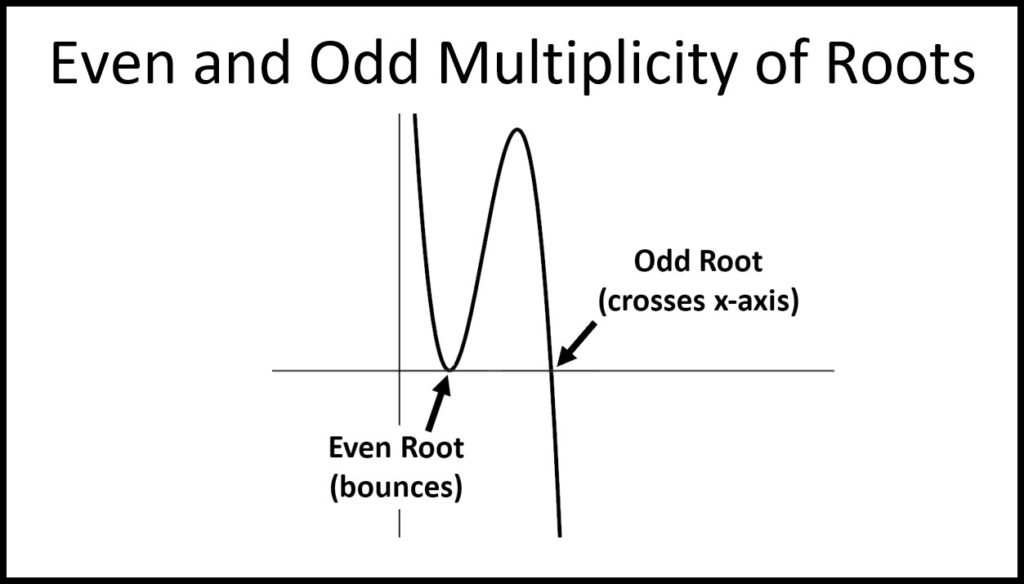 \(…\)
\(…\)
\(\bullet\text{ Rational Zero Theorem}\)
\(\,\,\,\,\,\,\,\,\pm1,\pm2,\pm3,\pm4,\pm6,\pm12…\)
\(\bullet\text{ Descartes Rule of Signs}\)
\(\,\)
\(\bullet\text{ Roots and Zeroes}\)
\(\,\,\,\,\,\,\,\,\text{Solve for }x.\ 3x^2+4x=0…\)
\(\bullet\text{ Linear Factored Form}\)
\(\,\,\,\,\,\,\,\,f(x)=(x+4)(x+1)(x-3)…\)
\(\bullet\text{ Polynomial Inequalities}\)
\(\,\,\,\,\,\,\,\,x^3-4x^2-4x+16\gt0…\)