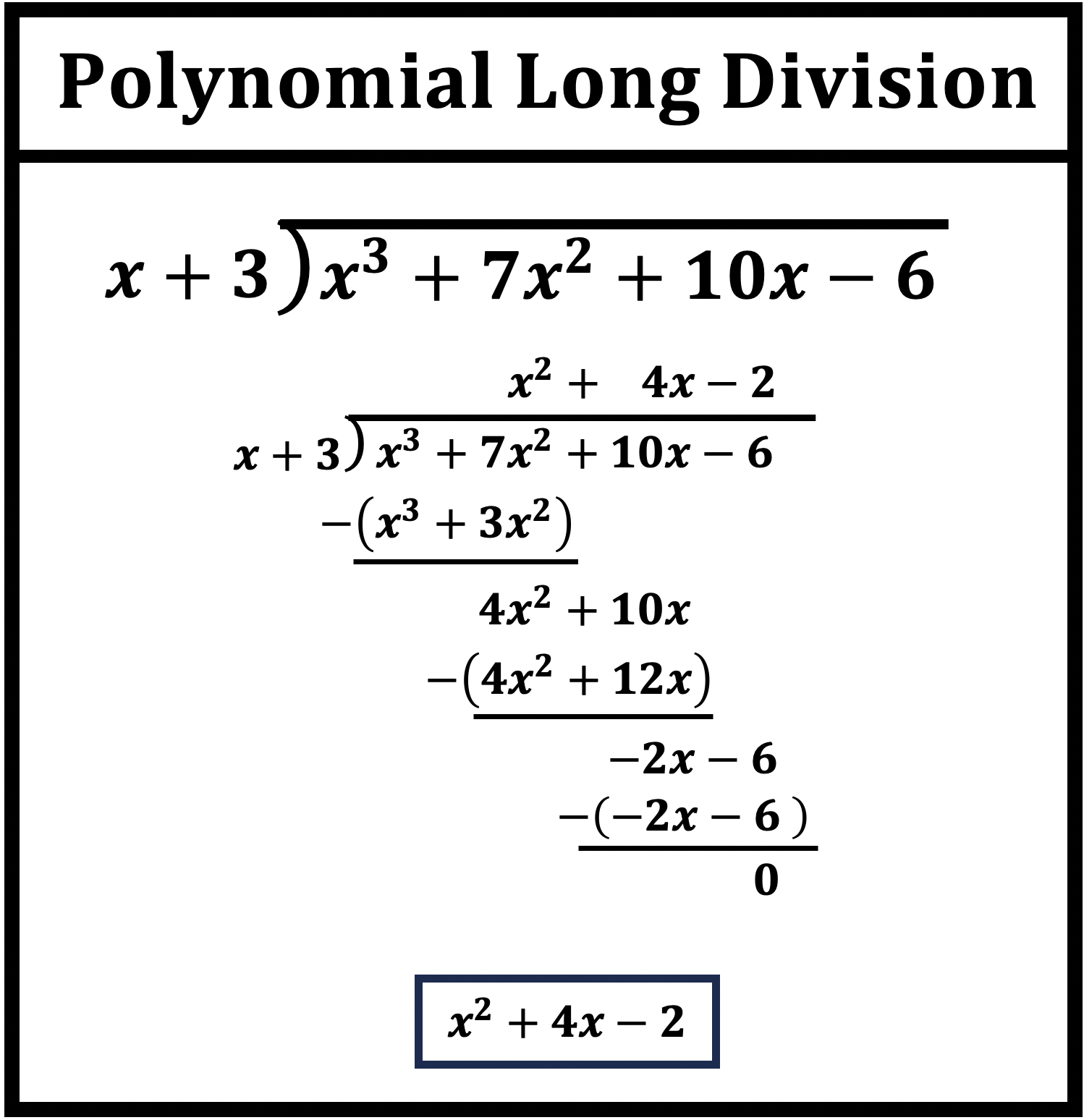

Practice Problems
Divide using long division.
\(\textbf{1)}\) \( \displaystyle\frac{x^3+3x^2-5x+4}{x-2} \)
The answer is \( x^2+5x+5+\displaystyle\frac{14}{x-2} \)
\(\textbf{2)}\) \( (x^3-8)÷(x-2) \)
The answer is \( x^2+2x+4 \)
\(\textbf{3)}\) \( (x^4+2x^3-4x^2+2x-8)÷(x^2-3x+4) \)
The answer is \( x^2+5x+7+\displaystyle\frac{3x-36}{x^2-3x+4} \)
\(\textbf{4)}\) \( (x^4+3x^3+6x^2+3x+5)÷(x^2+1) \) The answer is \( x^2+3x+5 \)
\(\textbf{5)}\) \( \displaystyle\frac{x^3+3x^2-4x+1}{x+3} \) The answer is \( x^2-4+\displaystyle\frac{13}{x+3} \)
\(\textbf{6)}\) \( \displaystyle\frac{x^3+3x^2-4x-6}{x+1} \) The answer is \( x^2+2x-6\)
\(\textbf{7)}\) \( \displaystyle\frac{x^4+2x^2-3x+7}{x-2} \) The answer is \( x^3+2x^2+6x+9+\frac{25}{x-2}\)
\(\textbf{8)}\) \( \displaystyle\frac{x^5+3x^2-x+1}{x+3} \) The answer is \( x^4-3x^3+9x^2-24x+71-\frac{212}{x+3}\)
\(\textbf{9)}\) \( \displaystyle\frac{x^3+5x^2+7x+2}{x+2} \) The answer is \( x^2+3x+1\)
\(\textbf{10)}\) \( \displaystyle\frac{x^6+x^5+x^2+9x+8}{x+1} \) The answer is \( x^5+x+8\)
\(\textbf{11)}\) \( \displaystyle\left(4x^3+x^2+9x+5\right) \div \left(x^2-1\right) \) The answer is \( \displaystyle 4x+1+\frac{13x+6}{x^2-1}\)
Challenge Problems
Identify the divisor for the given dividend, quotient, and remainder.
\(\textbf{12)}\)
\(\,\,\,\,\,\)Dividend: \(4x^3+7x^2+8x-2,\)
\(\,\,\,\,\,\)Quotient: \(4x^2-5x+23,\)
\(\,\,\,\,\,\)Remainder: \(-71\)
The divisor is \( x+3 \)
\(\textbf{13)}\)
\(\,\,\,\,\,\)Dividend: \(2x^3+3x^2-2x+4,\)
\(\,\,\,\,\,\)Quotient: \(2x^2+7x+12,\)
\(\,\,\,\,\,\)Remainder: \(28\)
The divisor is \( x-2 \)
\(\textbf{14)}\)
\(\,\,\,\,\,\)Dividend: \(5x^3-3x^2-2x+1,\)
\(\,\,\,\,\,\)Quotient: \(5x^2-28x+138,\)
\(\,\,\,\,\,\)Remainder: \(-689\)
The divisor is \( x+5 \)
See Related Pages\(\)
\(\bullet \text{ Polynomial Long Division Calculator (Wolfram|Alpha)}\)
\(\bullet\text{ Multiply Monomials}\)
\(\,\,\,\,\,\,\,\,(7m^2 k^5 )(8m^3 k^4 )…\)
\(\bullet\text{ Dividing Monomials}\)
\(\,\,\,\,\,\,\,\,\displaystyle \frac{12x^4 y^3 z}{3x^2 z^4 x}…\)
\(\bullet\text{ Adding and Subtracting Polynomials}\)
\(\,\,\,\,\,\,\,\,(4d+7)−(2d−5)…\)
\(\bullet\text{ Multiplying Polynomials}\)
\(\,\,\,\,\,\,\,\,(x+2)(x^2+3x−5)…\)
\(\bullet\text{ Dividing Polynomials}\)
\(\,\,\,\,\,\,\,\,(x^3-8)÷(x-2)…\)
\(\bullet\text{ Dividing Polynomials (Synthetic Division)}\)
\(\,\,\,\,\,\,\,\,(x^3-8)÷(x-2)…\)
\(\bullet\text{ Synthetic Substitution}\)
\(\,\,\,\,\,\,\,\,f(x)=4x^4−3x^2+8x−2…\)
\(\bullet\text{ End Behavior}\)
\(\,\,\,\,\,\,\,\, \text{As } x\rightarrow \infty, \quad f(x)\rightarrow \infty \)
\(\,\,\,\,\,\,\,\, \text{As } x\rightarrow -\infty, \quad f(x)\rightarrow \infty… \)
\(\bullet\text{ Completing the Square}\)
\(\,\,\,\,\,\,\,\,x^2+10x−24=0…\)
\(\bullet\text{ Quadratic Formula and the Discriminant}\)
\(\,\,\,\,\,\,\,\,x=-b \pm \displaystyle\frac{\sqrt{b^2-4ac}}{2a}…\)
\(\bullet\text{ Complex Numbers}\)
\(\,\,\,\,\,\,\,\,i=\sqrt{-1}…\)
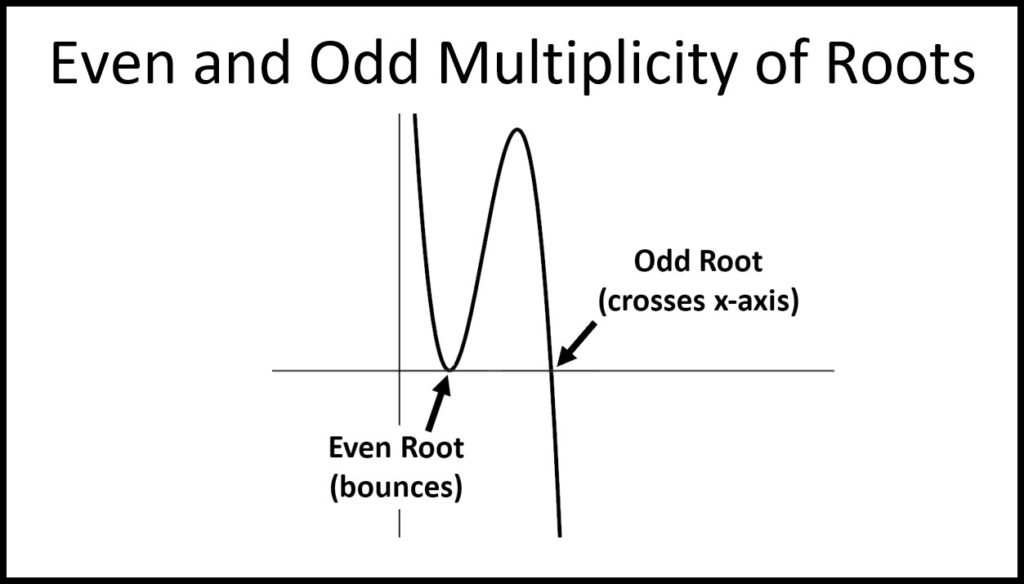
\(\bullet\text{ Multiplicity of Roots}\)
\(\,\,\,\,\,\,\,\,\) \(…\)
\(…\)
\(\bullet\text{ Rational Zero Theorem}\)
\(\,\,\,\,\,\,\,\, \pm 1,\pm 2,\pm 3,\pm 4,\pm 6,\pm 12…\)
\(\bullet\text{ Descartes Rule of Signs}\)
\(\,\)
\(\bullet\text{ Roots and Zeroes}\)
\(\,\,\,\,\,\,\,\,\text{Solve for }x. 3x^2+4x=0…\)
\(\bullet\text{ Linear Factored Form}\)
\(\,\,\,\,\,\,\,\,f(x)=(x+4)(x+1)(x−3)…\)
\(\bullet\text{ Polynomial Inequalities}\)
\(\,\,\,\,\,\,\,\,x^3-4x^2-4x+16 \gt 0…\)
In Summary
Dividing polynomials involves dividing two or more algebraic expressions that consist of multiple terms. This process is also known as polynomial long division. Dividing polynomials is typically taught in an algebra class. In an algebra or pre-algebra class, students learn the basics of working with polynomials, including adding, subtracting, multiplying, and dividing them. These skills are essential for success in higher level math classes, such as geometry, trigonometry, and calculus. In the real world, dividing polynomials is used in a variety of contexts, including engineering, science, and finance.