

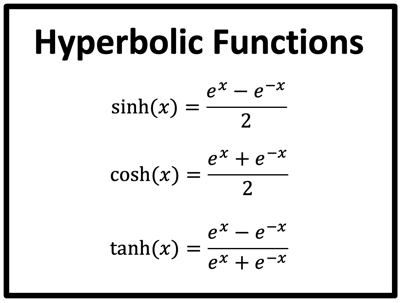
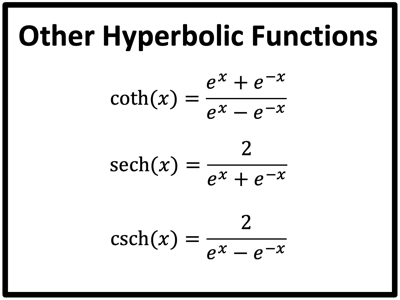
Hyperbolic functions are special functions built from exponential expressions, such as \(\sinh{x}=\frac{e^x-e^{-x}}{2}\) and \(\cosh{x}=\frac{e^x+e^{-x}}{2}\). They have identities, derivatives, and integrals that look similar to trigonometric functions, but they are based on exponential growth and decay. These problems include simplifying hyperbolic expressions, solving hyperbolic equations, evaluating values, checking even and odd symmetry, finding derivatives, and finding integrals.
Notes
Practice Problems
\(\textbf{1)}\) Simplify \(\cosh{x}+\sinh{x}\)
The answer is \( e^x \)
\(\,\,\,\,\,\,\cosh{x}+\sinh{x}\)
\(\,\,\,\,\,\,\displaystyle \frac{1}{2}\left(e^x+e^{-x}\right)+\frac{1}{2}\left(e^x-e^{-x}\right)\)
\(\,\,\,\,\,\,\displaystyle \frac{1}{2}e^x+\frac{1}{2}e^{-x}+\frac{1}{2}e^x-\frac{1}{2}e^{-x}\)
\(\,\,\,\,\,\,\displaystyle \frac{1}{2}e^x+\frac{1}{2}e^x\)
\(\,\,\,\,\,\,\)The answer is \( e^x \)
\(\,\,\,\,\,\,\cosh{x}+\sinh{x}\)
\(\,\,\,\,\,\,\displaystyle \frac{1}{2}\left(e^x+e^{-x}\right)+\frac{1}{2}\left(e^x-e^{-x}\right)\)
\(\,\,\,\,\,\,\displaystyle \frac{1}{2}e^x+\frac{1}{2}e^{-x}+\frac{1}{2}e^x-\frac{1}{2}e^{-x}\)
\(\,\,\,\,\,\,\displaystyle \frac{1}{2}e^x+\frac{1}{2}e^x\)
\(\,\,\,\,\,\,\)The answer is \( e^x \)
\(\textbf{2)}\) Solve for x, \(\sinh{x}=\frac{5}{12}\)
The answer is \( x=\ln{\left(\frac{3}{2}\right)} \)
\(\,\,\,\,\,\,\sinh{x}=\displaystyle \frac{5}{12}\)
\(\,\,\,\,\,\,\displaystyle \frac{1}{2}\left(e^x-e^{-x}\right)=\frac{5}{12}\)
\(\,\,\,\,\,\,\displaystyle e^x-e^{-x}=\frac{5}{6}\)
\(\,\,\,\,\,\,\displaystyle 6e^x-6e^{-x}=5\)
\(\,\,\,\,\,\,\displaystyle 6e^{2x}-6=5e^x\)
\(\,\,\,\,\,\,\displaystyle 6e^{2x}-5e^x-6=0\)
\(\,\,\,\,\,\,\displaystyle \left(2e^x-3\right)\left(3e^x+2\right)=0\)
\(\,\,\,\,\,\,\displaystyle 2e^x-3=0 \text{ or }3e^x+2=0\)
\(\,\,\,\,\,\,\displaystyle e^x=\frac{3}{2} \text{ or }e^x=-\frac{2}{3}\)
\(\,\,\,\,\,\,\displaystyle x=\ln{\left(\frac{3}{2}\right)} \text{ or Not Possible}\)
\(\,\,\,\,\,\,\)The answer is \( \displaystyle x=\ln{\left(\frac{3}{2}\right)} \)
\(\,\,\,\,\,\,\sinh{x}=\displaystyle \frac{5}{12}\)
\(\,\,\,\,\,\,\displaystyle \frac{1}{2}\left(e^x-e^{-x}\right)=\frac{5}{12}\)
\(\,\,\,\,\,\,\displaystyle e^x-e^{-x}=\frac{5}{6}\)
\(\,\,\,\,\,\,\displaystyle 6e^x-6e^{-x}=5\)
\(\,\,\,\,\,\,\displaystyle 6e^{2x}-6=5e^x\)
\(\,\,\,\,\,\,\displaystyle 6e^{2x}-5e^x-6=0\)
\(\,\,\,\,\,\,\displaystyle \left(2e^x-3\right)\left(3e^x+2\right)=0\)
\(\,\,\,\,\,\,\displaystyle 2e^x-3=0 \text{ or }3e^x+2=0\)
\(\,\,\,\,\,\,\displaystyle e^x=\frac{3}{2} \text{ or }e^x=-\frac{2}{3}\)
\(\,\,\,\,\,\,\displaystyle x=\ln{\left(\frac{3}{2}\right)} \text{ or Not Possible}\)
\(\,\,\,\,\,\,\)The answer is \( \displaystyle x=\ln{\left(\frac{3}{2}\right)} \)
\(\textbf{3)}\) Solve for x, \(\cosh{(x)}+5\sinh{(x)}=5\)
The answer is \( x=\ln(2) \)
\(\,\,\,\,\,\,\cosh{(x)}+5\sinh{(x)}=5\)
\(\,\,\,\,\,\,\displaystyle \frac{1}{2}\left(e^x+e^{-x}\right)+5\cdot\frac{1}{2}\left(e^x-e^{-x}\right)=5\)
\(\,\,\,\,\,\,\displaystyle \frac{1}{2}e^x+\frac{1}{2}e^{-x}+\frac{5}{2}e^x-\frac{5}{2}e^{-x}=5\)
\(\,\,\,\,\,\,\displaystyle 3e^x-2e^{-x}=5\)
\(\,\,\,\,\,\,\displaystyle 3e^{2x}-2=5e^x\)
\(\,\,\,\,\,\,\displaystyle 3e^{2x}-5e^x-2=0\)
\(\,\,\,\,\,\,\displaystyle \left(3e^x+1\right)\left(e^x-2\right)=0\)
\(\,\,\,\,\,\,\displaystyle e^x=-\frac{1}{3}\text{ or }e^x=2\)
\(\,\,\,\,\,\,\)The answer is \(x=\ln(2)\)
\(\,\,\,\,\,\,\cosh{(x)}+5\sinh{(x)}=5\)
\(\,\,\,\,\,\,\displaystyle \frac{1}{2}\left(e^x+e^{-x}\right)+5\cdot\frac{1}{2}\left(e^x-e^{-x}\right)=5\)
\(\,\,\,\,\,\,\displaystyle \frac{1}{2}e^x+\frac{1}{2}e^{-x}+\frac{5}{2}e^x-\frac{5}{2}e^{-x}=5\)
\(\,\,\,\,\,\,\displaystyle 3e^x-2e^{-x}=5\)
\(\,\,\,\,\,\,\displaystyle 3e^{2x}-2=5e^x\)
\(\,\,\,\,\,\,\displaystyle 3e^{2x}-5e^x-2=0\)
\(\,\,\,\,\,\,\displaystyle \left(3e^x+1\right)\left(e^x-2\right)=0\)
\(\,\,\,\,\,\,\displaystyle e^x=-\frac{1}{3}\text{ or }e^x=2\)
\(\,\,\,\,\,\,\)The answer is \(x=\ln(2)\)
\(\textbf{4)}\) Solve for x, \(5\sinh\left(4x\right)-2\cosh\left(4x\right)=10\)
The answer is \( x= \frac{1}{4}\ln{(7)} \)
\(\,\,\,\,\,\,5\sinh\left(4x\right)-2\cosh\left(4x\right)=10\)
\(\,\,\,\,\,\,\displaystyle 5\cdot\frac{e^{4x}-e^{-4x}}{2}-2\cdot\frac{e^{4x}+e^{-4x}}{2}=10\)
\(\,\,\,\,\,\,\displaystyle \frac{5}{2}e^{4x}-\frac{5}{2}e^{-4x}-e^{4x}-e^{-4x}=10\)
\(\,\,\,\,\,\,\displaystyle \frac{3}{2}e^{4x}-\frac{7}{2}e^{-4x}=10\)
\(\,\,\,\,\,\,\displaystyle 3e^{4x}-7e^{-4x}=20\)
\(\,\,\,\,\,\,\displaystyle 3e^{8x}-7=20e^{4x}\)
\(\,\,\,\,\,\,\displaystyle 3e^{8x}-20e^{4x}-7=0\)
\(\,\,\,\,\,\,\displaystyle \left(3e^{4x}+1\right)\left(e^{4x}-7\right)=0\)
\(\,\,\,\,\,\,\displaystyle e^{4x}=-\frac{1}{3}\text{ or }e^{4x}=7\)
\(\,\,\,\,\,\,\)The answer is \(x=\frac{1}{4}\ln(7)\)
\(\,\,\,\,\,\,5\sinh\left(4x\right)-2\cosh\left(4x\right)=10\)
\(\,\,\,\,\,\,\displaystyle 5\cdot\frac{e^{4x}-e^{-4x}}{2}-2\cdot\frac{e^{4x}+e^{-4x}}{2}=10\)
\(\,\,\,\,\,\,\displaystyle \frac{5}{2}e^{4x}-\frac{5}{2}e^{-4x}-e^{4x}-e^{-4x}=10\)
\(\,\,\,\,\,\,\displaystyle \frac{3}{2}e^{4x}-\frac{7}{2}e^{-4x}=10\)
\(\,\,\,\,\,\,\displaystyle 3e^{4x}-7e^{-4x}=20\)
\(\,\,\,\,\,\,\displaystyle 3e^{8x}-7=20e^{4x}\)
\(\,\,\,\,\,\,\displaystyle 3e^{8x}-20e^{4x}-7=0\)
\(\,\,\,\,\,\,\displaystyle \left(3e^{4x}+1\right)\left(e^{4x}-7\right)=0\)
\(\,\,\,\,\,\,\displaystyle e^{4x}=-\frac{1}{3}\text{ or }e^{4x}=7\)
\(\,\,\,\,\,\,\)The answer is \(x=\frac{1}{4}\ln(7)\)
\(\textbf{5)}\) Find \(\frac{dy}{dx}\) of \(y=6\cosh{(x)}\)
The answer is \( \frac{dy}{dx}= 6 \sinh{(x)} \)
\(\,\,\,\,\,\,y=6\cosh(x)\)
\(\,\,\,\,\,\,\displaystyle \frac{d}{dx}\left[\cosh(x)\right]=\sinh(x)\)
\(\,\,\,\,\,\,\displaystyle \frac{dy}{dx}=6\sinh(x)\)
\(\,\,\,\,\,\,\)The answer is \(\frac{dy}{dx}=6\sinh(x)\)
\(\,\,\,\,\,\,y=6\cosh(x)\)
\(\,\,\,\,\,\,\displaystyle \frac{d}{dx}\left[\cosh(x)\right]=\sinh(x)\)
\(\,\,\,\,\,\,\displaystyle \frac{dy}{dx}=6\sinh(x)\)
\(\,\,\,\,\,\,\)The answer is \(\frac{dy}{dx}=6\sinh(x)\)
\(\textbf{6)}\) Evaluate \(\sinh 0\)
The answer is \(\sinh 0 = 0\)
\(\,\,\,\,\,\,\sinh x=\displaystyle \frac{e^x – e^{-x}}{2}\)
\(\,\,\,\,\,\,\sinh 0=\displaystyle \frac{e^0 – e^{-0}}{2}\)
\(\,\,\,\,\,\,\sinh 0=\displaystyle \frac{1-1}{2}\)
\(\,\,\,\,\,\,\)The answer is \(\sinh 0 = 0\)
\(\,\,\,\,\,\,\sinh x=\displaystyle \frac{e^x – e^{-x}}{2}\)
\(\,\,\,\,\,\,\sinh 0=\displaystyle \frac{e^0 – e^{-0}}{2}\)
\(\,\,\,\,\,\,\sinh 0=\displaystyle \frac{1-1}{2}\)
\(\,\,\,\,\,\,\)The answer is \(\sinh 0 = 0\)
\(\textbf{7)}\) Evaluate \(\cosh 0\)
The answer is \(\cosh 0 = 1\)
\(\,\,\,\,\,\,\cosh x=\displaystyle \frac{e^x + e^{-x}}{2}\)
\(\,\,\,\,\,\,\cosh 0=\displaystyle \frac{e^0 + e^0}{2}\)
\(\,\,\,\,\,\,\cosh 0=\displaystyle \frac{1 + 1}{2}\)
\(\,\,\,\,\,\,\)The answer is \(\cosh 0=1\)
\(\,\,\,\,\,\,\cosh x=\displaystyle \frac{e^x + e^{-x}}{2}\)
\(\,\,\,\,\,\,\cosh 0=\displaystyle \frac{e^0 + e^0}{2}\)
\(\,\,\,\,\,\,\cosh 0=\displaystyle \frac{1 + 1}{2}\)
\(\,\,\,\,\,\,\)The answer is \(\cosh 0=1\)
\(\textbf{8)}\) Evaluate \(\tanh 0\)
The answer is \(\tanh 0 = 0\)
\(\,\,\,\,\,\,\tanh x=\displaystyle\frac{\sinh x}{\cosh x}\)
\(\,\,\,\,\,\,\tanh 0=\displaystyle\frac{\sinh 0}{\cosh 0}\)
\(\,\,\,\,\,\,\tanh 0=\displaystyle\frac{0}{1}\)
\(\,\,\,\,\,\,\)The answer is \(\tanh 0=0\)
\(\,\,\,\,\,\,\tanh x=\displaystyle\frac{\sinh x}{\cosh x}\)
\(\,\,\,\,\,\,\tanh 0=\displaystyle\frac{\sinh 0}{\cosh 0}\)
\(\,\,\,\,\,\,\tanh 0=\displaystyle\frac{0}{1}\)
\(\,\,\,\,\,\,\)The answer is \(\tanh 0=0\)
\(\textbf{9)}\) Evaluate \(\sinh(\ln 2)\)
The answer is \(\sinh(\ln 2) = \displaystyle \frac{3}{4} \)
\(\,\,\,\,\,\,\sinh (x)=\displaystyle \frac{e^x – e^{-x}}{2}\)
\(\,\,\,\,\,\,\sinh(\ln 2) = \displaystyle \frac{e^{\ln 2} – e^{-\ln 2}}{2} \)
\(\,\,\,\,\,\,\sinh(\ln 2) = \displaystyle \frac{2 – \frac{1}{2}}{2} \)
\(\,\,\,\,\,\,\sinh(\ln 2) = \displaystyle \frac{\frac{3}{2}}{2} \)
\(\,\,\,\,\,\,\)The answer is \(\sinh(\ln 2)=\displaystyle \frac{3}{4} \)
\(\,\,\,\,\,\,\sinh (x)=\displaystyle \frac{e^x – e^{-x}}{2}\)
\(\,\,\,\,\,\,\sinh(\ln 2) = \displaystyle \frac{e^{\ln 2} – e^{-\ln 2}}{2} \)
\(\,\,\,\,\,\,\sinh(\ln 2) = \displaystyle \frac{2 – \frac{1}{2}}{2} \)
\(\,\,\,\,\,\,\sinh(\ln 2) = \displaystyle \frac{\frac{3}{2}}{2} \)
\(\,\,\,\,\,\,\)The answer is \(\sinh(\ln 2)=\displaystyle \frac{3}{4} \)
\(\textbf{10)}\) Evaluate \(\cosh(\ln 3)\)
The answer is \(\cosh(\ln 3) =\frac{5}{3}\)
\(\,\,\,\,\,\,\cosh (x)=\displaystyle \frac{e^x + e^{-x}}{2}\)
\(\,\,\,\,\,\,\cosh (\ln 3)=\displaystyle \frac{e^{\ln 3} + e^{-\ln 3}}{2}\)
\(\,\,\,\,\,\,\cosh (\ln 3)=\displaystyle \frac{3 + \frac{1}{3}}{2}\)
\(\,\,\,\,\,\,\cosh (\ln 3)=\displaystyle \frac{\frac{10}{3}}{2}\)
\(\,\,\,\,\,\,\)The answer is \(\cosh(\ln 3)=\displaystyle \frac{5}{3}\)
\(\,\,\,\,\,\,\cosh (x)=\displaystyle \frac{e^x + e^{-x}}{2}\)
\(\,\,\,\,\,\,\cosh (\ln 3)=\displaystyle \frac{e^{\ln 3} + e^{-\ln 3}}{2}\)
\(\,\,\,\,\,\,\cosh (\ln 3)=\displaystyle \frac{3 + \frac{1}{3}}{2}\)
\(\,\,\,\,\,\,\cosh (\ln 3)=\displaystyle \frac{\frac{10}{3}}{2}\)
\(\,\,\,\,\,\,\)The answer is \(\cosh(\ln 3)=\displaystyle \frac{5}{3}\)
\(\textbf{11)}\) Is the function \(\sinh x \) even, odd or neither?
The answer is \(\sinh(x)\) is odd.
\(\,\,\,\,\,\,f(-x)=-f(x)\)
\(\,\,\,\,\,\,\sinh(-x)=\displaystyle\frac{e^{-x}-e^x}{2}\)
\(\,\,\,\,\,\,\sinh(-x)=\displaystyle-\frac{e^x-e^{-x}}{2}\)
\(\,\,\,\,\,\,\sinh(-x)=-\sinh(x)\)
\(\,\,\,\,\,\,\)The answer is \(\sinh x\) is odd.
\(\,\,\,\,\,\,f(-x)=-f(x)\)
\(\,\,\,\,\,\,\sinh(-x)=\displaystyle\frac{e^{-x}-e^x}{2}\)
\(\,\,\,\,\,\,\sinh(-x)=\displaystyle-\frac{e^x-e^{-x}}{2}\)
\(\,\,\,\,\,\,\sinh(-x)=-\sinh(x)\)
\(\,\,\,\,\,\,\)The answer is \(\sinh x\) is odd.
\(\textbf{12)}\) Is the function \(\cosh x \) even, odd or neither?
The answer is \(\cosh x\) is even.
\(\,\,\,\,\,\,f(-x)=f(x)\)
\(\,\,\,\,\,\,\cosh(-x)=\displaystyle \frac{e^{-x}+e^{-(-x)}}{2}\)
\(\,\,\,\,\,\,\cosh(-x)=\displaystyle \frac{e^{-x}+e^x}{2}\)
\(\,\,\,\,\,\,\cosh(-x)=\displaystyle \frac{e^x+e^{-x}}{2}\)
\(\,\,\,\,\,\,\cosh(-x)=\cosh(x)\)
\(\,\,\,\,\,\,\)The answer is \(\cosh x\) is even.
\(\,\,\,\,\,\,f(-x)=f(x)\)
\(\,\,\,\,\,\,\cosh(-x)=\displaystyle \frac{e^{-x}+e^{-(-x)}}{2}\)
\(\,\,\,\,\,\,\cosh(-x)=\displaystyle \frac{e^{-x}+e^x}{2}\)
\(\,\,\,\,\,\,\cosh(-x)=\displaystyle \frac{e^x+e^{-x}}{2}\)
\(\,\,\,\,\,\,\cosh(-x)=\cosh(x)\)
\(\,\,\,\,\,\,\)The answer is \(\cosh x\) is even.
\(\textbf{13)}\) Simplify \(\cosh{x}-\sinh{x}\)
The answer is \(e^{-x}\)
\(\,\,\,\,\,\,\cosh{x}-\sinh{x}\)
\(\,\,\,\,\,\,\displaystyle \frac{1}{2}\left(e^x+e^{-x}\right)-\frac{1}{2}\left(e^x-e^{-x}\right)\)
\(\,\,\,\,\,\,\displaystyle \frac{1}{2}e^x+\frac{1}{2}e^{-x}-\frac{1}{2}e^x+\frac{1}{2}e^{-x}\)
\(\,\,\,\,\,\,\displaystyle e^{-x}\)
\(\,\,\,\,\,\,\)The answer is \(e^{-x}\)
\(\,\,\,\,\,\,\cosh{x}-\sinh{x}\)
\(\,\,\,\,\,\,\displaystyle \frac{1}{2}\left(e^x+e^{-x}\right)-\frac{1}{2}\left(e^x-e^{-x}\right)\)
\(\,\,\,\,\,\,\displaystyle \frac{1}{2}e^x+\frac{1}{2}e^{-x}-\frac{1}{2}e^x+\frac{1}{2}e^{-x}\)
\(\,\,\,\,\,\,\displaystyle e^{-x}\)
\(\,\,\,\,\,\,\)The answer is \(e^{-x}\)
\(\textbf{14)}\) Simplify \(\cosh^2{x}-\sinh^2{x}\)
The answer is \(1\)
\(\,\,\,\,\,\,\cosh^2{x}-\sinh^2{x}\)
\(\,\,\,\,\,\,\left(\cosh{x}+\sinh{x}\right)\left(\cosh{x}-\sinh{x}\right)\)
\(\,\,\,\,\,\,\left(e^x\right)\left(e^{-x}\right)\)
\(\,\,\,\,\,\,e^0\)
\(\,\,\,\,\,\,\)The answer is \(1\)
\(\,\,\,\,\,\,\cosh^2{x}-\sinh^2{x}\)
\(\,\,\,\,\,\,\left(\cosh{x}+\sinh{x}\right)\left(\cosh{x}-\sinh{x}\right)\)
\(\,\,\,\,\,\,\left(e^x\right)\left(e^{-x}\right)\)
\(\,\,\,\,\,\,e^0\)
\(\,\,\,\,\,\,\)The answer is \(1\)
\(\textbf{15)}\) Find \(\frac{dy}{dx}\) of \(y=4\sinh(3x)\)
The answer is \(\frac{dy}{dx}=12\cosh(3x)\)
\(\,\,\,\,\,\,y=4\sinh(3x)\)
\(\,\,\,\,\,\,\displaystyle \frac{d}{dx}\left[\sinh(u)\right]=\cosh(u)\cdot u’\)
\(\,\,\,\,\,\,u=3x\)
\(\,\,\,\,\,\,u’=3\)
\(\,\,\,\,\,\,\displaystyle \frac{dy}{dx}=4\cosh(3x)(3)\)
\(\,\,\,\,\,\,\)The answer is \(\frac{dy}{dx}=12\cosh(3x)\)
\(\,\,\,\,\,\,y=4\sinh(3x)\)
\(\,\,\,\,\,\,\displaystyle \frac{d}{dx}\left[\sinh(u)\right]=\cosh(u)\cdot u’\)
\(\,\,\,\,\,\,u=3x\)
\(\,\,\,\,\,\,u’=3\)
\(\,\,\,\,\,\,\displaystyle \frac{dy}{dx}=4\cosh(3x)(3)\)
\(\,\,\,\,\,\,\)The answer is \(\frac{dy}{dx}=12\cosh(3x)\)
\(\textbf{16)}\) Find \(\frac{dy}{dx}\) of \(y=\tanh(5x)\)
The answer is \(\frac{dy}{dx}=5\sech^2(5x)\)
\(\,\,\,\,\,\,y=\tanh(5x)\)
\(\,\,\,\,\,\,\displaystyle \frac{d}{dx}\left[\tanh(u)\right]=\sech^2(u)\cdot u’\)
\(\,\,\,\,\,\,u=5x\)
\(\,\,\,\,\,\,u’=5\)
\(\,\,\,\,\,\,\displaystyle \frac{dy}{dx}=5\sech^2(5x)\)
\(\,\,\,\,\,\,\)The answer is \(\frac{dy}{dx}=5\sech^2(5x)\)
\(\,\,\,\,\,\,y=\tanh(5x)\)
\(\,\,\,\,\,\,\displaystyle \frac{d}{dx}\left[\tanh(u)\right]=\sech^2(u)\cdot u’\)
\(\,\,\,\,\,\,u=5x\)
\(\,\,\,\,\,\,u’=5\)
\(\,\,\,\,\,\,\displaystyle \frac{dy}{dx}=5\sech^2(5x)\)
\(\,\,\,\,\,\,\)The answer is \(\frac{dy}{dx}=5\sech^2(5x)\)
\(\textbf{17)}\) Find \(\displaystyle\int \sinh(2x)\,dx\)
The answer is \(\frac{1}{2}\cosh(2x)+C\)
\(\,\,\,\,\,\,\displaystyle\int \sinh(2x)\,dx\)
\(\,\,\,\,\,\,u=2x\)
\(\,\,\,\,\,\,du=2\,dx\)
\(\,\,\,\,\,\,\displaystyle \frac{1}{2}du=dx\)
\(\,\,\,\,\,\,\displaystyle \frac{1}{2}\int\sinh(u)\,du\)
\(\,\,\,\,\,\,\displaystyle \frac{1}{2}\cosh(u)+C\)
\(\,\,\,\,\,\,\)The answer is \(\frac{1}{2}\cosh(2x)+C\)
\(\,\,\,\,\,\,\displaystyle\int \sinh(2x)\,dx\)
\(\,\,\,\,\,\,u=2x\)
\(\,\,\,\,\,\,du=2\,dx\)
\(\,\,\,\,\,\,\displaystyle \frac{1}{2}du=dx\)
\(\,\,\,\,\,\,\displaystyle \frac{1}{2}\int\sinh(u)\,du\)
\(\,\,\,\,\,\,\displaystyle \frac{1}{2}\cosh(u)+C\)
\(\,\,\,\,\,\,\)The answer is \(\frac{1}{2}\cosh(2x)+C\)
\(\textbf{18)}\) Find \(\displaystyle\int \cosh(4x)\,dx\)
The answer is \(\frac{1}{4}\sinh(4x)+C\)
\(\,\,\,\,\,\,\displaystyle\int \cosh(4x)\,dx\)
\(\,\,\,\,\,\,u=4x\)
\(\,\,\,\,\,\,du=4\,dx\)
\(\,\,\,\,\,\,\displaystyle \frac{1}{4}du=dx\)
\(\,\,\,\,\,\,\displaystyle \frac{1}{4}\int\cosh(u)\,du\)
\(\,\,\,\,\,\,\displaystyle \frac{1}{4}\sinh(u)+C\)
\(\,\,\,\,\,\,\)The answer is \(\frac{1}{4}\sinh(4x)+C\)
\(\,\,\,\,\,\,\displaystyle\int \cosh(4x)\,dx\)
\(\,\,\,\,\,\,u=4x\)
\(\,\,\,\,\,\,du=4\,dx\)
\(\,\,\,\,\,\,\displaystyle \frac{1}{4}du=dx\)
\(\,\,\,\,\,\,\displaystyle \frac{1}{4}\int\cosh(u)\,du\)
\(\,\,\,\,\,\,\displaystyle \frac{1}{4}\sinh(u)+C\)
\(\,\,\,\,\,\,\)The answer is \(\frac{1}{4}\sinh(4x)+C\)
\(\textbf{19)}\) Find \(\displaystyle\int \sech^2{x}\,dx\)
The answer is \(\tanh{x}+C\)
\(\,\,\,\,\,\,\displaystyle\frac{d}{dx}\left[\tanh{x}\right]=\sech^2{x}\)
\(\,\,\,\,\,\,\displaystyle\int \sech^2{x}\,dx=\tanh{x}+C\)
\(\,\,\,\,\,\,\)The answer is \(\tanh{x}+C\)
\(\,\,\,\,\,\,\displaystyle\frac{d}{dx}\left[\tanh{x}\right]=\sech^2{x}\)
\(\,\,\,\,\,\,\displaystyle\int \sech^2{x}\,dx=\tanh{x}+C\)
\(\,\,\,\,\,\,\)The answer is \(\tanh{x}+C\)
\(\textbf{20)}\) Find \(\displaystyle\int \tanh{x}\,dx\)
The answer is \(\ln|\cosh{x}|+C\)
\(\,\,\,\,\,\,\displaystyle\int \tanh{x}\,dx\)
\(\,\,\,\,\,\,\displaystyle\int \frac{\sinh{x}}{\cosh{x}}\,dx\)
\(\,\,\,\,\,\,u=\cosh{x}\)
\(\,\,\,\,\,\,du=\sinh{x}\,dx\)
\(\,\,\,\,\,\,\displaystyle\int \frac{1}{u}\,du\)
\(\,\,\,\,\,\,\displaystyle \ln|u|+C\)
\(\,\,\,\,\,\,\)The answer is \(\ln|\cosh{x}|+C\)
\(\,\,\,\,\,\,\displaystyle\int \tanh{x}\,dx\)
\(\,\,\,\,\,\,\displaystyle\int \frac{\sinh{x}}{\cosh{x}}\,dx\)
\(\,\,\,\,\,\,u=\cosh{x}\)
\(\,\,\,\,\,\,du=\sinh{x}\,dx\)
\(\,\,\,\,\,\,\displaystyle\int \frac{1}{u}\,du\)
\(\,\,\,\,\,\,\displaystyle \ln|u|+C\)
\(\,\,\,\,\,\,\)The answer is \(\ln|\cosh{x}|+C\)
See Related Pages\(\)
\(\bullet\text{ Calculus Homepage}\)
\(\,\,\,\,\,\,\,\,\text{All the Best Topics…}\)
\(\bullet\text{ Definition of Derivative}\)
\(\,\,\,\,\,\,\,\, \displaystyle \lim_{\Delta x\to 0} \frac{f(x+ \Delta x)-f(x)}{\Delta x} \)
\(\bullet\text{ Equation of the Tangent Line}\)
\(\,\,\,\,\,\,\,\,f(x)=x^3+3x^2−x \text{ at the point } (2,18)\)
\(\bullet\text{ Derivatives- Constant Rule}\)
\(\,\,\,\,\,\,\,\,\displaystyle\frac{d}{dx}(c)=0\)
\(\bullet\text{ Derivatives- Power Rule}\)
\(\,\,\,\,\,\,\,\,\displaystyle\frac{d}{dx}(x^n)=nx^{n-1}\)
\(\bullet\text{ Derivatives- Constant Multiple Rule}\)
\(\,\,\,\,\,\,\,\,\displaystyle\frac{d}{dx}(cf(x))=cf'(x)\)
\(\bullet\text{ Derivatives- Sum and Difference Rules}\)
\(\,\,\,\,\,\,\,\,\displaystyle\frac{d}{dx}[f(x) \pm g(x)]=f'(x) \pm g'(x)\)
\(\bullet\text{ Derivatives- Sin and Cos}\)
\(\,\,\,\,\,\,\,\,\displaystyle\frac{d}{dx}sin(x)=cos(x)\)
\(\bullet\text{ Derivatives- Product Rule}\)
\(\,\,\,\,\,\,\,\,\displaystyle\frac{d}{dx}[f(x) \cdot g(x)]=f(x) \cdot g'(x)+f'(x) \cdot g(x)\)
\(\bullet\text{ Derivatives- Quotient Rule}\)
\(\,\,\,\,\,\,\,\,\displaystyle\frac{d}{dx}\left[\displaystyle\frac{f(x)}{g(x)}\right]=\displaystyle\frac{g(x) \cdot f'(x)-f(x) \cdot g'(x)}{[g(x)]^2}\)
\(\bullet\text{ Derivatives- Chain Rule}\)
\(\,\,\,\,\,\,\,\,\displaystyle\frac{d}{dx}[f(g(x))]= f'(g(x)) \cdot g'(x)\)
\(\bullet\text{ Derivatives- ln(x)}\)
\(\,\,\,\,\,\,\,\,\displaystyle\frac{d}{dx}[ln(x)]= \displaystyle \frac{1}{x}\)
\(\bullet\text{ Implicit Differentiation}\)
\(\,\,\,\,\,\,\,\,\)
\(\bullet\text{ Horizontal Tangent Line}\)
\(\,\,\,\,\,\,\,\,\)
\(\bullet\text{ Mean Value Theorem}\)
\(\,\,\,\,\,\,\,\,\)
\(\bullet\text{ Related Rates}\)
\(\,\,\,\,\,\,\,\,\)
\(\bullet\text{ Increasing and Decreasing Intervals}\)
\(\,\,\,\,\,\,\,\,\)
\(\bullet\text{ Intervals of concave up and down}\)
\(\,\,\,\,\,\,\,\,\)
\(\bullet\text{ Inflection Points}\)
\(\,\,\,\,\,\,\,\,\)
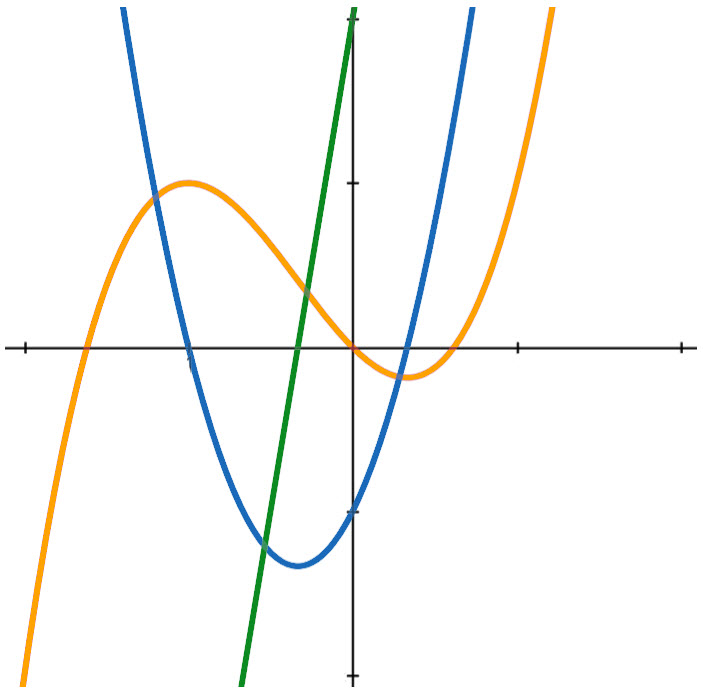
\(\bullet\text{ Graph of f(x), f'(x) and f”(x)}\)
\(\,\,\,\,\,\,\,\,\)
\(\bullet\text{ Newton’s Method}\)
\(\,\,\,\,\,\,\,\,x_{n+1}=x_n – \displaystyle \frac{f(x_n)}{f'(x_n)}\)