

Inverse trigonometric functions are used to work backward from a trig ratio to find an angle. The answers depend on the restricted ranges of inverse sine, inverse cosine, and inverse tangent. These problems include exact inverse trig values, degrees and radians, and compositions like \(\sin(\cos^{-1}(x))\) using right triangle relationships.
Practice Problems
\(\textbf{1)}\) \( \cos^{-1}(-1) \)The answer is \( \theta= 180^\circ \) or \( x=\pi \)
\(\text{For }\cos^{-1}(x),\text{ the range is }0\leq \theta \leq 180^\circ\text{ or }0\leq x\leq \pi.\)
\(\cos^{-1}(-1)\text{ asks for the angle whose cosine is }-1.\)
\(\cos(\pi)=-1\)
\(\cos(180^\circ)=-1\)
\(\text{The answer is }\theta=180^\circ\text{ or }x=\pi.\)
\(\text{For }\cos^{-1}(x),\text{ the range is }0\leq \theta \leq 180^\circ\text{ or }0\leq x\leq \pi.\)
\(\cos^{-1}(-1)\text{ asks for the angle whose cosine is }-1.\)
\(\cos(\pi)=-1\)
\(\cos(180^\circ)=-1\)
\(\text{The answer is }\theta=180^\circ\text{ or }x=\pi.\)
\(\textbf{2)}\) \( \sin^{-1} \left(-\frac{1}{2}\right) \) The answer is \( \theta=-30^\circ \) or \( x=-\displaystyle\frac{\pi}{6} \)
\(\text{For }\sin^{-1}(x),\text{ the range is }-90^\circ\leq \theta \leq 90^\circ\text{ or }-\frac{\pi}{2}\leq x\leq \frac{\pi}{2}.\)
\(\sin^{-1}\left(-\frac12\right)\text{ asks for the angle whose sine is }-\frac12.\)
\(\sin\left(-\frac{\pi}{6}\right)=-\frac12\)
\(\sin(-30^\circ)=-\frac12\)
\(\text{The answer is }\theta=-30^\circ\text{ or }x=-\frac{\pi}{6}.\)
\(\text{For }\sin^{-1}(x),\text{ the range is }-90^\circ\leq \theta \leq 90^\circ\text{ or }-\frac{\pi}{2}\leq x\leq \frac{\pi}{2}.\)
\(\sin^{-1}\left(-\frac12\right)\text{ asks for the angle whose sine is }-\frac12.\)
\(\sin\left(-\frac{\pi}{6}\right)=-\frac12\)
\(\sin(-30^\circ)=-\frac12\)
\(\text{The answer is }\theta=-30^\circ\text{ or }x=-\frac{\pi}{6}.\)
\(\textbf{3)}\) \( \tan^{-1} \left(-\sqrt{3}\right) \) The answer is \( \theta=-60^\circ \) or \( x=-\displaystyle\frac{\pi}{3} \)
\(\text{For }\tan^{-1}(x),\text{ the range is }-90^\circ\lt \theta \lt 90^\circ\text{ or }-\frac{\pi}{2}\lt x\lt \frac{\pi}{2}.\)
\(\tan^{-1}(-\sqrt3)\text{ asks for the angle whose tangent is }-\sqrt3.\)
\(\tan\left(-\frac{\pi}{3}\right)=-\sqrt3\)
\(\tan(-60^\circ)=-\sqrt3\)
\(\text{The answer is }\theta=-60^\circ\text{ or }x=-\frac{\pi}{3}.\)
\(\text{For }\tan^{-1}(x),\text{ the range is }-90^\circ\lt \theta \lt 90^\circ\text{ or }-\frac{\pi}{2}\lt x\lt \frac{\pi}{2}.\)
\(\tan^{-1}(-\sqrt3)\text{ asks for the angle whose tangent is }-\sqrt3.\)
\(\tan\left(-\frac{\pi}{3}\right)=-\sqrt3\)
\(\tan(-60^\circ)=-\sqrt3\)
\(\text{The answer is }\theta=-60^\circ\text{ or }x=-\frac{\pi}{3}.\)
\(\textbf{4)}\) \( \cos^{-1} \left(\frac{1}{2}\right) \)The answer is \( \theta=60^\circ \) or \( x=\displaystyle\frac{\pi}{3} \)
\(\text{For }\cos^{-1}(x),\text{ the range is }0\leq \theta \leq 180^\circ\text{ or }0\leq x\leq \pi.\)
\(\cos^{-1}\left(\frac12\right)\text{ asks for the angle whose cosine is }\frac12.\)
\(\cos\left(\frac{\pi}{3}\right)=\frac12\)
\(\cos(60^\circ)=\frac12\)
\(\text{The answer is }\theta=60^\circ\text{ or }x=\frac{\pi}{3}.\)
\(\text{For }\cos^{-1}(x),\text{ the range is }0\leq \theta \leq 180^\circ\text{ or }0\leq x\leq \pi.\)
\(\cos^{-1}\left(\frac12\right)\text{ asks for the angle whose cosine is }\frac12.\)
\(\cos\left(\frac{\pi}{3}\right)=\frac12\)
\(\cos(60^\circ)=\frac12\)
\(\text{The answer is }\theta=60^\circ\text{ or }x=\frac{\pi}{3}.\)
\(\textbf{5)}\) \( \sin^{-1} \left(\frac{\sqrt{3}}{2}\right) \)The answer is \( \theta=60^\circ \) or \( x=\displaystyle\frac{\pi}{3} \)
\(\text{For }\sin^{-1}(x),\text{ the range is }-90^\circ\leq \theta \leq 90^\circ\text{ or }-\frac{\pi}{2}\leq x\leq \frac{\pi}{2}.\)
\(\sin^{-1}\left(\frac{\sqrt3}{2}\right)\text{ asks for the angle whose sine is }\frac{\sqrt3}{2}.\)
\(\sin\left(\frac{\pi}{3}\right)=\frac{\sqrt3}{2}\)
\(\sin(60^\circ)=\frac{\sqrt3}{2}\)
\(\text{The answer is }\theta=60^\circ\text{ or }x=\frac{\pi}{3}.\)
\(\text{For }\sin^{-1}(x),\text{ the range is }-90^\circ\leq \theta \leq 90^\circ\text{ or }-\frac{\pi}{2}\leq x\leq \frac{\pi}{2}.\)
\(\sin^{-1}\left(\frac{\sqrt3}{2}\right)\text{ asks for the angle whose sine is }\frac{\sqrt3}{2}.\)
\(\sin\left(\frac{\pi}{3}\right)=\frac{\sqrt3}{2}\)
\(\sin(60^\circ)=\frac{\sqrt3}{2}\)
\(\text{The answer is }\theta=60^\circ\text{ or }x=\frac{\pi}{3}.\)
\(\textbf{6)}\) \( \tan^{-1} (1) \)The answer is \( \theta=45^\circ \) or \( x=\displaystyle\frac{\pi}{4} \)
\(\text{For }\tan^{-1}(x),\text{ the range is }-90^\circ\lt \theta \lt 90^\circ\text{ or }-\frac{\pi}{2}\lt x\lt \frac{\pi}{2}.\)
\(\tan^{-1}(1)\text{ asks for the angle whose tangent is }1.\)
\(\tan\left(\frac{\pi}{4}\right)=1\)
\(\tan(45^\circ)=1\)
\(\text{The answer is }\theta=45^\circ\text{ or }x=\frac{\pi}{4}.\)
\(\text{For }\tan^{-1}(x),\text{ the range is }-90^\circ\lt \theta \lt 90^\circ\text{ or }-\frac{\pi}{2}\lt x\lt \frac{\pi}{2}.\)
\(\tan^{-1}(1)\text{ asks for the angle whose tangent is }1.\)
\(\tan\left(\frac{\pi}{4}\right)=1\)
\(\tan(45^\circ)=1\)
\(\text{The answer is }\theta=45^\circ\text{ or }x=\frac{\pi}{4}.\)
\(\textbf{7)}\) \( \cos^{-1} (0) \)The answer is \( \theta=90^\circ \) or \( x=\displaystyle\frac{\pi}{2} \)
\(\text{For }\cos^{-1}(x),\text{ the range is }0\leq \theta \leq 180^\circ\text{ or }0\leq x\leq \pi.\)
\(\cos^{-1}(0)\text{ asks for the angle whose cosine is }0.\)
\(\cos\left(\frac{\pi}{2}\right)=0\)
\(\cos(90^\circ)=0\)
\(\text{The answer is }\theta=90^\circ\text{ or }x=\frac{\pi}{2}.\)
\(\text{For }\cos^{-1}(x),\text{ the range is }0\leq \theta \leq 180^\circ\text{ or }0\leq x\leq \pi.\)
\(\cos^{-1}(0)\text{ asks for the angle whose cosine is }0.\)
\(\cos\left(\frac{\pi}{2}\right)=0\)
\(\cos(90^\circ)=0\)
\(\text{The answer is }\theta=90^\circ\text{ or }x=\frac{\pi}{2}.\)
\(\textbf{8)}\) \( \sin^{-1} \left(-\frac{\sqrt{2}}{2}\right) \)The answer is \( \theta=-45^\circ \) or \( x=-\displaystyle\frac{\pi}{4} \)
\(\text{For }\sin^{-1}(x),\text{ the range is }-90^\circ\leq \theta \leq 90^\circ\text{ or }-\frac{\pi}{2}\leq x\leq \frac{\pi}{2}.\)
\(\sin^{-1}\left(-\frac{\sqrt2}{2}\right)\text{ asks for the angle whose sine is }-\frac{\sqrt2}{2}.\)
\(\sin\left(-\frac{\pi}{4}\right)=-\frac{\sqrt2}{2}\)
\(\sin(-45^\circ)=-\frac{\sqrt2}{2}\)
\(\text{The answer is }\theta=-45^\circ\text{ or }x=-\frac{\pi}{4}.\)
\(\text{For }\sin^{-1}(x),\text{ the range is }-90^\circ\leq \theta \leq 90^\circ\text{ or }-\frac{\pi}{2}\leq x\leq \frac{\pi}{2}.\)
\(\sin^{-1}\left(-\frac{\sqrt2}{2}\right)\text{ asks for the angle whose sine is }-\frac{\sqrt2}{2}.\)
\(\sin\left(-\frac{\pi}{4}\right)=-\frac{\sqrt2}{2}\)
\(\sin(-45^\circ)=-\frac{\sqrt2}{2}\)
\(\text{The answer is }\theta=-45^\circ\text{ or }x=-\frac{\pi}{4}.\)
\(\textbf{9)}\) \( \tan^{-1} (0) \)The answer is \( \theta=0^\circ \) or \( x=0 \)
\(\text{For }\tan^{-1}(x),\text{ the range is }-90^\circ\lt \theta \lt 90^\circ\text{ or }-\frac{\pi}{2}\lt x\lt \frac{\pi}{2}.\)
\(\tan^{-1}(0)\text{ asks for the angle whose tangent is }0.\)
\(\tan(0)=0\)
\(\tan(0^\circ)=0\)
\(\text{The answer is }\theta=0^\circ\text{ or }x=0.\)
\(\text{For }\tan^{-1}(x),\text{ the range is }-90^\circ\lt \theta \lt 90^\circ\text{ or }-\frac{\pi}{2}\lt x\lt \frac{\pi}{2}.\)
\(\tan^{-1}(0)\text{ asks for the angle whose tangent is }0.\)
\(\tan(0)=0\)
\(\tan(0^\circ)=0\)
\(\text{The answer is }\theta=0^\circ\text{ or }x=0.\)
\(\textbf{10)}\) \( \cos^{-1} \left(-\frac{\sqrt{3}}{2}\right) \)The answer is \( \theta=150^\circ \) or \( x=\displaystyle\frac{5\pi}{6} \)
\(\text{For }\cos^{-1}(x),\text{ the range is }0\leq \theta \leq 180^\circ\text{ or }0\leq x\leq \pi.\)
\(\cos^{-1}\left(-\frac{\sqrt3}{2}\right)\text{ asks for the angle whose cosine is }-\frac{\sqrt3}{2}.\)
\(\cos\left(\frac{5\pi}{6}\right)=-\frac{\sqrt3}{2}\)
\(\cos(150^\circ)=-\frac{\sqrt3}{2}\)
\(\text{The answer is }\theta=150^\circ\text{ or }x=\frac{5\pi}{6}.\)
\(\text{For }\cos^{-1}(x),\text{ the range is }0\leq \theta \leq 180^\circ\text{ or }0\leq x\leq \pi.\)
\(\cos^{-1}\left(-\frac{\sqrt3}{2}\right)\text{ asks for the angle whose cosine is }-\frac{\sqrt3}{2}.\)
\(\cos\left(\frac{5\pi}{6}\right)=-\frac{\sqrt3}{2}\)
\(\cos(150^\circ)=-\frac{\sqrt3}{2}\)
\(\text{The answer is }\theta=150^\circ\text{ or }x=\frac{5\pi}{6}.\)
\(\textbf{11)}\) \( \sin^{-1} (1) \)The answer is \( \theta=90^\circ \) or \( x=\displaystyle\frac{\pi}{2} \)
\(\text{For }\sin^{-1}(x),\text{ the range is }-90^\circ\leq \theta \leq 90^\circ\text{ or }-\frac{\pi}{2}\leq x\leq \frac{\pi}{2}.\)
\(\sin^{-1}(1)\text{ asks for the angle whose sine is }1.\)
\(\sin\left(\frac{\pi}{2}\right)=1\)
\(\sin(90^\circ)=1\)
\(\text{The answer is }\theta=90^\circ\text{ or }x=\frac{\pi}{2}.\)
\(\text{For }\sin^{-1}(x),\text{ the range is }-90^\circ\leq \theta \leq 90^\circ\text{ or }-\frac{\pi}{2}\leq x\leq \frac{\pi}{2}.\)
\(\sin^{-1}(1)\text{ asks for the angle whose sine is }1.\)
\(\sin\left(\frac{\pi}{2}\right)=1\)
\(\sin(90^\circ)=1\)
\(\text{The answer is }\theta=90^\circ\text{ or }x=\frac{\pi}{2}.\)
\(\textbf{12)}\) \( \tan^{-1} \left(-\frac{\sqrt{3}}{3}\right) \)The answer is \( \theta=-30^\circ \) or \( x=-\displaystyle\frac{\pi}{6} \)
\(\text{For }\tan^{-1}(x),\text{ the range is }-90^\circ\lt \theta \lt 90^\circ\text{ or }-\frac{\pi}{2}\lt x\lt \frac{\pi}{2}.\)
\(\tan^{-1}\left(-\frac{\sqrt3}{3}\right)\text{ asks for the angle whose tangent is }-\frac{\sqrt3}{3}.\)
\(\tan\left(-\frac{\pi}{6}\right)=-\frac{\sqrt3}{3}\)
\(\tan(-30^\circ)=-\frac{\sqrt3}{3}\)
\(\text{The answer is }\theta=-30^\circ\text{ or }x=-\frac{\pi}{6}.\)
\(\text{For }\tan^{-1}(x),\text{ the range is }-90^\circ\lt \theta \lt 90^\circ\text{ or }-\frac{\pi}{2}\lt x\lt \frac{\pi}{2}.\)
\(\tan^{-1}\left(-\frac{\sqrt3}{3}\right)\text{ asks for the angle whose tangent is }-\frac{\sqrt3}{3}.\)
\(\tan\left(-\frac{\pi}{6}\right)=-\frac{\sqrt3}{3}\)
\(\tan(-30^\circ)=-\frac{\sqrt3}{3}\)
\(\text{The answer is }\theta=-30^\circ\text{ or }x=-\frac{\pi}{6}.\)
\(\textbf{13)}\) \( \cos^{-1} \left(\frac{\sqrt{2}}{2}\right) \)The answer is \( \theta=45^\circ \) or \( x=\displaystyle\frac{\pi}{4} \)
\(\text{For }\cos^{-1}(x),\text{ the range is }0\leq \theta \leq 180^\circ\text{ or }0\leq x\leq \pi.\)
\(\cos^{-1}\left(\frac{\sqrt2}{2}\right)\text{ asks for the angle whose cosine is }\frac{\sqrt2}{2}.\)
\(\cos\left(\frac{\pi}{4}\right)=\frac{\sqrt2}{2}\)
\(\cos(45^\circ)=\frac{\sqrt2}{2}\)
\(\text{The answer is }\theta=45^\circ\text{ or }x=\frac{\pi}{4}.\)
\(\text{For }\cos^{-1}(x),\text{ the range is }0\leq \theta \leq 180^\circ\text{ or }0\leq x\leq \pi.\)
\(\cos^{-1}\left(\frac{\sqrt2}{2}\right)\text{ asks for the angle whose cosine is }\frac{\sqrt2}{2}.\)
\(\cos\left(\frac{\pi}{4}\right)=\frac{\sqrt2}{2}\)
\(\cos(45^\circ)=\frac{\sqrt2}{2}\)
\(\text{The answer is }\theta=45^\circ\text{ or }x=\frac{\pi}{4}.\)
\(\textbf{14)}\) \( \sin^{-1} \left(-\frac{\sqrt{3}}{2}\right) \)The answer is \( \theta=-60^\circ \) or \( x=-\displaystyle\frac{\pi}{3} \)
\(\text{For }\sin^{-1}(x),\text{ the range is }-90^\circ\leq \theta \leq 90^\circ\text{ or }-\frac{\pi}{2}\leq x\leq \frac{\pi}{2}.\)
\(\sin^{-1}\left(-\frac{\sqrt3}{2}\right)\text{ asks for the angle whose sine is }-\frac{\sqrt3}{2}.\)
\(\sin\left(-\frac{\pi}{3}\right)=-\frac{\sqrt3}{2}\)
\(\sin(-60^\circ)=-\frac{\sqrt3}{2}\)
\(\text{The answer is }\theta=-60^\circ\text{ or }x=-\frac{\pi}{3}.\)
\(\text{For }\sin^{-1}(x),\text{ the range is }-90^\circ\leq \theta \leq 90^\circ\text{ or }-\frac{\pi}{2}\leq x\leq \frac{\pi}{2}.\)
\(\sin^{-1}\left(-\frac{\sqrt3}{2}\right)\text{ asks for the angle whose sine is }-\frac{\sqrt3}{2}.\)
\(\sin\left(-\frac{\pi}{3}\right)=-\frac{\sqrt3}{2}\)
\(\sin(-60^\circ)=-\frac{\sqrt3}{2}\)
\(\text{The answer is }\theta=-60^\circ\text{ or }x=-\frac{\pi}{3}.\)
\(\textbf{15)}\) \( \tan^{-1} (\sqrt{3}) \)The answer is \( \theta=60^\circ \) or \( x=\displaystyle\frac{\pi}{3} \)
\(\text{For }\tan^{-1}(x),\text{ the range is }-90^\circ\lt \theta \lt 90^\circ\text{ or }-\frac{\pi}{2}\lt x\lt \frac{\pi}{2}.\)
\(\tan^{-1}(\sqrt3)\text{ asks for the angle whose tangent is }\sqrt3.\)
\(\tan\left(\frac{\pi}{3}\right)=\sqrt3\)
\(\tan(60^\circ)=\sqrt3\)
\(\text{The answer is }\theta=60^\circ\text{ or }x=\frac{\pi}{3}.\)
\(\text{For }\tan^{-1}(x),\text{ the range is }-90^\circ\lt \theta \lt 90^\circ\text{ or }-\frac{\pi}{2}\lt x\lt \frac{\pi}{2}.\)
\(\tan^{-1}(\sqrt3)\text{ asks for the angle whose tangent is }\sqrt3.\)
\(\tan\left(\frac{\pi}{3}\right)=\sqrt3\)
\(\tan(60^\circ)=\sqrt3\)
\(\text{The answer is }\theta=60^\circ\text{ or }x=\frac{\pi}{3}.\)
Challenge Problems
\(\textbf{16)}\) \( \cos^{-1} \left(\sin{\left(-\frac{\pi}{2}\right)}\right) \)The answer is \( \theta=180^\circ \) or \( x=\pi \)
\(\text{For }\cos^{-1}(x),\text{ the range is }0\leq \theta \leq 180^\circ\text{ or }0\leq x\leq \pi.\)
\(\sin\left(-\frac{\pi}{2}\right)=-1\)
\(\cos^{-1}\left(\sin\left(-\frac{\pi}{2}\right)\right)=\cos^{-1}(-1)\)
\(\cos(\pi)=-1\)
\(\text{The answer is }\theta=180^\circ\text{ or }x=\pi.\)
\(\text{For }\cos^{-1}(x),\text{ the range is }0\leq \theta \leq 180^\circ\text{ or }0\leq x\leq \pi.\)
\(\sin\left(-\frac{\pi}{2}\right)=-1\)
\(\cos^{-1}\left(\sin\left(-\frac{\pi}{2}\right)\right)=\cos^{-1}(-1)\)
\(\cos(\pi)=-1\)
\(\text{The answer is }\theta=180^\circ\text{ or }x=\pi.\)
\(\textbf{17)}\) \( \cos^{-1} \left(\sin{\pi}\right) \) The answer is \( \theta=90^\circ \) or \( x=\displaystyle\frac{\pi}{2} \)
\(\text{For }\cos^{-1}(x),\text{ the range is }0\leq \theta \leq 180^\circ\text{ or }0\leq x\leq \pi.\)
\(\sin(\pi)=0\)
\(\cos^{-1}\left(\sin{\pi}\right)=\cos^{-1}(0)\)
\(\cos\left(\frac{\pi}{2}\right)=0\)
\(\text{The answer is }\theta=90^\circ\text{ or }x=\frac{\pi}{2}.\)
\(\text{For }\cos^{-1}(x),\text{ the range is }0\leq \theta \leq 180^\circ\text{ or }0\leq x\leq \pi.\)
\(\sin(\pi)=0\)
\(\cos^{-1}\left(\sin{\pi}\right)=\cos^{-1}(0)\)
\(\cos\left(\frac{\pi}{2}\right)=0\)
\(\text{The answer is }\theta=90^\circ\text{ or }x=\frac{\pi}{2}.\)
\(\textbf{18)}\) \( \sin\left(\cos^{-1} \left(\frac{3}{5}\right)\right) \) The answer is \( \displaystyle\frac{4}{5} \)
\(\text{For }\cos^{-1}(x),\text{ the range is }0\leq \theta \leq \pi.\)
\(\text{Let }\theta=\cos^{-1}\left(\frac35\right).\)
\(\cos\theta=\frac35\)
\(\cos\theta=\frac{\text{adjacent}}{\text{hypotenuse}}=\frac35\)
\(\text{Use a right triangle with adjacent }3\text{ and hypotenuse }5.\)
\(\text{The opposite side is }4\text{ by the }3-4-5\text{ triangle.}\)
\(\sin\theta=\frac{\text{opposite}}{\text{hypotenuse}}=\frac45\)
\(\sin\left(\cos^{-1}\left(\frac35\right)\right)=\frac45\)
\(\text{For }\cos^{-1}(x),\text{ the range is }0\leq \theta \leq \pi.\)
\(\text{Let }\theta=\cos^{-1}\left(\frac35\right).\)
\(\cos\theta=\frac35\)
\(\cos\theta=\frac{\text{adjacent}}{\text{hypotenuse}}=\frac35\)
\(\text{Use a right triangle with adjacent }3\text{ and hypotenuse }5.\)
\(\text{The opposite side is }4\text{ by the }3-4-5\text{ triangle.}\)
\(\sin\theta=\frac{\text{opposite}}{\text{hypotenuse}}=\frac45\)
\(\sin\left(\cos^{-1}\left(\frac35\right)\right)=\frac45\)
\(\textbf{19)}\) \(\tan\left(\sin^{-1}\left(\frac{3}{5}\right)\right)= \)
The answer is \( \displaystyle\frac{3}{4} \)
\(\text{For }\sin^{-1}(x),\text{ the range is }-\frac{\pi}{2}\leq \theta \leq \frac{\pi}{2}.\)
\(\text{Let }\theta=\sin^{-1}\left(\frac35\right).\)
\(\sin\theta=\frac35\)
\(\sin\theta=\frac{\text{opposite}}{\text{hypotenuse}}=\frac35\)
\(\text{Use a right triangle with opposite }3\text{ and hypotenuse }5.\)
\(\text{The adjacent side is }4\text{ by the }3-4-5\text{ triangle.}\)
\(\tan\theta=\frac{\text{opposite}}{\text{adjacent}}=\frac34\)
\(\tan\left(\sin^{-1}\left(\frac35\right)\right)=\frac34\)

\(\text{For }\sin^{-1}(x),\text{ the range is }-\frac{\pi}{2}\leq \theta \leq \frac{\pi}{2}.\)
\(\text{Let }\theta=\sin^{-1}\left(\frac35\right).\)
\(\sin\theta=\frac35\)
\(\sin\theta=\frac{\text{opposite}}{\text{hypotenuse}}=\frac35\)
\(\text{Use a right triangle with opposite }3\text{ and hypotenuse }5.\)
\(\text{The adjacent side is }4\text{ by the }3-4-5\text{ triangle.}\)
\(\tan\theta=\frac{\text{opposite}}{\text{adjacent}}=\frac34\)
\(\tan\left(\sin^{-1}\left(\frac35\right)\right)=\frac34\)
\(\textbf{20)}\) \(\cos\left(\sin^{-1}\left(\frac{5}{13}\right)\right)\)The answer is \(\displaystyle\frac{12}{13}\)
\(\text{For }\sin^{-1}(x),\text{ the range is }-\frac{\pi}{2}\leq \theta \leq \frac{\pi}{2}.\)
\(\text{Let }\theta=\sin^{-1}\left(\frac{5}{13}\right).\)
\(\sin\theta=\frac{5}{13}\)
\(\sin\theta=\frac{\text{opposite}}{\text{hypotenuse}}=\frac{5}{13}\)
\(\text{Use a right triangle with opposite }5\text{ and hypotenuse }13.\)
\(\text{The adjacent side is }12\text{ by the }5-12-13\text{ triangle.}\)
\(\cos\theta=\frac{\text{adjacent}}{\text{hypotenuse}}=\frac{12}{13}\)
\(\cos\left(\sin^{-1}\left(\frac{5}{13}\right)\right)=\frac{12}{13}\)
\(\text{For }\sin^{-1}(x),\text{ the range is }-\frac{\pi}{2}\leq \theta \leq \frac{\pi}{2}.\)
\(\text{Let }\theta=\sin^{-1}\left(\frac{5}{13}\right).\)
\(\sin\theta=\frac{5}{13}\)
\(\sin\theta=\frac{\text{opposite}}{\text{hypotenuse}}=\frac{5}{13}\)
\(\text{Use a right triangle with opposite }5\text{ and hypotenuse }13.\)
\(\text{The adjacent side is }12\text{ by the }5-12-13\text{ triangle.}\)
\(\cos\theta=\frac{\text{adjacent}}{\text{hypotenuse}}=\frac{12}{13}\)
\(\cos\left(\sin^{-1}\left(\frac{5}{13}\right)\right)=\frac{12}{13}\)
See Related Pages\(\)
\(\bullet\text{ Right Triangle Trigonometry}\)
\(\,\,\,\,\,\,\,\,\sin{(x)}=\displaystyle\frac{\text{opp}}{\text{hyp}}…\)
\(\bullet\text{ Angle of Depression and Elevation}\)
\(\,\,\,\,\,\,\,\,\text{Angle of Depression}=\text{Angle of Elevation}…\)
\(\bullet\text{ Convert to Radians and to Degrees}\)
\(\,\,\,\,\,\,\,\,\text{Radians} \rightarrow \text{Degrees}, \times \displaystyle \frac{180^{\circ}}{\pi}…\)
\(\bullet\text{ Degrees, Minutes and Seconds}\)
\(\,\,\,\,\,\,\,\,48^{\circ}34’21”…\)
\(\bullet\text{ Coterminal Angles}\)
\(\,\,\,\,\,\,\,\,\pm 360^{\circ} \text { or } \pm 2\pi n…\)
\(\bullet\text{ Reference Angles}\)
\(\,\,\,\,\,\,\,\,\)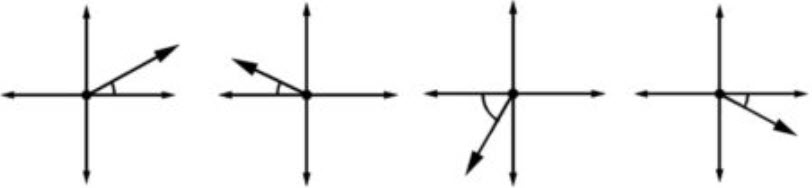 \(…\)
\(…\)
\(\bullet\text{ Find All 6 Trig Functions}\)
\(\,\,\,\,\,\,\,\,\) \(…\)
\(…\)
\(\bullet\text{ Unit Circle}\)
\(\,\,\,\,\,\,\,\,\sin{(60^{\circ})}=\displaystyle\frac{\sqrt{3}}{2}…\)
\(\bullet\text{ Law of Sines}\)
\(\,\,\,\,\,\,\,\,\displaystyle\frac{\sin{A}}{a}=\frac{\sin{B}}{b}=\frac{\sin{C}}{c}\) 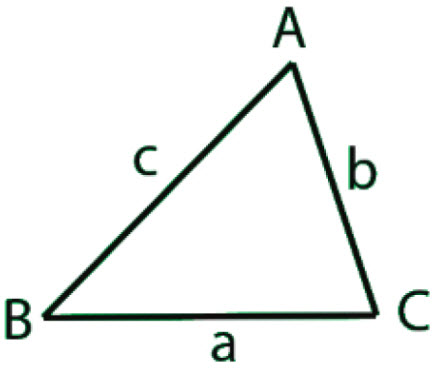 \(…\)
\(…\)
\(\bullet\text{ Area of SAS Triangles}\)
\(\,\,\,\,\,\,\,\,\text{Area}=\frac{1}{2}ab \sin{C}\) \(…\)
\(\bullet\text{ Law of Cosines}\)
\(\,\,\,\,\,\,\,\,a^2=b^2+c^2-2bc \cos{A}\) \(…\)
\(\bullet\text{ Area of SSS Triangles (Heron’s formula)}\)
\(\,\,\,\,\,\,\,\,\text{Area}=\sqrt{s(s-a)(s-b)(s-c)}\) \(…\)
\(\bullet\text{ Geometric Mean}\)
\(\,\,\,\,\,\,\,\,x=\sqrt{ab} \text{ or } \displaystyle\frac{a}{x}=\frac{x}{b}…\)
\(\bullet\text{ Geometric Mean- Similar Right Triangles}\)
\(\,\,\,\,\,\,\,\,\)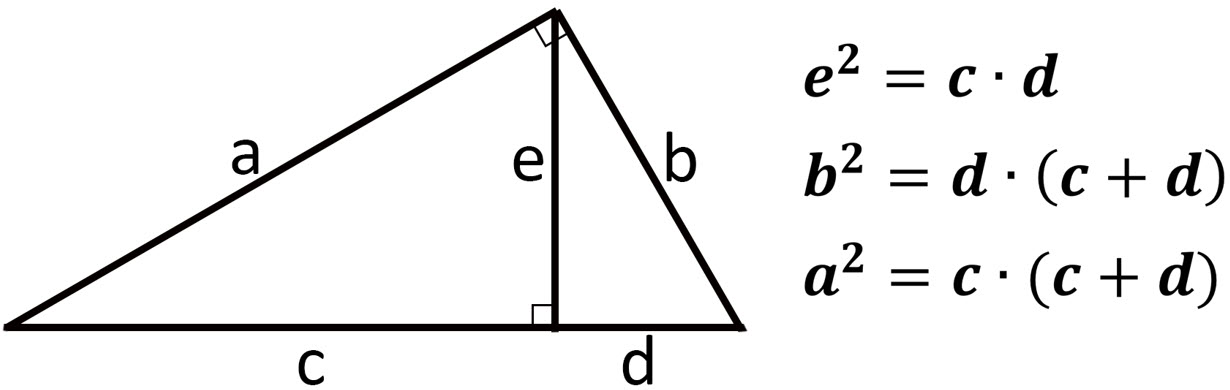 \(…\)
\(…\)
\(\bullet\text{ Inverse Trigonmetric Functions}\)
\(\,\,\,\,\,\,\,\,\sin {\left(cos^{-1}\left(\frac{3}{5}\right)\right)}…\)
\(\bullet\text{ Sum and Difference of Angles Formulas}\)
\(\,\,\,\,\,\,\,\,\sin{(A+B)}=\sin{A}\cos{B}+\cos{A}\sin{B}…\)
\(\bullet\text{ Double-Angle and Half-Angle Formulas}\)
\(\,\,\,\,\,\,\,\,\sin{(2A)}=2\sin{(A)}\cos{(A)}…\)
\(\bullet\text{ Trigonometry-Pythagorean Identities}\)
\(\,\,\,\,\,\,\,\,\sin^2{(x)}+\cos^2{(x)}=1…\)
\(\bullet\text{ Product-Sum Identities}\)
\(\,\,\,\,\,\,\,\,\cos{\alpha}\cos{\beta}=\left(\displaystyle\frac{\cos{(\alpha+\beta)}+\cos{(\alpha-\beta)}}{2}\right)…\)
\(\bullet\text{ Cofunction Identities}\)
\(\,\,\,\,\,\,\,\,\sin{(x)}=\cos{(\frac{\pi}{2}-x)}…\)
\(\bullet\text{ Proving Trigonometric Identities}\)
\(\,\,\,\,\,\,\,\,\sec{x}-\cos{x}=\displaystyle\frac{\tan^2{x}}{\sec{x}}…\)
\(\bullet\text{ Graphing Trig Functions- sin and cos}\)
\(\,\,\,\,\,\,\,\,f(x)=A \sin{B(x-c)}+D \) 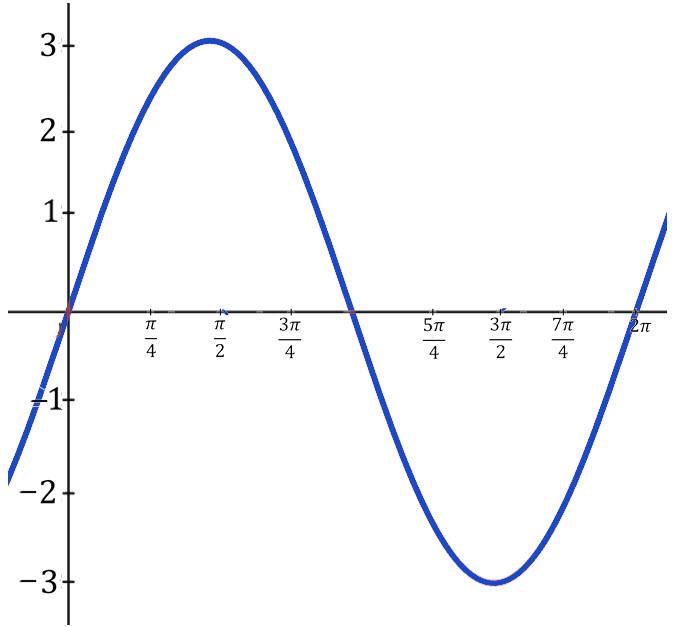 \(…\)
\(…\)
\(\bullet\text{ Solving Trigonometric Equations}\)
\(\,\,\,\,\,\,\,\,2\cos{(x)}=\sqrt{3}…\)