Notes
Practice Problems
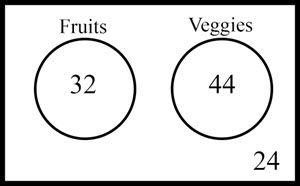
For problems 1-9, use the Venn diagram below.
\(\textbf{1)}\) P (fruit) Show Answer
P (fruit) \(= \frac{32}{100}=32\)%
\(\textbf{2)}\) P (not fruit) Show Answer
P (not fruit) \(=1- \frac{32}{100}=68\)%
\(\textbf{3)}\) P (fruit and vegetable) Show Answer
P (fruit and vegetable) \(= \frac{0}{100}=0\)%
\(\textbf{4)}\) P (fruit or vegetable) Show Answer
P (fruit or vegetable) \(= \frac{32}{100}+\frac{44}{100}=76\)%
\(\textbf{5)}\) P (fruit | vegetable) Show Answer
P (fruit | vegetable) \(=0\)%
\(\textbf{6)}\) P (vegetable | fruit) Show Answer
P (vegetable | fruit) \(=0\)%
\(\textbf{7)}\) P (fruit and not vegetable) Show Answer
P (fruit and not vegetable) \(= \frac{32}{100}=32\)%
\(\textbf{8)}\) Are “fruit” and “vegetable” independent? Show Answer
Not independent
\(\textbf{9)}\) Are “fruit” and “vegetable” mutually exclusive? Show Answer
Yes, they are mutually exclusive.
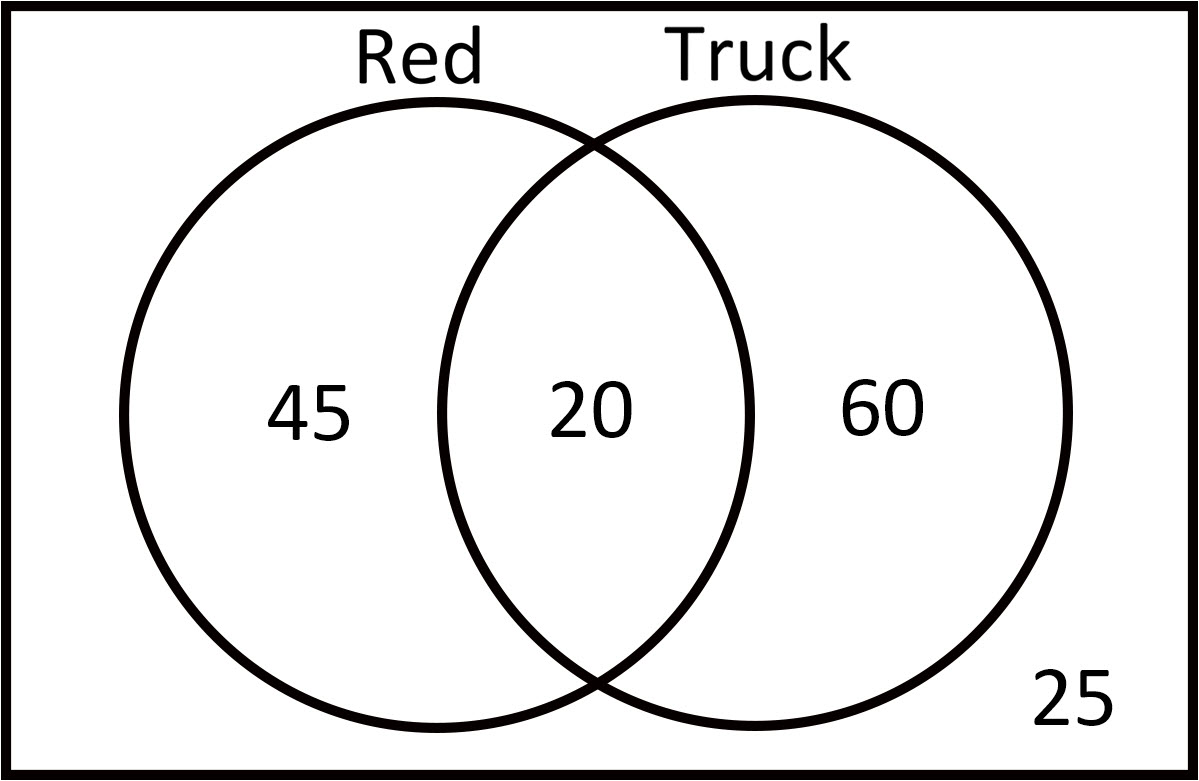
\(\textbf{10)}\) Are “red” and “truck” mutually exclusive? Show Answer
No, they are not mutually exclusive.
See Related Pages\(\)
In Summary
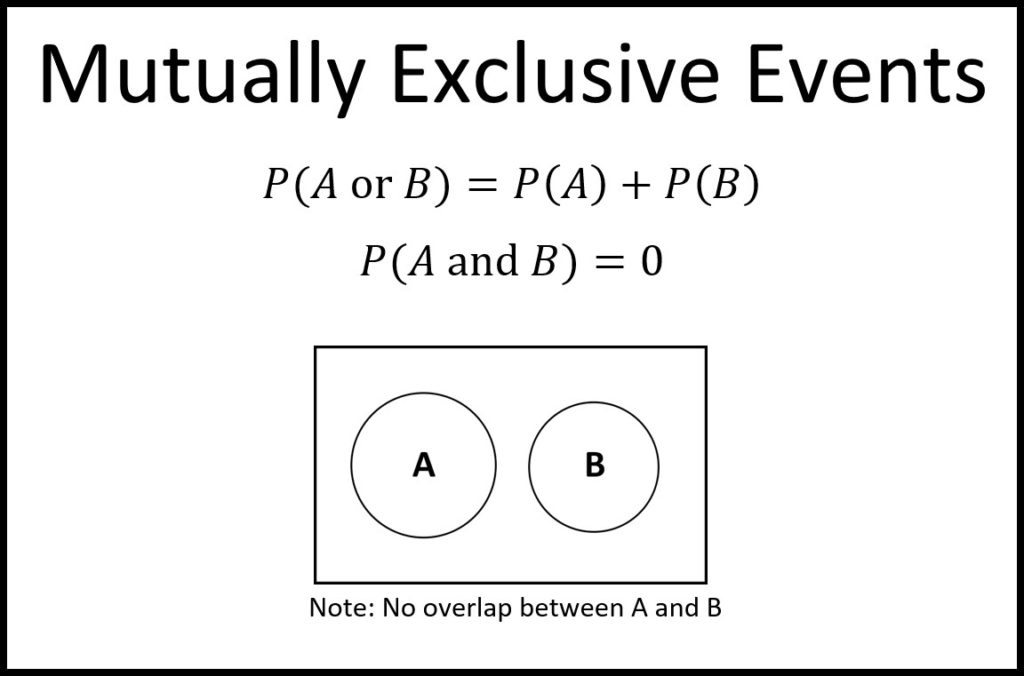
Mutually exclusive events (aka disjoint events) are events that cannot occur at the same time. A lot of interesting probabilities come from recognizing if 2 events are mutually exclusive.
\(P\left(A \text{ or } B\right) = P\left(A\right) + P\left(B\right)\)
\(P\left(A \text{ and } B\right) = 0 \)
 …
… …
…