

Infinite limits describe what happens when a function grows without bound as \(x\) approaches a specific value from the left or right. These problems focus on identifying whether a function approaches \(\infty\), \(-\infty\), or does not have a two-sided infinite limit. The key idea is to track the sign of the numerator and denominator as the denominator gets closer to \(0\).
Practice Problems
Find the following infinite limits
\(\textbf{1)}\) \( \displaystyle \lim_{x\to 4^{-}} \frac{5}{x-4} \)The answer is \( -\infty \)
Let’s start by evaluating the expression for values of \(x\) just to the left of 4.
For \(x = 3.9\), \(\frac{5}{3.9 – 4} = \frac{5}{-0.1} = -50\)
For \(x = 3.99\), \(\frac{5}{3.99 – 4} = \frac{5}{-0.01} = -500\)
For \(x = 3.999\), \(\frac{5}{3.999 – 4} = \frac{5}{-0.001} = -5000\)
For \(x = 3.9999\), \(\frac{5}{3.9999 – 4} = \frac{5}{-0.0001} = -50000\)
As \(x\) approaches 4 from the left, the expression approaches \(-\infty\)
The answer is \( -\infty \)
Let’s start by evaluating the expression for values of \(x\) just to the left of 4.
For \(x = 3.9\), \(\frac{5}{3.9 – 4} = \frac{5}{-0.1} = -50\)
For \(x = 3.99\), \(\frac{5}{3.99 – 4} = \frac{5}{-0.01} = -500\)
For \(x = 3.999\), \(\frac{5}{3.999 – 4} = \frac{5}{-0.001} = -5000\)
For \(x = 3.9999\), \(\frac{5}{3.9999 – 4} = \frac{5}{-0.0001} = -50000\)
As \(x\) approaches 4 from the left, the expression approaches \(-\infty\)
The answer is \( -\infty \)
\(\textbf{2)}\) \( \displaystyle \lim_{x\to 4^{+}} \frac{5}{x-4} \)The answer is \( \infty \)
Let’s start by evaluating the expression for values of \(x\) just to the right of 4.
For \(x = 4.1\), \(\frac{5}{4.1 – 4} = \frac{5}{0.1} = 50\)
For \(x = 4.01\), \(\frac{5}{4.01 – 4} = \frac{5}{0.01} = 500\)
For \(x = 4.001\), \(\frac{5}{4.001 – 4} = \frac{5}{0.001} = 5000\)
For \(x = 4.0001\), \(\frac{5}{4.0001 – 4} = \frac{5}{0.0001} = 50000\)
As \(x\) approaches 4 from the right, the expression approaches \(\infty\)
The answer is \( \infty \)
Let’s start by evaluating the expression for values of \(x\) just to the right of 4.
For \(x = 4.1\), \(\frac{5}{4.1 – 4} = \frac{5}{0.1} = 50\)
For \(x = 4.01\), \(\frac{5}{4.01 – 4} = \frac{5}{0.01} = 500\)
For \(x = 4.001\), \(\frac{5}{4.001 – 4} = \frac{5}{0.001} = 5000\)
For \(x = 4.0001\), \(\frac{5}{4.0001 – 4} = \frac{5}{0.0001} = 50000\)
As \(x\) approaches 4 from the right, the expression approaches \(\infty\)
The answer is \( \infty \)
\(\textbf{3)}\) \( \displaystyle \lim_{x\to -7^{+}} \frac{x+9}{x+7} \)The answer is \( \infty \)
Let’s start by evaluating the expression for values of \(x\) just to the right of -7.
For \(x = -6.9\), \(\frac{-6.9+9}{-6.9+7} = \frac{2.1}{0.1} = 21\)
For \(x = -6.99\), \(\frac{-6.99+9}{-6.99+7} = \frac{2.01}{0.01} = 201\)
For \(x = -6.999\), \(\frac{-6.999+9}{-6.999+7} = \frac{2.001}{0.001} = 2001\)
For \(x = -6.9999\), \(\frac{-6.9999+9}{-6.9999+7} = \frac{2.0001}{0.0001} = 20001\)
As \(x\) approaches -7 from the right, the expression approaches \(\infty\)
The answer is \( \infty \)
Let’s start by evaluating the expression for values of \(x\) just to the right of -7.
For \(x = -6.9\), \(\frac{-6.9+9}{-6.9+7} = \frac{2.1}{0.1} = 21\)
For \(x = -6.99\), \(\frac{-6.99+9}{-6.99+7} = \frac{2.01}{0.01} = 201\)
For \(x = -6.999\), \(\frac{-6.999+9}{-6.999+7} = \frac{2.001}{0.001} = 2001\)
For \(x = -6.9999\), \(\frac{-6.9999+9}{-6.9999+7} = \frac{2.0001}{0.0001} = 20001\)
As \(x\) approaches -7 from the right, the expression approaches \(\infty\)
The answer is \( \infty \)
\(\textbf{4)}\)\( \displaystyle \lim_{x\to 5^{-}} \frac{e^x}{(x-5)^3} \)The answer is \( -\infty \)
Let’s start by evaluating the expression for values of \(x\) just to the left of 5.
For \(x = 4.9\), \(\frac{e^{4.9}}{(4.9-5)^3} = \frac{e^{4.9}}{(-0.1)^3} = \frac{e^{4.9}}{-0.001}\)
For \(x = 4.99\), \(\frac{e^{4.99}}{(4.99-5)^3} = \frac{e^{4.99}}{(-0.01)^3} = \frac{e^{4.99}}{-0.000001}\)
For \(x = 4.999\), \(\frac{e^{4.999}}{(4.999-5)^3} = \frac{e^{4.999}}{(-0.001)^3} = \frac{e^{4.999}}{-0.000000001}\)
For \(x = 4.9999\), \(\frac{e^{4.9999}}{(4.9999-5)^3} = \frac{e^{4.9999}}{(-0.0001)^3} = \frac{e^{4.9999}}{-0.000000000001}\)
As \(x\) approaches 5 from the left, the expression approaches negative infinity.
The answer is \( -\infty \)
Let’s start by evaluating the expression for values of \(x\) just to the left of 5.
For \(x = 4.9\), \(\frac{e^{4.9}}{(4.9-5)^3} = \frac{e^{4.9}}{(-0.1)^3} = \frac{e^{4.9}}{-0.001}\)
For \(x = 4.99\), \(\frac{e^{4.99}}{(4.99-5)^3} = \frac{e^{4.99}}{(-0.01)^3} = \frac{e^{4.99}}{-0.000001}\)
For \(x = 4.999\), \(\frac{e^{4.999}}{(4.999-5)^3} = \frac{e^{4.999}}{(-0.001)^3} = \frac{e^{4.999}}{-0.000000001}\)
For \(x = 4.9999\), \(\frac{e^{4.9999}}{(4.9999-5)^3} = \frac{e^{4.9999}}{(-0.0001)^3} = \frac{e^{4.9999}}{-0.000000000001}\)
As \(x\) approaches 5 from the left, the expression approaches negative infinity.
The answer is \( -\infty \)
\(\textbf{5)}\)\( \displaystyle \lim_{x\to 1^{-}} \frac{5}{x^3-1} \)The answer is \( -\infty \)
Let’s start by evaluating the expression for values of \(x\) just to the left of 1.
For \(x = 0.9\), \(\frac{5}{0.9^3-1} = \frac{5}{0.729-1} = \frac{5}{-0.271}\)
For \(x = 0.99\), \(\frac{5}{0.99^3-1} = \frac{5}{0.970299-1} = \frac{5}{-0.029701}\)
For \(x = 0.999\), \(\frac{5}{0.999^3-1} = \frac{5}{0.997002999-1} = \frac{5}{-0.002997001}\)
For \(x = 0.9999\), \(\frac{5}{0.9999^3-1} = \frac{5}{0.999700029999-1} = \frac{5}{-0.000299970001}\)
As \(x\) approaches 1 from the left, the expression approaches negative infinity.
The answer is \( -\infty \)
Let’s start by evaluating the expression for values of \(x\) just to the left of 1.
For \(x = 0.9\), \(\frac{5}{0.9^3-1} = \frac{5}{0.729-1} = \frac{5}{-0.271}\)
For \(x = 0.99\), \(\frac{5}{0.99^3-1} = \frac{5}{0.970299-1} = \frac{5}{-0.029701}\)
For \(x = 0.999\), \(\frac{5}{0.999^3-1} = \frac{5}{0.997002999-1} = \frac{5}{-0.002997001}\)
For \(x = 0.9999\), \(\frac{5}{0.9999^3-1} = \frac{5}{0.999700029999-1} = \frac{5}{-0.000299970001}\)
As \(x\) approaches 1 from the left, the expression approaches negative infinity.
The answer is \( -\infty \)
\(\textbf{6)}\)\( \displaystyle \lim_{x\to 1^{+}} \frac{5}{x^3-1} \)The answer is \( \infty \)
Let’s start by evaluating the expression for values of \(x\) just to the right of 1.
For \(x = 1.1\), \(\frac{5}{1.1^3-1} = \frac{5}{1.331-1} = \frac{5}{0.331}\)
For \(x = 1.01\), \(\frac{5}{1.01^3-1} = \frac{5}{1.030301-1} = \frac{5}{0.030301}\)
For \(x = 1.001\), \(\frac{5}{1.001^3-1} = \frac{5}{1.003003001-1} = \frac{5}{0.003003001}\)
For \(x = 1.0001\), \(\frac{5}{1.0001^3-1} = \frac{5}{1.000300030001-1} = \frac{5}{0.000300030001}\)
As \(x\) approaches 1 from the right, the expression approaches infinity.
The answer is \( \infty \)
Let’s start by evaluating the expression for values of \(x\) just to the right of 1.
For \(x = 1.1\), \(\frac{5}{1.1^3-1} = \frac{5}{1.331-1} = \frac{5}{0.331}\)
For \(x = 1.01\), \(\frac{5}{1.01^3-1} = \frac{5}{1.030301-1} = \frac{5}{0.030301}\)
For \(x = 1.001\), \(\frac{5}{1.001^3-1} = \frac{5}{1.003003001-1} = \frac{5}{0.003003001}\)
For \(x = 1.0001\), \(\frac{5}{1.0001^3-1} = \frac{5}{1.000300030001-1} = \frac{5}{0.000300030001}\)
As \(x\) approaches 1 from the right, the expression approaches infinity.
The answer is \( \infty \)
\(\textbf{7)}\)\( \displaystyle \lim_{x\to 2^{+}} \frac{\ln(x)}{(x-2)^2} \)The answer is \( \infty \)
Let’s start by evaluating the expression for values of \(x\) just to the right of 2.
For \(x = 2.1\), \(\frac{\ln(2.1)}{(2.1-2)^2} = \frac{\ln(2.1)}{0.1^2} = \frac{\ln(2.1)}{0.01}\)
For \(x = 2.01\), \(\frac{\ln(2.01)}{(2.01-2)^2} = \frac{\ln(2.01)}{0.01^2} = \frac{\ln(2.01)}{0.0001}\)
For \(x = 2.001\), \(\frac{\ln(2.001)}{(2.001-2)^2} = \frac{\ln(2.001)}{0.001^2} = \frac{\ln(2.001)}{0.000001}\)
For \(x = 2.0001\), \(\frac{\ln(2.0001)}{(2.0001-2)^2} = \frac{\ln(2.0001)}{0.0001^2} = \frac{\ln(2.0001)}{0.00000001}\)
As \(x\) approaches 2 from the right, the expression approaches infinity.
The answer is \( \infty \)
Let’s start by evaluating the expression for values of \(x\) just to the right of 2.
For \(x = 2.1\), \(\frac{\ln(2.1)}{(2.1-2)^2} = \frac{\ln(2.1)}{0.1^2} = \frac{\ln(2.1)}{0.01}\)
For \(x = 2.01\), \(\frac{\ln(2.01)}{(2.01-2)^2} = \frac{\ln(2.01)}{0.01^2} = \frac{\ln(2.01)}{0.0001}\)
For \(x = 2.001\), \(\frac{\ln(2.001)}{(2.001-2)^2} = \frac{\ln(2.001)}{0.001^2} = \frac{\ln(2.001)}{0.000001}\)
For \(x = 2.0001\), \(\frac{\ln(2.0001)}{(2.0001-2)^2} = \frac{\ln(2.0001)}{0.0001^2} = \frac{\ln(2.0001)}{0.00000001}\)
As \(x\) approaches 2 from the right, the expression approaches infinity.
The answer is \( \infty \)
\(\textbf{8)}\)\( \displaystyle \lim_{x\to -3^{-}} \frac{1}{x+3} \)The answer is \( -\infty \)
Let’s start by evaluating the expression for values of \(x\) just to the left of -3.
For \(x = -3.1\), \(\frac{1}{-3.1+3} = \frac{1}{-0.1} = -10\)
For \(x = -3.01\), \(\frac{1}{-3.01+3} = \frac{1}{-0.01} = -100\)
For \(x = -3.001\), \(\frac{1}{-3.001+3} = \frac{1}{-0.001} = -1000\)
For \(x = -3.0001\), \(\frac{1}{-3.0001+3} = \frac{1}{-0.0001} = -10000\)
As \(x\) approaches -3 from the left, the expression approaches negative infinity.
The answer is \( -\infty \)
Let’s start by evaluating the expression for values of \(x\) just to the left of -3.
For \(x = -3.1\), \(\frac{1}{-3.1+3} = \frac{1}{-0.1} = -10\)
For \(x = -3.01\), \(\frac{1}{-3.01+3} = \frac{1}{-0.01} = -100\)
For \(x = -3.001\), \(\frac{1}{-3.001+3} = \frac{1}{-0.001} = -1000\)
For \(x = -3.0001\), \(\frac{1}{-3.0001+3} = \frac{1}{-0.0001} = -10000\)
As \(x\) approaches -3 from the left, the expression approaches negative infinity.
The answer is \( -\infty \)
\(\textbf{9)}\)\( \displaystyle \lim_{x\to 4^{-}} \frac{\sqrt{x}}{x-4} \)The answer is \( -\infty \)
Let’s start by evaluating the expression for values of \(x\) just to the left of 4.
For \(x = 3.9\), \(\frac{\sqrt{3.9}}{3.9-4} = \frac{\sqrt{3.9}}{-0.1}\)
For \(x = 3.99\), \(\frac{\sqrt{3.99}}{3.99-4} = \frac{\sqrt{3.99}}{-0.01}\)
For \(x = 3.999\), \(\frac{\sqrt{3.999}}{3.999-4} = \frac{\sqrt{3.999}}{-0.001}\)
For \(x = 3.9999\), \(\frac{\sqrt{3.9999}}{3.9999-4} = \frac{\sqrt{3.9999}}{-0.0001}\)
As \(x\) approaches 4 from the left, the numerator approaches \(2\) and the denominator approaches \(0\) from the negative side.
The answer is \( -\infty \)
Let’s start by evaluating the expression for values of \(x\) just to the left of 4.
For \(x = 3.9\), \(\frac{\sqrt{3.9}}{3.9-4} = \frac{\sqrt{3.9}}{-0.1}\)
For \(x = 3.99\), \(\frac{\sqrt{3.99}}{3.99-4} = \frac{\sqrt{3.99}}{-0.01}\)
For \(x = 3.999\), \(\frac{\sqrt{3.999}}{3.999-4} = \frac{\sqrt{3.999}}{-0.001}\)
For \(x = 3.9999\), \(\frac{\sqrt{3.9999}}{3.9999-4} = \frac{\sqrt{3.9999}}{-0.0001}\)
As \(x\) approaches 4 from the left, the numerator approaches \(2\) and the denominator approaches \(0\) from the negative side.
The answer is \( -\infty \)
\(\textbf{10)}\) \( \displaystyle \lim_{x\to -3^{-}} \frac{x-3}{x^2-9} \)The answer is \( -\infty \)
Let’s start by evaluating the expression for values of \(x\) just to the left of -3.
For \(x = -3.1\), \(\frac{-3.1-3}{(-3.1)^2-9}=\frac{-6.1}{0.61}\)
For \(x = -3.01\), \(\frac{-3.01-3}{(-3.01)^2-9}=\frac{-6.01}{0.0601}\)
For \(x = -3.001\), \(\frac{-3.001-3}{(-3.001)^2-9}=\frac{-6.001}{0.006001}\)
For \(x = -3.0001\), \(\frac{-3.0001-3}{(-3.0001)^2-9}=\frac{-6.0001}{0.00060001}\)
As \(x\) approaches -3 from the left, the expression approaches negative infinity.
The answer is \( -\infty \)
Let’s start by evaluating the expression for values of \(x\) just to the left of -3.
For \(x = -3.1\), \(\frac{-3.1-3}{(-3.1)^2-9}=\frac{-6.1}{0.61}\)
For \(x = -3.01\), \(\frac{-3.01-3}{(-3.01)^2-9}=\frac{-6.01}{0.0601}\)
For \(x = -3.001\), \(\frac{-3.001-3}{(-3.001)^2-9}=\frac{-6.001}{0.006001}\)
For \(x = -3.0001\), \(\frac{-3.0001-3}{(-3.0001)^2-9}=\frac{-6.0001}{0.00060001}\)
As \(x\) approaches -3 from the left, the expression approaches negative infinity.
The answer is \( -\infty \)
\(\textbf{11)}\) \( \displaystyle \lim_{x\to 2^{-}} \frac{3}{x-2} \)The answer is \(-\infty\)
As \(x\to2^{-}\), \(x-2\) approaches \(0\) from the negative side.
The numerator \(3\) stays positive.
A positive number divided by a very small negative number becomes a very large negative number.
The answer is \(-\infty\)
As \(x\to2^{-}\), \(x-2\) approaches \(0\) from the negative side.
The numerator \(3\) stays positive.
A positive number divided by a very small negative number becomes a very large negative number.
The answer is \(-\infty\)
\(\textbf{12)}\) \( \displaystyle \lim_{x\to 2^{+}} \frac{3}{x-2} \)The answer is \(\infty\)
As \(x\to2^{+}\), \(x-2\) approaches \(0\) from the positive side.
The numerator \(3\) stays positive.
A positive number divided by a very small positive number becomes a very large positive number.
The answer is \(\infty\)
As \(x\to2^{+}\), \(x-2\) approaches \(0\) from the positive side.
The numerator \(3\) stays positive.
A positive number divided by a very small positive number becomes a very large positive number.
The answer is \(\infty\)
\(\textbf{13)}\) \( \displaystyle \lim_{x\to -1^{-}} \frac{x+4}{x+1} \)The answer is \(-\infty\)
As \(x\to-1^{-}\), \(x+1\) approaches \(0\) from the negative side.
The numerator \(x+4\) approaches \(3\), which is positive.
A positive number divided by a very small negative number becomes a very large negative number.
The answer is \(-\infty\)
As \(x\to-1^{-}\), \(x+1\) approaches \(0\) from the negative side.
The numerator \(x+4\) approaches \(3\), which is positive.
A positive number divided by a very small negative number becomes a very large negative number.
The answer is \(-\infty\)
\(\textbf{14)}\) \( \displaystyle \lim_{x\to -1^{+}} \frac{x+4}{x+1} \)The answer is \(\infty\)
As \(x\to-1^{+}\), \(x+1\) approaches \(0\) from the positive side.
The numerator \(x+4\) approaches \(3\), which is positive.
A positive number divided by a very small positive number becomes a very large positive number.
The answer is \(\infty\)
As \(x\to-1^{+}\), \(x+1\) approaches \(0\) from the positive side.
The numerator \(x+4\) approaches \(3\), which is positive.
A positive number divided by a very small positive number becomes a very large positive number.
The answer is \(\infty\)
\(\textbf{15)}\) \( \displaystyle \lim_{x\to 3^{-}} \frac{-2}{(x-3)^2} \)The answer is \(-\infty\)
As \(x\to3^{-}\), \((x-3)^2\) approaches \(0\) from the positive side.
The numerator \(-2\) stays negative.
A negative number divided by a very small positive number becomes a very large negative number.
The answer is \(-\infty\)
As \(x\to3^{-}\), \((x-3)^2\) approaches \(0\) from the positive side.
The numerator \(-2\) stays negative.
A negative number divided by a very small positive number becomes a very large negative number.
The answer is \(-\infty\)
\(\textbf{16)}\) \( \displaystyle \lim_{x\to 3^{+}} \frac{-2}{(x-3)^2} \)The answer is \(-\infty\)
As \(x\to3^{+}\), \((x-3)^2\) approaches \(0\) from the positive side.
The numerator \(-2\) stays negative.
A negative number divided by a very small positive number becomes a very large negative number.
The answer is \(-\infty\)
As \(x\to3^{+}\), \((x-3)^2\) approaches \(0\) from the positive side.
The numerator \(-2\) stays negative.
A negative number divided by a very small positive number becomes a very large negative number.
The answer is \(-\infty\)
\(\textbf{17)}\) \( \displaystyle \lim_{x\to 0^{-}} \frac{x+5}{x^2} \)The answer is \(\infty\)
As \(x\to0^{-}\), \(x^2\) approaches \(0\) from the positive side.
The numerator \(x+5\) approaches \(5\), which is positive.
A positive number divided by a very small positive number becomes a very large positive number.
The answer is \(\infty\)
As \(x\to0^{-}\), \(x^2\) approaches \(0\) from the positive side.
The numerator \(x+5\) approaches \(5\), which is positive.
A positive number divided by a very small positive number becomes a very large positive number.
The answer is \(\infty\)
\(\textbf{18)}\) \( \displaystyle \lim_{x\to 0^{+}} \frac{x+5}{x^2} \)The answer is \(\infty\)
As \(x\to0^{+}\), \(x^2\) approaches \(0\) from the positive side.
The numerator \(x+5\) approaches \(5\), which is positive.
A positive number divided by a very small positive number becomes a very large positive number.
The answer is \(\infty\)
As \(x\to0^{+}\), \(x^2\) approaches \(0\) from the positive side.
The numerator \(x+5\) approaches \(5\), which is positive.
A positive number divided by a very small positive number becomes a very large positive number.
The answer is \(\infty\)
\(\textbf{19)}\) \( \displaystyle \lim_{x\to 6^{-}} \frac{x-1}{(x-6)^3} \)The answer is \(-\infty\)
As \(x\to6^{-}\), \((x-6)^3\) approaches \(0\) from the negative side.
The numerator \(x-1\) approaches \(5\), which is positive.
A positive number divided by a very small negative number becomes a very large negative number.
The answer is \(-\infty\)
As \(x\to6^{-}\), \((x-6)^3\) approaches \(0\) from the negative side.
The numerator \(x-1\) approaches \(5\), which is positive.
A positive number divided by a very small negative number becomes a very large negative number.
The answer is \(-\infty\)
\(\textbf{20)}\) \( \displaystyle \lim_{x\to 6^{+}} \frac{x-1}{(x-6)^3} \)The answer is \(\infty\)
As \(x\to6^{+}\), \((x-6)^3\) approaches \(0\) from the positive side.
The numerator \(x-1\) approaches \(5\), which is positive.
A positive number divided by a very small positive number becomes a very large positive number.
The answer is \(\infty\)
As \(x\to6^{+}\), \((x-6)^3\) approaches \(0\) from the positive side.
The numerator \(x-1\) approaches \(5\), which is positive.
A positive number divided by a very small positive number becomes a very large positive number.
The answer is \(\infty\)
See Related Pages\(\)
\(\bullet\text{ Limit Calculator}\)
\(\,\,\,\,\,\,\,\,\text{(Symbolab.com)}\)
\(\bullet\text{ Calculus Homepage}\)
\(\,\,\,\,\,\,\,\,\text{All the Best Topics…}\)
\(\bullet\text{ Limits on Graphs}\)
\(\,\,\,\,\,\,\,\,\)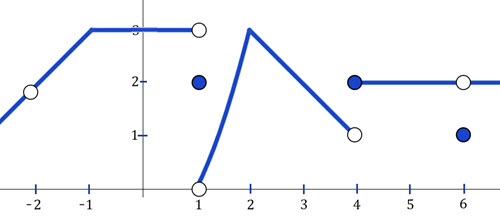 \(…\)
\(…\)
\(\bullet\text{ Continuity on Graphs}\)
\(\,\,\,\,\,\,\,\,\)\(…\)
\(\bullet\text{ Piecewise Functions- Limits and Continuity}\)
\(\,\,\,\,\,\,\,\,\)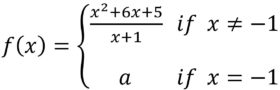 \(…\)
\(…\)
\(\bullet\text{ Limits at Infinity}\)
\(\,\,\,\,\,\,\,\,\displaystyle\lim_{x\to \infty}\frac{5x^2+2x-10}{3x^2+4x-5}…\)
\(\bullet\text{ Trig Limits}\)
\(\,\,\,\,\,\,\,\,\displaystyle \lim_{\theta\to0} \frac{\sin \theta}{\theta}=1…\)