

Related rates problems use derivatives to connect quantities that are changing at the same time. The main idea is to write an equation relating the variables, differentiate both sides with respect to time, and then substitute the given values. These problems include geometric formulas, distance problems, volume problems, and other real-world rate of change situations.
Practice Problems
\(\textbf{1)}\) \( y=x^2, \frac{dx}{dt}=5, \) Find \(\frac{dy}{dt}\) when \(x=2.\)
The answer is \( \frac{dy}{dt}=20 \)
\(\,\,\,\,\,\,y=x^2\)
\(\,\,\,\,\,\,\frac{dy}{dt}=2x\frac{dx}{dt}\)
\(\,\,\,\,\,\,\frac{dy}{dt}=2(2)(5)\)
\(\,\,\,\,\,\)The answer is \(\frac{dy}{dt}=20\)

\(\,\,\,\,\,\,y=x^2\)
\(\,\,\,\,\,\,\frac{dy}{dt}=2x\frac{dx}{dt}\)
\(\,\,\,\,\,\,\frac{dy}{dt}=2(2)(5)\)
\(\,\,\,\,\,\)The answer is \(\frac{dy}{dt}=20\)
\(\textbf{2)}\) \( y=\sqrt[3]{x}, \frac{dx}{dt}=6, \) Find \( \frac{dy}{dt} \) when \( x=1. \)
The answer is \( \frac{dy}{dt}=2 \)
\(\,\,\,\,\,\,y=\sqrt[3]{x}=x^{1/3}\)
\(\,\,\,\,\,\,\frac{dy}{dt}=\frac{1}{3}x^{-2/3}\frac{dx}{dt}\)
\(\,\,\,\,\,\,\frac{dy}{dt}=\frac{1}{3}(1)^{-2/3}(6)\)
\(\,\,\,\,\,\,\frac{dy}{dt}=2\)
\(\,\,\,\,\,\)The answer is \(\frac{dy}{dt}=2\)
\(\,\,\,\,\,\,y=\sqrt[3]{x}=x^{1/3}\)
\(\,\,\,\,\,\,\frac{dy}{dt}=\frac{1}{3}x^{-2/3}\frac{dx}{dt}\)
\(\,\,\,\,\,\,\frac{dy}{dt}=\frac{1}{3}(1)^{-2/3}(6)\)
\(\,\,\,\,\,\,\frac{dy}{dt}=2\)
\(\,\,\,\,\,\)The answer is \(\frac{dy}{dt}=2\)
\(\textbf{3)}\) \( xy=8, \frac{dx}{dt}=6, \) Find \( \frac{dy}{dt} \) when \( x=8 \)
The answer is \( \frac{dy}{dt}=-\frac{3}{4} \)
\(\,\,\,\,\,\,xy=8\)
\(\,\,\,\,\,\,x\frac{dy}{dt}+y\frac{dx}{dt}=0\)
\(\,\,\,\,\,\,\text{When }x=8,\text{ use }xy=8\text{ to get }y=1.\)
\(\,\,\,\,\,\,8\frac{dy}{dt}+1(6)=0\)
\(\,\,\,\,\,\,8\frac{dy}{dt}=-6\)
\(\,\,\,\,\,\)The answer is \(\frac{dy}{dt}=-\frac{3}{4}\)
\(\,\,\,\,\,\,xy=8\)
\(\,\,\,\,\,\,x\frac{dy}{dt}+y\frac{dx}{dt}=0\)
\(\,\,\,\,\,\,\text{When }x=8,\text{ use }xy=8\text{ to get }y=1.\)
\(\,\,\,\,\,\,8\frac{dy}{dt}+1(6)=0\)
\(\,\,\,\,\,\,8\frac{dy}{dt}=-6\)
\(\,\,\,\,\,\)The answer is \(\frac{dy}{dt}=-\frac{3}{4}\)
\(\textbf{4)}\) The radius of a circle is increasing at a rate of 2 inches per minute. What rate is the area of the circle changing when the radius is 10 inches?
The answer is \( 40\pi\) inches\(^2\)/minute
\(\,\,\,\,\,\,A=\pi r^2\)
\(\,\,\,\,\,\,\frac{dA}{dt}=2\pi r\frac{dr}{dt}\)
\(\,\,\,\,\,\,r=10\)
\(\,\,\,\,\,\,\frac{dr}{dt}=2\)
\(\,\,\,\,\,\,\frac{dA}{dt}=2\pi(10)(2)\)
\(\,\,\,\,\,\)The answer is \(40\pi\) inches\(^2\)/minute
\(\,\,\,\,\,\,A=\pi r^2\)
\(\,\,\,\,\,\,\frac{dA}{dt}=2\pi r\frac{dr}{dt}\)
\(\,\,\,\,\,\,r=10\)
\(\,\,\,\,\,\,\frac{dr}{dt}=2\)
\(\,\,\,\,\,\,\frac{dA}{dt}=2\pi(10)(2)\)
\(\,\,\,\,\,\)The answer is \(40\pi\) inches\(^2\)/minute
\(\textbf{5)}\) A sphere’s volume is increasing at 100 cubic meters per hour. How fast is the radius increasing when the radius is 10 meters?
The answer is \( \frac{1}{4\pi}\) meters/hour
\(\,\,\,\,\,\,V=\frac{4}{3}\pi r^3\)
\(\,\,\,\,\,\,\frac{dV}{dt}=4\pi r^2\frac{dr}{dt}\)
\(\,\,\,\,\,\,100=4\pi(10)^2\frac{dr}{dt}\)
\(\,\,\,\,\,\,100=400\pi\frac{dr}{dt}\)
\(\,\,\,\,\,\)The answer is \(\frac{dr}{dt}=\frac{1}{4\pi}\) meters/hour
\(\,\,\,\,\,\,V=\frac{4}{3}\pi r^3\)
\(\,\,\,\,\,\,\frac{dV}{dt}=4\pi r^2\frac{dr}{dt}\)
\(\,\,\,\,\,\,100=4\pi(10)^2\frac{dr}{dt}\)
\(\,\,\,\,\,\,100=400\pi\frac{dr}{dt}\)
\(\,\,\,\,\,\)The answer is \(\frac{dr}{dt}=\frac{1}{4\pi}\) meters/hour
\(\textbf{6)}\) The edges of a cube are expanding at a rate of 2 feet per minute. How fast is the volume changing when each edge is 4 feet?
The answer is \( 96 \) feet\(^3\)/ minute
\(\,\,\,\,\,\,V=s^3\)
\(\,\,\,\,\,\,\frac{dV}{dt}=3s^2\frac{ds}{dt}\)
\(\,\,\,\,\,\,s=4\)
\(\,\,\,\,\,\,\frac{ds}{dt}=2\)
\(\,\,\,\,\,\,\frac{dV}{dt}=3(4)^2(2)\)
\(\,\,\,\,\,\)The answer is \(96\) feet\(^3\)/minute
\(\,\,\,\,\,\,V=s^3\)
\(\,\,\,\,\,\,\frac{dV}{dt}=3s^2\frac{ds}{dt}\)
\(\,\,\,\,\,\,s=4\)
\(\,\,\,\,\,\,\frac{ds}{dt}=2\)
\(\,\,\,\,\,\,\frac{dV}{dt}=3(4)^2(2)\)
\(\,\,\,\,\,\)The answer is \(96\) feet\(^3\)/minute
\(\textbf{7)}\) A square has sides increasing at a rate of 4 m/s. At what rate is the area of the square increasing when the area is \( 25 m^2 \)?
The answer is \( 40 \) meters\(^2\)/second
\(\,\,\,\,\,\,A=s^2\)
\(\,\,\,\,\,\,\frac{dA}{dt}=2s\frac{ds}{dt}\)
\(\,\,\,\,\,\,25=s^2\)
\(\,\,\,\,\,\,s=5\)
\(\,\,\,\,\,\,\frac{dA}{dt}=2(5)(4)\)
\(\,\,\,\,\,\)The answer is \(40\) meters\(^2\)/second
\(\,\,\,\,\,\,A=s^2\)
\(\,\,\,\,\,\,\frac{dA}{dt}=2s\frac{ds}{dt}\)
\(\,\,\,\,\,\,25=s^2\)
\(\,\,\,\,\,\,s=5\)
\(\,\,\,\,\,\,\frac{dA}{dt}=2(5)(4)\)
\(\,\,\,\,\,\)The answer is \(40\) meters\(^2\)/second
\(\textbf{8)}\) A cylindrical tank has a fixed radius of 5 ft. The tank is being filled with water at a rate of 4 cubic feet per minute. How fast is the depth of the water increasing?
The answer is \( \frac{4}{25\pi} \) feet/ minute
\(\,\,\,\,\,\,V=\pi r^2h\)
\(\,\,\,\,\,\,r=5\)
\(\,\,\,\,\,\,V=25\pi h\)
\(\,\,\,\,\,\,\frac{dV}{dt}=25\pi\frac{dh}{dt}\)
\(\,\,\,\,\,\,4=25\pi\frac{dh}{dt}\)
\(\,\,\,\,\,\)The answer is \(\frac{dh}{dt}=\frac{4}{25\pi}\) feet/minute
\(\,\,\,\,\,\,V=\pi r^2h\)
\(\,\,\,\,\,\,r=5\)
\(\,\,\,\,\,\,V=25\pi h\)
\(\,\,\,\,\,\,\frac{dV}{dt}=25\pi\frac{dh}{dt}\)
\(\,\,\,\,\,\,4=25\pi\frac{dh}{dt}\)
\(\,\,\,\,\,\)The answer is \(\frac{dh}{dt}=\frac{4}{25\pi}\) feet/minute
\(\textbf{9)}\) A sphere has a radius increasing at 3 ft/minute. How fast is the volume increasing when the surface area of the sphere is 100 \(\pi \) square feet?
The answer is \( 300 \) feet\(^3\)/ minute
\(\,\,\,\,\,\,S=4\pi r^2\)
\(\,\,\,\,\,\,100\pi=4\pi r^2\)
\(\,\,\,\,\,\,r=5\)
\(\,\,\,\,\,\,V=\frac{4}{3}\pi r^3\)
\(\,\,\,\,\,\,\frac{dV}{dt}=4\pi r^2\frac{dr}{dt}\)
\(\,\,\,\,\,\,\frac{dV}{dt}=4\pi(5)^2(3)\)
\(\,\,\,\,\,\)The answer is \(300\pi\) feet\(^3\)/minute
\(\,\,\,\,\,\,S=4\pi r^2\)
\(\,\,\,\,\,\,100\pi=4\pi r^2\)
\(\,\,\,\,\,\,r=5\)
\(\,\,\,\,\,\,V=\frac{4}{3}\pi r^3\)
\(\,\,\,\,\,\,\frac{dV}{dt}=4\pi r^2\frac{dr}{dt}\)
\(\,\,\,\,\,\,\frac{dV}{dt}=4\pi(5)^2(3)\)
\(\,\,\,\,\,\)The answer is \(300\pi\) feet\(^3\)/minute
\(\textbf{10)}\) A sphere has a radius increasing at a rate of 6 mm/s. How fast is the surface area of the sphere changing when the diameter is 10 mm?
The answer is \( 240\pi \) mm\(^2\)/ second
\(\,\,\,\,\,\,S=4\pi r^2\)
\(\,\,\,\,\,\,\frac{dS}{dt}=8\pi r\frac{dr}{dt}\)
\(\,\,\,\,\,\,\text{If the diameter is }10,\text{ then }r=5.\)
\(\,\,\,\,\,\,\frac{dr}{dt}=6\)
\(\,\,\,\,\,\,\frac{dS}{dt}=8\pi(5)(6)\)
\(\,\,\,\,\,\)The answer is \(240\pi\) mm\(^2\)/second
\(\,\,\,\,\,\,S=4\pi r^2\)
\(\,\,\,\,\,\,\frac{dS}{dt}=8\pi r\frac{dr}{dt}\)
\(\,\,\,\,\,\,\text{If the diameter is }10,\text{ then }r=5.\)
\(\,\,\,\,\,\,\frac{dr}{dt}=6\)
\(\,\,\,\,\,\,\frac{dS}{dt}=8\pi(5)(6)\)
\(\,\,\,\,\,\)The answer is \(240\pi\) mm\(^2\)/second
\(\textbf{11)}\) A plane is flying above a school. Its altitude is 1 mile. Its speed is 200 mph. At what rate is the distance between the plane and school changing when the plane is 5 miles from the school?
The answer is \( 80\sqrt{6} \) miles/hour
\(\,\,\,\,\,\,x^2+1^2=s^2\)
\(\,\,\,\,\,\,2x\frac{dx}{dt}=2s\frac{ds}{dt}\)
\(\,\,\,\,\,\,x^2+1=5^2\)
\(\,\,\,\,\,\,x^2=24\)
\(\,\,\,\,\,\,x=2\sqrt{6}\)
\(\,\,\,\,\,\,2(2\sqrt{6})(200)=2(5)\frac{ds}{dt}\)
\(\,\,\,\,\,\)The answer is \(\frac{ds}{dt}=80\sqrt{6}\) miles/hour
\(\,\,\,\,\,\,x^2+1^2=s^2\)
\(\,\,\,\,\,\,2x\frac{dx}{dt}=2s\frac{ds}{dt}\)
\(\,\,\,\,\,\,x^2+1=5^2\)
\(\,\,\,\,\,\,x^2=24\)
\(\,\,\,\,\,\,x=2\sqrt{6}\)
\(\,\,\,\,\,\,2(2\sqrt{6})(200)=2(5)\frac{ds}{dt}\)
\(\,\,\,\,\,\)The answer is \(\frac{ds}{dt}=80\sqrt{6}\) miles/hour
\(\textbf{12)}\) Two planes leave the same point at the same time. 1 plane flies east at 200 mph. The other plane flies south at 150 mph. At what rate is the distance between the planes increasing 30 minutes after they take off?
The answer is \( 250 \) miles/hour
\(\,\,\,\,\,\,x^2+y^2=s^2\)
\(\,\,\,\,\,\,2x\frac{dx}{dt}+2y\frac{dy}{dt}=2s\frac{ds}{dt}\)
\(\,\,\,\,\,\,30\text{ minutes}=\frac{1}{2}\text{ hour}\)
\(\,\,\,\,\,\,x=200\left(\frac{1}{2}\right)=100\)
\(\,\,\,\,\,\,y=150\left(\frac{1}{2}\right)=75\)
\(\,\,\,\,\,\,s=\sqrt{100^2+75^2}=125\)
\(\,\,\,\,\,\,2(100)(200)+2(75)(150)=2(125)\frac{ds}{dt}\)
\(\,\,\,\,\,\)The answer is \(\frac{ds}{dt}=250\) miles/hour
\(\,\,\,\,\,\,x^2+y^2=s^2\)
\(\,\,\,\,\,\,2x\frac{dx}{dt}+2y\frac{dy}{dt}=2s\frac{ds}{dt}\)
\(\,\,\,\,\,\,30\text{ minutes}=\frac{1}{2}\text{ hour}\)
\(\,\,\,\,\,\,x=200\left(\frac{1}{2}\right)=100\)
\(\,\,\,\,\,\,y=150\left(\frac{1}{2}\right)=75\)
\(\,\,\,\,\,\,s=\sqrt{100^2+75^2}=125\)
\(\,\,\,\,\,\,2(100)(200)+2(75)(150)=2(125)\frac{ds}{dt}\)
\(\,\,\,\,\,\)The answer is \(\frac{ds}{dt}=250\) miles/hour
\(\textbf{13)}\) A liquid spilled from a container spreads in a circle whose circumference increases at a rate of 10 in/sec. How fast is the area of the spill increasing when the circumference of the circle is 30\(π\) inches?
The answer is \( 150 \) inches \(^2\)/ second
\(\,\,\,\,\,\,C=2\pi r\)
\(\,\,\,\,\,\,\frac{dC}{dt}=2\pi\frac{dr}{dt}\)
\(\,\,\,\,\,\,30\pi=2\pi r\)
\(\,\,\,\,\,\,r=15\)
\(\,\,\,\,\,\,10=2\pi\frac{dr}{dt}\)
\(\,\,\,\,\,\,\frac{dr}{dt}=\frac{5}{\pi}\)
\(\,\,\,\,\,\,A=\pi r^2\)
\(\,\,\,\,\,\,\frac{dA}{dt}=2\pi r\frac{dr}{dt}\)
\(\,\,\,\,\,\,\frac{dA}{dt}=2\pi(15)\left(\frac{5}{\pi}\right)\)
\(\,\,\,\,\,\)The answer is \(150\) inches\(^2\)/second
\(\,\,\,\,\,\,C=2\pi r\)
\(\,\,\,\,\,\,\frac{dC}{dt}=2\pi\frac{dr}{dt}\)
\(\,\,\,\,\,\,30\pi=2\pi r\)
\(\,\,\,\,\,\,r=15\)
\(\,\,\,\,\,\,10=2\pi\frac{dr}{dt}\)
\(\,\,\,\,\,\,\frac{dr}{dt}=\frac{5}{\pi}\)
\(\,\,\,\,\,\,A=\pi r^2\)
\(\,\,\,\,\,\,\frac{dA}{dt}=2\pi r\frac{dr}{dt}\)
\(\,\,\,\,\,\,\frac{dA}{dt}=2\pi(15)\left(\frac{5}{\pi}\right)\)
\(\,\,\,\,\,\)The answer is \(150\) inches\(^2\)/second
\(\textbf{14)}\) The volume of a sphere is increasing at a rate of \( 8π \) \( in^3\)/sec. How fast is the radius of the balloon increasing when the radius is 2 in?
The answer is \(\frac{1}{2}\) inches/ second
\(\,\,\,\,\,\,V=\frac{4}{3}\pi r^3\)
\(\,\,\,\,\,\,\frac{dV}{dt}=4\pi r^2\frac{dr}{dt}\)
\(\,\,\,\,\,\,8\pi=4\pi(2)^2\frac{dr}{dt}\)
\(\,\,\,\,\,\,8\pi=16\pi\frac{dr}{dt}\)
\(\,\,\,\,\,\)The answer is \(\frac{dr}{dt}=\frac{1}{2}\) inches/second
\(\,\,\,\,\,\,V=\frac{4}{3}\pi r^3\)
\(\,\,\,\,\,\,\frac{dV}{dt}=4\pi r^2\frac{dr}{dt}\)
\(\,\,\,\,\,\,8\pi=4\pi(2)^2\frac{dr}{dt}\)
\(\,\,\,\,\,\,8\pi=16\pi\frac{dr}{dt}\)
\(\,\,\,\,\,\)The answer is \(\frac{dr}{dt}=\frac{1}{2}\) inches/second
\(\textbf{15)}\) 2 cars leave a town at the same time. The first Car heads north at a rate of 40 mph and the second car heads west at a rate of 30 mph. How fast is the distance between the cars increasing after 2 hours?
The answer is \(50\) miles/ hour
\(\,\,\,\,\,\,x^2+y^2=s^2\)
\(\,\,\,\,\,\,2x\frac{dx}{dt}+2y\frac{dy}{dt}=2s\frac{ds}{dt}\)
\(\,\,\,\,\,\,x=30(2)=60\)
\(\,\,\,\,\,\,y=40(2)=80\)
\(\,\,\,\,\,\,s=\sqrt{60^2+80^2}=100\)
\(\,\,\,\,\,\,2(60)(30)+2(80)(40)=2(100)\frac{ds}{dt}\)
\(\,\,\,\,\,\,10000=200\frac{ds}{dt}\)
\(\,\,\,\,\,\)The answer is \(\frac{ds}{dt}=50\) miles/hour
\(\,\,\,\,\,\,x^2+y^2=s^2\)
\(\,\,\,\,\,\,2x\frac{dx}{dt}+2y\frac{dy}{dt}=2s\frac{ds}{dt}\)
\(\,\,\,\,\,\,x=30(2)=60\)
\(\,\,\,\,\,\,y=40(2)=80\)
\(\,\,\,\,\,\,s=\sqrt{60^2+80^2}=100\)
\(\,\,\,\,\,\,2(60)(30)+2(80)(40)=2(100)\frac{ds}{dt}\)
\(\,\,\,\,\,\,10000=200\frac{ds}{dt}\)
\(\,\,\,\,\,\)The answer is \(\frac{ds}{dt}=50\) miles/hour
\(\textbf{16)}\) A cylinder with fixed radius 5 meters is filling with fluid at a rate of 50\(π\) \(m^3 \)/ sec. How fast is the height increasing? The answer is \(2\) meters/ second
\(\,\,\,\,\,\,V=\pi r^2h\)
\(\,\,\,\,\,\,r=5\)
\(\,\,\,\,\,\,V=25\pi h\)
\(\,\,\,\,\,\,\frac{dV}{dt}=25\pi\frac{dh}{dt}\)
\(\,\,\,\,\,\,50\pi=25\pi\frac{dh}{dt}\)
\(\,\,\,\,\,\)The answer is \(\frac{dh}{dt}=2\) meters/second
\(\,\,\,\,\,\,V=\pi r^2h\)
\(\,\,\,\,\,\,r=5\)
\(\,\,\,\,\,\,V=25\pi h\)
\(\,\,\,\,\,\,\frac{dV}{dt}=25\pi\frac{dh}{dt}\)
\(\,\,\,\,\,\,50\pi=25\pi\frac{dh}{dt}\)
\(\,\,\,\,\,\)The answer is \(\frac{dh}{dt}=2\) meters/second
\(\textbf{17)}\) The sides of an equilateral triangle are increasing at the rate of 10 ft/min. How fast is the triangle’s area increasing when each side of the triangle is 15 inches long? The answer is \(\frac{25}{4} \sqrt{3}\) feet\(^2\)/ minute
\(\,\,\,\,\,\,A=\frac{\sqrt{3}}{4}s^2\)
\(\,\,\,\,\,\,\frac{dA}{dt}=\frac{\sqrt{3}}{2}s\frac{ds}{dt}\)
\(\,\,\,\,\,\,15\text{ inches}=\frac{15}{12}=\frac{5}{4}\text{ feet}\)
\(\,\,\,\,\,\,\frac{ds}{dt}=10\)
\(\,\,\,\,\,\,\frac{dA}{dt}=\frac{\sqrt{3}}{2}\left(\frac{5}{4}\right)(10)\)
\(\,\,\,\,\,\)The answer is \(\frac{25\sqrt{3}}{4}\) feet\(^2\)/minute
\(\,\,\,\,\,\,A=\frac{\sqrt{3}}{4}s^2\)
\(\,\,\,\,\,\,\frac{dA}{dt}=\frac{\sqrt{3}}{2}s\frac{ds}{dt}\)
\(\,\,\,\,\,\,15\text{ inches}=\frac{15}{12}=\frac{5}{4}\text{ feet}\)
\(\,\,\,\,\,\,\frac{ds}{dt}=10\)
\(\,\,\,\,\,\,\frac{dA}{dt}=\frac{\sqrt{3}}{2}\left(\frac{5}{4}\right)(10)\)
\(\,\,\,\,\,\)The answer is \(\frac{25\sqrt{3}}{4}\) feet\(^2\)/minute
\(\textbf{18)}\) An inverted cone has a radius of 25 in and a depth of 15 in. If water is flowing out of the vertex of the container at a rate of 5\(π\) inches\(^3\)/minute, how fast is the depth of the water dropping when the water height is 5 inches?
The answer is \(\frac{9}{125}\) inches/ minute
\(\,\,\,\,\,\,\frac{r}{h}=\frac{25}{15}=\frac{5}{3}\)
\(\,\,\,\,\,\,r=\frac{5}{3}h\)
\(\,\,\,\,\,\,V=\frac{1}{3}\pi r^2h\)
\(\,\,\,\,\,\,V=\frac{1}{3}\pi\left(\frac{5}{3}h\right)^2h\)
\(\,\,\,\,\,\,V=\frac{25\pi}{27}h^3\)
\(\,\,\,\,\,\,\frac{dV}{dt}=\frac{25\pi}{9}h^2\frac{dh}{dt}\)
\(\,\,\,\,\,\,-5\pi=\frac{25\pi}{9}(5)^2\frac{dh}{dt}\)
\(\,\,\,\,\,\,-5\pi=\frac{625\pi}{9}\frac{dh}{dt}\)
\(\,\,\,\,\,\,\frac{dh}{dt}=-\frac{9}{125}\)
\(\,\,\,\,\,\)The depth is dropping at \(\frac{9}{125}\) inches/minute
\(\,\,\,\,\,\,\frac{r}{h}=\frac{25}{15}=\frac{5}{3}\)
\(\,\,\,\,\,\,r=\frac{5}{3}h\)
\(\,\,\,\,\,\,V=\frac{1}{3}\pi r^2h\)
\(\,\,\,\,\,\,V=\frac{1}{3}\pi\left(\frac{5}{3}h\right)^2h\)
\(\,\,\,\,\,\,V=\frac{25\pi}{27}h^3\)
\(\,\,\,\,\,\,\frac{dV}{dt}=\frac{25\pi}{9}h^2\frac{dh}{dt}\)
\(\,\,\,\,\,\,-5\pi=\frac{25\pi}{9}(5)^2\frac{dh}{dt}\)
\(\,\,\,\,\,\,-5\pi=\frac{625\pi}{9}\frac{dh}{dt}\)
\(\,\,\,\,\,\,\frac{dh}{dt}=-\frac{9}{125}\)
\(\,\,\,\,\,\)The depth is dropping at \(\frac{9}{125}\) inches/minute
\(\textbf{19)}\) A boat is being pulled towards a larger boat by a rope. The rope is attached to the larger boat 10 feet above the rope hook on the smaller boat. The rope is pulled in at a rate of 2 ft/sec. How fast is the smaller boat approaching the larger boat when 20 feet of rope is still out?
The answer is \(– \frac{4\sqrt{3}}{3}\) feet/ second
\(\,\,\,\,\,\,x^2+10^2=s^2\)
\(\,\,\,\,\,\,2x\frac{dx}{dt}=2s\frac{ds}{dt}\)
\(\,\,\,\,\,\,s=20\)
\(\,\,\,\,\,\,\frac{ds}{dt}=-2\)
\(\,\,\,\,\,\,x^2+100=20^2\)
\(\,\,\,\,\,\,x^2=300\)
\(\,\,\,\,\,\,x=10\sqrt{3}\)
\(\,\,\,\,\,\,2(10\sqrt{3})\frac{dx}{dt}=2(20)(-2)\)
\(\,\,\,\,\,\,20\sqrt{3}\frac{dx}{dt}=-80\)
\(\,\,\,\,\,\)The answer is \(\frac{dx}{dt}=-\frac{4\sqrt{3}}{3}\) feet/second
\(\,\,\,\,\,\,x^2+10^2=s^2\)
\(\,\,\,\,\,\,2x\frac{dx}{dt}=2s\frac{ds}{dt}\)
\(\,\,\,\,\,\,s=20\)
\(\,\,\,\,\,\,\frac{ds}{dt}=-2\)
\(\,\,\,\,\,\,x^2+100=20^2\)
\(\,\,\,\,\,\,x^2=300\)
\(\,\,\,\,\,\,x=10\sqrt{3}\)
\(\,\,\,\,\,\,2(10\sqrt{3})\frac{dx}{dt}=2(20)(-2)\)
\(\,\,\,\,\,\,20\sqrt{3}\frac{dx}{dt}=-80\)
\(\,\,\,\,\,\)The answer is \(\frac{dx}{dt}=-\frac{4\sqrt{3}}{3}\) feet/second
\(\textbf{20)}\) The current is decreasing at -2 amps/sec as the resistance increases at 15 ohms/sec. How fast is the voltage changing when the voltage is 20 volts and the current is 5 amps? Note: use V=IR.
The answer is \(67\) volts/ second
\(\,\,\,\,\,\,V=IR\)
\(\,\,\,\,\,\,\frac{dV}{dt}=I\frac{dR}{dt}+R\frac{dI}{dt}\)
\(\,\,\,\,\,\,20=5R\)
\(\,\,\,\,\,\,R=4\)
\(\,\,\,\,\,\,I=5\)
\(\,\,\,\,\,\,\frac{dR}{dt}=15\)
\(\,\,\,\,\,\,\frac{dI}{dt}=-2\)
\(\,\,\,\,\,\,\frac{dV}{dt}=5(15)+4(-2)\)
\(\,\,\,\,\,\,\frac{dV}{dt}=75-8\)
\(\,\,\,\,\,\)The answer is \(67\) volts/second
\(\,\,\,\,\,\,V=IR\)
\(\,\,\,\,\,\,\frac{dV}{dt}=I\frac{dR}{dt}+R\frac{dI}{dt}\)
\(\,\,\,\,\,\,20=5R\)
\(\,\,\,\,\,\,R=4\)
\(\,\,\,\,\,\,I=5\)
\(\,\,\,\,\,\,\frac{dR}{dt}=15\)
\(\,\,\,\,\,\,\frac{dI}{dt}=-2\)
\(\,\,\,\,\,\,\frac{dV}{dt}=5(15)+4(-2)\)
\(\,\,\,\,\,\,\frac{dV}{dt}=75-8\)
\(\,\,\,\,\,\)The answer is \(67\) volts/second
Notes
Steps

Sample Layout
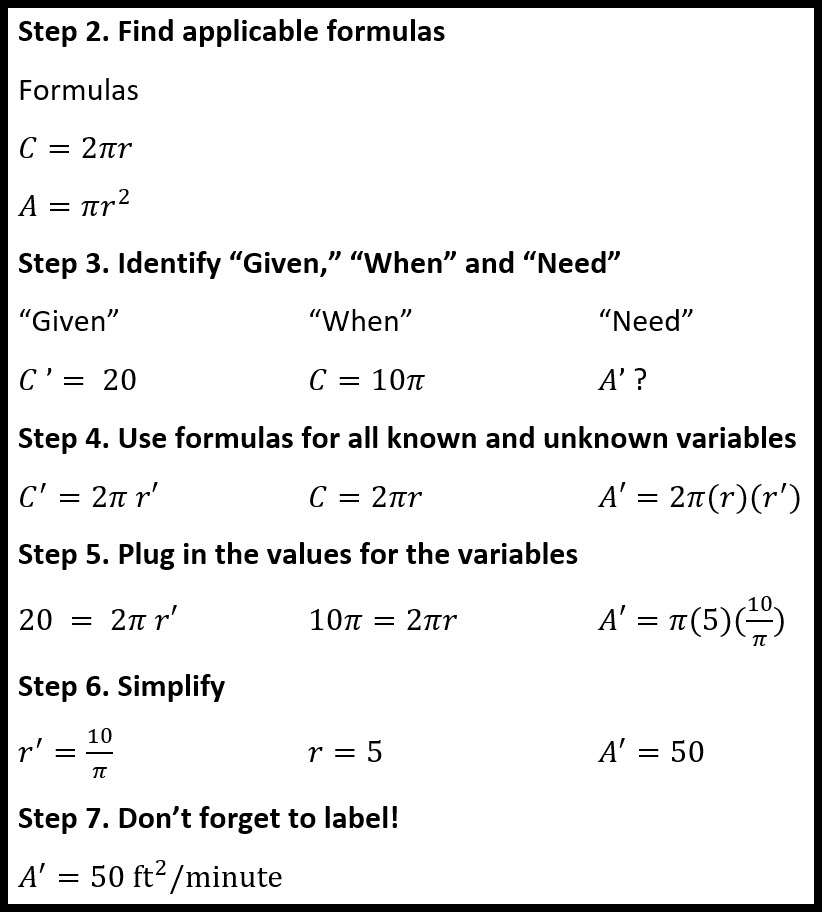
Common Formulas
Squares
Area\(=s^2 \enspace \enspace \) Perimeter\(=4s \)
Rectangles
Area\(=lw \enspace \enspace \) Perimeter\(=2l+2w \)
Circles
Area\(=πr^2 \enspace \enspace \) Circumference\(=2πr\)
Spheres
Volume\(=\frac{4}{3}πr^3 \enspace \enspace \) Surface Area\(= 4πr^2 \)
Cylinders
Volume\(= πr^2 h \enspace \enspace \) Surface Area\(= 2πr^2+2πrh \enspace \enspace \) Lateral Area\(= 2πrh \)
Cones
Volume\(= \frac{1}{3} πr^2 h\)
note: proportional triangles is popular inverted cones \(\frac{radius}{height}=\frac{x \enspace (new \enspace radius)}{depth \enspace of \enspace liquid} \)
Cubes
Volume\(= s^3 \enspace \enspace \) Surface Area\(=6s^2\)
Pythagorean Theorem
\(a^2+b^2=c^2\)
Electricity
\(V=IR\)
Angle of Elevation
\(\tan(\theta)=\displaystyle \frac{\text{opposite}}{\text{adjacent}}\)
See Related Pages\(\)
\(\bullet\text{ Calculus Homepage}\)
\(\,\,\,\,\,\,\,\,\text{All the Best Topics…}\)
\(\bullet\text{ Definition of Derivative}\)
\(\,\,\,\,\,\,\,\, \displaystyle \lim_{\Delta x\to 0} \frac{f(x+ \Delta x)-f(x)}{\Delta x} \)
\(\bullet\text{ Equation of the Tangent Line}\)
\(\,\,\,\,\,\,\,\,f(x)=x^3+3x^2−x \text{ at the point } (2,18)\)
\(\bullet\text{ Derivatives- Constant Rule}\)
\(\,\,\,\,\,\,\,\,\displaystyle\frac{d}{dx}(c)=0\)
\(\bullet\text{ Derivatives- Power Rule}\)
\(\,\,\,\,\,\,\,\,\displaystyle\frac{d}{dx}(x^n)=nx^{n-1}\)
\(\bullet\text{ Derivatives- Constant Multiple Rule}\)
\(\,\,\,\,\,\,\,\,\displaystyle\frac{d}{dx}(cf(x))=cf'(x)\)
\(\bullet\text{ Derivatives- Sum and Difference Rules}\)
\(\,\,\,\,\,\,\,\,\displaystyle\frac{d}{dx}[f(x) \pm g(x)]=f'(x) \pm g'(x)\)
\(\bullet\text{ Derivatives- Sin and Cos}\)
\(\,\,\,\,\,\,\,\,\displaystyle\frac{d}{dx}sin(x)=cos(x)\)
\(\bullet\text{ Derivatives- Product Rule}\)
\(\,\,\,\,\,\,\,\,\displaystyle\frac{d}{dx}[f(x) \cdot g(x)]=f(x) \cdot g'(x)+f'(x) \cdot g(x)\)
\(\bullet\text{ Derivatives- Quotient Rule}\)
\(\,\,\,\,\,\,\,\,\displaystyle\frac{d}{dx}\left[\displaystyle\frac{f(x)}{g(x)}\right]=\displaystyle\frac{g(x) \cdot f'(x)-f(x) \cdot g'(x)}{[g(x)]^2}\)
\(\bullet\text{ Derivatives- Chain Rule}\)
\(\,\,\,\,\,\,\,\,\displaystyle\frac{d}{dx}[f(g(x))]= f'(g(x)) \cdot g'(x)\)
\(\bullet\text{ Derivatives- ln(x)}\)
\(\,\,\,\,\,\,\,\,\displaystyle\frac{d}{dx}[ln(x)]= \displaystyle \frac{1}{x}\)
\(\bullet\text{ Implicit Differentiation}\)
\(\,\,\,\,\,\,\,\,\)
\(\bullet\text{ Horizontal Tangent Line}\)
\(\,\,\,\,\,\,\,\,\)
\(\bullet\text{ Mean Value Theorem}\)
\(\,\,\,\,\,\,\,\,\)
\(\bullet\text{ Related Rates}\)
\(\,\,\,\,\,\,\,\,\)
\(\bullet\text{ Increasing and Decreasing Intervals}\)
\(\,\,\,\,\,\,\,\,\)
\(\bullet\text{ Intervals of concave up and down}\)
\(\,\,\,\,\,\,\,\,\)
\(\bullet\text{ Inflection Points}\)
\(\,\,\,\,\,\,\,\,\)
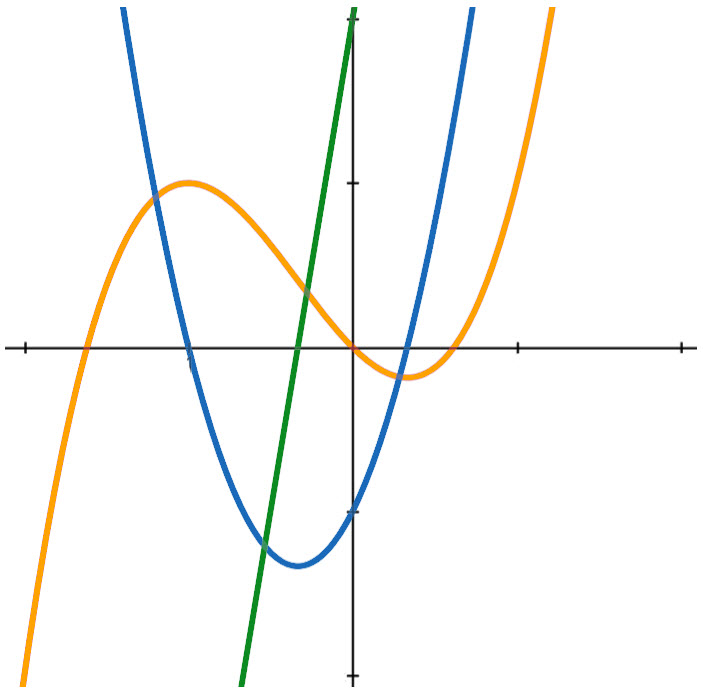
\(\bullet\text{ Graph of f(x), f'(x) and f”(x)}\)
\(\,\,\,\,\,\,\,\,\)
\(\bullet\text{ Newton’s Method}\)
\(\,\,\,\,\,\,\,\,x_{n+1}=x_n – \displaystyle \frac{f(x_n)}{f'(x_n)}\)