

Negative exponent derivative problems use the same power rule as positive exponent problems. The main idea is to bring the exponent down in front, then subtract one from the exponent. When a variable expression is written in the denominator, it can be rewritten with a negative exponent before taking the derivative.
Find the derivative of each function.
\(\textbf{1)}\) \(f(x)=x^{-5}\) The answer is \(f'(x)=-5x^{-6}\)
\(\,\,\,\,\,f(x)=x^{-5}\)
\(\,\,\,\,\,f'(x)=-5x^{-5-1}\)
\(\,\,\,\,\,f'(x)=-5x^{-6}\)
\(\,\,\,\,\,\)The answer is \(f'(x)=-5x^{-6}\)
\(\,\,\,\,\,f(x)=x^{-5}\)
\(\,\,\,\,\,f'(x)=-5x^{-5-1}\)
\(\,\,\,\,\,f'(x)=-5x^{-6}\)
\(\,\,\,\,\,\)The answer is \(f'(x)=-5x^{-6}\)
\(\textbf{2)}\) \(f(x)=-x^{-4}\) The answer is \(f'(x)=4x^{-5}\)
\(\,\,\,\,\,f(x)=-x^{-4}\)
\(\,\,\,\,\,f'(x)=-(-4)x^{-4-1}\)
\(\,\,\,\,\,f'(x)=4x^{-5}\)
\(\,\,\,\,\,\)The answer is \(f'(x)=4x^{-5}\)
\(\,\,\,\,\,f(x)=-x^{-4}\)
\(\,\,\,\,\,f'(x)=-(-4)x^{-4-1}\)
\(\,\,\,\,\,f'(x)=4x^{-5}\)
\(\,\,\,\,\,\)The answer is \(f'(x)=4x^{-5}\)
\(\textbf{3)}\) \(f(x)=x^{-1}\) The answer is \(f'(x)=-x^{-2}\)
\(\,\,\,\,\,f(x)=x^{-1}\)
\(\,\,\,\,\,f'(x)=-1x^{-1-1}\)
\(\,\,\,\,\,f'(x)=-x^{-2}\)
\(\,\,\,\,\,\)The answer is \(f'(x)=-x^{-2}\)
\(\,\,\,\,\,f(x)=x^{-1}\)
\(\,\,\,\,\,f'(x)=-1x^{-1-1}\)
\(\,\,\,\,\,f'(x)=-x^{-2}\)
\(\,\,\,\,\,\)The answer is \(f'(x)=-x^{-2}\)
\(\textbf{4)}\) \(f(x)=\displaystyle\frac{1}{x^{5}}\) The answer is \(f'(x)=-5x^{-6}\)
\(\,\,\,\,\,f(x)=\displaystyle\frac{1}{x^5}\)
\(\,\,\,\,\,f(x)=x^{-5}\)
\(\,\,\,\,\,f'(x)=-5x^{-6}\)
\(\,\,\,\,\,\)The answer is \(f'(x)=-5x^{-6}\)
\(\,\,\,\,\,f(x)=\displaystyle\frac{1}{x^5}\)
\(\,\,\,\,\,f(x)=x^{-5}\)
\(\,\,\,\,\,f'(x)=-5x^{-6}\)
\(\,\,\,\,\,\)The answer is \(f'(x)=-5x^{-6}\)
\(\textbf{5)}\) \(f(x)=-\displaystyle\frac{1}{x^{4}}\) The answer is \(f'(x)=4x^{-5}\)
\(\,\,\,\,\,f(x)=-\displaystyle\frac{1}{x^4}\)
\(\,\,\,\,\,f(x)=-x^{-4}\)
\(\,\,\,\,\,f'(x)=-(-4)x^{-5}\)
\(\,\,\,\,\,f'(x)=4x^{-5}\)
\(\,\,\,\,\,\)The answer is \(f'(x)=4x^{-5}\)
\(\,\,\,\,\,f(x)=-\displaystyle\frac{1}{x^4}\)
\(\,\,\,\,\,f(x)=-x^{-4}\)
\(\,\,\,\,\,f'(x)=-(-4)x^{-5}\)
\(\,\,\,\,\,f'(x)=4x^{-5}\)
\(\,\,\,\,\,\)The answer is \(f'(x)=4x^{-5}\)
\(\textbf{6)}\) \(f(x)=\displaystyle\frac{1}{x}\) The answer is \(f'(x)=-x^{-2}\)
\(\,\,\,\,\,f(x)=\displaystyle\frac{1}{x}\)
\(\,\,\,\,\,f(x)=x^{-1}\)
\(\,\,\,\,\,f'(x)=-1x^{-2}\)
\(\,\,\,\,\,f'(x)=-x^{-2}\)
\(\,\,\,\,\,\)The answer is \(f'(x)=-x^{-2}\)
\(\,\,\,\,\,f(x)=\displaystyle\frac{1}{x}\)
\(\,\,\,\,\,f(x)=x^{-1}\)
\(\,\,\,\,\,f'(x)=-1x^{-2}\)
\(\,\,\,\,\,f'(x)=-x^{-2}\)
\(\,\,\,\,\,\)The answer is \(f'(x)=-x^{-2}\)
\(\textbf{7)}\) \(f(x)=3x^{-2}\) The answer is \(f'(x)=-6x^{-3}\)
\(\,\,\,\,\,f(x)=3x^{-2}\)
\(\,\,\,\,\,f'(x)=3(-2)x^{-2-1}\)
\(\,\,\,\,\,f'(x)=-6x^{-3}\)
\(\,\,\,\,\,\)The answer is \(f'(x)=-6x^{-3}\)
\(\,\,\,\,\,f(x)=3x^{-2}\)
\(\,\,\,\,\,f'(x)=3(-2)x^{-2-1}\)
\(\,\,\,\,\,f'(x)=-6x^{-3}\)
\(\,\,\,\,\,\)The answer is \(f'(x)=-6x^{-3}\)
\(\textbf{8)}\) \(f(x)=-4x^{-3}\) The answer is \(f'(x)=12x^{-4}\)
\(\,\,\,\,\,f(x)=-4x^{-3}\)
\(\,\,\,\,\,f'(x)=-4(-3)x^{-3-1}\)
\(\,\,\,\,\,f'(x)=12x^{-4}\)
\(\,\,\,\,\,\)The answer is \(f'(x)=12x^{-4}\)
\(\,\,\,\,\,f(x)=-4x^{-3}\)
\(\,\,\,\,\,f'(x)=-4(-3)x^{-3-1}\)
\(\,\,\,\,\,f'(x)=12x^{-4}\)
\(\,\,\,\,\,\)The answer is \(f'(x)=12x^{-4}\)
\(\textbf{9)}\) \(f(x)=\displaystyle\frac{7}{x^2}\) The answer is \(f'(x)=-14x^{-3}\)
\(\,\,\,\,\,f(x)=\displaystyle\frac{7}{x^2}\)
\(\,\,\,\,\,f(x)=7x^{-2}\)
\(\,\,\,\,\,f'(x)=7(-2)x^{-3}\)
\(\,\,\,\,\,f'(x)=-14x^{-3}\)
\(\,\,\,\,\,\)The answer is \(f'(x)=-14x^{-3}\)
\(\,\,\,\,\,f(x)=\displaystyle\frac{7}{x^2}\)
\(\,\,\,\,\,f(x)=7x^{-2}\)
\(\,\,\,\,\,f'(x)=7(-2)x^{-3}\)
\(\,\,\,\,\,f'(x)=-14x^{-3}\)
\(\,\,\,\,\,\)The answer is \(f'(x)=-14x^{-3}\)
\(\textbf{10)}\) \(f(x)=-\displaystyle\frac{2}{x^6}\) The answer is \(f'(x)=12x^{-7}\)
\(\,\,\,\,\,f(x)=-\displaystyle\frac{2}{x^6}\)
\(\,\,\,\,\,f(x)=-2x^{-6}\)
\(\,\,\,\,\,f'(x)=-2(-6)x^{-7}\)
\(\,\,\,\,\,f'(x)=12x^{-7}\)
\(\,\,\,\,\,\)The answer is \(f'(x)=12x^{-7}\)
\(\,\,\,\,\,f(x)=-\displaystyle\frac{2}{x^6}\)
\(\,\,\,\,\,f(x)=-2x^{-6}\)
\(\,\,\,\,\,f'(x)=-2(-6)x^{-7}\)
\(\,\,\,\,\,f'(x)=12x^{-7}\)
\(\,\,\,\,\,\)The answer is \(f'(x)=12x^{-7}\)
\(\textbf{11)}\) \(f(x)=5x^{-1}+2x^{-3}\) The answer is \(f'(x)=-5x^{-2}-6x^{-4}\)
\(\,\,\,\,\,f(x)=5x^{-1}+2x^{-3}\)
\(\,\,\,\,\,f'(x)=5(-1)x^{-2}+2(-3)x^{-4}\)
\(\,\,\,\,\,f'(x)=-5x^{-2}-6x^{-4}\)
\(\,\,\,\,\,\)The answer is \(f'(x)=-5x^{-2}-6x^{-4}\)
\(\,\,\,\,\,f(x)=5x^{-1}+2x^{-3}\)
\(\,\,\,\,\,f'(x)=5(-1)x^{-2}+2(-3)x^{-4}\)
\(\,\,\,\,\,f'(x)=-5x^{-2}-6x^{-4}\)
\(\,\,\,\,\,\)The answer is \(f'(x)=-5x^{-2}-6x^{-4}\)
\(\textbf{12)}\) \(f(x)=\displaystyle\frac{4}{x}+\frac{3}{x^2}\) The answer is \(f'(x)=-4x^{-2}-6x^{-3}\)
\(\,\,\,\,\,f(x)=\displaystyle\frac{4}{x}+\frac{3}{x^2}\)
\(\,\,\,\,\,f(x)=4x^{-1}+3x^{-2}\)
\(\,\,\,\,\,f'(x)=4(-1)x^{-2}+3(-2)x^{-3}\)
\(\,\,\,\,\,f'(x)=-4x^{-2}-6x^{-3}\)
\(\,\,\,\,\,\)The answer is \(f'(x)=-4x^{-2}-6x^{-3}\)
\(\,\,\,\,\,f(x)=\displaystyle\frac{4}{x}+\frac{3}{x^2}\)
\(\,\,\,\,\,f(x)=4x^{-1}+3x^{-2}\)
\(\,\,\,\,\,f'(x)=4(-1)x^{-2}+3(-2)x^{-3}\)
\(\,\,\,\,\,f'(x)=-4x^{-2}-6x^{-3}\)
\(\,\,\,\,\,\)The answer is \(f'(x)=-4x^{-2}-6x^{-3}\)
\(\textbf{13)}\) \(f(x)=x^3+x^{-2}\) The answer is \(f'(x)=3x^2-2x^{-3}\)
\(\,\,\,\,\,f(x)=x^3+x^{-2}\)
\(\,\,\,\,\,f'(x)=3x^2+(-2)x^{-3}\)
\(\,\,\,\,\,f'(x)=3x^2-2x^{-3}\)
\(\,\,\,\,\,\)The answer is \(f'(x)=3x^2-2x^{-3}\)
\(\,\,\,\,\,f(x)=x^3+x^{-2}\)
\(\,\,\,\,\,f'(x)=3x^2+(-2)x^{-3}\)
\(\,\,\,\,\,f'(x)=3x^2-2x^{-3}\)
\(\,\,\,\,\,\)The answer is \(f'(x)=3x^2-2x^{-3}\)
\(\textbf{14)}\) \(f(x)=2x^4-6x^{-5}\) The answer is \(f'(x)=8x^3+30x^{-6}\)
\(\,\,\,\,\,f(x)=2x^4-6x^{-5}\)
\(\,\,\,\,\,f'(x)=2(4x^3)-6(-5x^{-6})\)
\(\,\,\,\,\,f'(x)=8x^3+30x^{-6}\)
\(\,\,\,\,\,\)The answer is \(f'(x)=8x^3+30x^{-6}\)
\(\,\,\,\,\,f(x)=2x^4-6x^{-5}\)
\(\,\,\,\,\,f'(x)=2(4x^3)-6(-5x^{-6})\)
\(\,\,\,\,\,f'(x)=8x^3+30x^{-6}\)
\(\,\,\,\,\,\)The answer is \(f'(x)=8x^3+30x^{-6}\)
\(\textbf{15)}\) \(f(x)=\displaystyle\frac{x^2+1}{x}\) The answer is \(f'(x)=1-x^{-2}\)
\(\,\,\,\,\,f(x)=\displaystyle\frac{x^2+1}{x}\)
\(\,\,\,\,\,f(x)=x+\frac{1}{x}\)
\(\,\,\,\,\,f(x)=x+x^{-1}\)
\(\,\,\,\,\,f'(x)=1-x^{-2}\)
\(\,\,\,\,\,\)The answer is \(f'(x)=1-x^{-2}\)
\(\,\,\,\,\,f(x)=\displaystyle\frac{x^2+1}{x}\)
\(\,\,\,\,\,f(x)=x+\frac{1}{x}\)
\(\,\,\,\,\,f(x)=x+x^{-1}\)
\(\,\,\,\,\,f'(x)=1-x^{-2}\)
\(\,\,\,\,\,\)The answer is \(f'(x)=1-x^{-2}\)
\(\textbf{16)}\) \(f(x)=\displaystyle\frac{x^3-2}{x^2}\) The answer is \(f'(x)=1+4x^{-3}\)
\(\,\,\,\,\,f(x)=\displaystyle\frac{x^3-2}{x^2}\)
\(\,\,\,\,\,f(x)=x-\frac{2}{x^2}\)
\(\,\,\,\,\,f(x)=x-2x^{-2}\)
\(\,\,\,\,\,f'(x)=1-2(-2)x^{-3}\)
\(\,\,\,\,\,f'(x)=1+4x^{-3}\)
\(\,\,\,\,\,\)The answer is \(f'(x)=1+4x^{-3}\)
\(\,\,\,\,\,f(x)=\displaystyle\frac{x^3-2}{x^2}\)
\(\,\,\,\,\,f(x)=x-\frac{2}{x^2}\)
\(\,\,\,\,\,f(x)=x-2x^{-2}\)
\(\,\,\,\,\,f'(x)=1-2(-2)x^{-3}\)
\(\,\,\,\,\,f'(x)=1+4x^{-3}\)
\(\,\,\,\,\,\)The answer is \(f'(x)=1+4x^{-3}\)
\(\textbf{17)}\) \(f(x)=\displaystyle\frac{3x^2-5}{x^3}\) The answer is \(f'(x)=-3x^{-2}+15x^{-4}\)
\(\,\,\,\,\,f(x)=\displaystyle\frac{3x^2-5}{x^3}\)
\(\,\,\,\,\,f(x)=3x^{-1}-5x^{-3}\)
\(\,\,\,\,\,f'(x)=3(-1)x^{-2}-5(-3)x^{-4}\)
\(\,\,\,\,\,f'(x)=-3x^{-2}+15x^{-4}\)
\(\,\,\,\,\,\)The answer is \(f'(x)=-3x^{-2}+15x^{-4}\)
\(\,\,\,\,\,f(x)=\displaystyle\frac{3x^2-5}{x^3}\)
\(\,\,\,\,\,f(x)=3x^{-1}-5x^{-3}\)
\(\,\,\,\,\,f'(x)=3(-1)x^{-2}-5(-3)x^{-4}\)
\(\,\,\,\,\,f'(x)=-3x^{-2}+15x^{-4}\)
\(\,\,\,\,\,\)The answer is \(f'(x)=-3x^{-2}+15x^{-4}\)
\(\textbf{18)}\) \(f(x)=\displaystyle\frac{2x^4+7}{x^5}\) The answer is \(f'(x)=-2x^{-2}-35x^{-6}\)
\(\,\,\,\,\,f(x)=\displaystyle\frac{2x^4+7}{x^5}\)
\(\,\,\,\,\,f(x)=2x^{-1}+7x^{-5}\)
\(\,\,\,\,\,f'(x)=2(-1)x^{-2}+7(-5)x^{-6}\)
\(\,\,\,\,\,f'(x)=-2x^{-2}-35x^{-6}\)
\(\,\,\,\,\,\)The answer is \(f'(x)=-2x^{-2}-35x^{-6}\)
\(\,\,\,\,\,f(x)=\displaystyle\frac{2x^4+7}{x^5}\)
\(\,\,\,\,\,f(x)=2x^{-1}+7x^{-5}\)
\(\,\,\,\,\,f'(x)=2(-1)x^{-2}+7(-5)x^{-6}\)
\(\,\,\,\,\,f'(x)=-2x^{-2}-35x^{-6}\)
\(\,\,\,\,\,\)The answer is \(f'(x)=-2x^{-2}-35x^{-6}\)
\(\textbf{19)}\) \(f(x)=\left(x^{-2}\right)^3\) The answer is \(f'(x)=-6x^{-7}\)
\(\,\,\,\,\,f(x)=\left(x^{-2}\right)^3\)
\(\,\,\,\,\,f(x)=x^{-6}\)
\(\,\,\,\,\,f'(x)=-6x^{-7}\)
\(\,\,\,\,\,\)The answer is \(f'(x)=-6x^{-7}\)
\(\,\,\,\,\,f(x)=\left(x^{-2}\right)^3\)
\(\,\,\,\,\,f(x)=x^{-6}\)
\(\,\,\,\,\,f'(x)=-6x^{-7}\)
\(\,\,\,\,\,\)The answer is \(f'(x)=-6x^{-7}\)
\(\textbf{20)}\) \(f(x)=\displaystyle\frac{1}{x^2}+\frac{1}{x^5}\) The answer is \(f'(x)=-2x^{-3}-5x^{-6}\)
\(\,\,\,\,\,f(x)=\displaystyle\frac{1}{x^2}+\frac{1}{x^5}\)
\(\,\,\,\,\,f(x)=x^{-2}+x^{-5}\)
\(\,\,\,\,\,f'(x)=-2x^{-3}-5x^{-6}\)
\(\,\,\,\,\,\)The answer is \(f'(x)=-2x^{-3}-5x^{-6}\)
\(\,\,\,\,\,f(x)=\displaystyle\frac{1}{x^2}+\frac{1}{x^5}\)
\(\,\,\,\,\,f(x)=x^{-2}+x^{-5}\)
\(\,\,\,\,\,f'(x)=-2x^{-3}-5x^{-6}\)
\(\,\,\,\,\,\)The answer is \(f'(x)=-2x^{-3}-5x^{-6}\)
See Related Pages\(\)
\(\bullet\text{Derivative Calculator }\)
\(\,\,\,\,\,\,\,\,\text{(Symbolab.com)}\)
\(\bullet\text{ Calculus Homepage}\)
\(\,\,\,\,\,\,\,\,\text{All the Best Topics…}\)
\(\bullet\text{ Definition of Derivative}\)
\(\,\,\,\,\,\,\,\, \displaystyle \lim_{\Delta x\to 0} \frac{f(x+ \Delta x)-f(x)}{\Delta x} \)
\(\bullet\text{ Equation of the Tangent Line}\)
\(\,\,\,\,\,\,\,\,f(x)=x^3+3x^2−x \text{ at the point } (2,18)\)
\(\bullet\text{ Derivatives- Constant Rule}\)
\(\,\,\,\,\,\,\,\,\displaystyle\frac{d}{dx}(c)=0\)
\(\bullet\text{ Derivatives- Power Rule}\)
\(\,\,\,\,\,\,\,\,\displaystyle\frac{d}{dx}(x^n)=nx^{n-1}\)
\(\bullet\text{ Derivatives- Constant Multiple Rule}\)
\(\,\,\,\,\,\,\,\,\displaystyle\frac{d}{dx}(cf(x))=cf'(x)\)
\(\bullet\text{ Derivatives- Sum and Difference Rules}\)
\(\,\,\,\,\,\,\,\,\displaystyle\frac{d}{dx}[f(x) \pm g(x)]=f'(x) \pm g'(x)\)
\(\bullet\text{ Derivatives- Sin and Cos}\)
\(\,\,\,\,\,\,\,\,\displaystyle\frac{d}{dx}sin(x)=cos(x)\)
\(\bullet\text{ Derivatives- Product Rule}\)
\(\,\,\,\,\,\,\,\,\displaystyle\frac{d}{dx}[f(x) \cdot g(x)]=f(x) \cdot g'(x)+f'(x) \cdot g(x)\)
\(\bullet\text{ Derivatives- Quotient Rule}\)
\(\,\,\,\,\,\,\,\,\displaystyle\frac{d}{dx}\left[\displaystyle\frac{f(x)}{g(x)}\right]=\displaystyle\frac{g(x) \cdot f'(x)-f(x) \cdot g'(x)}{[g(x)]^2}\)
\(\bullet\text{ Derivatives- Chain Rule}\)
\(\,\,\,\,\,\,\,\,\displaystyle\frac{d}{dx}[f(g(x))]= f'(g(x)) \cdot g'(x)\)
\(\bullet\text{ Derivatives- ln(x)}\)
\(\,\,\,\,\,\,\,\,\displaystyle\frac{d}{dx}[ln(x)]= \displaystyle \frac{1}{x}\)
\(\bullet\text{ Implicit Differentiation}\)
\(\,\,\,\,\,\,\,\,\)
\(\bullet\text{ Horizontal Tangent Line}\)
\(\,\,\,\,\,\,\,\,\)
\(\bullet\text{ Mean Value Theorem}\)
\(\,\,\,\,\,\,\,\,\)
\(\bullet\text{ Related Rates}\)
\(\,\,\,\,\,\,\,\,\)
\(\bullet\text{ Increasing and Decreasing Intervals}\)
\(\,\,\,\,\,\,\,\,\)
\(\bullet\text{ Intervals of concave up and down}\)
\(\,\,\,\,\,\,\,\,\)
\(\bullet\text{ Inflection Points}\)
\(\,\,\,\,\,\,\,\,\)
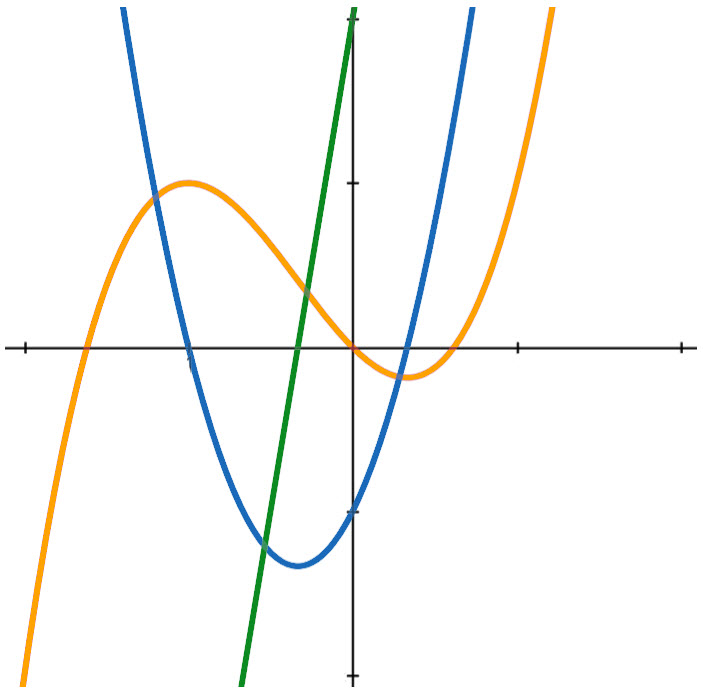
\(\bullet\text{ Graph of f(x), f'(x) and f”(x)}\)
\(\,\,\,\,\,\,\,\,\)
\(\bullet\text{ Newton’s Method}\)
\(\,\,\,\,\,\,\,\,x_{n+1}=x_n – \displaystyle \frac{f(x_n)}{f'(x_n)}\)