

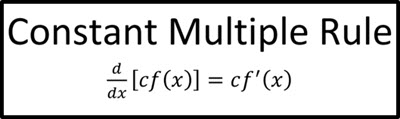
The constant multiple rule says that when a constant is multiplied by a function, the derivative is that same constant multiplied by the derivative of the function. This page focuses on using the constant multiple rule with power rule, trig derivatives, exponential derivatives, logarithmic derivatives, radicals, and fractions. These examples help build fluency with recognizing constants and applying derivative rules term by term.
Notes
Questions
Find the derivative of the function
\(\textbf{1)}\) \(f(x)=\displaystyle\frac{3}{x}\) The answer is \(-\displaystyle\frac{3}{x^2}\)
\(\,\,\,\,\,f(x)=3x^{-1}\)
\(\,\,\,\,\,f'(x)=(-1)3x^{-1-1}\)
\(\,\,\,\,\,f'(x)=-3x^{-2}\)
\(\,\,\,\,\,f'(x)=-\displaystyle\frac{3}{x^2}\)
\(\,\,\,\,\,\)The answer is \(-\displaystyle\frac{3}{x^2}\)

\(\,\,\,\,\,f(x)=3x^{-1}\)
\(\,\,\,\,\,f'(x)=(-1)3x^{-1-1}\)
\(\,\,\,\,\,f'(x)=-3x^{-2}\)
\(\,\,\,\,\,f'(x)=-\displaystyle\frac{3}{x^2}\)
\(\,\,\,\,\,\)The answer is \(-\displaystyle\frac{3}{x^2}\)
\(\textbf{2)}\) \(f(x)=\displaystyle\frac{5}{x}\) The derivative is \(f'(x)=-\displaystyle\frac{5}{x^2}\)
\(\,\,\,\,\,f(x)=5x^{-1}\)
\(\,\,\,\,\,f'(x)=(-1)5x^{-1-1}\)
\(\,\,\,\,\,f'(x)=-5x^{-2}\)
\(\,\,\,\,\,f'(x)=-\displaystyle\frac{5}{x^2}\)
\(\,\,\,\,\,\)The derivative is \(f'(x)=-\displaystyle\frac{5}{x^2}\)
\(\,\,\,\,\,f(x)=5x^{-1}\)
\(\,\,\,\,\,f'(x)=(-1)5x^{-1-1}\)
\(\,\,\,\,\,f'(x)=-5x^{-2}\)
\(\,\,\,\,\,f'(x)=-\displaystyle\frac{5}{x^2}\)
\(\,\,\,\,\,\)The derivative is \(f'(x)=-\displaystyle\frac{5}{x^2}\)
\(\textbf{3)}\) \(f(x)=\displaystyle\frac{1}{6}x^3\) The derivative is \(f'(x)=\displaystyle\frac{x^2}{2}\)
\(\,\,\,\,\,f(x)=\displaystyle\frac{1}{6}x^3\)
\(\,\,\,\,\,f'(x)=3\cdot\displaystyle\frac{1}{6}x^{3-1}\)
\(\,\,\,\,\,f'(x)=\displaystyle\frac{1}{2}x^{2}\)
\(\,\,\,\,\,f'(x)=\displaystyle\frac{x^2}{2}\)
\(\,\,\,\,\,\)The derivative is \(f'(x)=\displaystyle\frac{x^2}{2}\)
\(\,\,\,\,\,f(x)=\displaystyle\frac{1}{6}x^3\)
\(\,\,\,\,\,f'(x)=3\cdot\displaystyle\frac{1}{6}x^{3-1}\)
\(\,\,\,\,\,f'(x)=\displaystyle\frac{1}{2}x^{2}\)
\(\,\,\,\,\,f'(x)=\displaystyle\frac{x^2}{2}\)
\(\,\,\,\,\,\)The derivative is \(f'(x)=\displaystyle\frac{x^2}{2}\)
\(\textbf{4)}\) \(f(x)=5x^2\) The derivative is \(f'(x)=10x\)
\(\,\,\,\,\,f(x)=5x^2\)
\(\,\,\,\,\,f'(x)=2 \cdot 5x^{2-1}\)
\(\,\,\,\,\,f'(x)=10x\)
\(\,\,\,\,\,\)The derivative is \(f'(x)=10x\)
\(\,\,\,\,\,f(x)=5x^2\)
\(\,\,\,\,\,f'(x)=2 \cdot 5x^{2-1}\)
\(\,\,\,\,\,f'(x)=10x\)
\(\,\,\,\,\,\)The derivative is \(f'(x)=10x\)
\(\textbf{5)}\) \(f(x)=5 \sin x\) The derivative is \(f'(x)=5 \cos x\)
\(\,\,\,\,\,f(x)=5\sin x\)
\(\,\,\,\,\,\frac{d}{dx}(\sin x)=\cos x\)
\(\,\,\,\,\,f'(x)=5\cos x\)
\(\,\,\,\,\,\)The derivative is \(f'(x)=5 \cos x\)
\(\,\,\,\,\,f(x)=5\sin x\)
\(\,\,\,\,\,\frac{d}{dx}(\sin x)=\cos x\)
\(\,\,\,\,\,f'(x)=5\cos x\)
\(\,\,\,\,\,\)The derivative is \(f'(x)=5 \cos x\)
\(\textbf{6)}\) \(f(x)=-\displaystyle\frac{4}{x^2}\) The derivative is \(f'(x)=\displaystyle\frac{8}{x^3}\)
\(\,\,\,\,\,f(x)=-\frac{4}{x^2}\)
\(\,\,\,\,\,f(x)=-4x^{-2}\)
\(\,\,\,\,\,f'(x)=-4(-2)x^{-3}\)
\(\,\,\,\,\,f'(x)=8x^{-3}\)
\(\,\,\,\,\,f'(x)=\displaystyle\frac{8}{x^3}\)
\(\,\,\,\,\,\)The derivative is \(f'(x)=\displaystyle\frac{8}{x^3}\)
\(\,\,\,\,\,f(x)=-\frac{4}{x^2}\)
\(\,\,\,\,\,f(x)=-4x^{-2}\)
\(\,\,\,\,\,f'(x)=-4(-2)x^{-3}\)
\(\,\,\,\,\,f'(x)=8x^{-3}\)
\(\,\,\,\,\,f'(x)=\displaystyle\frac{8}{x^3}\)
\(\,\,\,\,\,\)The derivative is \(f'(x)=\displaystyle\frac{8}{x^3}\)
\(\textbf{7)}\) \(f(x)=3x^4-2x+8\) The answer is \(12x^3-2\)
\(\,\,\,\,\,f(x)=3x^4-2x+8\)
\(\,\,\,\,\,f'(x)=3(4x^3)-2(1)+0\)
\(\,\,\,\,\,f'(x)=12x^3-2\)
\(\,\,\,\,\,\)The answer is \(12x^3-2\)
\(\,\,\,\,\,f(x)=3x^4-2x+8\)
\(\,\,\,\,\,f'(x)=3(4x^3)-2(1)+0\)
\(\,\,\,\,\,f'(x)=12x^3-2\)
\(\,\,\,\,\,\)The answer is \(12x^3-2\)
\(\textbf{8)}\) \(f(x)=7x^3\) The derivative is \(f'(x)=21x^2\)
\(\,\,\,\,\,f(x)=7x^3\)
\(\,\,\,\,\,f'(x)=7(3x^2)\)
\(\,\,\,\,\,f'(x)=21x^2\)
\(\,\,\,\,\,\)The derivative is \(f'(x)=21x^2\)
\(\,\,\,\,\,f(x)=7x^3\)
\(\,\,\,\,\,f'(x)=7(3x^2)\)
\(\,\,\,\,\,f'(x)=21x^2\)
\(\,\,\,\,\,\)The derivative is \(f'(x)=21x^2\)
\(\textbf{9)}\) \(f(x)=-6x^5\) The derivative is \(f'(x)=-30x^4\)
\(\,\,\,\,\,f(x)=-6x^5\)
\(\,\,\,\,\,f'(x)=-6(5x^4)\)
\(\,\,\,\,\,f'(x)=-30x^4\)
\(\,\,\,\,\,\)The derivative is \(f'(x)=-30x^4\)
\(\,\,\,\,\,f(x)=-6x^5\)
\(\,\,\,\,\,f'(x)=-6(5x^4)\)
\(\,\,\,\,\,f'(x)=-30x^4\)
\(\,\,\,\,\,\)The derivative is \(f'(x)=-30x^4\)
\(\textbf{10)}\) \(f(x)=\displaystyle\frac{2}{3}x^6\) The derivative is \(f'(x)=4x^5\)
\(\,\,\,\,\,f(x)=\frac{2}{3}x^6\)
\(\,\,\,\,\,f'(x)=\frac{2}{3}(6x^5)\)
\(\,\,\,\,\,f'(x)=4x^5\)
\(\,\,\,\,\,\)The derivative is \(f'(x)=4x^5\)
\(\,\,\,\,\,f(x)=\frac{2}{3}x^6\)
\(\,\,\,\,\,f'(x)=\frac{2}{3}(6x^5)\)
\(\,\,\,\,\,f'(x)=4x^5\)
\(\,\,\,\,\,\)The derivative is \(f'(x)=4x^5\)
\(\textbf{11)}\) \(f(x)=-8\cos x\) The derivative is \(f'(x)=8\sin x\)
\(\,\,\,\,\,f(x)=-8\cos x\)
\(\,\,\,\,\,\frac{d}{dx}(\cos x)=-\sin x\)
\(\,\,\,\,\,f'(x)=-8(-\sin x)\)
\(\,\,\,\,\,f'(x)=8\sin x\)
\(\,\,\,\,\,\)The derivative is \(f'(x)=8\sin x\)
\(\,\,\,\,\,f(x)=-8\cos x\)
\(\,\,\,\,\,\frac{d}{dx}(\cos x)=-\sin x\)
\(\,\,\,\,\,f'(x)=-8(-\sin x)\)
\(\,\,\,\,\,f'(x)=8\sin x\)
\(\,\,\,\,\,\)The derivative is \(f'(x)=8\sin x\)
\(\textbf{12)}\) \(f(x)=9\tan x\) The derivative is \(f'(x)=9\sec^2 x\)
\(\,\,\,\,\,f(x)=9\tan x\)
\(\,\,\,\,\,\frac{d}{dx}(\tan x)=\sec^2 x\)
\(\,\,\,\,\,f'(x)=9\sec^2 x\)
\(\,\,\,\,\,\)The derivative is \(f'(x)=9\sec^2 x\)
\(\,\,\,\,\,f(x)=9\tan x\)
\(\,\,\,\,\,\frac{d}{dx}(\tan x)=\sec^2 x\)
\(\,\,\,\,\,f'(x)=9\sec^2 x\)
\(\,\,\,\,\,\)The derivative is \(f'(x)=9\sec^2 x\)
\(\textbf{13)}\) \(f(x)=-2e^x\) The derivative is \(f'(x)=-2e^x\)
\(\,\,\,\,\,f(x)=-2e^x\)
\(\,\,\,\,\,\frac{d}{dx}(e^x)=e^x\)
\(\,\,\,\,\,f'(x)=-2e^x\)
\(\,\,\,\,\,\)The derivative is \(f'(x)=-2e^x\)
\(\,\,\,\,\,f(x)=-2e^x\)
\(\,\,\,\,\,\frac{d}{dx}(e^x)=e^x\)
\(\,\,\,\,\,f'(x)=-2e^x\)
\(\,\,\,\,\,\)The derivative is \(f'(x)=-2e^x\)
\(\textbf{14)}\) \(f(x)=4\ln x\) The derivative is \(f'(x)=\displaystyle\frac{4}{x}\)
\(\,\,\,\,\,f(x)=4\ln x\)
\(\,\,\,\,\,\frac{d}{dx}(\ln x)=\frac{1}{x}\)
\(\,\,\,\,\,f'(x)=4\cdot\frac{1}{x}\)
\(\,\,\,\,\,f'(x)=\frac{4}{x}\)
\(\,\,\,\,\,\)The derivative is \(f'(x)=\displaystyle\frac{4}{x}\)
\(\,\,\,\,\,f(x)=4\ln x\)
\(\,\,\,\,\,\frac{d}{dx}(\ln x)=\frac{1}{x}\)
\(\,\,\,\,\,f'(x)=4\cdot\frac{1}{x}\)
\(\,\,\,\,\,f'(x)=\frac{4}{x}\)
\(\,\,\,\,\,\)The derivative is \(f'(x)=\displaystyle\frac{4}{x}\)
\(\textbf{15)}\) \(f(x)=\displaystyle\frac{9}{\sqrt{x}}\) The derivative is \(f'(x)=-\displaystyle\frac{9}{2x^{3/2}}\)
\(\,\,\,\,\,f(x)=\frac{9}{\sqrt{x}}\)
\(\,\,\,\,\,f(x)=9x^{-1/2}\)
\(\,\,\,\,\,f'(x)=9\left(-\frac{1}{2}\right)x^{-3/2}\)
\(\,\,\,\,\,f'(x)=-\frac{9}{2}x^{-3/2}\)
\(\,\,\,\,\,f'(x)=-\displaystyle\frac{9}{2x^{3/2}}\)
\(\,\,\,\,\,\)The derivative is \(f'(x)=-\displaystyle\frac{9}{2x^{3/2}}\)
\(\,\,\,\,\,f(x)=\frac{9}{\sqrt{x}}\)
\(\,\,\,\,\,f(x)=9x^{-1/2}\)
\(\,\,\,\,\,f'(x)=9\left(-\frac{1}{2}\right)x^{-3/2}\)
\(\,\,\,\,\,f'(x)=-\frac{9}{2}x^{-3/2}\)
\(\,\,\,\,\,f'(x)=-\displaystyle\frac{9}{2x^{3/2}}\)
\(\,\,\,\,\,\)The derivative is \(f'(x)=-\displaystyle\frac{9}{2x^{3/2}}\)
\(\textbf{16)}\) \(f(x)=-\displaystyle\frac{7}{x^3}\) The derivative is \(f'(x)=\displaystyle\frac{21}{x^4}\)
\(\,\,\,\,\,f(x)=-\frac{7}{x^3}\)
\(\,\,\,\,\,f(x)=-7x^{-3}\)
\(\,\,\,\,\,f'(x)=-7(-3)x^{-4}\)
\(\,\,\,\,\,f'(x)=21x^{-4}\)
\(\,\,\,\,\,f'(x)=\displaystyle\frac{21}{x^4}\)
\(\,\,\,\,\,\)The derivative is \(f'(x)=\displaystyle\frac{21}{x^4}\)
\(\,\,\,\,\,f(x)=-\frac{7}{x^3}\)
\(\,\,\,\,\,f(x)=-7x^{-3}\)
\(\,\,\,\,\,f'(x)=-7(-3)x^{-4}\)
\(\,\,\,\,\,f'(x)=21x^{-4}\)
\(\,\,\,\,\,f'(x)=\displaystyle\frac{21}{x^4}\)
\(\,\,\,\,\,\)The derivative is \(f'(x)=\displaystyle\frac{21}{x^4}\)
\(\textbf{17)}\) \(f(x)=\displaystyle\frac{5}{2}x^{-4}\) The derivative is \(f'(x)=-10x^{-5}\)
\(\,\,\,\,\,f(x)=\frac{5}{2}x^{-4}\)
\(\,\,\,\,\,f'(x)=\frac{5}{2}(-4)x^{-5}\)
\(\,\,\,\,\,f'(x)=-10x^{-5}\)
\(\,\,\,\,\,\)The derivative is \(f'(x)=-10x^{-5}\)
\(\,\,\,\,\,f(x)=\frac{5}{2}x^{-4}\)
\(\,\,\,\,\,f'(x)=\frac{5}{2}(-4)x^{-5}\)
\(\,\,\,\,\,f'(x)=-10x^{-5}\)
\(\,\,\,\,\,\)The derivative is \(f'(x)=-10x^{-5}\)
\(\textbf{18)}\) \(f(x)=3\sec x\) The derivative is \(f'(x)=3\sec x\tan x\)
\(\,\,\,\,\,f(x)=3\sec x\)
\(\,\,\,\,\,\frac{d}{dx}(\sec x)=\sec x\tan x\)
\(\,\,\,\,\,f'(x)=3\sec x\tan x\)
\(\,\,\,\,\,\)The derivative is \(f'(x)=3\sec x\tan x\)
\(\,\,\,\,\,f(x)=3\sec x\)
\(\,\,\,\,\,\frac{d}{dx}(\sec x)=\sec x\tan x\)
\(\,\,\,\,\,f'(x)=3\sec x\tan x\)
\(\,\,\,\,\,\)The derivative is \(f'(x)=3\sec x\tan x\)
\(\textbf{19)}\) \(f(x)=6\sqrt{x}\) The derivative is \(f'(x)=\displaystyle\frac{3}{\sqrt{x}}\)
\(\,\,\,\,\,f(x)=6\sqrt{x}\)
\(\,\,\,\,\,f(x)=6x^{1/2}\)
\(\,\,\,\,\,f'(x)=6\left(\frac{1}{2}\right)x^{-1/2}\)
\(\,\,\,\,\,f'(x)=3x^{-1/2}\)
\(\,\,\,\,\,f'(x)=\displaystyle\frac{3}{\sqrt{x}}\)
\(\,\,\,\,\,\)The derivative is \(f'(x)=\displaystyle\frac{3}{\sqrt{x}}\)
\(\,\,\,\,\,f(x)=6\sqrt{x}\)
\(\,\,\,\,\,f(x)=6x^{1/2}\)
\(\,\,\,\,\,f'(x)=6\left(\frac{1}{2}\right)x^{-1/2}\)
\(\,\,\,\,\,f'(x)=3x^{-1/2}\)
\(\,\,\,\,\,f'(x)=\displaystyle\frac{3}{\sqrt{x}}\)
\(\,\,\,\,\,\)The derivative is \(f'(x)=\displaystyle\frac{3}{\sqrt{x}}\)
\(\textbf{20)}\) \(f(x)=-11x\) The derivative is \(f'(x)=-11\)
\(\,\,\,\,\,f(x)=-11x\)
\(\,\,\,\,\,\frac{d}{dx}(x)=1\)
\(\,\,\,\,\,f'(x)=-11(1)\)
\(\,\,\,\,\,f'(x)=-11\)
\(\,\,\,\,\,\)The derivative is \(f'(x)=-11\)
\(\,\,\,\,\,f(x)=-11x\)
\(\,\,\,\,\,\frac{d}{dx}(x)=1\)
\(\,\,\,\,\,f'(x)=-11(1)\)
\(\,\,\,\,\,f'(x)=-11\)
\(\,\,\,\,\,\)The derivative is \(f'(x)=-11\)
See Related Pages\(\)
\(\bullet\text{Derivative Calculator }\)
\(\,\,\,\,\,\,\,\,\text{(Symbolab.com)}\)
\(\bullet\text{ Calculus Homepage}\)
\(\,\,\,\,\,\,\,\,\text{All the Best Topics…}\)
\(\bullet\text{ Definition of Derivative}\)
\(\,\,\,\,\,\,\,\, \displaystyle \lim_{\Delta x\to 0} \frac{f(x+ \Delta x)-f(x)}{\Delta x} \)
\(\bullet\text{ Equation of the Tangent Line}\)
\(\,\,\,\,\,\,\,\,f(x)=x^3+3x^2−x \text{ at the point } (2,18)\)
\(\bullet\text{ Derivatives- Constant Rule}\)
\(\,\,\,\,\,\,\,\,\displaystyle\frac{d}{dx}(c)=0\)
\(\bullet\text{ Derivatives- Power Rule}\)
\(\,\,\,\,\,\,\,\,\displaystyle\frac{d}{dx}(x^n)=nx^{n-1}\)
\(\bullet\text{ Derivatives- Constant Multiple Rule}\)
\(\,\,\,\,\,\,\,\,\displaystyle\frac{d}{dx}(cf(x))=cf'(x)\)
\(\bullet\text{ Derivatives- Sum and Difference Rules}\)
\(\,\,\,\,\,\,\,\,\displaystyle\frac{d}{dx}[f(x) \pm g(x)]=f'(x) \pm g'(x)\)
\(\bullet\text{ Derivatives- Sin and Cos}\)
\(\,\,\,\,\,\,\,\,\displaystyle\frac{d}{dx}sin(x)=cos(x)\)
\(\bullet\text{ Derivatives- Product Rule}\)
\(\,\,\,\,\,\,\,\,\displaystyle\frac{d}{dx}[f(x) \cdot g(x)]=f(x) \cdot g'(x)+f'(x) \cdot g(x)\)
\(\bullet\text{ Derivatives- Quotient Rule}\)
\(\,\,\,\,\,\,\,\,\displaystyle\frac{d}{dx}\left[\displaystyle\frac{f(x)}{g(x)}\right]=\displaystyle\frac{g(x) \cdot f'(x)-f(x) \cdot g'(x)}{[g(x)]^2}\)
\(\bullet\text{ Derivatives- Chain Rule}\)
\(\,\,\,\,\,\,\,\,\displaystyle\frac{d}{dx}[f(g(x))]= f'(g(x)) \cdot g'(x)\)
\(\bullet\text{ Derivatives- ln(x)}\)
\(\,\,\,\,\,\,\,\,\displaystyle\frac{d}{dx}[ln(x)]= \displaystyle \frac{1}{x}\)
\(\bullet\text{ Implicit Differentiation}\)
\(\,\,\,\,\,\,\,\,\)
\(\bullet\text{ Horizontal Tangent Line}\)
\(\,\,\,\,\,\,\,\,\)
\(\bullet\text{ Mean Value Theorem}\)
\(\,\,\,\,\,\,\,\,\)
\(\bullet\text{ Related Rates}\)
\(\,\,\,\,\,\,\,\,\)
\(\bullet\text{ Increasing and Decreasing Intervals}\)
\(\,\,\,\,\,\,\,\,\)
\(\bullet\text{ Intervals of concave up and down}\)
\(\,\,\,\,\,\,\,\,\)
\(\bullet\text{ Inflection Points}\)
\(\,\,\,\,\,\,\,\,\)
\(\bullet\text{ Graph of f(x), f'(x) and f”(x)}\)
\(\,\,\,\,\,\,\,\,\)
\(\bullet\text{ Newton’s Method}\)
\(\,\,\,\,\,\,\,\,x_{n+1}=x_n – \displaystyle \frac{f(x_n)}{f'(x_n)}\)