

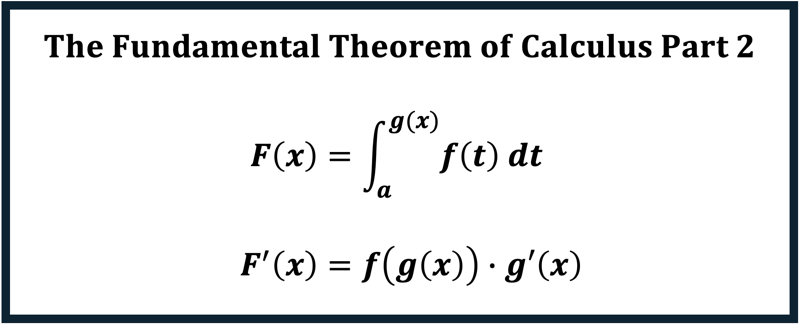
The Fundamental Theorem of Calculus Part 2 connects derivatives and definite integrals. When an integral has a variable limit of integration, you can find its derivative by plugging the variable limit into the integrand and multiplying by the derivative of that limit. These problems focus on the advanced version where both the upper and lower limits may be functions of \(x\).
Notes
Fundamental Theorem of Calculus Part 2 (Advanced)
\(\frac{d}{dx}\displaystyle\int_{f(x)}^{g(x)} h(t) \, dt \,\,=\,\, \left[h\left(g(x)\right)\cdot g'(x)\right]-\left[h\left(f(x)\right) \cdot f'(x)\right]\)
Practice Problems
\(\textbf{1)}\) \(\frac{d}{dx}\left(\displaystyle\int_3^x 3t^3+4t\,dt\right)\)
\(\text{The answer is } 3x^3+4x\)
\(\,\,\,\,\,\,\frac{d}{dx}\displaystyle\int_{f(x)}^{g(x)} h(t) \, dt\,\,=\,\, \left[h\left(g(x)\right)\cdot g'(x)\right]-\left[h\left(f(x)\right) \cdot f'(x)\right]\)
\(\,\,\,\,\,\,\frac{d}{dx}\left(\displaystyle\int_3^x 3t^3+4t\,dt\right)\,\,=\,\, \left[\left(3x^3+4x\right)\cdot (1)\right]-\left[\left(3(3)^3+4(3)\right) \cdot (0)\right] \)
\(\,\,\,\,\,\,\text{The answer is } 3x^3+4x\)
\(\,\,\,\,\,\,\frac{d}{dx}\displaystyle\int_{f(x)}^{g(x)} h(t) \, dt\,\,=\,\, \left[h\left(g(x)\right)\cdot g'(x)\right]-\left[h\left(f(x)\right) \cdot f'(x)\right]\)
\(\,\,\,\,\,\,\frac{d}{dx}\left(\displaystyle\int_3^x 3t^3+4t\,dt\right)\,\,=\,\, \left[\left(3x^3+4x\right)\cdot (1)\right]-\left[\left(3(3)^3+4(3)\right) \cdot (0)\right] \)
\(\,\,\,\,\,\,\text{The answer is } 3x^3+4x\)
\(\textbf{2)}\) \(\frac{d}{dx}\left(\displaystyle\int_x^3\sin \left(t\right)\,dt\right)\)
\(\text{The answer is } -\sin \left(x\right)\)
\(\,\,\,\,\,\,\frac{d}{dx}\displaystyle\int_{f(x)}^{g(x)} h(t) \, dt\,\,=\,\, \left[h\left(g(x)\right)\cdot g'(x)\right]-\left[h\left(f(x)\right) \cdot f'(x)\right]\)
\(\,\,\,\,\,\,\frac{d}{dx}\left(\displaystyle\int _x^3\sin \left(t\right)\,dt\right)\,\,=\,\, \left[\left(\sin \left(3\right)\right)\cdot (0)\right]-\left[\left(\sin \left(x\right)\right) \cdot (1)\right] \)
\(\,\,\,\,\,\,\text{The answer is } -\sin \left(x\right)\)
\(\,\,\,\,\,\,\frac{d}{dx}\displaystyle\int_{f(x)}^{g(x)} h(t) \, dt\,\,=\,\, \left[h\left(g(x)\right)\cdot g'(x)\right]-\left[h\left(f(x)\right) \cdot f'(x)\right]\)
\(\,\,\,\,\,\,\frac{d}{dx}\left(\displaystyle\int _x^3\sin \left(t\right)\,dt\right)\,\,=\,\, \left[\left(\sin \left(3\right)\right)\cdot (0)\right]-\left[\left(\sin \left(x\right)\right) \cdot (1)\right] \)
\(\,\,\,\,\,\,\text{The answer is } -\sin \left(x\right)\)
\(\textbf{3)}\) \(\frac{d}{dx}\left(\displaystyle\int_3^{x^2}3t+5\,dt\right)\)
\(\text{The answer is } 6x^3+10x\)
\(\,\,\,\,\,\,\frac{d}{dx}\displaystyle\int_{f(x)}^{g(x)} h(t) \, dt\,\,=\,\, \left[h\left(g(x)\right)\cdot g'(x)\right]-\left[h\left(f(x)\right) \cdot f'(x)\right]\)
\(\,\,\,\,\,\,\frac{d}{dx}\left(\displaystyle\int_3^{x^2}3t+5\,dt\right)\,\,=\,\, \left[\left(3x^2+5\right)\cdot (2x)\right]-\left[\left(3(3)+5\right) \cdot (0)\right] \)
\(\,\,\,\,\,\,\left(3x^2+5\right)(2x)=6x^3+10x\)
\(\,\,\,\,\,\,\text{The answer is } 6x^3+10x\)
\(\,\,\,\,\,\,\frac{d}{dx}\displaystyle\int_{f(x)}^{g(x)} h(t) \, dt\,\,=\,\, \left[h\left(g(x)\right)\cdot g'(x)\right]-\left[h\left(f(x)\right) \cdot f'(x)\right]\)
\(\,\,\,\,\,\,\frac{d}{dx}\left(\displaystyle\int_3^{x^2}3t+5\,dt\right)\,\,=\,\, \left[\left(3x^2+5\right)\cdot (2x)\right]-\left[\left(3(3)+5\right) \cdot (0)\right] \)
\(\,\,\,\,\,\,\left(3x^2+5\right)(2x)=6x^3+10x\)
\(\,\,\,\,\,\,\text{The answer is } 6x^3+10x\)
\(\textbf{4)}\) \(\frac{d}{dx}\left(\displaystyle\int _x^{2x}te^t\,dt\right)\)
\(\text{The answer is } 4xe^{2x}-xe^x \)
\(\,\,\,\,\,\,\frac{d}{dx}\displaystyle\int_{f(x)}^{g(x)} h(t) \, dt\,\,=\,\, \left[h\left(g(x)\right)\cdot g'(x)\right]-\left[h\left(f(x)\right) \cdot f'(x)\right]\)
\(\,\,\,\,\,\,\frac{d}{dx}\left(\displaystyle\int _x^{2x}te^t\,dt\right)\,\,=\,\, \left[\left((2x)e^{2x}\right)\cdot (2)\right]-\left[\left(xe^x\right) \cdot (1)\right] \)
\(\,\,\,\,\,\,\text{The answer is } 4xe^{2x}-xe^x\)
\(\,\,\,\,\,\,\frac{d}{dx}\displaystyle\int_{f(x)}^{g(x)} h(t) \, dt\,\,=\,\, \left[h\left(g(x)\right)\cdot g'(x)\right]-\left[h\left(f(x)\right) \cdot f'(x)\right]\)
\(\,\,\,\,\,\,\frac{d}{dx}\left(\displaystyle\int _x^{2x}te^t\,dt\right)\,\,=\,\, \left[\left((2x)e^{2x}\right)\cdot (2)\right]-\left[\left(xe^x\right) \cdot (1)\right] \)
\(\,\,\,\,\,\,\text{The answer is } 4xe^{2x}-xe^x\)
\(\textbf{5)}\) \(\frac{d}{dx}\left(\displaystyle\int _6^x e^{3t}\sin\left(te^{4t}-\tan^2\left(t\right)\right)\,dt\right)\)
\(\text{The answer is } e^{3x}\sin\left(xe^{4x}-\tan^2\left(x\right)\right)\)
\(\,\,\,\,\,\,\frac{d}{dx}\displaystyle\int_{f(x)}^{g(x)} h(t) \, dt\,\,=\,\, \left[h\left(g(x)\right)\cdot g'(x)\right]-\left[h\left(f(x)\right) \cdot f'(x)\right]\)
\(\,\,\,\,\,\,\frac{d}{dx}\left(\displaystyle\int _6^x e^{3t}\sin\left(te^{4t}-\tan^2\left(t\right)\right)\,dt\right)\,\,=\,\, \left[\left(e^{3x}\sin\left(xe^{4x}-\tan^2\left(x\right)\right)\right)\cdot (1)\right]-\left[\left(e^{18}\sin\left(6e^{24}-\tan^2\left(6\right)\right)\right) \cdot (0)\right] \)
\(\,\,\,\,\,\,\text{The answer is } e^{3x}\sin\left(xe^{4x}-\tan^2\left(x\right)\right)\)
\(\,\,\,\,\,\,\frac{d}{dx}\displaystyle\int_{f(x)}^{g(x)} h(t) \, dt\,\,=\,\, \left[h\left(g(x)\right)\cdot g'(x)\right]-\left[h\left(f(x)\right) \cdot f'(x)\right]\)
\(\,\,\,\,\,\,\frac{d}{dx}\left(\displaystyle\int _6^x e^{3t}\sin\left(te^{4t}-\tan^2\left(t\right)\right)\,dt\right)\,\,=\,\, \left[\left(e^{3x}\sin\left(xe^{4x}-\tan^2\left(x\right)\right)\right)\cdot (1)\right]-\left[\left(e^{18}\sin\left(6e^{24}-\tan^2\left(6\right)\right)\right) \cdot (0)\right] \)
\(\,\,\,\,\,\,\text{The answer is } e^{3x}\sin\left(xe^{4x}-\tan^2\left(x\right)\right)\)
\(\textbf{6)}\) \(\frac{d}{dx}\left(\displaystyle\int_{\sqrt{x}}^{x^2}t^2\,dt\right)\)
\(\text{The answer is } 2x^5-\displaystyle \frac{\sqrt{x}}{2}\)
\(\,\,\,\,\,\,\frac{d}{dx}\displaystyle\int_{f(x)}^{g(x)} h(t) \, dt\,\,=\,\, \left[h\left(g(x)\right)\cdot g'(x)\right]-\left[h\left(f(x)\right) \cdot f'(x)\right]\)
\(\,\,\,\,\,\,\frac{d}{dx}\left(\displaystyle\int_{\sqrt{x}}^{x^2}t^2\,dt\right)\,\,=\,\, \left[\left((x^2)^2\right)\cdot (2x)\right]-\left[\left((\sqrt{x})^2\right) \cdot \left(\frac{1}{2\sqrt{x}}\right)\right] \)
\(\,\,\,\,\,\,\frac{d}{dx}\left(\displaystyle\int_{\sqrt{x}}^{x^2}t^2\,dt\right)=2x^5-\frac{x}{2\sqrt{x}}\)
\(\,\,\,\,\,\,\text{The answer is } 2x^5-\displaystyle \frac{\sqrt{x}}{2}\)
\(\,\,\,\,\,\,\frac{d}{dx}\displaystyle\int_{f(x)}^{g(x)} h(t) \, dt\,\,=\,\, \left[h\left(g(x)\right)\cdot g'(x)\right]-\left[h\left(f(x)\right) \cdot f'(x)\right]\)
\(\,\,\,\,\,\,\frac{d}{dx}\left(\displaystyle\int_{\sqrt{x}}^{x^2}t^2\,dt\right)\,\,=\,\, \left[\left((x^2)^2\right)\cdot (2x)\right]-\left[\left((\sqrt{x})^2\right) \cdot \left(\frac{1}{2\sqrt{x}}\right)\right] \)
\(\,\,\,\,\,\,\frac{d}{dx}\left(\displaystyle\int_{\sqrt{x}}^{x^2}t^2\,dt\right)=2x^5-\frac{x}{2\sqrt{x}}\)
\(\,\,\,\,\,\,\text{The answer is } 2x^5-\displaystyle \frac{\sqrt{x}}{2}\)
\(\textbf{7)}\) \(\frac{d}{dx}\left(\displaystyle\int_9^{x} t \cos^2(t)\left(t^4-t^3\right)\,dt \right)\)
\(\text{The answer is } x \cos^2(x)\left(x^4-x^3\right)\)
\(\,\,\,\,\,\,\frac{d}{dx}\displaystyle\int_{f(x)}^{g(x)} h(t) \, dt\,\,=\,\, \left[h\left(g(x)\right)\cdot g'(x)\right]-\left[h\left(f(x)\right) \cdot f'(x)\right]\)
\(\,\,\,\,\,\,\frac{d}{dx}\left(\displaystyle\int_9^{x} t \cos^2(t)\left(t^4-t^3\right)\,dt\right)\,\,=\,\, \left[\left(x \cos^2(x)\right)\left(x^4-x^3\right)\cdot (1)\right]-\left[\left(9 \cos^2(9)\right)\left(9^4-9^3\right) \cdot (0)\right] \)
\(\,\,\,\,\,\,\text{The answer is } x \cos^2(x)\left(x^4-x^3\right)\)
\(\,\,\,\,\,\,\frac{d}{dx}\displaystyle\int_{f(x)}^{g(x)} h(t) \, dt\,\,=\,\, \left[h\left(g(x)\right)\cdot g'(x)\right]-\left[h\left(f(x)\right) \cdot f'(x)\right]\)
\(\,\,\,\,\,\,\frac{d}{dx}\left(\displaystyle\int_9^{x} t \cos^2(t)\left(t^4-t^3\right)\,dt\right)\,\,=\,\, \left[\left(x \cos^2(x)\right)\left(x^4-x^3\right)\cdot (1)\right]-\left[\left(9 \cos^2(9)\right)\left(9^4-9^3\right) \cdot (0)\right] \)
\(\,\,\,\,\,\,\text{The answer is } x \cos^2(x)\left(x^4-x^3\right)\)
\(\textbf{8)}\) \(\frac{d}{dx}\left(\displaystyle\int_0^{\cos \left(x\right)}t^2 \,dt \right)\)
\(\text{The answer is } -\cos ^2\left(x\right)\sin \left(x\right)\)
\(\,\,\,\,\,\,\frac{d}{dx}\displaystyle\int_{f(x)}^{g(x)} h(t) \, dt\,\,=\,\, \left[h\left(g(x)\right)\cdot g'(x)\right]-\left[h\left(f(x)\right) \cdot f'(x)\right]\)
\(\,\,\,\,\,\,\frac{d}{dx}\left(\displaystyle\int_0^{\cos \left(x\right)}t^2 \,dt \right)\,\,=\,\, \left[\left(\cos^2(x)\right)\cdot (-\sin(x))\right]-\left[(0)^2 \cdot (0)\right] \)
\(\,\,\,\,\,\,\text{The answer is } -\cos ^2\left(x\right)\sin \left(x\right)\)
\(\,\,\,\,\,\,\frac{d}{dx}\displaystyle\int_{f(x)}^{g(x)} h(t) \, dt\,\,=\,\, \left[h\left(g(x)\right)\cdot g'(x)\right]-\left[h\left(f(x)\right) \cdot f'(x)\right]\)
\(\,\,\,\,\,\,\frac{d}{dx}\left(\displaystyle\int_0^{\cos \left(x\right)}t^2 \,dt \right)\,\,=\,\, \left[\left(\cos^2(x)\right)\cdot (-\sin(x))\right]-\left[(0)^2 \cdot (0)\right] \)
\(\,\,\,\,\,\,\text{The answer is } -\cos ^2\left(x\right)\sin \left(x\right)\)
\(\textbf{9)}\) \(\frac{d}{dx}\left(\displaystyle\int _{5x^2}^7\frac{t^2}{t-5} \,dt\right)\)
\(\text{The answer is } -\displaystyle \frac{50x^5}{x^2-1}\)
\(\,\,\,\,\,\,\frac{d}{dx}\displaystyle\int_{f(x)}^{g(x)} h(t) \, dt\,\,=\,\, \left[h\left(g(x)\right)\cdot g'(x)\right]-\left[h\left(f(x)\right) \cdot f'(x)\right]\)
\(\,\,\,\,\,\,\frac{d}{dx}\left(\displaystyle\int _{5x^2}^7\frac{t^2}{t-5} \,dt\right)\,\,=\,\, \left[\left(\frac{7^2}{7-5}\right)\cdot (0)\right]-\left[\left(\frac{(5x^2)^2}{5x^2-5}\right) \cdot (10x)\right] \)
\(\,\,\,\,\,\,\frac{(5x^2)^2}{5x^2-5}\cdot 10x=\frac{25x^4}{5(x^2-1)}\cdot10x\)
\(\,\,\,\,\,\,\text{The answer is } -\displaystyle \frac{50x^5}{x^2-1}\)
\(\,\,\,\,\,\,\frac{d}{dx}\displaystyle\int_{f(x)}^{g(x)} h(t) \, dt\,\,=\,\, \left[h\left(g(x)\right)\cdot g'(x)\right]-\left[h\left(f(x)\right) \cdot f'(x)\right]\)
\(\,\,\,\,\,\,\frac{d}{dx}\left(\displaystyle\int _{5x^2}^7\frac{t^2}{t-5} \,dt\right)\,\,=\,\, \left[\left(\frac{7^2}{7-5}\right)\cdot (0)\right]-\left[\left(\frac{(5x^2)^2}{5x^2-5}\right) \cdot (10x)\right] \)
\(\,\,\,\,\,\,\frac{(5x^2)^2}{5x^2-5}\cdot 10x=\frac{25x^4}{5(x^2-1)}\cdot10x\)
\(\,\,\,\,\,\,\text{The answer is } -\displaystyle \frac{50x^5}{x^2-1}\)
\(\textbf{10)}\) \(\frac{d}{dx}\left(\displaystyle\int_1^{3}t^3 \, dt\right)\)
\(\text{The answer is } 0\)
\(\,\,\,\,\,\,\frac{d}{dx}\displaystyle\int_{f(x)}^{g(x)} h(t) \, dt\,\,=\,\, \left[h\left(g(x)\right)\cdot g'(x)\right]-\left[h\left(f(x)\right) \cdot f'(x)\right]\)
\(\,\,\,\,\,\,\frac{d}{dx}\left(\displaystyle\int_1^{3}t^3 \, dt\right)\,\,=\,\, \left[\left(3^3\right)\cdot (0)\right]-\left[\left(1^3\right) \cdot (0)\right] \)
\(\,\,\,\,\,\,\text{The answer is } 0\)
\(\,\,\,\,\,\,\frac{d}{dx}\displaystyle\int_{f(x)}^{g(x)} h(t) \, dt\,\,=\,\, \left[h\left(g(x)\right)\cdot g'(x)\right]-\left[h\left(f(x)\right) \cdot f'(x)\right]\)
\(\,\,\,\,\,\,\frac{d}{dx}\left(\displaystyle\int_1^{3}t^3 \, dt\right)\,\,=\,\, \left[\left(3^3\right)\cdot (0)\right]-\left[\left(1^3\right) \cdot (0)\right] \)
\(\,\,\,\,\,\,\text{The answer is } 0\)
\(\textbf{11)}\) Find \( F'(x) \) if \(F(x)=\displaystyle\int^{\pi/4}_{\sqrt{x}}t \tan{(t)} \,dt\)
\(F'(x)=\displaystyle\frac{\left(\sqrt{x}\right)\tan{\left(\sqrt{x}\right)}}{2\sqrt{x}} \)
\(\,\,\,\,\,\,F(x)=\displaystyle\int^{\pi/4}_{\sqrt{x}}t \tan{(t)} \,dt\)
\(\,\,\,\,\,\,\frac{d}{dx}\displaystyle\int_{f(x)}^{g(x)} h(t) \, dt\,\,=\,\, \left[h\left(g(x)\right)\cdot g'(x)\right]-\left[h\left(f(x)\right) \cdot f'(x)\right] \)
\(\,\,\,\,\,\,F'(x)=\left[\left( \pi/4\right)\tan{\left(\pi/4\right)}\cdot 0\right]-\left[\left(\sqrt{x}\right)\tan{\left(\sqrt{x}\right)} \cdot \left(\frac{1}{2\sqrt{x}} \right )\right] \)
\(\,\,\,\,\,\,F'(x)=\displaystyle -\frac{\left(\sqrt{x}\right)\tan{\left(\sqrt{x}\right)}}{2\sqrt{x}}\)
\(\,\,\,\,\,\,\text{The answer is } \displaystyle -\frac{\tan{\left(\sqrt{x}\right)}}{2}\)
\(\,\,\,\,\,\,F(x)=\displaystyle\int^{\pi/4}_{\sqrt{x}}t \tan{(t)} \,dt\)
\(\,\,\,\,\,\,\frac{d}{dx}\displaystyle\int_{f(x)}^{g(x)} h(t) \, dt\,\,=\,\, \left[h\left(g(x)\right)\cdot g'(x)\right]-\left[h\left(f(x)\right) \cdot f'(x)\right] \)
\(\,\,\,\,\,\,F'(x)=\left[\left( \pi/4\right)\tan{\left(\pi/4\right)}\cdot 0\right]-\left[\left(\sqrt{x}\right)\tan{\left(\sqrt{x}\right)} \cdot \left(\frac{1}{2\sqrt{x}} \right )\right] \)
\(\,\,\,\,\,\,F'(x)=\displaystyle -\frac{\left(\sqrt{x}\right)\tan{\left(\sqrt{x}\right)}}{2\sqrt{x}}\)
\(\,\,\,\,\,\,\text{The answer is } \displaystyle -\frac{\tan{\left(\sqrt{x}\right)}}{2}\)
\(\textbf{12)}\) \(\frac{d}{dx}\left(\displaystyle\int_{2}^{x^3}\sqrt{t+1}\,dt\right)\)
\(\text{The answer is }3x^2\sqrt{x^3+1}\)
\(\,\,\,\,\,\,\frac{d}{dx}\displaystyle\int_{f(x)}^{g(x)} h(t) \, dt\,\,=\,\, \left[h\left(g(x)\right)\cdot g'(x)\right]-\left[h\left(f(x)\right) \cdot f'(x)\right]\)
\(\,\,\,\,\,\,g(x)=x^3\)
\(\,\,\,\,\,\,g'(x)=3x^2\)
\(\,\,\,\,\,\,\frac{d}{dx}\left(\displaystyle\int_{2}^{x^3}\sqrt{t+1}\,dt\right)=\sqrt{x^3+1}\cdot 3x^2-\sqrt{3}\cdot0\)
\(\,\,\,\,\,\,\text{The answer is }3x^2\sqrt{x^3+1}\)
\(\,\,\,\,\,\,\frac{d}{dx}\displaystyle\int_{f(x)}^{g(x)} h(t) \, dt\,\,=\,\, \left[h\left(g(x)\right)\cdot g'(x)\right]-\left[h\left(f(x)\right) \cdot f'(x)\right]\)
\(\,\,\,\,\,\,g(x)=x^3\)
\(\,\,\,\,\,\,g'(x)=3x^2\)
\(\,\,\,\,\,\,\frac{d}{dx}\left(\displaystyle\int_{2}^{x^3}\sqrt{t+1}\,dt\right)=\sqrt{x^3+1}\cdot 3x^2-\sqrt{3}\cdot0\)
\(\,\,\,\,\,\,\text{The answer is }3x^2\sqrt{x^3+1}\)
\(\textbf{13)}\) \(\frac{d}{dx}\left(\displaystyle\int_{x^2}^{x^3}\ln(t)\,dt\right)\)
\(\text{The answer is }3x^2\ln(x^3)-2x\ln(x^2)\)
\(\,\,\,\,\,\,\frac{d}{dx}\displaystyle\int_{f(x)}^{g(x)} h(t) \, dt\,\,=\,\, \left[h\left(g(x)\right)\cdot g'(x)\right]-\left[h\left(f(x)\right) \cdot f'(x)\right]\)
\(\,\,\,\,\,\,f(x)=x^2,\quad g(x)=x^3,\quad h(t)=\ln(t)\)
\(\,\,\,\,\,\,f'(x)=2x,\quad g'(x)=3x^2\)
\(\,\,\,\,\,\,\frac{d}{dx}\left(\displaystyle\int_{x^2}^{x^3}\ln(t)\,dt\right)=\ln(x^3)(3x^2)-\ln(x^2)(2x)\)
\(\,\,\,\,\,\,\text{The answer is }3x^2\ln(x^3)-2x\ln(x^2)\)
\(\,\,\,\,\,\,\frac{d}{dx}\displaystyle\int_{f(x)}^{g(x)} h(t) \, dt\,\,=\,\, \left[h\left(g(x)\right)\cdot g'(x)\right]-\left[h\left(f(x)\right) \cdot f'(x)\right]\)
\(\,\,\,\,\,\,f(x)=x^2,\quad g(x)=x^3,\quad h(t)=\ln(t)\)
\(\,\,\,\,\,\,f'(x)=2x,\quad g'(x)=3x^2\)
\(\,\,\,\,\,\,\frac{d}{dx}\left(\displaystyle\int_{x^2}^{x^3}\ln(t)\,dt\right)=\ln(x^3)(3x^2)-\ln(x^2)(2x)\)
\(\,\,\,\,\,\,\text{The answer is }3x^2\ln(x^3)-2x\ln(x^2)\)
\(\textbf{14)}\) \(\frac{d}{dx}\left(\displaystyle\int_{\sin x}^{x} e^{t^2}\,dt\right)\)
\(\text{The answer is }e^{x^2}-e^{\sin^2x}\cos x\)
\(\,\,\,\,\,\,\frac{d}{dx}\displaystyle\int_{f(x)}^{g(x)} h(t) \, dt\,\,=\,\, \left[h\left(g(x)\right)\cdot g'(x)\right]-\left[h\left(f(x)\right) \cdot f'(x)\right]\)
\(\,\,\,\,\,\,f(x)=\sin x,\quad g(x)=x,\quad h(t)=e^{t^2}\)
\(\,\,\,\,\,\,f'(x)=\cos x,\quad g'(x)=1\)
\(\,\,\,\,\,\,\frac{d}{dx}\left(\displaystyle\int_{\sin x}^{x} e^{t^2}\,dt\right)=e^{x^2}(1)-e^{(\sin x)^2}(\cos x)\)
\(\,\,\,\,\,\,\text{The answer is }e^{x^2}-e^{\sin^2x}\cos x\)
\(\,\,\,\,\,\,\frac{d}{dx}\displaystyle\int_{f(x)}^{g(x)} h(t) \, dt\,\,=\,\, \left[h\left(g(x)\right)\cdot g'(x)\right]-\left[h\left(f(x)\right) \cdot f'(x)\right]\)
\(\,\,\,\,\,\,f(x)=\sin x,\quad g(x)=x,\quad h(t)=e^{t^2}\)
\(\,\,\,\,\,\,f'(x)=\cos x,\quad g'(x)=1\)
\(\,\,\,\,\,\,\frac{d}{dx}\left(\displaystyle\int_{\sin x}^{x} e^{t^2}\,dt\right)=e^{x^2}(1)-e^{(\sin x)^2}(\cos x)\)
\(\,\,\,\,\,\,\text{The answer is }e^{x^2}-e^{\sin^2x}\cos x\)
\(\textbf{15)}\) \(\frac{d}{dx}\left(\displaystyle\int_{1}^{\tan x}\frac{1}{1+t^2}\,dt\right)\)
\(\text{The answer is }1\)
\(\,\,\,\,\,\,\frac{d}{dx}\displaystyle\int_{f(x)}^{g(x)} h(t) \, dt\,\,=\,\, \left[h\left(g(x)\right)\cdot g'(x)\right]-\left[h\left(f(x)\right) \cdot f'(x)\right]\)
\(\,\,\,\,\,\,g(x)=\tan x,\quad h(t)=\frac{1}{1+t^2}\)
\(\,\,\,\,\,\,g'(x)=\sec^2x\)
\(\,\,\,\,\,\,\frac{d}{dx}\left(\displaystyle\int_{1}^{\tan x}\frac{1}{1+t^2}\,dt\right)=\frac{1}{1+\tan^2x}\cdot\sec^2x\)
\(\,\,\,\,\,\,\frac{\sec^2x}{1+\tan^2x}=\frac{\sec^2x}{\sec^2x}=1\)
\(\,\,\,\,\,\,\text{The answer is }1\)
\(\,\,\,\,\,\,\frac{d}{dx}\displaystyle\int_{f(x)}^{g(x)} h(t) \, dt\,\,=\,\, \left[h\left(g(x)\right)\cdot g'(x)\right]-\left[h\left(f(x)\right) \cdot f'(x)\right]\)
\(\,\,\,\,\,\,g(x)=\tan x,\quad h(t)=\frac{1}{1+t^2}\)
\(\,\,\,\,\,\,g'(x)=\sec^2x\)
\(\,\,\,\,\,\,\frac{d}{dx}\left(\displaystyle\int_{1}^{\tan x}\frac{1}{1+t^2}\,dt\right)=\frac{1}{1+\tan^2x}\cdot\sec^2x\)
\(\,\,\,\,\,\,\frac{\sec^2x}{1+\tan^2x}=\frac{\sec^2x}{\sec^2x}=1\)
\(\,\,\,\,\,\,\text{The answer is }1\)
\(\textbf{16)}\) \(\frac{d}{dx}\left(\displaystyle\int_{\ln x}^{x^2}\frac{1}{t+1}\,dt\right)\)
\(\text{The answer is }\displaystyle\frac{2x}{x^2+1}-\frac{1}{x(\ln x+1)}\)
\(\,\,\,\,\,\,\frac{d}{dx}\displaystyle\int_{f(x)}^{g(x)} h(t) \, dt\,\,=\,\, \left[h\left(g(x)\right)\cdot g'(x)\right]-\left[h\left(f(x)\right) \cdot f'(x)\right]\)
\(\,\,\,\,\,\,f(x)=\ln x,\quad g(x)=x^2,\quad h(t)=\frac{1}{t+1}\)
\(\,\,\,\,\,\,f'(x)=\frac{1}{x},\quad g'(x)=2x\)
\(\,\,\,\,\,\,\frac{d}{dx}\left(\displaystyle\int_{\ln x}^{x^2}\frac{1}{t+1}\,dt\right)=\frac{1}{x^2+1}(2x)-\frac{1}{\ln x+1}\left(\frac{1}{x}\right)\)
\(\,\,\,\,\,\,\text{The answer is }\displaystyle\frac{2x}{x^2+1}-\frac{1}{x(\ln x+1)}\)
\(\,\,\,\,\,\,\frac{d}{dx}\displaystyle\int_{f(x)}^{g(x)} h(t) \, dt\,\,=\,\, \left[h\left(g(x)\right)\cdot g'(x)\right]-\left[h\left(f(x)\right) \cdot f'(x)\right]\)
\(\,\,\,\,\,\,f(x)=\ln x,\quad g(x)=x^2,\quad h(t)=\frac{1}{t+1}\)
\(\,\,\,\,\,\,f'(x)=\frac{1}{x},\quad g'(x)=2x\)
\(\,\,\,\,\,\,\frac{d}{dx}\left(\displaystyle\int_{\ln x}^{x^2}\frac{1}{t+1}\,dt\right)=\frac{1}{x^2+1}(2x)-\frac{1}{\ln x+1}\left(\frac{1}{x}\right)\)
\(\,\,\,\,\,\,\text{The answer is }\displaystyle\frac{2x}{x^2+1}-\frac{1}{x(\ln x+1)}\)
\(\textbf{17)}\) Find \(F'(x)\) if \(F(x)=\displaystyle\int_{x}^{x+1}\sqrt{t^4+1}\,dt\)
\(\text{The answer is }\sqrt{(x+1)^4+1}-\sqrt{x^4+1}\)
\(\,\,\,\,\,\,\frac{d}{dx}\displaystyle\int_{f(x)}^{g(x)} h(t) \, dt\,\,=\,\, \left[h\left(g(x)\right)\cdot g'(x)\right]-\left[h\left(f(x)\right) \cdot f'(x)\right]\)
\(\,\,\,\,\,\,f(x)=x,\quad g(x)=x+1,\quad h(t)=\sqrt{t^4+1}\)
\(\,\,\,\,\,\,f'(x)=1,\quad g'(x)=1\)
\(\,\,\,\,\,\,F'(x)=\sqrt{(x+1)^4+1}(1)-\sqrt{x^4+1}(1)\)
\(\,\,\,\,\,\,\text{The answer is }\sqrt{(x+1)^4+1}-\sqrt{x^4+1}\)
\(\,\,\,\,\,\,\frac{d}{dx}\displaystyle\int_{f(x)}^{g(x)} h(t) \, dt\,\,=\,\, \left[h\left(g(x)\right)\cdot g'(x)\right]-\left[h\left(f(x)\right) \cdot f'(x)\right]\)
\(\,\,\,\,\,\,f(x)=x,\quad g(x)=x+1,\quad h(t)=\sqrt{t^4+1}\)
\(\,\,\,\,\,\,f'(x)=1,\quad g'(x)=1\)
\(\,\,\,\,\,\,F'(x)=\sqrt{(x+1)^4+1}(1)-\sqrt{x^4+1}(1)\)
\(\,\,\,\,\,\,\text{The answer is }\sqrt{(x+1)^4+1}-\sqrt{x^4+1}\)
\(\textbf{18)}\) Find \(F'(x)\) if \(F(x)=\displaystyle\int_{0}^{x}\cos(t^2)\,dt\)
\(\text{The answer is }\cos(x^2)\)
\(\,\,\,\,\,\,\frac{d}{dx}\displaystyle\int_{f(x)}^{g(x)} h(t) \, dt\,\,=\,\, \left[h\left(g(x)\right)\cdot g'(x)\right]-\left[h\left(f(x)\right) \cdot f'(x)\right]\)
\(\,\,\,\,\,\,f(x)=0,\quad g(x)=x,\quad h(t)=\cos(t^2)\)
\(\,\,\,\,\,\,f'(x)=0,\quad g'(x)=1\)
\(\,\,\,\,\,\,F'(x)=\cos(x^2)(1)-\cos(0^2)(0)\)
\(\,\,\,\,\,\,\text{The answer is }\cos(x^2)\)
\(\,\,\,\,\,\,\frac{d}{dx}\displaystyle\int_{f(x)}^{g(x)} h(t) \, dt\,\,=\,\, \left[h\left(g(x)\right)\cdot g'(x)\right]-\left[h\left(f(x)\right) \cdot f'(x)\right]\)
\(\,\,\,\,\,\,f(x)=0,\quad g(x)=x,\quad h(t)=\cos(t^2)\)
\(\,\,\,\,\,\,f'(x)=0,\quad g'(x)=1\)
\(\,\,\,\,\,\,F'(x)=\cos(x^2)(1)-\cos(0^2)(0)\)
\(\,\,\,\,\,\,\text{The answer is }\cos(x^2)\)
\(\textbf{19)}\) Find \(F'(x)\) if \(F(x)=\displaystyle\int_{x^2}^{4x} \frac{t}{t^2+1}\,dt\)
\(\text{The answer is }\displaystyle\frac{16x}{16x^2+1}-\frac{2x^5}{x^4+1}\)
\(\,\,\,\,\,\,\frac{d}{dx}\displaystyle\int_{f(x)}^{g(x)} h(t) \, dt\,\,=\,\, \left[h\left(g(x)\right)\cdot g'(x)\right]-\left[h\left(f(x)\right) \cdot f'(x)\right]\)
\(\,\,\,\,\,\,f(x)=x^2,\quad g(x)=4x,\quad h(t)=\frac{t}{t^2+1}\)
\(\,\,\,\,\,\,f'(x)=2x,\quad g'(x)=4\)
\(\,\,\,\,\,\,F'(x)=\frac{4x}{(4x)^2+1}(4)-\frac{x^2}{(x^2)^2+1}(2x)\)
\(\,\,\,\,\,\,\text{The answer is }\displaystyle\frac{16x}{16x^2+1}-\frac{2x^3}{x^4+1}\)
\(\,\,\,\,\,\,\frac{d}{dx}\displaystyle\int_{f(x)}^{g(x)} h(t) \, dt\,\,=\,\, \left[h\left(g(x)\right)\cdot g'(x)\right]-\left[h\left(f(x)\right) \cdot f'(x)\right]\)
\(\,\,\,\,\,\,f(x)=x^2,\quad g(x)=4x,\quad h(t)=\frac{t}{t^2+1}\)
\(\,\,\,\,\,\,f'(x)=2x,\quad g'(x)=4\)
\(\,\,\,\,\,\,F'(x)=\frac{4x}{(4x)^2+1}(4)-\frac{x^2}{(x^2)^2+1}(2x)\)
\(\,\,\,\,\,\,\text{The answer is }\displaystyle\frac{16x}{16x^2+1}-\frac{2x^3}{x^4+1}\)
\(\textbf{20)}\) Find \(F'(x)\) if \(F(x)=\displaystyle\int_{\cos x}^{\sin x} \left(t^3+2t\right)\,dt\)
\(\text{The answer is }\left(\sin^3x+2\sin x\right)\cos x+\left(\cos^3x+2\cos x\right)\sin x\)
\(\,\,\,\,\,\,\frac{d}{dx}\displaystyle\int_{f(x)}^{g(x)} h(t) \, dt\,\,=\,\, \left[h\left(g(x)\right)\cdot g'(x)\right]-\left[h\left(f(x)\right) \cdot f'(x)\right]\)
\(\,\,\,\,\,\,f(x)=\cos x,\quad g(x)=\sin x,\quad h(t)=t^3+2t\)
\(\,\,\,\,\,\,f'(x)=-\sin x,\quad g'(x)=\cos x\)
\(\,\,\,\,\,\,F'(x)=\left(\sin^3x+2\sin x\right)\cos x-\left(\cos^3x+2\cos x\right)(-\sin x)\)
\(\,\,\,\,\,\,\text{The answer is }\left(\sin^3x+2\sin x\right)\cos x+\left(\cos^3x+2\cos x\right)\sin x\)
\(\,\,\,\,\,\,\frac{d}{dx}\displaystyle\int_{f(x)}^{g(x)} h(t) \, dt\,\,=\,\, \left[h\left(g(x)\right)\cdot g'(x)\right]-\left[h\left(f(x)\right) \cdot f'(x)\right]\)
\(\,\,\,\,\,\,f(x)=\cos x,\quad g(x)=\sin x,\quad h(t)=t^3+2t\)
\(\,\,\,\,\,\,f'(x)=-\sin x,\quad g'(x)=\cos x\)
\(\,\,\,\,\,\,F'(x)=\left(\sin^3x+2\sin x\right)\cos x-\left(\cos^3x+2\cos x\right)(-\sin x)\)
\(\,\,\,\,\,\,\text{The answer is }\left(\sin^3x+2\sin x\right)\cos x+\left(\cos^3x+2\cos x\right)\sin x\)
See Related Pages\(\)
\(\bullet\text{ Calculus Homepage}\)
\(\,\,\,\,\,\,\,\,\text{All the Best Topics…}\)
\(\bullet\text{ Trapezoidal Rule}\)
\(\,\,\,\,\,\,\,\,\displaystyle\frac{b-a}{2n}\left[f(a)+2f(x_1)+2f(x_2)+…+2fx_{n-1}+f(b)\right]…\)
\(\bullet\text{ Properties of Integrals}\)
\(\,\,\,\,\,\,\,\,\displaystyle \int_{a}^{b}cf(x) \, dx=c\displaystyle \int_{a}^{b}f(x) \,dx…\)
\(\bullet\text{ Indefinite Integrals- Power Rule}\)
\(\,\,\,\,\,\,\,\,\displaystyle \int x^n \, dx = \displaystyle \frac{x^{n+1}}{n+1}+C…\)
\(\bullet\text{ Indefinite Integrals- Trig Functions}\)
\(\,\,\,\,\,\,\,\,\displaystyle \int \cos{x} \, dx=\sin{x}+C…\)
\(\bullet\text{ Definite Integrals}\)
\(\,\,\,\,\,\,\,\,\displaystyle \int_{5}^{7} x^3 \, dx…\)
\(\bullet\text{ Integration by Substitution}\)
\(\,\,\,\,\,\,\,\,\displaystyle \int (x^2+3)^3(2x) \,dx…\)
\(\bullet\text{ Area of Region Between Two Curves}\)
\(\,\,\,\,\,\,\,\,A=\displaystyle \int_{a}^{b}\left[f(x)-g(x)\right]\,dx…\)
\(\bullet\text{ Arc Length}\)
\(\,\,\,\,\,\,\,\,\displaystyle \int_{a}^{b}\sqrt{1+\left[f'(x)\right]^2} \,dx…\)
\(\bullet\text{ Average Function Value}\)
\(\,\,\,\,\,\,\,\,\displaystyle\frac{1}{b-a} \int_{a}^{b}f(x) \,dx\)
\(\bullet\text{ Volume by Cross Sections}\)
\(\,\,\,\,\,\,\,\,\)
\(\bullet\text{ Disk Method}\)
\(\,\,\,\,\,\,\,\,V=\displaystyle \int_{a}^{b}\left[f(x)\right]^2\,dx…\)
\(\bullet\text{ Cylindrical Shells}\)
\(\,\,\,\,\,\,\,\,V=2 \pi \displaystyle \int_{a}^{b} y f(y) \, dy…\)