

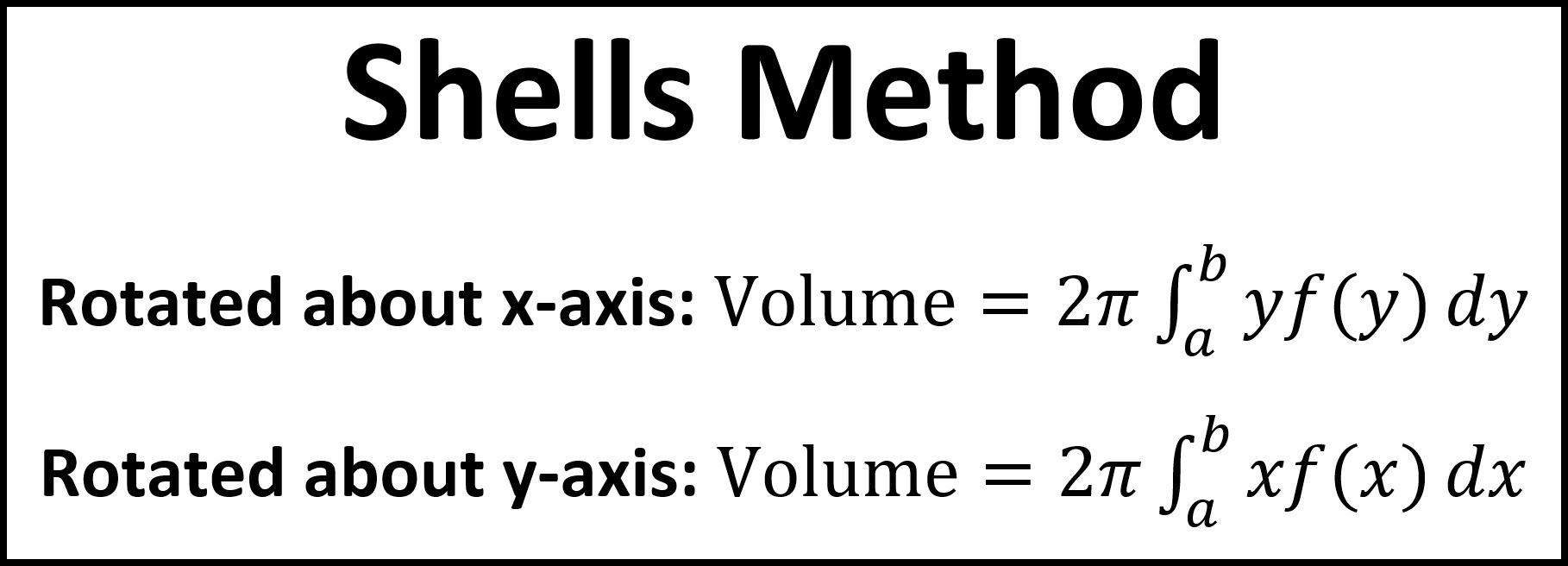
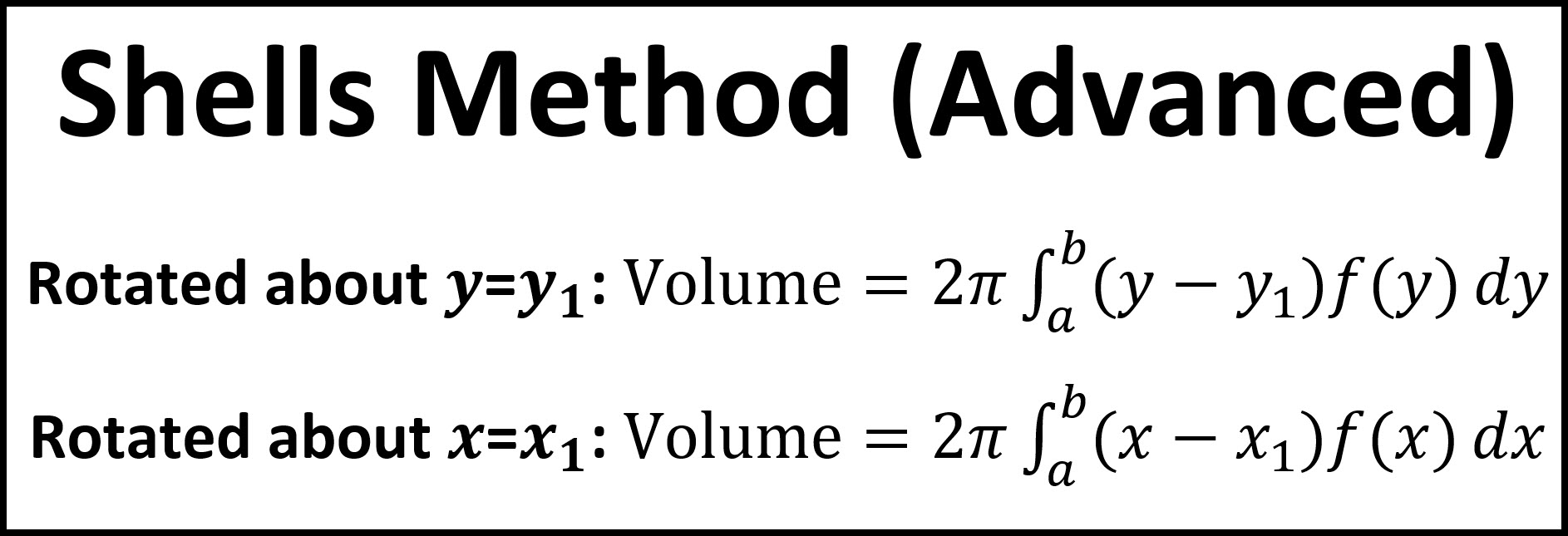
The cylindrical shells method is used to find the volume of a solid formed by rotating a region around an axis. Instead of slicing the solid into disks or washers, this method uses thin cylindrical shells. The basic idea is \(V=2\pi\int_a^b(\text{radius})(\text{height})\,dx\) or \(V=2\pi\int_a^b(\text{radius})(\text{height})\,dy\), depending on the axis of rotation.
Notes
Practice Problems
\(\textbf{1)}\) Find the volume generated by rotating the region under \(y=x^2\) from \(x=0\) to \(x=2\) about the \(y\)-axis.
\(V=2\pi\int_a^b(\text{radius})(\text{height})\,dx\)
\(\text{radius}=x\)
\(\text{height}=x^2\)
\(V=2\pi\int_0^2 x(x^2)\,dx\)
\(V=2\pi\int_0^2 x^3\,dx\)
\(V=2\pi\left[\frac{x^4}{4}\right]_0^2\)
\(V=2\pi\left(\frac{16}{4}-0\right)\)
\(V=8\pi\)
\(\text{The answer is }8\pi\)
\(V=2\pi\int_a^b(\text{radius})(\text{height})\,dx\)
\(\text{radius}=x\)
\(\text{height}=x^2\)
\(V=2\pi\int_0^2 x(x^2)\,dx\)
\(V=2\pi\int_0^2 x^3\,dx\)
\(V=2\pi\left[\frac{x^4}{4}\right]_0^2\)
\(V=2\pi\left(\frac{16}{4}-0\right)\)
\(V=8\pi\)
\(\text{The answer is }8\pi\)
\(\textbf{2)}\) Find the volume generated by rotating the region under \(y=3x\) from \(x=0\) to \(x=4\) about the \(y\)-axis.
\(V=2\pi\int_a^b(\text{radius})(\text{height})\,dx\)
\(\text{radius}=x\)
\(\text{height}=3x\)
\(V=2\pi\int_0^4 x(3x)\,dx\)
\(V=6\pi\int_0^4 x^2\,dx\)
\(V=6\pi\left[\frac{x^3}{3}\right]_0^4\)
\(V=6\pi\left(\frac{64}{3}\right)\)
\(V=128\pi\)
\(\text{The answer is }128\pi\)
\(V=2\pi\int_a^b(\text{radius})(\text{height})\,dx\)
\(\text{radius}=x\)
\(\text{height}=3x\)
\(V=2\pi\int_0^4 x(3x)\,dx\)
\(V=6\pi\int_0^4 x^2\,dx\)
\(V=6\pi\left[\frac{x^3}{3}\right]_0^4\)
\(V=6\pi\left(\frac{64}{3}\right)\)
\(V=128\pi\)
\(\text{The answer is }128\pi\)
\(\textbf{3)}\) Find the volume generated by rotating the region under \(y=4-x\) from \(x=0\) to \(x=4\) about the \(y\)-axis.
\(V=2\pi\int_a^b(\text{radius})(\text{height})\,dx\)
\(\text{radius}=x\)
\(\text{height}=4-x\)
\(V=2\pi\int_0^4 x(4-x)\,dx\)
\(V=2\pi\int_0^4 (4x-x^2)\,dx\)
\(V=2\pi\left[2x^2-\frac{x^3}{3}\right]_0^4\)
\(V=2\pi\left(32-\frac{64}{3}\right)\)
\(V=2\pi\left(\frac{32}{3}\right)\)
\(V=\frac{64\pi}{3}\)
\(\text{The answer is }\frac{64\pi}{3}\)
\(V=2\pi\int_a^b(\text{radius})(\text{height})\,dx\)
\(\text{radius}=x\)
\(\text{height}=4-x\)
\(V=2\pi\int_0^4 x(4-x)\,dx\)
\(V=2\pi\int_0^4 (4x-x^2)\,dx\)
\(V=2\pi\left[2x^2-\frac{x^3}{3}\right]_0^4\)
\(V=2\pi\left(32-\frac{64}{3}\right)\)
\(V=2\pi\left(\frac{32}{3}\right)\)
\(V=\frac{64\pi}{3}\)
\(\text{The answer is }\frac{64\pi}{3}\)
\(\textbf{4)}\) Find the volume generated by rotating the region under \(y=9-x^2\) from \(x=0\) to \(x=3\) about the \(y\)-axis.
\(V=2\pi\int_a^b(\text{radius})(\text{height})\,dx\)
\(\text{radius}=x\)
\(\text{height}=9-x^2\)
\(V=2\pi\int_0^3 x(9-x^2)\,dx\)
\(V=2\pi\int_0^3 (9x-x^3)\,dx\)
\(V=2\pi\left[\frac{9x^2}{2}-\frac{x^4}{4}\right]_0^3\)
\(V=2\pi\left(\frac{81}{2}-\frac{81}{4}\right)\)
\(V=2\pi\left(\frac{81}{4}\right)\)
\(V=\frac{81\pi}{2}\)
\(\text{The answer is }\frac{81\pi}{2}\)
\(V=2\pi\int_a^b(\text{radius})(\text{height})\,dx\)
\(\text{radius}=x\)
\(\text{height}=9-x^2\)
\(V=2\pi\int_0^3 x(9-x^2)\,dx\)
\(V=2\pi\int_0^3 (9x-x^3)\,dx\)
\(V=2\pi\left[\frac{9x^2}{2}-\frac{x^4}{4}\right]_0^3\)
\(V=2\pi\left(\frac{81}{2}-\frac{81}{4}\right)\)
\(V=2\pi\left(\frac{81}{4}\right)\)
\(V=\frac{81\pi}{2}\)
\(\text{The answer is }\frac{81\pi}{2}\)
\(\textbf{5)}\) Find the volume generated by rotating the region under \(y=\sqrt{x}\) from \(x=0\) to \(x=4\) about the \(y\)-axis.
\(V=2\pi\int_a^b(\text{radius})(\text{height})\,dx\)
\(\text{radius}=x\)
\(\text{height}=\sqrt{x}\)
\(V=2\pi\int_0^4 x\sqrt{x}\,dx\)
\(V=2\pi\int_0^4 x^{3/2}\,dx\)
\(V=2\pi\left[\frac{2}{5}x^{5/2}\right]_0^4\)
\(V=2\pi\left(\frac{2}{5}\cdot 4^{5/2}\right)\)
\(V=2\pi\left(\frac{2}{5}\cdot 32\right)\)
\(V=\frac{128\pi}{5}\)
\(\text{The answer is }\frac{128\pi}{5}\)
\(V=2\pi\int_a^b(\text{radius})(\text{height})\,dx\)
\(\text{radius}=x\)
\(\text{height}=\sqrt{x}\)
\(V=2\pi\int_0^4 x\sqrt{x}\,dx\)
\(V=2\pi\int_0^4 x^{3/2}\,dx\)
\(V=2\pi\left[\frac{2}{5}x^{5/2}\right]_0^4\)
\(V=2\pi\left(\frac{2}{5}\cdot 4^{5/2}\right)\)
\(V=2\pi\left(\frac{2}{5}\cdot 32\right)\)
\(V=\frac{128\pi}{5}\)
\(\text{The answer is }\frac{128\pi}{5}\)
\(\textbf{6)}\) Find the volume generated by rotating the region bounded by \(y=x\), \(y=0\), and \(x=3\) about the \(y\)-axis.
\(V=2\pi\int_a^b(\text{radius})(\text{height})\,dx\)
\(\text{radius}=x\)
\(\text{height}=x\)
\(V=2\pi\int_0^3 x(x)\,dx\)
\(V=2\pi\int_0^3 x^2\,dx\)
\(V=2\pi\left[\frac{x^3}{3}\right]_0^3\)
\(V=2\pi\left(9\right)\)
\(V=18\pi\)
\(\text{The answer is }18\pi\)
\(V=2\pi\int_a^b(\text{radius})(\text{height})\,dx\)
\(\text{radius}=x\)
\(\text{height}=x\)
\(V=2\pi\int_0^3 x(x)\,dx\)
\(V=2\pi\int_0^3 x^2\,dx\)
\(V=2\pi\left[\frac{x^3}{3}\right]_0^3\)
\(V=2\pi\left(9\right)\)
\(V=18\pi\)
\(\text{The answer is }18\pi\)
\(\textbf{7)}\) Find the volume generated by rotating the region bounded by \(y=x^2\), \(y=0\), and \(x=1\) about the line \(x=2\).
\(V=2\pi\int_a^b(\text{radius})(\text{height})\,dx\)
\(\text{radius}=2-x\)
\(\text{height}=x^2\)
\(V=2\pi\int_0^1 (2-x)x^2\,dx\)
\(V=2\pi\int_0^1 (2x^2-x^3)\,dx\)
\(V=2\pi\left[\frac{2x^3}{3}-\frac{x^4}{4}\right]_0^1\)
\(V=2\pi\left(\frac{2}{3}-\frac{1}{4}\right)\)
\(V=2\pi\left(\frac{5}{12}\right)\)
\(V=\frac{5\pi}{6}\)
\(\text{The answer is }\frac{5\pi}{6}\)
\(V=2\pi\int_a^b(\text{radius})(\text{height})\,dx\)
\(\text{radius}=2-x\)
\(\text{height}=x^2\)
\(V=2\pi\int_0^1 (2-x)x^2\,dx\)
\(V=2\pi\int_0^1 (2x^2-x^3)\,dx\)
\(V=2\pi\left[\frac{2x^3}{3}-\frac{x^4}{4}\right]_0^1\)
\(V=2\pi\left(\frac{2}{3}-\frac{1}{4}\right)\)
\(V=2\pi\left(\frac{5}{12}\right)\)
\(V=\frac{5\pi}{6}\)
\(\text{The answer is }\frac{5\pi}{6}\)
\(\textbf{8)}\) Find the volume generated by rotating the region under \(y=2x+1\) from \(x=0\) to \(x=2\) about the \(y\)-axis.
\(V=2\pi\int_a^b(\text{radius})(\text{height})\,dx\)
\(\text{radius}=x\)
\(\text{height}=2x+1\)
\(V=2\pi\int_0^2 x(2x+1)\,dx\)
\(V=2\pi\int_0^2 (2x^2+x)\,dx\)
\(V=2\pi\left[\frac{2x^3}{3}+\frac{x^2}{2}\right]_0^2\)
\(V=2\pi\left(\frac{16}{3}+2\right)\)
\(V=2\pi\left(\frac{22}{3}\right)\)
\(V=\frac{44\pi}{3}\)
\(\text{The answer is }\frac{44\pi}{3}\)
\(V=2\pi\int_a^b(\text{radius})(\text{height})\,dx\)
\(\text{radius}=x\)
\(\text{height}=2x+1\)
\(V=2\pi\int_0^2 x(2x+1)\,dx\)
\(V=2\pi\int_0^2 (2x^2+x)\,dx\)
\(V=2\pi\left[\frac{2x^3}{3}+\frac{x^2}{2}\right]_0^2\)
\(V=2\pi\left(\frac{16}{3}+2\right)\)
\(V=2\pi\left(\frac{22}{3}\right)\)
\(V=\frac{44\pi}{3}\)
\(\text{The answer is }\frac{44\pi}{3}\)
\(\textbf{9)}\) Find the volume generated by rotating the region under \(y=5\) from \(x=0\) to \(x=3\) about the \(y\)-axis.
\(V=2\pi\int_a^b(\text{radius})(\text{height})\,dx\)
\(\text{radius}=x\)
\(\text{height}=5\)
\(V=2\pi\int_0^3 5x\,dx\)
\(V=10\pi\int_0^3 x\,dx\)
\(V=10\pi\left[\frac{x^2}{2}\right]_0^3\)
\(V=10\pi\left(\frac{9}{2}\right)\)
\(V=45\pi\)
\(\text{The answer is }45\pi\)
\(V=2\pi\int_a^b(\text{radius})(\text{height})\,dx\)
\(\text{radius}=x\)
\(\text{height}=5\)
\(V=2\pi\int_0^3 5x\,dx\)
\(V=10\pi\int_0^3 x\,dx\)
\(V=10\pi\left[\frac{x^2}{2}\right]_0^3\)
\(V=10\pi\left(\frac{9}{2}\right)\)
\(V=45\pi\)
\(\text{The answer is }45\pi\)
\(\textbf{10)}\) Find the volume generated by rotating the region under \(y=6-2x\) from \(x=0\) to \(x=3\) about the \(y\)-axis.
\(V=2\pi\int_a^b(\text{radius})(\text{height})\,dx\)
\(\text{radius}=x\)
\(\text{height}=6-2x\)
\(V=2\pi\int_0^3 x(6-2x)\,dx\)
\(V=2\pi\int_0^3 (6x-2x^2)\,dx\)
\(V=2\pi\left[3x^2-\frac{2x^3}{3}\right]_0^3\)
\(V=2\pi(27-18)\)
\(V=18\pi\)
\(\text{The answer is }18\pi\)
\(V=2\pi\int_a^b(\text{radius})(\text{height})\,dx\)
\(\text{radius}=x\)
\(\text{height}=6-2x\)
\(V=2\pi\int_0^3 x(6-2x)\,dx\)
\(V=2\pi\int_0^3 (6x-2x^2)\,dx\)
\(V=2\pi\left[3x^2-\frac{2x^3}{3}\right]_0^3\)
\(V=2\pi(27-18)\)
\(V=18\pi\)
\(\text{The answer is }18\pi\)
\(\textbf{11)}\) Find the volume generated by rotating the region between \(y=x\) and \(y=x^2\) from \(x=0\) to \(x=1\) about the \(y\)-axis.
\(V=2\pi\int_a^b(\text{radius})(\text{height})\,dx\)
\(\text{radius}=x\)
\(\text{height}=x-x^2\)
\(V=2\pi\int_0^1 x(x-x^2)\,dx\)
\(V=2\pi\int_0^1 (x^2-x^3)\,dx\)
\(V=2\pi\left[\frac{x^3}{3}-\frac{x^4}{4}\right]_0^1\)
\(V=2\pi\left(\frac{1}{3}-\frac{1}{4}\right)\)
\(V=2\pi\left(\frac{1}{12}\right)\)
\(V=\frac{\pi}{6}\)
\(\text{The answer is }\frac{\pi}{6}\)
\(V=2\pi\int_a^b(\text{radius})(\text{height})\,dx\)
\(\text{radius}=x\)
\(\text{height}=x-x^2\)
\(V=2\pi\int_0^1 x(x-x^2)\,dx\)
\(V=2\pi\int_0^1 (x^2-x^3)\,dx\)
\(V=2\pi\left[\frac{x^3}{3}-\frac{x^4}{4}\right]_0^1\)
\(V=2\pi\left(\frac{1}{3}-\frac{1}{4}\right)\)
\(V=2\pi\left(\frac{1}{12}\right)\)
\(V=\frac{\pi}{6}\)
\(\text{The answer is }\frac{\pi}{6}\)
\(\textbf{12)}\) Find the volume generated by rotating the region between \(y=4\) and \(y=x^2\) from \(x=0\) to \(x=2\) about the \(y\)-axis.
\(V=2\pi\int_a^b(\text{radius})(\text{height})\,dx\)
\(\text{radius}=x\)
\(\text{height}=4-x^2\)
\(V=2\pi\int_0^2 x(4-x^2)\,dx\)
\(V=2\pi\int_0^2 (4x-x^3)\,dx\)
\(V=2\pi\left[2x^2-\frac{x^4}{4}\right]_0^2\)
\(V=2\pi(8-4)\)
\(V=8\pi\)
\(\text{The answer is }8\pi\)
\(V=2\pi\int_a^b(\text{radius})(\text{height})\,dx\)
\(\text{radius}=x\)
\(\text{height}=4-x^2\)
\(V=2\pi\int_0^2 x(4-x^2)\,dx\)
\(V=2\pi\int_0^2 (4x-x^3)\,dx\)
\(V=2\pi\left[2x^2-\frac{x^4}{4}\right]_0^2\)
\(V=2\pi(8-4)\)
\(V=8\pi\)
\(\text{The answer is }8\pi\)
\(\textbf{13)}\) Find the volume generated by rotating the region bounded by \(x=y^2\), \(x=0\), \(y=0\), and \(y=3\) about the \(x\)-axis.
\(V=2\pi\int_a^b(\text{radius})(\text{height})\,dy\)
\(\text{radius}=y\)
\(\text{height}=y^2\)
\(V=2\pi\int_0^3 y(y^2)\,dy\)
\(V=2\pi\int_0^3 y^3\,dy\)
\(V=2\pi\left[\frac{y^4}{4}\right]_0^3\)
\(V=2\pi\left(\frac{81}{4}\right)\)
\(V=\frac{81\pi}{2}\)
\(\text{The answer is }\frac{81\pi}{2}\)
\(V=2\pi\int_a^b(\text{radius})(\text{height})\,dy\)
\(\text{radius}=y\)
\(\text{height}=y^2\)
\(V=2\pi\int_0^3 y(y^2)\,dy\)
\(V=2\pi\int_0^3 y^3\,dy\)
\(V=2\pi\left[\frac{y^4}{4}\right]_0^3\)
\(V=2\pi\left(\frac{81}{4}\right)\)
\(V=\frac{81\pi}{2}\)
\(\text{The answer is }\frac{81\pi}{2}\)
\(\textbf{14)}\) Find the volume generated by rotating the region bounded by \(x=4-y\), \(x=0\), \(y=0\), and \(y=4\) about the \(x\)-axis.
\(V=2\pi\int_a^b(\text{radius})(\text{height})\,dy\)
\(\text{radius}=y\)
\(\text{height}=4-y\)
\(V=2\pi\int_0^4 y(4-y)\,dy\)
\(V=2\pi\int_0^4 (4y-y^2)\,dy\)
\(V=2\pi\left[2y^2-\frac{y^3}{3}\right]_0^4\)
\(V=2\pi\left(32-\frac{64}{3}\right)\)
\(V=2\pi\left(\frac{32}{3}\right)\)
\(V=\frac{64\pi}{3}\)
\(\text{The answer is }\frac{64\pi}{3}\)
\(V=2\pi\int_a^b(\text{radius})(\text{height})\,dy\)
\(\text{radius}=y\)
\(\text{height}=4-y\)
\(V=2\pi\int_0^4 y(4-y)\,dy\)
\(V=2\pi\int_0^4 (4y-y^2)\,dy\)
\(V=2\pi\left[2y^2-\frac{y^3}{3}\right]_0^4\)
\(V=2\pi\left(32-\frac{64}{3}\right)\)
\(V=2\pi\left(\frac{32}{3}\right)\)
\(V=\frac{64\pi}{3}\)
\(\text{The answer is }\frac{64\pi}{3}\)
\(\textbf{15)}\) Find the volume generated by rotating the region bounded by \(x=9-y^2\), \(x=0\), \(y=0\), and \(y=3\) about the \(x\)-axis.
\(V=2\pi\int_a^b(\text{radius})(\text{height})\,dy\)
\(\text{radius}=y\)
\(\text{height}=9-y^2\)
\(V=2\pi\int_0^3 y(9-y^2)\,dy\)
\(V=2\pi\int_0^3 (9y-y^3)\,dy\)
\(V=2\pi\left[\frac{9y^2}{2}-\frac{y^4}{4}\right]_0^3\)
\(V=2\pi\left(\frac{81}{2}-\frac{81}{4}\right)\)
\(V=2\pi\left(\frac{81}{4}\right)\)
\(V=\frac{81\pi}{2}\)
\(\text{The answer is }\frac{81\pi}{2}\)
\(V=2\pi\int_a^b(\text{radius})(\text{height})\,dy\)
\(\text{radius}=y\)
\(\text{height}=9-y^2\)
\(V=2\pi\int_0^3 y(9-y^2)\,dy\)
\(V=2\pi\int_0^3 (9y-y^3)\,dy\)
\(V=2\pi\left[\frac{9y^2}{2}-\frac{y^4}{4}\right]_0^3\)
\(V=2\pi\left(\frac{81}{2}-\frac{81}{4}\right)\)
\(V=2\pi\left(\frac{81}{4}\right)\)
\(V=\frac{81\pi}{2}\)
\(\text{The answer is }\frac{81\pi}{2}\)
\(\textbf{16)}\) Find the volume generated by rotating the region bounded by \(x=y\), \(x=0\), and \(y=2\) about the \(x\)-axis.
\(V=2\pi\int_a^b(\text{radius})(\text{height})\,dy\)
\(\text{radius}=y\)
\(\text{height}=y\)
\(V=2\pi\int_0^2 y(y)\,dy\)
\(V=2\pi\int_0^2 y^2\,dy\)
\(V=2\pi\left[\frac{y^3}{3}\right]_0^2\)
\(V=2\pi\left(\frac{8}{3}\right)\)
\(V=\frac{16\pi}{3}\)
\(\text{The answer is }\frac{16\pi}{3}\)
\(V=2\pi\int_a^b(\text{radius})(\text{height})\,dy\)
\(\text{radius}=y\)
\(\text{height}=y\)
\(V=2\pi\int_0^2 y(y)\,dy\)
\(V=2\pi\int_0^2 y^2\,dy\)
\(V=2\pi\left[\frac{y^3}{3}\right]_0^2\)
\(V=2\pi\left(\frac{8}{3}\right)\)
\(V=\frac{16\pi}{3}\)
\(\text{The answer is }\frac{16\pi}{3}\)
\(\textbf{17)}\) Find the volume generated by rotating the region under \(y=x^2+1\) from \(x=0\) to \(x=2\) about the \(y\)-axis.
\(V=2\pi\int_a^b(\text{radius})(\text{height})\,dx\)
\(\text{radius}=x\)
\(\text{height}=x^2+1\)
\(V=2\pi\int_0^2 x(x^2+1)\,dx\)
\(V=2\pi\int_0^2 (x^3+x)\,dx\)
\(V=2\pi\left[\frac{x^4}{4}+\frac{x^2}{2}\right]_0^2\)
\(V=2\pi(4+2)\)
\(V=12\pi\)
\(\text{The answer is }12\pi\)
\(V=2\pi\int_a^b(\text{radius})(\text{height})\,dx\)
\(\text{radius}=x\)
\(\text{height}=x^2+1\)
\(V=2\pi\int_0^2 x(x^2+1)\,dx\)
\(V=2\pi\int_0^2 (x^3+x)\,dx\)
\(V=2\pi\left[\frac{x^4}{4}+\frac{x^2}{2}\right]_0^2\)
\(V=2\pi(4+2)\)
\(V=12\pi\)
\(\text{The answer is }12\pi\)
\(\textbf{18)}\) Find the volume generated by rotating the region bounded by \(y=2x\) and \(y=x^2\) about the \(y\)-axis.
\(2x=x^2\)
\(x^2-2x=0\)
\(x(x-2)=0\)
\(x=0\text{ and }x=2\)
\(V=2\pi\int_a^b(\text{radius})(\text{height})\,dx\)
\(\text{radius}=x\)
\(\text{height}=2x-x^2\)
\(V=2\pi\int_0^2 x(2x-x^2)\,dx\)
\(V=2\pi\int_0^2 (2x^2-x^3)\,dx\)
\(V=2\pi\left[\frac{2x^3}{3}-\frac{x^4}{4}\right]_0^2\)
\(V=2\pi\left(\frac{16}{3}-4\right)\)
\(V=2\pi\left(\frac{4}{3}\right)\)
\(V=\frac{8\pi}{3}\)
\(\text{The answer is }\frac{8\pi}{3}\)
\(2x=x^2\)
\(x^2-2x=0\)
\(x(x-2)=0\)
\(x=0\text{ and }x=2\)
\(V=2\pi\int_a^b(\text{radius})(\text{height})\,dx\)
\(\text{radius}=x\)
\(\text{height}=2x-x^2\)
\(V=2\pi\int_0^2 x(2x-x^2)\,dx\)
\(V=2\pi\int_0^2 (2x^2-x^3)\,dx\)
\(V=2\pi\left[\frac{2x^3}{3}-\frac{x^4}{4}\right]_0^2\)
\(V=2\pi\left(\frac{16}{3}-4\right)\)
\(V=2\pi\left(\frac{4}{3}\right)\)
\(V=\frac{8\pi}{3}\)
\(\text{The answer is }\frac{8\pi}{3}\)
\(\textbf{19)}\) Find the volume generated by rotating the region bounded by \(y=6x-x^2\) and \(y=0\) about the \(y\)-axis.
\(6x-x^2=0\)
\(x(6-x)=0\)
\(x=0\text{ and }x=6\)
\(V=2\pi\int_a^b(\text{radius})(\text{height})\,dx\)
\(\text{radius}=x\)
\(\text{height}=6x-x^2\)
\(V=2\pi\int_0^6 x(6x-x^2)\,dx\)
\(V=2\pi\int_0^6 (6x^2-x^3)\,dx\)
\(V=2\pi\left[2x^3-\frac{x^4}{4}\right]_0^6\)
\(V=2\pi(432-324)\)
\(V=216\pi\)
\(\text{The answer is }216\pi\)
\(6x-x^2=0\)
\(x(6-x)=0\)
\(x=0\text{ and }x=6\)
\(V=2\pi\int_a^b(\text{radius})(\text{height})\,dx\)
\(\text{radius}=x\)
\(\text{height}=6x-x^2\)
\(V=2\pi\int_0^6 x(6x-x^2)\,dx\)
\(V=2\pi\int_0^6 (6x^2-x^3)\,dx\)
\(V=2\pi\left[2x^3-\frac{x^4}{4}\right]_0^6\)
\(V=2\pi(432-324)\)
\(V=216\pi\)
\(\text{The answer is }216\pi\)
\(\textbf{20)}\) Find the volume generated by rotating the region bounded by \(x=4y-y^2\) and \(x=0\) about the \(x\)-axis.
\(4y-y^2=0\)
\(y(4-y)=0\)
\(y=0\text{ and }y=4\)
\(V=2\pi\int_a^b(\text{radius})(\text{height})\,dy\)
\(\text{radius}=y\)
\(\text{height}=4y-y^2\)
\(V=2\pi\int_0^4 y(4y-y^2)\,dy\)
\(V=2\pi\int_0^4 (4y^2-y^3)\,dy\)
\(V=2\pi\left[\frac{4y^3}{3}-\frac{y^4}{4}\right]_0^4\)
\(V=2\pi\left(\frac{256}{3}-64\right)\)
\(V=2\pi\left(\frac{64}{3}\right)\)
\(V=\frac{128\pi}{3}\)
\(\text{The answer is }\frac{128\pi}{3}\)
\(4y-y^2=0\)
\(y(4-y)=0\)
\(y=0\text{ and }y=4\)
\(V=2\pi\int_a^b(\text{radius})(\text{height})\,dy\)
\(\text{radius}=y\)
\(\text{height}=4y-y^2\)
\(V=2\pi\int_0^4 y(4y-y^2)\,dy\)
\(V=2\pi\int_0^4 (4y^2-y^3)\,dy\)
\(V=2\pi\left[\frac{4y^3}{3}-\frac{y^4}{4}\right]_0^4\)
\(V=2\pi\left(\frac{256}{3}-64\right)\)
\(V=2\pi\left(\frac{64}{3}\right)\)
\(V=\frac{128\pi}{3}\)
\(\text{The answer is }\frac{128\pi}{3}\)
See Related Pages\(\)
\(\bullet\text{ Calculus Homepage}\)
\(\,\,\,\,\,\,\,\,\text{All the Best Topics…}\)
\(\bullet\text{ Trapezoidal Rule}\)
\(\,\,\,\,\,\,\,\,\displaystyle\frac{b-a}{2n}\left[f(a)+2f(x_1)+2f(x_2)+…+2fx_{n-1}+f(b)\right]…\)
\(\bullet\text{ Properties of Integrals}\)
\(\,\,\,\,\,\,\,\,\displaystyle \int_{a}^{b}cf(x) \, dx=c\displaystyle \int_{a}^{b}f(x) \,dx…\)
\(\bullet\text{ Indefinite Integrals- Power Rule}\)
\(\,\,\,\,\,\,\,\,\displaystyle \int x^n \, dx = \displaystyle \frac{x^{n+1}}{n+1}+C…\)
\(\bullet\text{ Indefinite Integrals- Trig Functions}\)
\(\,\,\,\,\,\,\,\,\displaystyle \int \cos{x} \, dx=\sin{x}+C…\)
\(\bullet\text{ Definite Integrals}\)
\(\,\,\,\,\,\,\,\,\displaystyle \int_{5}^{7} x^3 \, dx…\)
\(\bullet\text{ Integration by Substitution}\)
\(\,\,\,\,\,\,\,\,\displaystyle \int (x^2+3)^3(2x) \,dx…\)
\(\bullet\text{ Area of Region Between Two Curves}\)
\(\,\,\,\,\,\,\,\,A=\displaystyle \int_{a}^{b}\left[f(x)-g(x)\right]\,dx…\)
\(\bullet\text{ Arc Length}\)
\(\,\,\,\,\,\,\,\,\displaystyle \int_{a}^{b}\sqrt{1+\left[f'(x)\right]^2} \,dx…\)
\(\bullet\text{ Average Function Value}\)
\(\,\,\,\,\,\,\,\,\displaystyle\frac{1}{b-a} \int_{a}^{b}f(x) \,dx\)
\(\bullet\text{ Volume by Cross Sections}\)
\(\,\,\,\,\,\,\,\,\)
\(\bullet\text{ Disk Method}\)
\(\,\,\,\,\,\,\,\,V=\displaystyle \int_{a}^{b}\left[f(x)\right]^2\,dx…\)
\(\bullet\text{ Cylindrical Shells}\)
\(\,\,\,\,\,\,\,\,V=2 \pi \displaystyle \int_{a}^{b} y f(y) \, dy…\)
In Summary
The cylindrical shells method uses a definite integral to calculate the volume of a solid of revolution. Similar to peeling back the layers of an onion, cylindrical shells method sums the volumes of the infinitely many thin cylindrical shells with thickness Δx.
Cylindrical Shells is sometimes preferable to Disk or Washer Methods because it integrates with respect to the other variable.