

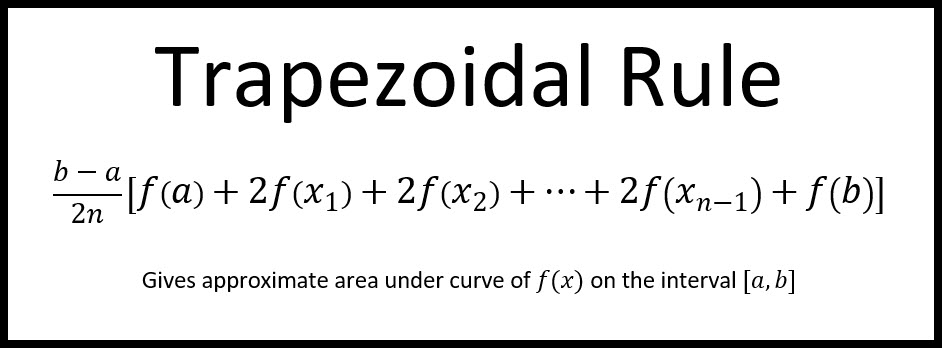
The Trapezoidal Rule is used to approximate definite integrals by splitting the interval into smaller subintervals and using trapezoids instead of rectangles. This is especially helpful when an exact antiderivative is difficult to find or when values come from a table or graph. The formula uses the endpoints once and the interior points twice to estimate the area under the curve.
Notes
Practice Problems
\(\textbf{1)}\) Solve using trapezoidal approximation with n subintervals.
\(\,\,\,\,\,\,\,\,\,\,\displaystyle\int_{2}^{7}x^2 \,dx \,\,\, n=5 \)
The answer is \( 112.5 \)
\(\,\,\,\displaystyle\frac{b-a}{2n}\left[f(a)+2f\left(x_1\right)+2f\left(x_2\right)+…+2f\left(x_{n-1}\right)+f(b) \right]\)
\(\,\,\,\displaystyle\frac{(7)-(2)}{2(5)}\left[f(2)+2f\left(3\right)+2f\left(4\right)+2f\left(5\right)+2f\left(6\right)+f(7) \right]\)
\(\,\,\,\displaystyle\frac{5}{10}\left[2^2+2\left(3^2\right)+2\left(4^2\right)+2\left(5^2\right)+2\left(6^2\right)+7^2 \right]\)
\(\,\,\,\displaystyle\frac{1}{2}\left[4+2\left(9\right)+2\left(16\right)+2\left(25\right)+2\left(36\right)+49 \right]\)
\(\,\,\,\displaystyle\frac{1}{2}\left[4+18+32+50+72+49 \right]\)
\(\,\,\,\displaystyle\frac{1}{2}\left[225 \right]\)
\(\,\,\,\)The answer is \( 112.5 \)
\(\,\,\,\displaystyle\frac{b-a}{2n}\left[f(a)+2f\left(x_1\right)+2f\left(x_2\right)+…+2f\left(x_{n-1}\right)+f(b) \right]\)
\(\,\,\,\displaystyle\frac{(7)-(2)}{2(5)}\left[f(2)+2f\left(3\right)+2f\left(4\right)+2f\left(5\right)+2f\left(6\right)+f(7) \right]\)
\(\,\,\,\displaystyle\frac{5}{10}\left[2^2+2\left(3^2\right)+2\left(4^2\right)+2\left(5^2\right)+2\left(6^2\right)+7^2 \right]\)
\(\,\,\,\displaystyle\frac{1}{2}\left[4+2\left(9\right)+2\left(16\right)+2\left(25\right)+2\left(36\right)+49 \right]\)
\(\,\,\,\displaystyle\frac{1}{2}\left[4+18+32+50+72+49 \right]\)
\(\,\,\,\displaystyle\frac{1}{2}\left[225 \right]\)
\(\,\,\,\)The answer is \( 112.5 \)
\(\textbf{2)}\) Solve using trapezoidal approximation with n subintervals.
\(\,\,\,\,\,\,\,\,\,\,\displaystyle\int_{0}^{3}x^3 \,dx \,\,\, n=3 \)
The answer is \( 22.5 \)
\(\,\,\,\displaystyle\frac{b-a}{2n}\left[f(a)+2f\left(x_1\right)+2f\left(x_2\right)+…+2f\left(x_{n-1}\right)+f(b) \right]\)
\(\,\,\,\displaystyle\frac{3-0}{2(3)}\left[f(0)+2f\left(1\right)+2f\left(2\right)+f(3) \right]\)
\(\,\,\,\displaystyle\frac{3}{6}\left[0^3+2\left(1\right)^3+2\left(2\right)^3+3^3 \right]\)
\(\,\,\,\displaystyle\frac{1}{2}\left[0+2+16+27 \right]\)
\(\,\,\,\displaystyle\frac{1}{2}\left[45 \right]\)
\(\,\,\,\)The answer is \( 22.5 \)
\(\,\,\,\displaystyle\frac{b-a}{2n}\left[f(a)+2f\left(x_1\right)+2f\left(x_2\right)+…+2f\left(x_{n-1}\right)+f(b) \right]\)
\(\,\,\,\displaystyle\frac{3-0}{2(3)}\left[f(0)+2f\left(1\right)+2f\left(2\right)+f(3) \right]\)
\(\,\,\,\displaystyle\frac{3}{6}\left[0^3+2\left(1\right)^3+2\left(2\right)^3+3^3 \right]\)
\(\,\,\,\displaystyle\frac{1}{2}\left[0+2+16+27 \right]\)
\(\,\,\,\displaystyle\frac{1}{2}\left[45 \right]\)
\(\,\,\,\)The answer is \( 22.5 \)
\(\textbf{3)}\) Solve using trapezoidal approximation with n subintervals.
\(\,\,\,\,\,\,\,\,\,\,\displaystyle\int_{0}^{2\pi}\sin{x} \,dx \,\,\, n=4 \)
The answer is \( 0 \)
\(\,\,\,\displaystyle\frac{b-a}{2n}\left[f(a)+2f\left(x_1\right)+2f\left(x_2\right)+…+2f\left(x_{n-1}\right)+f(b) \right]\)
\(\,\,\,\displaystyle\frac{2\pi-0}{2(4)}\left[f(0)+2f\left(\frac{\pi}{2}\right)+2f\left(\pi\right)+2f\left(\frac{3\pi}{2}\right)+f(2\pi) \right]\)
\(\,\,\,\displaystyle\frac{2\pi}{8}\left[\sin(0)+2\sin\left(\frac{\pi}{2}\right)+2\sin\left(\pi\right)+2\sin\left(\frac{3\pi}{2}\right)+\sin(2\pi) \right]\)
\(\,\,\,\displaystyle\frac{2\pi}{8}\left[(0)+2\cdot\left(1\right)+2\left(0\right)+2\left(-1\right)+(0) \right]\)
\(\,\,\,\displaystyle\frac{\pi}{4}\left[(0)+(2)+(0)+\left(-2\right)+(0)\right]\)
\(\,\,\,\displaystyle\frac{\pi}{4}\left[0\right]\)
\(\,\,\,\)The answer is \( 0 \)
\(\,\,\,\displaystyle\frac{b-a}{2n}\left[f(a)+2f\left(x_1\right)+2f\left(x_2\right)+…+2f\left(x_{n-1}\right)+f(b) \right]\)
\(\,\,\,\displaystyle\frac{2\pi-0}{2(4)}\left[f(0)+2f\left(\frac{\pi}{2}\right)+2f\left(\pi\right)+2f\left(\frac{3\pi}{2}\right)+f(2\pi) \right]\)
\(\,\,\,\displaystyle\frac{2\pi}{8}\left[\sin(0)+2\sin\left(\frac{\pi}{2}\right)+2\sin\left(\pi\right)+2\sin\left(\frac{3\pi}{2}\right)+\sin(2\pi) \right]\)
\(\,\,\,\displaystyle\frac{2\pi}{8}\left[(0)+2\cdot\left(1\right)+2\left(0\right)+2\left(-1\right)+(0) \right]\)
\(\,\,\,\displaystyle\frac{\pi}{4}\left[(0)+(2)+(0)+\left(-2\right)+(0)\right]\)
\(\,\,\,\displaystyle\frac{\pi}{4}\left[0\right]\)
\(\,\,\,\)The answer is \( 0 \)
\(\textbf{4)}\) Solve using trapezoidal approximation with n subintervals.
\(\,\,\,\,\,\,\,\,\,\,\displaystyle\int_{0}^{2}5-x^2 \,dx \,\,\, n=4 \)
The answer is \( 7.125 \)
\(\,\,\,\displaystyle\frac{b-a}{2n}\left[f(a)+2f\left(x_1\right)+2f\left(x_2\right)+…+2f\left(x_{n-1}\right)+f(b) \right]\)
\(\,\,\,\displaystyle\frac{2-0}{2(4)}\left[f(0)+2f\left(\frac{1}{2}\right)+2f(1)+2f\left(\frac{3}{2}\right)+f(2) \right]\)
\(\,\,\,\displaystyle\frac{1}{4}\left[5-0^2+2\left(5-\left(\frac{1}{2}\right)^2\right)+2\left(5-1^2\right)+2\left(5-\left(\frac{3}{2}\right)^2\right)+5-2^2 \right]\)
\(\,\,\,\displaystyle\frac{1}{4}\left[5+2\left(5-\frac{1}{4}\right)+2\left(5-1\right)+2\left(5-\frac{9}{4}\right)+5-4 \right]\)
\(\,\,\,\displaystyle\frac{1}{4}\left[5+\frac{38}{4}+8+\frac{22}{4}+1 \right]\)
\(\,\,\,\displaystyle\frac{1}{4}\left[14+8+5.5+1 \right]\)
\(\,\,\,\displaystyle\frac{1}{4}\left[28.5 \right]\)
\(\,\,\,\)The answer is \( 7.125 \)
\(\,\,\,\displaystyle\frac{b-a}{2n}\left[f(a)+2f\left(x_1\right)+2f\left(x_2\right)+…+2f\left(x_{n-1}\right)+f(b) \right]\)
\(\,\,\,\displaystyle\frac{2-0}{2(4)}\left[f(0)+2f\left(\frac{1}{2}\right)+2f(1)+2f\left(\frac{3}{2}\right)+f(2) \right]\)
\(\,\,\,\displaystyle\frac{1}{4}\left[5-0^2+2\left(5-\left(\frac{1}{2}\right)^2\right)+2\left(5-1^2\right)+2\left(5-\left(\frac{3}{2}\right)^2\right)+5-2^2 \right]\)
\(\,\,\,\displaystyle\frac{1}{4}\left[5+2\left(5-\frac{1}{4}\right)+2\left(5-1\right)+2\left(5-\frac{9}{4}\right)+5-4 \right]\)
\(\,\,\,\displaystyle\frac{1}{4}\left[5+\frac{38}{4}+8+\frac{22}{4}+1 \right]\)
\(\,\,\,\displaystyle\frac{1}{4}\left[14+8+5.5+1 \right]\)
\(\,\,\,\displaystyle\frac{1}{4}\left[28.5 \right]\)
\(\,\,\,\)The answer is \( 7.125 \)
\(\textbf{5)}\) Solve using trapezoidal approximation with n subintervals.
\(\,\,\,\,\,\,\,\,\,\,\displaystyle\int_{1}^{5}\displaystyle \frac{1}{x+2} \,dx \,\,\, n=4 \)
The answer is \( \approx 0.85476 \)
\(\,\,\,\displaystyle\Delta x=\frac{5-1}{4}=1\)
\(\,\,\,\displaystyle x_0=1,\;x_1=2,\;x_2=3,\;x_3=4,\;x_4=5\)
\(\,\,\,\displaystyle\frac{\Delta x}{2}\left[f(x_0)+2f(x_1)+2f(x_2)+2f(x_3)+f(x_4)\right]\)
\(\,\,\,\displaystyle\frac{1}{2}\left[\frac{1}{3}+2\left(\frac{1}{4}\right)+2\left(\frac{1}{5}\right)+2\left(\frac{1}{6}\right)+\frac{1}{7}\right]\)
\(\,\,\,\displaystyle\frac{1}{2}\left[\frac{1}{3}+\frac{1}{2}+\frac{2}{5}+\frac{1}{3}+\frac{1}{7}\right]\)
\(\,\,\,\)The answer is \(\approx0.85476\)
\(\,\,\,\displaystyle\Delta x=\frac{5-1}{4}=1\)
\(\,\,\,\displaystyle x_0=1,\;x_1=2,\;x_2=3,\;x_3=4,\;x_4=5\)
\(\,\,\,\displaystyle\frac{\Delta x}{2}\left[f(x_0)+2f(x_1)+2f(x_2)+2f(x_3)+f(x_4)\right]\)
\(\,\,\,\displaystyle\frac{1}{2}\left[\frac{1}{3}+2\left(\frac{1}{4}\right)+2\left(\frac{1}{5}\right)+2\left(\frac{1}{6}\right)+\frac{1}{7}\right]\)
\(\,\,\,\displaystyle\frac{1}{2}\left[\frac{1}{3}+\frac{1}{2}+\frac{2}{5}+\frac{1}{3}+\frac{1}{7}\right]\)
\(\,\,\,\)The answer is \(\approx0.85476\)
\(\textbf{6)}\) Solve using trapezoidal approximation with n subintervals.
\(\,\,\,\,\,\,\,\,\,\,\displaystyle\int_{1}^{3}x \sin{x} \,dx \,\,\, n=4 \)
The answer is \( \approx 2.7217 \)
\(\,\,\,\displaystyle\Delta x=\frac{3-1}{4}=0.5\)
\(\,\,\,\displaystyle x_0=1,\;x_1=1.5,\;x_2=2,\;x_3=2.5,\;x_4=3\)
\(\,\,\,\displaystyle\frac{\Delta x}{2}\left[f(x_0)+2f(x_1)+2f(x_2)+2f(x_3)+f(x_4)\right]\)
\(\,\,\,\displaystyle\frac{0.5}{2}\left[1\sin(1)+2(1.5\sin(1.5))+2(2\sin(2))+2(2.5\sin(2.5))+3\sin(3)\right]\)
\(\,\,\,\displaystyle0.25\left[1\sin(1)+3\sin(1.5)+4\sin(2)+5\sin(2.5)+3\sin(3)\right]\)
\(\,\,\,\)The answer is \(\approx2.7217\)
\(\,\,\,\displaystyle\Delta x=\frac{3-1}{4}=0.5\)
\(\,\,\,\displaystyle x_0=1,\;x_1=1.5,\;x_2=2,\;x_3=2.5,\;x_4=3\)
\(\,\,\,\displaystyle\frac{\Delta x}{2}\left[f(x_0)+2f(x_1)+2f(x_2)+2f(x_3)+f(x_4)\right]\)
\(\,\,\,\displaystyle\frac{0.5}{2}\left[1\sin(1)+2(1.5\sin(1.5))+2(2\sin(2))+2(2.5\sin(2.5))+3\sin(3)\right]\)
\(\,\,\,\displaystyle0.25\left[1\sin(1)+3\sin(1.5)+4\sin(2)+5\sin(2.5)+3\sin(3)\right]\)
\(\,\,\,\)The answer is \(\approx2.7217\)
\(\textbf{7)}\) Solve using trapezoidal approximation with n subintervals.
\(\,\,\,\,\,\,\,\,\,\,\displaystyle\int_{0}^{6}\sqrt{x^2+4} \,dx \,\,\, n=4 \)
The answer is \( \approx 22.788 \)
\(\,\,\,\displaystyle\Delta x=\frac{6-0}{4}=1.5\)
\(\,\,\,\displaystyle x_0=0,\;x_1=1.5,\;x_2=3,\;x_3=4.5,\;x_4=6\)
\(\,\,\,\displaystyle\frac{\Delta x}{2}\left[f(x_0)+2f(x_1)+2f(x_2)+2f(x_3)+f(x_4)\right]\)
\(\,\,\,\displaystyle\frac{1.5}{2}\left[\sqrt{0^2+4}+2\sqrt{1.5^2+4}+2\sqrt{3^2+4}+2\sqrt{4.5^2+4}+\sqrt{6^2+4}\right]\)
\(\,\,\,\displaystyle0.75\left[2+2\sqrt{6.25}+2\sqrt{13}+2\sqrt{24.25}+\sqrt{40}\right]\)
\(\,\,\,\)The answer is \(\approx22.788\)
\(\,\,\,\displaystyle\Delta x=\frac{6-0}{4}=1.5\)
\(\,\,\,\displaystyle x_0=0,\;x_1=1.5,\;x_2=3,\;x_3=4.5,\;x_4=6\)
\(\,\,\,\displaystyle\frac{\Delta x}{2}\left[f(x_0)+2f(x_1)+2f(x_2)+2f(x_3)+f(x_4)\right]\)
\(\,\,\,\displaystyle\frac{1.5}{2}\left[\sqrt{0^2+4}+2\sqrt{1.5^2+4}+2\sqrt{3^2+4}+2\sqrt{4.5^2+4}+\sqrt{6^2+4}\right]\)
\(\,\,\,\displaystyle0.75\left[2+2\sqrt{6.25}+2\sqrt{13}+2\sqrt{24.25}+\sqrt{40}\right]\)
\(\,\,\,\)The answer is \(\approx22.788\)
\(\textbf{8)}\) Solve using trapezoidal approximation with n subintervals.
\(\,\,\,\,\,\,\,\,\,\,\displaystyle\int_{0}^{2}e^x \,dx \,\,\, n=4 \)
The answer is \(\approx6.5216\)
\(\,\,\,\displaystyle\Delta x=\frac{2-0}{4}=0.5\)
\(\,\,\,\displaystyle x_0=0,\;x_1=0.5,\;x_2=1,\;x_3=1.5,\;x_4=2\)
\(\,\,\,\displaystyle\frac{0.5}{2}\left[e^0+2e^{0.5}+2e^1+2e^{1.5}+e^2\right]\)
\(\,\,\,\displaystyle0.25\left[e^0+2e^{0.5}+2e^1+2e^{1.5}+e^2\right]\)
\(\,\,\,\)The answer is \(\approx6.5216\)
\(\,\,\,\displaystyle\Delta x=\frac{2-0}{4}=0.5\)
\(\,\,\,\displaystyle x_0=0,\;x_1=0.5,\;x_2=1,\;x_3=1.5,\;x_4=2\)
\(\,\,\,\displaystyle\frac{0.5}{2}\left[e^0+2e^{0.5}+2e^1+2e^{1.5}+e^2\right]\)
\(\,\,\,\displaystyle0.25\left[e^0+2e^{0.5}+2e^1+2e^{1.5}+e^2\right]\)
\(\,\,\,\)The answer is \(\approx6.5216\)
\(\textbf{9)}\) Solve using trapezoidal approximation with n subintervals.
\(\,\,\,\,\,\,\,\,\,\,\displaystyle\int_{1}^{5}\ln{x} \,dx \,\,\, n=4 \)
The answer is \(\approx3.9828\)
\(\,\,\,\displaystyle\Delta x=\frac{5-1}{4}=1\)
\(\,\,\,\displaystyle x_0=1,\;x_1=2,\;x_2=3,\;x_3=4,\;x_4=5\)
\(\,\,\,\displaystyle\frac{1}{2}\left[\ln(1)+2\ln(2)+2\ln(3)+2\ln(4)+\ln(5)\right]\)
\(\,\,\,\)The answer is \(\approx3.9828\)
\(\,\,\,\displaystyle\Delta x=\frac{5-1}{4}=1\)
\(\,\,\,\displaystyle x_0=1,\;x_1=2,\;x_2=3,\;x_3=4,\;x_4=5\)
\(\,\,\,\displaystyle\frac{1}{2}\left[\ln(1)+2\ln(2)+2\ln(3)+2\ln(4)+\ln(5)\right]\)
\(\,\,\,\)The answer is \(\approx3.9828\)
\(\textbf{10)}\) Solve using trapezoidal approximation with n subintervals.
\(\,\,\,\,\,\,\,\,\,\,\displaystyle\int_{0}^{\pi}\cos{x} \,dx \,\,\, n=4 \)
The answer is \(0\)
\(\,\,\,\displaystyle\Delta x=\frac{\pi-0}{4}=\frac{\pi}{4}\)
\(\,\,\,\displaystyle x_0=0,\;x_1=\frac{\pi}{4},\;x_2=\frac{\pi}{2},\;x_3=\frac{3\pi}{4},\;x_4=\pi\)
\(\,\,\,\displaystyle\frac{\pi/4}{2}\left[\cos(0)+2\cos\left(\frac{\pi}{4}\right)+2\cos\left(\frac{\pi}{2}\right)+2\cos\left(\frac{3\pi}{4}\right)+\cos(\pi)\right]\)
\(\,\,\,\displaystyle\frac{\pi}{8}\left[1+\sqrt{2}+0-\sqrt{2}-1\right]\)
\(\,\,\,\)The answer is \(0\)
\(\,\,\,\displaystyle\Delta x=\frac{\pi-0}{4}=\frac{\pi}{4}\)
\(\,\,\,\displaystyle x_0=0,\;x_1=\frac{\pi}{4},\;x_2=\frac{\pi}{2},\;x_3=\frac{3\pi}{4},\;x_4=\pi\)
\(\,\,\,\displaystyle\frac{\pi/4}{2}\left[\cos(0)+2\cos\left(\frac{\pi}{4}\right)+2\cos\left(\frac{\pi}{2}\right)+2\cos\left(\frac{3\pi}{4}\right)+\cos(\pi)\right]\)
\(\,\,\,\displaystyle\frac{\pi}{8}\left[1+\sqrt{2}+0-\sqrt{2}-1\right]\)
\(\,\,\,\)The answer is \(0\)
\(\textbf{11)}\) Solve using trapezoidal approximation with n subintervals.
\(\,\,\,\,\,\,\,\,\,\,\displaystyle\int_{0}^{4}\left(x^2+1\right) \,dx \,\,\, n=4 \)
The answer is \(26\)
\(\,\,\,\displaystyle\Delta x=\frac{4-0}{4}=1\)
\(\,\,\,\displaystyle x_0=0,\;x_1=1,\;x_2=2,\;x_3=3,\;x_4=4\)
\(\,\,\,\displaystyle\frac{1}{2}\left[f(0)+2f(1)+2f(2)+2f(3)+f(4)\right]\)
\(\,\,\,\displaystyle\frac{1}{2}\left[(1)+2(2)+2(5)+2(10)+(17)\right]\)
\(\,\,\,\displaystyle\frac{1}{2}(52)\)
\(\,\,\,\)The answer is \(26\)
\(\,\,\,\displaystyle\Delta x=\frac{4-0}{4}=1\)
\(\,\,\,\displaystyle x_0=0,\;x_1=1,\;x_2=2,\;x_3=3,\;x_4=4\)
\(\,\,\,\displaystyle\frac{1}{2}\left[f(0)+2f(1)+2f(2)+2f(3)+f(4)\right]\)
\(\,\,\,\displaystyle\frac{1}{2}\left[(1)+2(2)+2(5)+2(10)+(17)\right]\)
\(\,\,\,\displaystyle\frac{1}{2}(52)\)
\(\,\,\,\)The answer is \(26\)
\(\textbf{12)}\) Solve using trapezoidal approximation with n subintervals.
\(\,\,\,\,\,\,\,\,\,\,\displaystyle\int_{1}^{3}\frac{1}{x} \,dx \,\,\, n=4 \)
The answer is \(\approx1.1167\)
\(\,\,\,\displaystyle\Delta x=\frac{3-1}{4}=0.5\)
\(\,\,\,\displaystyle x_0=1,\;x_1=1.5,\;x_2=2,\;x_3=2.5,\;x_4=3\)
\(\,\,\,\displaystyle\frac{0.5}{2}\left[1+2\left(\frac{1}{1.5}\right)+2\left(\frac{1}{2}\right)+2\left(\frac{1}{2.5}\right)+\frac{1}{3}\right]\)
\(\,\,\,\displaystyle0.25\left[1+\frac{4}{3}+1+\frac{4}{5}+\frac{1}{3}\right]\)
\(\,\,\,\)The answer is \(\approx1.1167\)
\(\,\,\,\displaystyle\Delta x=\frac{3-1}{4}=0.5\)
\(\,\,\,\displaystyle x_0=1,\;x_1=1.5,\;x_2=2,\;x_3=2.5,\;x_4=3\)
\(\,\,\,\displaystyle\frac{0.5}{2}\left[1+2\left(\frac{1}{1.5}\right)+2\left(\frac{1}{2}\right)+2\left(\frac{1}{2.5}\right)+\frac{1}{3}\right]\)
\(\,\,\,\displaystyle0.25\left[1+\frac{4}{3}+1+\frac{4}{5}+\frac{1}{3}\right]\)
\(\,\,\,\)The answer is \(\approx1.1167\)
\(\textbf{13)}\) Solve using trapezoidal approximation with n subintervals.
\(\,\,\,\,\,\,\,\,\,\,\displaystyle\int_{0}^{4}\sqrt{x} \,dx \,\,\, n=4 \)
The answer is \(\approx5.1463\)
\(\,\,\,\displaystyle\Delta x=\frac{4-0}{4}=1\)
\(\,\,\,\displaystyle x_0=0,\;x_1=1,\;x_2=2,\;x_3=3,\;x_4=4\)
\(\,\,\,\displaystyle\frac{1}{2}\left[\sqrt{0}+2\sqrt{1}+2\sqrt{2}+2\sqrt{3}+\sqrt{4}\right]\)
\(\,\,\,\)The answer is \(\approx5.1463\)
\(\,\,\,\displaystyle\Delta x=\frac{4-0}{4}=1\)
\(\,\,\,\displaystyle x_0=0,\;x_1=1,\;x_2=2,\;x_3=3,\;x_4=4\)
\(\,\,\,\displaystyle\frac{1}{2}\left[\sqrt{0}+2\sqrt{1}+2\sqrt{2}+2\sqrt{3}+\sqrt{4}\right]\)
\(\,\,\,\)The answer is \(\approx5.1463\)
\(\textbf{14)}\) Solve using trapezoidal approximation with n subintervals.
\(\,\,\,\,\,\,\,\,\,\,\displaystyle\int_{-1}^{3}\left(x^3+1\right) \,dx \,\,\, n=4 \)
The answer is \(26\)
\(\,\,\,\displaystyle\Delta x=\frac{3-(-1)}{4}=1\)
\(\,\,\,\displaystyle x_0=-1,\;x_1=0,\;x_2=1,\;x_3=2,\;x_4=3\)
\(\,\,\,\displaystyle\frac{1}{2}\left[f(-1)+2f(0)+2f(1)+2f(2)+f(3)\right]\)
\(\,\,\,\displaystyle\frac{1}{2}\left[0+2(1)+2(2)+2(9)+28\right]\)
\(\,\,\,\displaystyle\frac{1}{2}(52)\)
\(\,\,\,\)The answer is \(26\)
\(\,\,\,\displaystyle\Delta x=\frac{3-(-1)}{4}=1\)
\(\,\,\,\displaystyle x_0=-1,\;x_1=0,\;x_2=1,\;x_3=2,\;x_4=3\)
\(\,\,\,\displaystyle\frac{1}{2}\left[f(-1)+2f(0)+2f(1)+2f(2)+f(3)\right]\)
\(\,\,\,\displaystyle\frac{1}{2}\left[0+2(1)+2(2)+2(9)+28\right]\)
\(\,\,\,\displaystyle\frac{1}{2}(52)\)
\(\,\,\,\)The answer is \(26\)
\(\textbf{15)}\) Solve using trapezoidal approximation with n subintervals.
\(\,\,\,\,\,\,\,\,\,\,\displaystyle\int_{0}^{\pi}\left(\sin{x}+2\right) \,dx \,\,\, n=4 \)
The answer is \(\approx8.1793\)
\(\,\,\,\displaystyle\Delta x=\frac{\pi}{4}\)
\(\,\,\,\displaystyle x_0=0,\;x_1=\frac{\pi}{4},\;x_2=\frac{\pi}{2},\;x_3=\frac{3\pi}{4},\;x_4=\pi\)
\(\,\,\,\displaystyle\frac{\pi}{8}\left[(2)+2\left(2+\frac{\sqrt2}{2}\right)+2(3)+2\left(2+\frac{\sqrt2}{2}\right)+(2)\right]\)
\(\,\,\,\displaystyle\frac{\pi}{8}\left[14+2\sqrt2\right]\)
\(\,\,\,\)The answer is \(\approx8.1793\)
\(\,\,\,\displaystyle\Delta x=\frac{\pi}{4}\)
\(\,\,\,\displaystyle x_0=0,\;x_1=\frac{\pi}{4},\;x_2=\frac{\pi}{2},\;x_3=\frac{3\pi}{4},\;x_4=\pi\)
\(\,\,\,\displaystyle\frac{\pi}{8}\left[(2)+2\left(2+\frac{\sqrt2}{2}\right)+2(3)+2\left(2+\frac{\sqrt2}{2}\right)+(2)\right]\)
\(\,\,\,\displaystyle\frac{\pi}{8}\left[14+2\sqrt2\right]\)
\(\,\,\,\)The answer is \(\approx8.1793\)
\(\textbf{16)}\) Solve using trapezoidal approximation with n subintervals.
\(\,\,\,\,\,\,\,\,\,\,\displaystyle\int_{0}^{2}\frac{1}{1+x^2} \,dx \,\,\, n=4 \)
The answer is \(\approx1.1038\)
\(\,\,\,\displaystyle\Delta x=\frac{2-0}{4}=0.5\)
\(\,\,\,\displaystyle x_0=0,\;x_1=0.5,\;x_2=1,\;x_3=1.5,\;x_4=2\)
\(\,\,\,\displaystyle\frac{0.5}{2}\left[1+2\left(\frac{1}{1+0.5^2}\right)+2\left(\frac{1}{1+1^2}\right)+2\left(\frac{1}{1+1.5^2}\right)+\frac{1}{1+2^2}\right]\)
\(\,\,\,\)The answer is \(\approx1.1038\)
\(\,\,\,\displaystyle\Delta x=\frac{2-0}{4}=0.5\)
\(\,\,\,\displaystyle x_0=0,\;x_1=0.5,\;x_2=1,\;x_3=1.5,\;x_4=2\)
\(\,\,\,\displaystyle\frac{0.5}{2}\left[1+2\left(\frac{1}{1+0.5^2}\right)+2\left(\frac{1}{1+1^2}\right)+2\left(\frac{1}{1+1.5^2}\right)+\frac{1}{1+2^2}\right]\)
\(\,\,\,\)The answer is \(\approx1.1038\)
\(\textbf{17)}\) Solve using trapezoidal approximation with n subintervals.
\(\,\,\,\,\,\,\,\,\,\,\displaystyle\int_{0}^{2}e^{-x} \,dx \,\,\, n=4 \)
The answer is \(\approx0.8826\)
\(\,\,\,\displaystyle\Delta x=\frac{2-0}{4}=0.5\)
\(\,\,\,\displaystyle x_0=0,\;x_1=0.5,\;x_2=1,\;x_3=1.5,\;x_4=2\)
\(\,\,\,\displaystyle\frac{0.5}{2}\left[e^0+2e^{-0.5}+2e^{-1}+2e^{-1.5}+e^{-2}\right]\)
\(\,\,\,\displaystyle0.25\left[e^0+2e^{-0.5}+2e^{-1}+2e^{-1.5}+e^{-2}\right]\)
\(\,\,\,\)The answer is \(\approx0.8826\)
\(\,\,\,\displaystyle\Delta x=\frac{2-0}{4}=0.5\)
\(\,\,\,\displaystyle x_0=0,\;x_1=0.5,\;x_2=1,\;x_3=1.5,\;x_4=2\)
\(\,\,\,\displaystyle\frac{0.5}{2}\left[e^0+2e^{-0.5}+2e^{-1}+2e^{-1.5}+e^{-2}\right]\)
\(\,\,\,\displaystyle0.25\left[e^0+2e^{-0.5}+2e^{-1}+2e^{-1.5}+e^{-2}\right]\)
\(\,\,\,\)The answer is \(\approx0.8826\)
\(\textbf{18)}\) Use the Trapezoidal Rule with the table values below to approximate \(\displaystyle\int_0^4 f(x)\,dx\).
\(\begin{array}{c|ccccc}x&0&1&2&3&4\\ \hline f(x)&3&5&4&6&8\end{array}\)
The answer is \(20.5\)
\(\,\,\,\Delta x=1\)
\(\,\,\,\displaystyle T=\frac{\Delta x}{2}\left[f(0)+2f(1)+2f(2)+2f(3)+f(4)\right]\)
\(\,\,\,\displaystyle T=\frac{1}{2}\left[3+2(5)+2(4)+2(6)+8\right]\)
\(\,\,\,\displaystyle T=\frac{1}{2}\left[41\right]\)
\(\,\,\,\)The answer is \(20.5\)
\(\,\,\,\Delta x=1\)
\(\,\,\,\displaystyle T=\frac{\Delta x}{2}\left[f(0)+2f(1)+2f(2)+2f(3)+f(4)\right]\)
\(\,\,\,\displaystyle T=\frac{1}{2}\left[3+2(5)+2(4)+2(6)+8\right]\)
\(\,\,\,\displaystyle T=\frac{1}{2}\left[41\right]\)
\(\,\,\,\)The answer is \(20.5\)
\(\textbf{19)}\) Use the Trapezoidal Rule with the table values below to approximate \(\displaystyle\int_1^5 f(x)\,dx\).
\(\begin{array}{c|ccccc}x&1&2&3&4&5\\ \hline f(x)&2&7&9&10&14\end{array}\)
The answer is \(34\)
\(\,\,\,\Delta x=1\)
\(\,\,\,\displaystyle T=\frac{\Delta x}{2}\left[f(1)+2f(2)+2f(3)+2f(4)+f(5)\right]\)
\(\,\,\,\displaystyle T=\frac{1}{2}\left[2+2(7)+2(9)+2(10)+14\right]\)
\(\,\,\,\displaystyle T=\frac{1}{2}\left[68\right]\)
\(\,\,\,\)The answer is \(34\)
\(\,\,\,\Delta x=1\)
\(\,\,\,\displaystyle T=\frac{\Delta x}{2}\left[f(1)+2f(2)+2f(3)+2f(4)+f(5)\right]\)
\(\,\,\,\displaystyle T=\frac{1}{2}\left[2+2(7)+2(9)+2(10)+14\right]\)
\(\,\,\,\displaystyle T=\frac{1}{2}\left[68\right]\)
\(\,\,\,\)The answer is \(34\)
\(\textbf{20)}\) Use the Trapezoidal Rule with the table values below to approximate \(\displaystyle\int_0^{10} f(x)\,dx\).
\(\begin{array}{c|cccccc}x&0&2&4&6&8&10\\ \hline f(x)&1&3&4&6&5&7\end{array}\)
The answer is \(44\)
\(\,\,\,\Delta x=2\)
\(\,\,\,\displaystyle T=\frac{\Delta x}{2}\left[f(0)+2f(2)+2f(4)+2f(6)+2f(8)+f(10)\right]\)
\(\,\,\,\displaystyle T=\frac{2}{2}\left[1+2(3)+2(4)+2(6)+2(5)+7\right]\)
\(\,\,\,\displaystyle T=1\left[44\right]\)
\(\,\,\,\)The answer is \(44\)
\(\,\,\,\Delta x=2\)
\(\,\,\,\displaystyle T=\frac{\Delta x}{2}\left[f(0)+2f(2)+2f(4)+2f(6)+2f(8)+f(10)\right]\)
\(\,\,\,\displaystyle T=\frac{2}{2}\left[1+2(3)+2(4)+2(6)+2(5)+7\right]\)
\(\,\,\,\displaystyle T=1\left[44\right]\)
\(\,\,\,\)The answer is \(44\)
See Related Pages\(\)
\(\bullet\text{ Calculus Homepage}\)
\(\,\,\,\,\,\,\,\,\text{All the Best Topics…}\)
\(\bullet\text{ Properties of Integrals}\)
\(\,\,\,\,\,\,\,\,\displaystyle \int_{a}^{b}cf(x) \, dx=c\displaystyle \int_{a}^{b}f(x) \,dx…\)
\(\bullet\text{ Indefinite Integrals- Power Rule}\)
\(\,\,\,\,\,\,\,\,\displaystyle \int x^n \, dx = \displaystyle \frac{x^{n+1}}{n+1}+C…\)
\(\bullet\text{ Indefinite Integrals- Trig Functions}\)
\(\,\,\,\,\,\,\,\,\displaystyle \int \cos{x} \, dx=\sin{x}+C…\)
\(\bullet\text{ Definite Integrals}\)
\(\,\,\,\,\,\,\,\,\displaystyle \int_{5}^{7} x^3 \, dx…\)
\(\bullet\text{ Integration by Substitution}\)
\(\,\,\,\,\,\,\,\,\displaystyle \int (x^2+3)^3(2x) \,dx…\)
\(\bullet\text{ Area of Region Between Two Curves}\)
\(\,\,\,\,\,\,\,\,A=\displaystyle \int_{a}^{b}\left[f(x)-g(x)\right]\,dx…\)
\(\bullet\text{ Arc Length}\)
\(\,\,\,\,\,\,\,\,\displaystyle \int_{a}^{b}\sqrt{1+\left[f'(x)\right]^2} \,dx…\)
\(\bullet\text{ Average Function Value}\)
\(\,\,\,\,\,\,\,\,\displaystyle\frac{1}{b-a} \int_{a}^{b}f(x) \,dx\)
\(\bullet\text{ Volume by Cross Sections}\)
\(\,\,\,\,\,\,\,\,\text{Volume}=\displaystyle \int_{a}^{b}\left(\text{Area}\right) \, dx…\)
\(\bullet\text{ Disk Method}\)
\(\,\,\,\,\,\,\,\,V=\displaystyle \int_{a}^{b}\left[f(x)\right]^2\,dx…\)
\(\bullet\text{ Cylindrical Shells}\)
\(\,\,\,\,\,\,\,\,V=2 \pi \displaystyle \int_{a}^{b} y f(y) \, dy…\)