

Notes
Questions
Find the distance between the 2 points.
\(\textbf{1)}\) \((3,4)\) and \((7,1)\). The answer is \(5\)
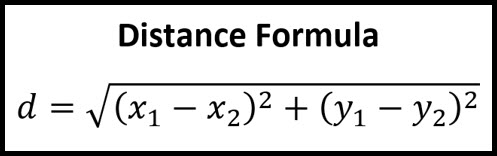
\(\,\,\,\,\,\,\text{Distance}=\sqrt{\left(x_1-x_2\right)^2+\left(y_1-y_2\right)^2}\)
\(\,\,\,\,\,\,\sqrt{\left(3-7\right)^2+\left(4-1\right)^2}\)
\(\,\,\,\,\,\,\sqrt{\left(-4\right)^2+\left(3\right)^2}\)
\(\,\,\,\,\,\,\sqrt{16+9}\)
\(\,\,\,\,\,\,\sqrt{25}\)
\(\,\,\,\,\,\,5\)
\(\,\,\,\,\,\,\text{Distance}=\sqrt{\left(x_1-x_2\right)^2+\left(y_1-y_2\right)^2}\)
\(\,\,\,\,\,\,\sqrt{\left(3-7\right)^2+\left(4-1\right)^2}\)
\(\,\,\,\,\,\,\sqrt{\left(-4\right)^2+\left(3\right)^2}\)
\(\,\,\,\,\,\,\sqrt{16+9}\)
\(\,\,\,\,\,\,\sqrt{25}\)
\(\,\,\,\,\,\,5\)
\(\textbf{2)}\) \((-2,6)\) and \((3,-6)\). The answer is \(13\)
\(\,\,\,\,\,\,\text{Distance}=\sqrt{\left(x_1-x_2\right)^2+\left(y_1-y_2\right)^2}\)
\(\,\,\,\,\,\,\text{Distance}=\sqrt{\left(-2-3\right)^2+\left(6-(-6)\right)^2}\)
\(\,\,\,\,\,\,\text{Distance}=\sqrt{\left(-5\right)^2+\left(12\right)^2}\)
\(\,\,\,\,\,\,\text{Distance}=\sqrt{\left(25+144}\)
\(\,\,\,\,\,\,\text{Distance}=\sqrt{\left(169}\)
\(\,\,\,\,\,\,\text{Distance}=13\)
\(\,\,\,\,\,\,\text{Distance}=\sqrt{\left(x_1-x_2\right)^2+\left(y_1-y_2\right)^2}\)
\(\,\,\,\,\,\,\text{Distance}=\sqrt{\left(-2-3\right)^2+\left(6-(-6)\right)^2}\)
\(\,\,\,\,\,\,\text{Distance}=\sqrt{\left(-5\right)^2+\left(12\right)^2}\)
\(\,\,\,\,\,\,\text{Distance}=\sqrt{\left(25+144}\)
\(\,\,\,\,\,\,\text{Distance}=\sqrt{\left(169}\)
\(\,\,\,\,\,\,\text{Distance}=13\)
\(\textbf{3)}\) \((3,0)\) and \((-3,8)\). The answer is \(10\)
\(\,\,\,\,\,\,\text{Distance}=\sqrt{\left(x_1-x_2\right)^2+\left(y_1-y_2\right)^2}\)
\(\,\,\,\,\,\,\text{Distance}=\sqrt{\left(3-(-3)\right)^2+\left(0-8\right)^2}\)
\(\,\,\,\,\,\,\text{Distance}=\sqrt{\left(6\right)^2+\left(-8\right)^2}\)
\(\,\,\,\,\,\,\text{Distance}=\sqrt{36+64}\)
\(\,\,\,\,\,\,\text{Distance}=\sqrt{100}\)
\(\,\,\,\,\,\,10\)
\(\,\,\,\,\,\,\text{Distance}=\sqrt{\left(x_1-x_2\right)^2+\left(y_1-y_2\right)^2}\)
\(\,\,\,\,\,\,\text{Distance}=\sqrt{\left(3-(-3)\right)^2+\left(0-8\right)^2}\)
\(\,\,\,\,\,\,\text{Distance}=\sqrt{\left(6\right)^2+\left(-8\right)^2}\)
\(\,\,\,\,\,\,\text{Distance}=\sqrt{36+64}\)
\(\,\,\,\,\,\,\text{Distance}=\sqrt{100}\)
\(\,\,\,\,\,\,10\)
\(\textbf{4)}\) \((3,4)\) and \((7,-8)\).
The answer is \(4\sqrt{10}\)
\(\textbf{5)}\) Find the distance of \(\overline{DY}\)
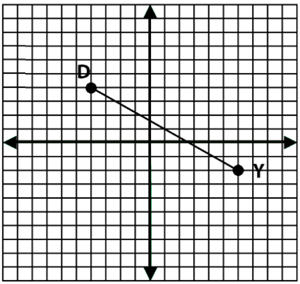
The answer is \(2\sqrt{34}\)
Challenge Problems
\(\textbf{6)}\) Find the k so the distance is 4,
\((3,0)\) and \((7,k)\). The answer is \(k=0\)
\(\,\,\,\,\,\,\text{Distance}=\sqrt{\left(x_1-x_2\right)^2+\left(y_1-y_2\right)^2}\)
\(\,\,\,\,\,\,4=\sqrt{\left(3-7\right)^2+\left(0-k\right)^2}\)
\(\,\,\,\,\,\,16=\left(3-7\right)^2+\left(0-k\right)^2\)
\(\,\,\,\,\,\,16=\left(-4\right)^2+\left(-k\right)^2\)
\(\,\,\,\,\,\,16=16+\left(-k\right)^2\)
\(\,\,\,\,\,\,0=\left(-k\right)^2\)
\(\,\,\,\,\,\,0=-k\)
\(\,\,\,\,\,\,k=0\)
\(\,\,\,\,\,\,\text{Distance}=\sqrt{\left(x_1-x_2\right)^2+\left(y_1-y_2\right)^2}\)
\(\,\,\,\,\,\,4=\sqrt{\left(3-7\right)^2+\left(0-k\right)^2}\)
\(\,\,\,\,\,\,16=\left(3-7\right)^2+\left(0-k\right)^2\)
\(\,\,\,\,\,\,16=\left(-4\right)^2+\left(-k\right)^2\)
\(\,\,\,\,\,\,16=16+\left(-k\right)^2\)
\(\,\,\,\,\,\,0=\left(-k\right)^2\)
\(\,\,\,\,\,\,0=-k\)
\(\,\,\,\,\,\,k=0\)
\(\textbf{7)}\) Find the n so the distance is 8,
\((10,5)\) and \((n,5)\). The answer is \(n=2 \text{ or } n=18\)
\(\,\,\,\,\,\,\text{Distance}=\sqrt{\left(x_1-x_2\right)^2+\left(y_1-y_2\right)^2}\)
\(\,\,\,\,\,\,8=\sqrt{\left(10-n\right)^2+\left(5-5\right)^2}\)
\(\,\,\,\,\,\,8=\sqrt{\left(10-n\right)^2+\left(0\right)^2}\)
\(\,\,\,\,\,\,8=\sqrt{\left(10-n\right)^2}\)
\(\,\,\,\,\,\,64=\left(10-n\right)^2\)
\(\,\,\,\,\,\,\pm 8=10-n\)
\(\,\,\,\,\,\,-10 \pm 8=-n\)
\(\,\,\,\,\,\,10 \pm 8=n\)
\(\,\,\,\,\,\,n=10 – 8 \text{ or }n=10+ 8\)
\(\,\,\,\,\,\,n=2 \text{ or }n=18\)
\(\,\,\,\,\,\,\text{Distance}=\sqrt{\left(x_1-x_2\right)^2+\left(y_1-y_2\right)^2}\)
\(\,\,\,\,\,\,8=\sqrt{\left(10-n\right)^2+\left(5-5\right)^2}\)
\(\,\,\,\,\,\,8=\sqrt{\left(10-n\right)^2+\left(0\right)^2}\)
\(\,\,\,\,\,\,8=\sqrt{\left(10-n\right)^2}\)
\(\,\,\,\,\,\,64=\left(10-n\right)^2\)
\(\,\,\,\,\,\,\pm 8=10-n\)
\(\,\,\,\,\,\,-10 \pm 8=-n\)
\(\,\,\,\,\,\,10 \pm 8=n\)
\(\,\,\,\,\,\,n=10 – 8 \text{ or }n=10+ 8\)
\(\,\,\,\,\,\,n=2 \text{ or }n=18\)
See Related Pages\(\)
\(\bullet\text{ Distance Formula Calculator }\)
\(\,\,\,\,\,\,\,\,\text{(Calculator.net)}\)
\(\bullet\text{ Geometry Homepage}\)
\(\,\,\,\,\,\,\,\,\text{All the Best Topics…}\)
\(\bullet\text{ Midpoint Formula}\)
\(\,\,\,\,\,\,\,\,\left(\frac{x_1+x_2}{2},\frac{y_1+y_2}{2}\right)…\)
In Summary
The distance formula is a mathematical concept that allows us to calculate the distance between two points in a coordinate plane. It is typically represented by the equation \(d = \sqrt{\left(x_1-x_2\right)^2+\left(y_1-y_2\right)^2}\), where \((x_1, y_1)\) and \((x_2, y_2)\) are the coordinates of the two points, and \(d\) is the distance between them.
The distance formula is a standard part of geometry and is usually introduced in high school math classes. It can be beneficial for students who are interested in pursuing careers in fields that rely on spatial reasoning and problem-solving. It is a useful tool for finding the distance between points in a variety of contexts, including in physics, engineering, and computer graphics. It can also be a useful tool for everyday life, such as finding the shortest route between two points on a map.