

Orthogonal vectors are vectors that meet at a right angle. Algebraically, two vectors are orthogonal when their dot product is equal to \(0\). These problems include checking whether vectors are orthogonal and solving for missing values that make vectors perpendicular.
Notes
Orthogonal Vectors
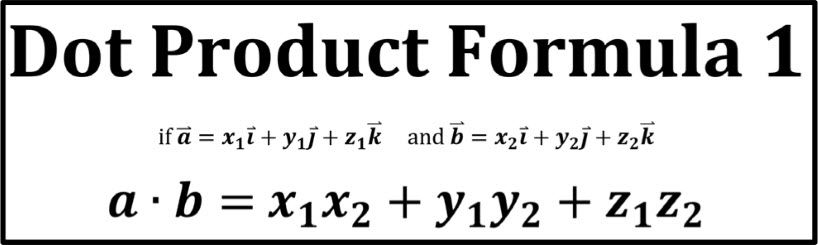
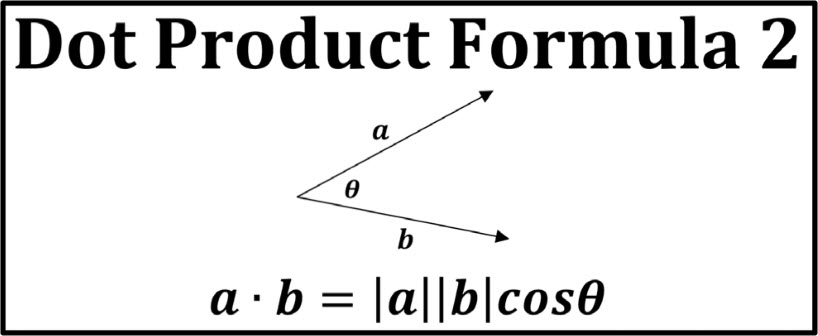
Dot Product \(\vec{u} \cdot \vec{v}=0\)
Practice Problems
\(\textbf{1)}\) Are \( \vec{u}=(1,2,3) \) and \( \vec{v}=(8,-4,0) \) orthogonal?
\(\vec{u} \cdot \vec{v}=(1)(8)+(2)(-4)+(3)(0)\)
\(\vec{u} \cdot \vec{v}=8-8+0\)
\(\vec{u} \cdot \vec{v}=0\)
\(\text{Since the dot product is }0,\text{ the vectors are orthogonal.}\)
Yes, they are orthogonal.
\(\vec{u} \cdot \vec{v}=(1)(8)+(2)(-4)+(3)(0)\)
\(\vec{u} \cdot \vec{v}=8-8+0\)
\(\vec{u} \cdot \vec{v}=0\)
\(\text{Since the dot product is }0,\text{ the vectors are orthogonal.}\)
\(\textbf{2)}\) Are \( \vec{u}=(1,5,8) \) and \( \vec{v}=(3,-5,1) \) orthogonal?
\(\vec{u} \cdot \vec{v}=(1)(3)+(5)(-5)+(8)(1)\)
\(\vec{u} \cdot \vec{v}=3-25+8\)
\(\vec{u} \cdot \vec{v}=-14\)
\(\text{Since the dot product is not }0,\text{ the vectors are not orthogonal.}\)
No, they are not orthogonal.
\(\vec{u} \cdot \vec{v}=(1)(3)+(5)(-5)+(8)(1)\)
\(\vec{u} \cdot \vec{v}=3-25+8\)
\(\vec{u} \cdot \vec{v}=-14\)
\(\text{Since the dot product is not }0,\text{ the vectors are not orthogonal.}\)
\(\textbf{3)}\) Are \( \vec{u}=(-5,-4,10) \) and \( \vec{v}=(4,5,4) \) orthogonal?
\(\vec{u} \cdot \vec{v}=(-5)(4)+(-4)(5)+(10)(4)\)
\(\vec{u} \cdot \vec{v}=-20-20+40\)
\(\vec{u} \cdot \vec{v}=0\)
\(\text{Since the dot product is }0,\text{ the vectors are orthogonal.}\)
Yes, they are orthogonal.
\(\vec{u} \cdot \vec{v}=(-5)(4)+(-4)(5)+(10)(4)\)
\(\vec{u} \cdot \vec{v}=-20-20+40\)
\(\vec{u} \cdot \vec{v}=0\)
\(\text{Since the dot product is }0,\text{ the vectors are orthogonal.}\)
\(\textbf{4)}\) Are \( \vec{u}=(-2,3,5) \) and \( \vec{v}=(5,4,2) \) orthogonal?
\(\vec{u} \cdot \vec{v}=(-2)(5)+(3)(4)+(5)(2)\)
\(\vec{u} \cdot \vec{v}=-10+12+10\)
\(\vec{u} \cdot \vec{v}=12\)
\(\text{Since the dot product is not }0,\text{ the vectors are not orthogonal.}\)
No, they are not orthogonal.
\(\vec{u} \cdot \vec{v}=(-2)(5)+(3)(4)+(5)(2)\)
\(\vec{u} \cdot \vec{v}=-10+12+10\)
\(\vec{u} \cdot \vec{v}=12\)
\(\text{Since the dot product is not }0,\text{ the vectors are not orthogonal.}\)
\(\textbf{5)}\) Are \(\vec{u}=(4,-1)\) and \(\vec{v}=(2,8)\) orthogonal?
\(\vec{u}\cdot\vec{v}=(4)(2)+(-1)(8)\)
\(\vec{u}\cdot\vec{v}=8-8\)
\(\vec{u}\cdot\vec{v}=0\)
\(\text{Since the dot product is }0,\text{ the vectors are orthogonal.}\)
Yes, they are orthogonal.
\(\vec{u}\cdot\vec{v}=(4)(2)+(-1)(8)\)
\(\vec{u}\cdot\vec{v}=8-8\)
\(\vec{u}\cdot\vec{v}=0\)
\(\text{Since the dot product is }0,\text{ the vectors are orthogonal.}\)
\(\textbf{6)}\) Are \(\vec{u}=(6,2)\) and \(\vec{v}=(-1,3)\) orthogonal?
\(\vec{u}\cdot\vec{v}=(6)(-1)+(2)(3)\)
\(\vec{u}\cdot\vec{v}=-6+6\)
\(\vec{u}\cdot\vec{v}=0\)
\(\text{Since the dot product is }0,\text{ the vectors are orthogonal.}\)
Yes, they are orthogonal.
\(\vec{u}\cdot\vec{v}=(6)(-1)+(2)(3)\)
\(\vec{u}\cdot\vec{v}=-6+6\)
\(\vec{u}\cdot\vec{v}=0\)
\(\text{Since the dot product is }0,\text{ the vectors are orthogonal.}\)
\(\textbf{7)}\) Are \(\vec{u}=(7,3)\) and \(\vec{v}=(2,-5)\) orthogonal?
\(\vec{u}\cdot\vec{v}=(7)(2)+(3)(-5)\)
\(\vec{u}\cdot\vec{v}=14-15\)
\(\vec{u}\cdot\vec{v}=-1\)
\(\text{Since the dot product is not }0,\text{ the vectors are not orthogonal.}\)
No, they are not orthogonal.
\(\vec{u}\cdot\vec{v}=(7)(2)+(3)(-5)\)
\(\vec{u}\cdot\vec{v}=14-15\)
\(\vec{u}\cdot\vec{v}=-1\)
\(\text{Since the dot product is not }0,\text{ the vectors are not orthogonal.}\)
\(\textbf{8)}\) Are \(\vec{u}=(3,-6,2)\) and \(\vec{v}=(4,2,0)\) orthogonal?
\(\vec{u}\cdot\vec{v}=(3)(4)+(-6)(2)+(2)(0)\)
\(\vec{u}\cdot\vec{v}=12-12+0\)
\(\vec{u}\cdot\vec{v}=0\)
\(\text{Since the dot product is }0,\text{ the vectors are orthogonal.}\)
Yes, they are orthogonal.
\(\vec{u}\cdot\vec{v}=(3)(4)+(-6)(2)+(2)(0)\)
\(\vec{u}\cdot\vec{v}=12-12+0\)
\(\vec{u}\cdot\vec{v}=0\)
\(\text{Since the dot product is }0,\text{ the vectors are orthogonal.}\)
\(\textbf{9)}\) Are \(\vec{u}=(-1,4,2)\) and \(\vec{v}=(8,1,1)\) orthogonal?
\(\vec{u}\cdot\vec{v}=(-1)(8)+(4)(1)+(2)(1)\)
\(\vec{u}\cdot\vec{v}=-8+4+2\)
\(\vec{u}\cdot\vec{v}=-2\)
\(\text{Since the dot product is not }0,\text{ the vectors are not orthogonal.}\)
No, they are not orthogonal.
\(\vec{u}\cdot\vec{v}=(-1)(8)+(4)(1)+(2)(1)\)
\(\vec{u}\cdot\vec{v}=-8+4+2\)
\(\vec{u}\cdot\vec{v}=-2\)
\(\text{Since the dot product is not }0,\text{ the vectors are not orthogonal.}\)
\(\textbf{10)}\) Are \(\vec{u}=(2,1,-3)\) and \(\vec{v}=(3,0,2)\) orthogonal?
\(\vec{u}\cdot\vec{v}=(2)(3)+(1)(0)+(-3)(2)\)
\(\vec{u}\cdot\vec{v}=6+0-6\)
\(\vec{u}\cdot\vec{v}=0\)
\(\text{Since the dot product is }0,\text{ the vectors are orthogonal.}\)
Yes, they are orthogonal.
\(\vec{u}\cdot\vec{v}=(2)(3)+(1)(0)+(-3)(2)\)
\(\vec{u}\cdot\vec{v}=6+0-6\)
\(\vec{u}\cdot\vec{v}=0\)
\(\text{Since the dot product is }0,\text{ the vectors are orthogonal.}\)
\(\textbf{11)}\) Are \(\vec{u}=(5,-2,1)\) and \(\vec{v}=(1,2,-1)\) orthogonal?
\(\vec{u}\cdot\vec{v}=(5)(1)+(-2)(2)+(1)(-1)\)
\(\vec{u}\cdot\vec{v}=5-4-1\)
\(\vec{u}\cdot\vec{v}=0\)
\(\text{Since the dot product is }0,\text{ the vectors are orthogonal.}\)
Yes, they are orthogonal.
\(\vec{u}\cdot\vec{v}=(5)(1)+(-2)(2)+(1)(-1)\)
\(\vec{u}\cdot\vec{v}=5-4-1\)
\(\vec{u}\cdot\vec{v}=0\)
\(\text{Since the dot product is }0,\text{ the vectors are orthogonal.}\)
\(\textbf{12)}\) Are \(\vec{u}=(-3,2,7)\) and \(\vec{v}=(4,1,2)\) orthogonal?
\(\vec{u}\cdot\vec{v}=(-3)(4)+(2)(1)+(7)(2)\)
\(\vec{u}\cdot\vec{v}=-12+2+14\)
\(\vec{u}\cdot\vec{v}=4\)
\(\text{Since the dot product is not }0,\text{ the vectors are not orthogonal.}\)
No, they are not orthogonal.
\(\vec{u}\cdot\vec{v}=(-3)(4)+(2)(1)+(7)(2)\)
\(\vec{u}\cdot\vec{v}=-12+2+14\)
\(\vec{u}\cdot\vec{v}=4\)
\(\text{Since the dot product is not }0,\text{ the vectors are not orthogonal.}\)
\(\textbf{13)}\) Are \(\vec{u}=(0,4,-2)\) and \(\vec{v}=(3,1,2)\) orthogonal?
\(\vec{u}\cdot\vec{v}=(0)(3)+(4)(1)+(-2)(2)\)
\(\vec{u}\cdot\vec{v}=0+4-4\)
\(\vec{u}\cdot\vec{v}=0\)
\(\text{Since the dot product is }0,\text{ the vectors are orthogonal.}\)
Yes, they are orthogonal.
\(\vec{u}\cdot\vec{v}=(0)(3)+(4)(1)+(-2)(2)\)
\(\vec{u}\cdot\vec{v}=0+4-4\)
\(\vec{u}\cdot\vec{v}=0\)
\(\text{Since the dot product is }0,\text{ the vectors are orthogonal.}\)
\(\textbf{14)}\) Are \(\vec{u}=(9,-3)\) and \(\vec{v}=(1,3)\) orthogonal?
\(\vec{u}\cdot\vec{v}=(9)(1)+(-3)(3)\)
\(\vec{u}\cdot\vec{v}=9-9\)
\(\vec{u}\cdot\vec{v}=0\)
\(\text{Since the dot product is }0,\text{ the vectors are orthogonal.}\)
Yes, they are orthogonal.
\(\vec{u}\cdot\vec{v}=(9)(1)+(-3)(3)\)
\(\vec{u}\cdot\vec{v}=9-9\)
\(\vec{u}\cdot\vec{v}=0\)
\(\text{Since the dot product is }0,\text{ the vectors are orthogonal.}\)
\(\textbf{15)}\) Are \(\vec{u}=(1,1,1)\) and \(\vec{v}=(2,-1,4)\) orthogonal?
\(\vec{u}\cdot\vec{v}=(1)(2)+(1)(-1)+(1)(4)\)
\(\vec{u}\cdot\vec{v}=2-1+4\)
\(\vec{u}\cdot\vec{v}=5\)
\(\text{Since the dot product is not }0,\text{ the vectors are not orthogonal.}\)
No, they are not orthogonal.
\(\vec{u}\cdot\vec{v}=(1)(2)+(1)(-1)+(1)(4)\)
\(\vec{u}\cdot\vec{v}=2-1+4\)
\(\vec{u}\cdot\vec{v}=5\)
\(\text{Since the dot product is not }0,\text{ the vectors are not orthogonal.}\)
Challenge Problems
\(\textbf{16)}\) Find k so that \( \vec{u}=(2,3,4) \) and \( \vec{v}=(-5,k,1) \) are orthogonal.
\(\vec{u} \cdot \vec{v}=(2)(-5)+(3)(k)+(4)(1)\)
\(\vec{u} \cdot \vec{v}=-10+3k+4\)
\(\vec{u} \cdot \vec{v}=-6+3k\)
\(-6+3k=0\)
\(3k=6\)
\(k=2\)
The answer is \(k=2\)
\(\vec{u} \cdot \vec{v}=(2)(-5)+(3)(k)+(4)(1)\)
\(\vec{u} \cdot \vec{v}=-10+3k+4\)
\(\vec{u} \cdot \vec{v}=-6+3k\)
\(-6+3k=0\)
\(3k=6\)
\(k=2\)
\(\textbf{17)}\) Find k so that \(\vec{u}=(1,k,2)\) and \(\vec{v}=(3,4,-5)\) are orthogonal.
\(\vec{u}\cdot\vec{v}=(1)(3)+(k)(4)+(2)(-5)\)
\(\vec{u}\cdot\vec{v}=3+4k-10\)
\(\vec{u}\cdot\vec{v}=4k-7\)
\(4k-7=0\)
\(4k=7\)
\(k=\frac{7}{4}\)
The answer is \(k=\frac{7}{4}\)
\(\vec{u}\cdot\vec{v}=(1)(3)+(k)(4)+(2)(-5)\)
\(\vec{u}\cdot\vec{v}=3+4k-10\)
\(\vec{u}\cdot\vec{v}=4k-7\)
\(4k-7=0\)
\(4k=7\)
\(k=\frac{7}{4}\)
\(\textbf{18)}\) Find k so that \(\vec{u}=(k,2,-1)\) and \(\vec{v}=(4,-3,6)\) are orthogonal.
\(\vec{u}\cdot\vec{v}=(k)(4)+(2)(-3)+(-1)(6)\)
\(\vec{u}\cdot\vec{v}=4k-6-6\)
\(\vec{u}\cdot\vec{v}=4k-12\)
\(4k-12=0\)
\(4k=12\)
\(k=3\)
The answer is \(k=3\)
\(\vec{u}\cdot\vec{v}=(k)(4)+(2)(-3)+(-1)(6)\)
\(\vec{u}\cdot\vec{v}=4k-6-6\)
\(\vec{u}\cdot\vec{v}=4k-12\)
\(4k-12=0\)
\(4k=12\)
\(k=3\)
\(\textbf{19)}\) Find k so that \(\vec{u}=(5,-2,k)\) and \(\vec{v}=(1,4,3)\) are orthogonal.
\(\vec{u}\cdot\vec{v}=(5)(1)+(-2)(4)+(k)(3)\)
\(\vec{u}\cdot\vec{v}=5-8+3k\)
\(\vec{u}\cdot\vec{v}=-3+3k\)
\(-3+3k=0\)
\(3k=3\)
\(k=1\)
The answer is \(k=1\)
\(\vec{u}\cdot\vec{v}=(5)(1)+(-2)(4)+(k)(3)\)
\(\vec{u}\cdot\vec{v}=5-8+3k\)
\(\vec{u}\cdot\vec{v}=-3+3k\)
\(-3+3k=0\)
\(3k=3\)
\(k=1\)
\(\textbf{20)}\) Find k so that \(\vec{u}=(3,k,-4)\) and \(\vec{v}=(-2,5,1)\) are orthogonal.
\(\vec{u}\cdot\vec{v}=(3)(-2)+(k)(5)+(-4)(1)\)
\(\vec{u}\cdot\vec{v}=-6+5k-4\)
\(\vec{u}\cdot\vec{v}=5k-10\)
\(5k-10=0\)
\(5k=10\)
\(k=2\)
The answer is \(k=2\)
\(\vec{u}\cdot\vec{v}=(3)(-2)+(k)(5)+(-4)(1)\)
\(\vec{u}\cdot\vec{v}=-6+5k-4\)
\(\vec{u}\cdot\vec{v}=5k-10\)
\(5k-10=0\)
\(5k=10\)
\(k=2\)
See Related Pages\(\)
\(\bullet\text{ Displacement Vectors}\)
\(\,\,\,\,\,\,\,\,(x_2-x_1)\vec{i}+(y_2-y_1)\vec{j}…\)
\(\bullet\text{ Magnitude, Direction, and Unit Vectors}\)
\(\,\,\,\,\,\,\,\,|\vec{u}|=\sqrt{a^2+b^2}…\)
\(\bullet\text{ Dot Product}\)
\(\,\,\,\,\,\,\,\,a \cdot b=x_1 x_2+ y_1 y_2…\)
\(\bullet\text{ Parallel and Perpendicular Vectors}\)
\(\,\,\,\,\,\,\,\,⟨8,2⟩ \text{ and } ⟨−4,−1⟩…\)
\(\bullet\text{ Scalar and Vector Projections}\)
\(\,\,\,\,\,\,\,\,\displaystyle\frac{a \cdot b}{|b|^2} \, \vec{b}…\)
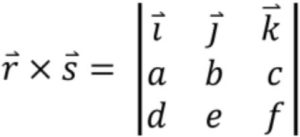
\(\bullet\text{ Cross Product}\)
\(\,\,\,\,\,\,\,\,\) \(…\)
\(…\)
\(\bullet\text{ Equation of a Plane}\)
\(\,\,\,\,\,\,\,\,Ax+By+Cz=D…\)