
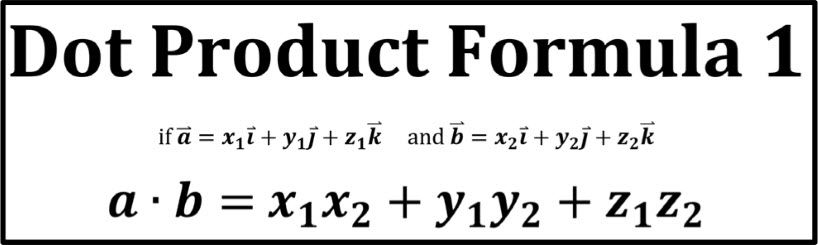
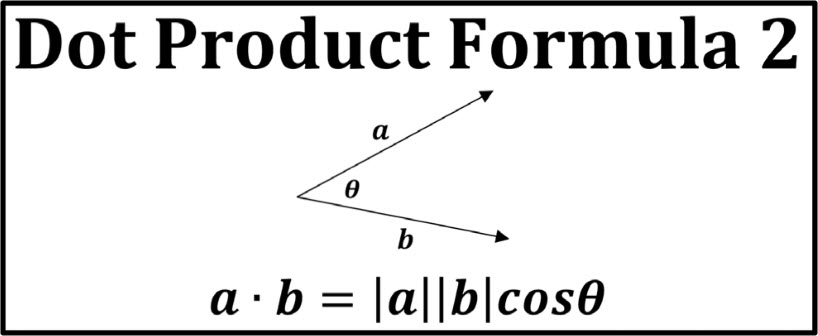
The dot product is an operation that takes two vectors and returns a scalar value. It can be found algebraically by multiplying corresponding components and adding, or geometrically using the magnitudes of the vectors and the cosine of the angle between them. These problems include finding dot products, finding angles between vectors, checking whether vectors are orthogonal, and using the dot product formula with magnitudes and angles.
Notes
Practice Problems
\(\textbf{1)}\) Let \(\vec{u}=2\vec{i}-3\vec{j}\) and \(\vec{v}=4\vec{i} +2\vec{j}\).
Find the dot product \( \vec{u} \cdot \vec{v} \) The answer is \( \vec{u} \cdot \vec{v}=2 \)
\(\,\,\,\,\,\,\vec{u} \cdot \vec{v}=(2)(4)+(-3)(2)\)
\(\,\,\,\,\,\,\vec{u} \cdot \vec{v}=8-6\)
\(\,\,\,\,\,\,\vec{u} \cdot \vec{v}=2\)
\(\,\,\,\,\,\,\)The answer is \(2\)
\(\,\,\,\,\,\,\vec{u} \cdot \vec{v}=(2)(4)+(-3)(2)\)
\(\,\,\,\,\,\,\vec{u} \cdot \vec{v}=8-6\)
\(\,\,\,\,\,\,\vec{u} \cdot \vec{v}=2\)
\(\,\,\,\,\,\,\)The answer is \(2\)
\(\textbf{2)}\) Let \(\vec{u}=2\vec{i}-3\vec{j}\) and \(\vec{v}=4\vec{i} +2\vec{j}\).
Find the angle between \( \vec{u} \) and \( \vec{v} \) The answer is \( cos^{-1} (\displaystyle\frac{2}{\sqrt{13}\sqrt{20}})\approx82.87^{\circ} \)
\(\,\,\,\,\,\,\vec{u}\cdot\vec{v}=2\)
\(\,\,\,\,\,\,|\vec{u}|=\sqrt{2^2+(-3)^2}=\sqrt{13}\)
\(\,\,\,\,\,\,|\vec{v}|=\sqrt{4^2+2^2}=\sqrt{20}\)
\(\,\,\,\,\,\,\vec{u}\cdot\vec{v}=|\vec{u}||\vec{v}|\cos{\theta}\)
\(\,\,\,\,\,\,2=\sqrt{13}\sqrt{20}\cos{\theta}\)
\(\,\,\,\,\,\,\cos{\theta}=\displaystyle\frac{2}{\sqrt{13}\sqrt{20}}\)
\(\,\,\,\,\,\,\theta=\cos^{-1}\left(\displaystyle\frac{2}{\sqrt{13}\sqrt{20}}\right)\)
\(\,\,\,\,\,\,\)The answer is \(\theta\approx82.87^{\circ}\)
\(\,\,\,\,\,\,\vec{u}\cdot\vec{v}=2\)
\(\,\,\,\,\,\,|\vec{u}|=\sqrt{2^2+(-3)^2}=\sqrt{13}\)
\(\,\,\,\,\,\,|\vec{v}|=\sqrt{4^2+2^2}=\sqrt{20}\)
\(\,\,\,\,\,\,\vec{u}\cdot\vec{v}=|\vec{u}||\vec{v}|\cos{\theta}\)
\(\,\,\,\,\,\,2=\sqrt{13}\sqrt{20}\cos{\theta}\)
\(\,\,\,\,\,\,\cos{\theta}=\displaystyle\frac{2}{\sqrt{13}\sqrt{20}}\)
\(\,\,\,\,\,\,\theta=\cos^{-1}\left(\displaystyle\frac{2}{\sqrt{13}\sqrt{20}}\right)\)
\(\,\,\,\,\,\,\)The answer is \(\theta\approx82.87^{\circ}\)
\(\textbf{3)}\) Let \(\vec{r}=2\vec{i}+5\vec{j}-1\vec{k}\) and \(\vec{s}=3\vec{i}-4\vec{j}+6\vec{k}\).
Find the dot product \( \vec{r} \cdot \vec{s} \) The answer is \( \vec{r} \cdot \vec{s}=-20 \)
\(\,\,\,\,\,\,\vec{r} \cdot \vec{s} =(2)(3)+(5)(-4)+(-1)(6)\)
\(\,\,\,\,\,\,\vec{r} \cdot \vec{s}=6-20-6\)
\(\,\,\,\,\,\,\vec{r} \cdot \vec{s}=-20\)
\(\,\,\,\,\,\,\)The answer is \(-20\)

\(\,\,\,\,\,\,\vec{r} \cdot \vec{s} =(2)(3)+(5)(-4)+(-1)(6)\)
\(\,\,\,\,\,\,\vec{r} \cdot \vec{s}=6-20-6\)
\(\,\,\,\,\,\,\vec{r} \cdot \vec{s}=-20\)
\(\,\,\,\,\,\,\)The answer is \(-20\)
\(\textbf{4)}\) Let \(\vec{r}=2\vec{i}+5\vec{j}-1\vec{k}\) and \(\vec{s}=3\vec{i}-4\vec{j}+6\vec{k}\).
Find the angle between \( \vec{r} \) and \( \vec{s} \) The answer is \( \cos^{-1} \left(\displaystyle\frac{-20}{\sqrt{30}\sqrt{61}}\right)\approx117.87^{\circ} \)
\(\,\,\,\,\,\,\vec{r}\cdot\vec{s}=-20\)
\(\,\,\,\,\,\,|\vec{r}|=\sqrt{2^2+5^2+(-1)^2}=\sqrt{30}\)
\(\,\,\,\,\,\,|\vec{s}|=\sqrt{3^2+(-4)^2+6^2}=\sqrt{61}\)
\(\,\,\,\,\,\,\vec{r}\cdot\vec{s}=|\vec{r}||\vec{s}|\cos{\theta}\)
\(\,\,\,\,\,\,-20=\sqrt{30}\sqrt{61}\cos{\theta}\)
\(\,\,\,\,\,\,\theta=\cos^{-1}\left(\displaystyle\frac{-20}{\sqrt{30}\sqrt{61}}\right)\)
\(\,\,\,\,\,\,\)The answer is \(\theta\approx117.87^{\circ}\)
\(\,\,\,\,\,\,\vec{r}\cdot\vec{s}=-20\)
\(\,\,\,\,\,\,|\vec{r}|=\sqrt{2^2+5^2+(-1)^2}=\sqrt{30}\)
\(\,\,\,\,\,\,|\vec{s}|=\sqrt{3^2+(-4)^2+6^2}=\sqrt{61}\)
\(\,\,\,\,\,\,\vec{r}\cdot\vec{s}=|\vec{r}||\vec{s}|\cos{\theta}\)
\(\,\,\,\,\,\,-20=\sqrt{30}\sqrt{61}\cos{\theta}\)
\(\,\,\,\,\,\,\theta=\cos^{-1}\left(\displaystyle\frac{-20}{\sqrt{30}\sqrt{61}}\right)\)
\(\,\,\,\,\,\,\)The answer is \(\theta\approx117.87^{\circ}\)
\(\textbf{5)}\) \( |\vec{n}|=4, |\vec{c}|=8, \) and the angle between the two vectors when placed tail to tail is \( 52^{\circ}. \) Find the Dot Product \( \vec{n} \cdot \vec{c} \) The answer is \( \vec{n} \cdot \vec{c}\approx19.7 \)
\(\,\,\,\,\,\,\vec{n} \cdot \vec{c}=|\vec{n}||\vec{c}|\cos{\theta}\)
\(\,\,\,\,\,\,\vec{n} \cdot \vec{c}=(4)(8)\cos(52^{\circ})\)
\(\,\,\,\,\,\,\vec{n} \cdot \vec{c}=32\cos(52^{\circ})\)
\(\,\,\,\,\,\,\)The answer is \(\vec{n} \cdot \vec{c}\approx19.7\)
\(\,\,\,\,\,\,\vec{n} \cdot \vec{c}=|\vec{n}||\vec{c}|\cos{\theta}\)
\(\,\,\,\,\,\,\vec{n} \cdot \vec{c}=(4)(8)\cos(52^{\circ})\)
\(\,\,\,\,\,\,\vec{n} \cdot \vec{c}=32\cos(52^{\circ})\)
\(\,\,\,\,\,\,\)The answer is \(\vec{n} \cdot \vec{c}\approx19.7\)
\(\textbf{6)}\) Find the dot product of the two vectors in the picture below.
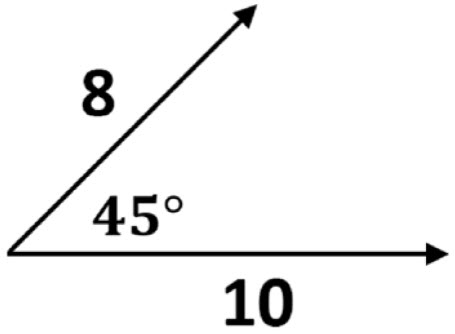
The answer is \( 40\sqrt{2}\approx56.6 \)
\(\,\,\,\,\,\,\vec{u}\cdot\vec{v}=|\vec{u}||\vec{v}|\cos{\theta}\)
\(\,\,\,\,\,\,\vec{u}\cdot\vec{v}=(8)(10)\cos(45^{\circ})\)
\(\,\,\,\,\,\,\vec{u}\cdot\vec{v}=80\cdot\frac{\sqrt{2}}{2}\)
\(\,\,\,\,\,\,\vec{u}\cdot\vec{v}=40\sqrt{2}\)
\(\,\,\,\,\,\,\)The answer is \(40\sqrt{2}\approx56.6\)
\(\,\,\,\,\,\,\vec{u}\cdot\vec{v}=|\vec{u}||\vec{v}|\cos{\theta}\)
\(\,\,\,\,\,\,\vec{u}\cdot\vec{v}=(8)(10)\cos(45^{\circ})\)
\(\,\,\,\,\,\,\vec{u}\cdot\vec{v}=80\cdot\frac{\sqrt{2}}{2}\)
\(\,\,\,\,\,\,\vec{u}\cdot\vec{v}=40\sqrt{2}\)
\(\,\,\,\,\,\,\)The answer is \(40\sqrt{2}\approx56.6\)
\(\textbf{7)}\) Find k so that \( \vec{u}=(2,3,4) \) and \( \vec{v}=(-5,k,1) \) are orthogonal. Orthogonal means the vectors meet at \(90^{\circ}\), which means the dot product \(=0\)
\(\,\,\,\,\,\,\vec{u} \cdot \vec{v}=(2)(-5)+(3)(k)+(4)(1)\)
\(\,\,\,\,\,\,\vec{u} \cdot \vec{v}=-10+3k+4\)
\(\,\,\,\,\,\,\vec{u} \cdot \vec{v}=-6+3k\)
\(\,\,\,\,\,\,-6+3k=0\)
\(\,\,\,\,\,\,3k=6\)
\(\,\,\,\,\,\,k=2\)
\(\,\,\,\,\,\,\)The answer is \(k=2\)
The answer is \(k=2\)
\(\,\,\,\,\,\,\vec{u} \cdot \vec{v}=(2)(-5)+(3)(k)+(4)(1)\)
\(\,\,\,\,\,\,\vec{u} \cdot \vec{v}=-10+3k+4\)
\(\,\,\,\,\,\,\vec{u} \cdot \vec{v}=-6+3k\)
\(\,\,\,\,\,\,-6+3k=0\)
\(\,\,\,\,\,\,3k=6\)
\(\,\,\,\,\,\,k=2\)
\(\,\,\,\,\,\,\)The answer is \(k=2\)
\(\textbf{8)}\) Find \(\vec{a}\cdot\vec{b}\) where \(\vec{a}=\langle7,-2\rangle\) and \(\vec{b}=\langle3,5\rangle\). The answer is \(11\)
\(\,\,\,\,\,\,\vec{a}\cdot\vec{b}=(7)(3)+(-2)(5)\)
\(\,\,\,\,\,\,\vec{a}\cdot\vec{b}=21-10\)
\(\,\,\,\,\,\,\)The answer is \(11\)
\(\,\,\,\,\,\,\vec{a}\cdot\vec{b}=(7)(3)+(-2)(5)\)
\(\,\,\,\,\,\,\vec{a}\cdot\vec{b}=21-10\)
\(\,\,\,\,\,\,\)The answer is \(11\)
\(\textbf{9)}\) Find \(\vec{p}\cdot\vec{q}\) where \(\vec{p}=\langle-4,6,2\rangle\) and \(\vec{q}=\langle5,1,-3\rangle\). The answer is \(-20\)
\(\,\,\,\,\,\,\vec{p}\cdot\vec{q}=(-4)(5)+(6)(1)+(2)(-3)\)
\(\,\,\,\,\,\,\vec{p}\cdot\vec{q}=-20+6-6\)
\(\,\,\,\,\,\,\)The answer is \(-20\)
\(\,\,\,\,\,\,\vec{p}\cdot\vec{q}=(-4)(5)+(6)(1)+(2)(-3)\)
\(\,\,\,\,\,\,\vec{p}\cdot\vec{q}=-20+6-6\)
\(\,\,\,\,\,\,\)The answer is \(-20\)
\(\textbf{10)}\) Find \(\vec{x}\cdot\vec{y}\) where \(\vec{x}=\langle0,-3,8\rangle\) and \(\vec{y}=\langle4,2,-1\rangle\). The answer is \(-14\)
\(\,\,\,\,\,\,\vec{x}\cdot\vec{y}=(0)(4)+(-3)(2)+(8)(-1)\)
\(\,\,\,\,\,\,\vec{x}\cdot\vec{y}=0-6-8\)
\(\,\,\,\,\,\,\)The answer is \(-14\)
\(\,\,\,\,\,\,\vec{x}\cdot\vec{y}=(0)(4)+(-3)(2)+(8)(-1)\)
\(\,\,\,\,\,\,\vec{x}\cdot\vec{y}=0-6-8\)
\(\,\,\,\,\,\,\)The answer is \(-14\)
\(\textbf{11)}\) Find the angle between \(\vec{a}=\langle1,2\rangle\) and \(\vec{b}=\langle4,-1\rangle\). The answer is \(\theta\approx66.04^{\circ}\)
\(\,\,\,\,\,\,\vec{a}\cdot\vec{b}=(1)(4)+(2)(-1)=2\)
\(\,\,\,\,\,\,|\vec{a}|=\sqrt{1^2+2^2}=\sqrt{5}\)
\(\,\,\,\,\,\,|\vec{b}|=\sqrt{4^2+(-1)^2}=\sqrt{17}\)
\(\,\,\,\,\,\,\cos{\theta}=\displaystyle\frac{\vec{a}\cdot\vec{b}}{|\vec{a}||\vec{b}|}\)
\(\,\,\,\,\,\,\cos{\theta}=\displaystyle\frac{2}{\sqrt{5}\sqrt{17}}\)
\(\,\,\,\,\,\,\theta=\cos^{-1}\left(\displaystyle\frac{2}{\sqrt{85}}\right)\)
\(\,\,\,\,\,\,\)The answer is \(\theta\approx66.04^{\circ}\)
\(\,\,\,\,\,\,\vec{a}\cdot\vec{b}=(1)(4)+(2)(-1)=2\)
\(\,\,\,\,\,\,|\vec{a}|=\sqrt{1^2+2^2}=\sqrt{5}\)
\(\,\,\,\,\,\,|\vec{b}|=\sqrt{4^2+(-1)^2}=\sqrt{17}\)
\(\,\,\,\,\,\,\cos{\theta}=\displaystyle\frac{\vec{a}\cdot\vec{b}}{|\vec{a}||\vec{b}|}\)
\(\,\,\,\,\,\,\cos{\theta}=\displaystyle\frac{2}{\sqrt{5}\sqrt{17}}\)
\(\,\,\,\,\,\,\theta=\cos^{-1}\left(\displaystyle\frac{2}{\sqrt{85}}\right)\)
\(\,\,\,\,\,\,\)The answer is \(\theta\approx66.04^{\circ}\)
\(\textbf{12)}\) Find the angle between \(\vec{u}=\langle2,1,2\rangle\) and \(\vec{v}=\langle1,2,-2\rangle\). The answer is \(90^{\circ}\)
\(\,\,\,\,\,\,\vec{u}\cdot\vec{v}=(2)(1)+(1)(2)+(2)(-2)\)
\(\,\,\,\,\,\,\vec{u}\cdot\vec{v}=2+2-4\)
\(\,\,\,\,\,\,\vec{u}\cdot\vec{v}=0\)
\(\,\,\,\,\,\,\text{Since the dot product is }0,\text{ the vectors are orthogonal.}\)
\(\,\,\,\,\,\,\)The answer is \(90^{\circ}\)
\(\,\,\,\,\,\,\vec{u}\cdot\vec{v}=(2)(1)+(1)(2)+(2)(-2)\)
\(\,\,\,\,\,\,\vec{u}\cdot\vec{v}=2+2-4\)
\(\,\,\,\,\,\,\vec{u}\cdot\vec{v}=0\)
\(\,\,\,\,\,\,\text{Since the dot product is }0,\text{ the vectors are orthogonal.}\)
\(\,\,\,\,\,\,\)The answer is \(90^{\circ}\)
\(\textbf{13)}\) Find \(k\) so that \(\vec{a}=\langle1,k,2\rangle\) and \(\vec{b}=\langle3,4,-5\rangle\) are orthogonal. The answer is \(k=\frac{7}{4}\)
\(\,\,\,\,\,\,\vec{a}\cdot\vec{b}=0\)
\(\,\,\,\,\,\,(1)(3)+(k)(4)+(2)(-5)=0\)
\(\,\,\,\,\,\,3+4k-10=0\)
\(\,\,\,\,\,\,4k-7=0\)
\(\,\,\,\,\,\,4k=7\)
\(\,\,\,\,\,\,\)The answer is \(k=\frac{7}{4}\)
\(\,\,\,\,\,\,\vec{a}\cdot\vec{b}=0\)
\(\,\,\,\,\,\,(1)(3)+(k)(4)+(2)(-5)=0\)
\(\,\,\,\,\,\,3+4k-10=0\)
\(\,\,\,\,\,\,4k-7=0\)
\(\,\,\,\,\,\,4k=7\)
\(\,\,\,\,\,\,\)The answer is \(k=\frac{7}{4}\)
\(\textbf{14)}\) Find \(k\) so that \(\vec{u}=\langle k,2,-1\rangle\) and \(\vec{v}=\langle4,-3,6\rangle\) are orthogonal. The answer is \(k=3\)
\(\,\,\,\,\,\,\vec{u}\cdot\vec{v}=0\)
\(\,\,\,\,\,\,(k)(4)+(2)(-3)+(-1)(6)=0\)
\(\,\,\,\,\,\,4k-6-6=0\)
\(\,\,\,\,\,\,4k-12=0\)
\(\,\,\,\,\,\,4k=12\)
\(\,\,\,\,\,\,\)The answer is \(k=3\)
\(\,\,\,\,\,\,\vec{u}\cdot\vec{v}=0\)
\(\,\,\,\,\,\,(k)(4)+(2)(-3)+(-1)(6)=0\)
\(\,\,\,\,\,\,4k-6-6=0\)
\(\,\,\,\,\,\,4k-12=0\)
\(\,\,\,\,\,\,4k=12\)
\(\,\,\,\,\,\,\)The answer is \(k=3\)
\(\textbf{15)}\) Are \(\vec{u}=\langle3,-1,2\rangle\) and \(\vec{v}=\langle2,4,-1\rangle\) orthogonal? The answer is Yes, the vectors are orthogonal.
\(\,\,\,\,\,\,\vec{u}\cdot\vec{v}=(3)(2)+(-1)(4)+(2)(-1)\)
\(\,\,\,\,\,\,\vec{u}\cdot\vec{v}=6-4-2\)
\(\,\,\,\,\,\,\vec{u}\cdot\vec{v}=0\)
\(\,\,\,\,\,\,\text{Since the dot product is }0,\text{ the vectors are orthogonal.}\)
\(\,\,\,\,\,\,\)The answer is Yes, the vectors are orthogonal.
\(\,\,\,\,\,\,\vec{u}\cdot\vec{v}=(3)(2)+(-1)(4)+(2)(-1)\)
\(\,\,\,\,\,\,\vec{u}\cdot\vec{v}=6-4-2\)
\(\,\,\,\,\,\,\vec{u}\cdot\vec{v}=0\)
\(\,\,\,\,\,\,\text{Since the dot product is }0,\text{ the vectors are orthogonal.}\)
\(\,\,\,\,\,\,\)The answer is Yes, the vectors are orthogonal.
\(\textbf{16)}\) Are \(\vec{a}=\langle5,2\rangle\) and \(\vec{b}=\langle-2,5\rangle\) orthogonal? The answer is Yes, the vectors are orthogonal.
\(\,\,\,\,\,\,\vec{a}\cdot\vec{b}=(5)(-2)+(2)(5)\)
\(\,\,\,\,\,\,\vec{a}\cdot\vec{b}=-10+10\)
\(\,\,\,\,\,\,\vec{a}\cdot\vec{b}=0\)
\(\,\,\,\,\,\,\text{Since the dot product is }0,\text{ the vectors are orthogonal.}\)
\(\,\,\,\,\,\,\)The answer is Yes, the vectors are orthogonal.
\(\,\,\,\,\,\,\vec{a}\cdot\vec{b}=(5)(-2)+(2)(5)\)
\(\,\,\,\,\,\,\vec{a}\cdot\vec{b}=-10+10\)
\(\,\,\,\,\,\,\vec{a}\cdot\vec{b}=0\)
\(\,\,\,\,\,\,\text{Since the dot product is }0,\text{ the vectors are orthogonal.}\)
\(\,\,\,\,\,\,\)The answer is Yes, the vectors are orthogonal.
\(\textbf{17)}\) Given \(|\vec{a}|=6\), \(|\vec{b}|=5\), and the angle between the vectors is \(120^{\circ}\), find \(\vec{a}\cdot\vec{b}\). The answer is \(-15\)
\(\,\,\,\,\,\,\vec{a}\cdot\vec{b}=|\vec{a}||\vec{b}|\cos{\theta}\)
\(\,\,\,\,\,\,\vec{a}\cdot\vec{b}=(6)(5)\cos(120^{\circ})\)
\(\,\,\,\,\,\,\vec{a}\cdot\vec{b}=30\left(-\frac{1}{2}\right)\)
\(\,\,\,\,\,\,\)The answer is \(-15\)
\(\,\,\,\,\,\,\vec{a}\cdot\vec{b}=|\vec{a}||\vec{b}|\cos{\theta}\)
\(\,\,\,\,\,\,\vec{a}\cdot\vec{b}=(6)(5)\cos(120^{\circ})\)
\(\,\,\,\,\,\,\vec{a}\cdot\vec{b}=30\left(-\frac{1}{2}\right)\)
\(\,\,\,\,\,\,\)The answer is \(-15\)
\(\textbf{18)}\) Given \(|\vec{u}|=10\), \(|\vec{v}|=3\), and \(\vec{u}\cdot\vec{v}=15\), find the angle between the vectors. The answer is \(60^{\circ}\)
\(\,\,\,\,\,\,\vec{u}\cdot\vec{v}=|\vec{u}||\vec{v}|\cos{\theta}\)
\(\,\,\,\,\,\,15=(10)(3)\cos{\theta}\)
\(\,\,\,\,\,\,15=30\cos{\theta}\)
\(\,\,\,\,\,\,\cos{\theta}=\frac{1}{2}\)
\(\,\,\,\,\,\,\)The answer is \(60^{\circ}\)
\(\,\,\,\,\,\,\vec{u}\cdot\vec{v}=|\vec{u}||\vec{v}|\cos{\theta}\)
\(\,\,\,\,\,\,15=(10)(3)\cos{\theta}\)
\(\,\,\,\,\,\,15=30\cos{\theta}\)
\(\,\,\,\,\,\,\cos{\theta}=\frac{1}{2}\)
\(\,\,\,\,\,\,\)The answer is \(60^{\circ}\)
\(\textbf{19)}\) Find the scalar projection of \(\vec{a}=\langle6,2\rangle\) onto \(\vec{b}=\langle3,4\rangle\). The answer is \(\frac{26}{5}\)
\(\,\,\,\,\,\,\text{Scalar projection}=\displaystyle\frac{\vec{a}\cdot\vec{b}}{|\vec{b}|}\)
\(\,\,\,\,\,\,\vec{a}\cdot\vec{b}=(6)(3)+(2)(4)=26\)
\(\,\,\,\,\,\,|\vec{b}|=\sqrt{3^2+4^2}=5\)
\(\,\,\,\,\,\,\text{Scalar projection}=\displaystyle\frac{26}{5}\)
\(\,\,\,\,\,\,\)The answer is \(\frac{26}{5}\)
\(\,\,\,\,\,\,\text{Scalar projection}=\displaystyle\frac{\vec{a}\cdot\vec{b}}{|\vec{b}|}\)
\(\,\,\,\,\,\,\vec{a}\cdot\vec{b}=(6)(3)+(2)(4)=26\)
\(\,\,\,\,\,\,|\vec{b}|=\sqrt{3^2+4^2}=5\)
\(\,\,\,\,\,\,\text{Scalar projection}=\displaystyle\frac{26}{5}\)
\(\,\,\,\,\,\,\)The answer is \(\frac{26}{5}\)
\(\textbf{20)}\) Find the vector projection of \(\vec{a}=\langle6,2\rangle\) onto \(\vec{b}=\langle3,4\rangle\). The answer is \(\left\langle\frac{78}{25},\frac{104}{25}\right\rangle\)
\(\,\,\,\,\,\,\text{Vector projection}=\displaystyle\frac{\vec{a}\cdot\vec{b}}{|\vec{b}|^2}\vec{b}\)
\(\,\,\,\,\,\,\vec{a}\cdot\vec{b}=(6)(3)+(2)(4)=26\)
\(\,\,\,\,\,\,|\vec{b}|^2=3^2+4^2=25\)
\(\,\,\,\,\,\,\text{Vector projection}=\displaystyle\frac{26}{25}\langle3,4\rangle\)
\(\,\,\,\,\,\,\text{Vector projection}=\left\langle\frac{78}{25},\frac{104}{25}\right\rangle\)
\(\,\,\,\,\,\,\)The answer is \(\left\langle\frac{78}{25},\frac{104}{25}\right\rangle\)
\(\,\,\,\,\,\,\text{Vector projection}=\displaystyle\frac{\vec{a}\cdot\vec{b}}{|\vec{b}|^2}\vec{b}\)
\(\,\,\,\,\,\,\vec{a}\cdot\vec{b}=(6)(3)+(2)(4)=26\)
\(\,\,\,\,\,\,|\vec{b}|^2=3^2+4^2=25\)
\(\,\,\,\,\,\,\text{Vector projection}=\displaystyle\frac{26}{25}\langle3,4\rangle\)
\(\,\,\,\,\,\,\text{Vector projection}=\left\langle\frac{78}{25},\frac{104}{25}\right\rangle\)
\(\,\,\,\,\,\,\)The answer is \(\left\langle\frac{78}{25},\frac{104}{25}\right\rangle\)
See Related Pages\(\)
\(\bullet\text{ Displacement Vectors}\)
\(\,\,\,\,\,\,\,\,(x_2-x_1)\vec{i}+(y_2-y_1)\vec{j}…\)
\(\bullet\text{ Magnitude, Direction, and Unit Vectors}\)
\(\,\,\,\,\,\,\,\,|\vec{u}|=\sqrt{a^2+b^2}…\)
\(\bullet\text{ Dot Product}\)
\(\,\,\,\,\,\,\,\,a \cdot b=x_1 x_2+ y_1 y_2…\)
\(\bullet\text{ Parallel and Perpendicular Vectors}\)
\(\,\,\,\,\,\,\,\,⟨8,2⟩ \text{ and } ⟨−4,−1⟩…\)
\(\bullet\text{ Scalar and Vector Projections}\)
\(\,\,\,\,\,\,\,\,\displaystyle\frac{a \cdot b}{|b|^2} \, \vec{b}…\)
\(\bullet\text{ Cross Product}\)
\(\,\,\,\,\,\,\,\,\)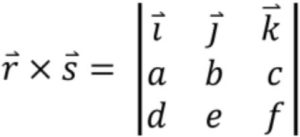 \(…\)
\(…\)
\(\bullet\text{ Equation of a Plane}\)
\(\,\,\,\,\,\,\,\,Ax+By+Cz=D…\)
\(\bullet\text{ Andymath Homepage}\)